



 by Tom Gurney
Tom Gurney BSc (Hons) is an art history expert with over 20 years experience
Published on June 19, 2020 / Updated on October 30, 2026
Email: tomgurney1@gmail.com / Phone: +44 7429 011000
Fishing by Édouard Manet: Introduction
A boat and its busy occupants cross the middle of a broad river landscape. On the bank at lower right, a couple in elaborate clothes stand beside a dog, watching the water. Their seventeenth-century costume gives Édouard Manet’s Fishing an unexpected historical presence. The Metropolitan Museum of Art dates the canvas to about 1862–63.[1]
The painting combines a landscape, a scene of work and an image of the artist with Suzanne Leenhoff, his future wife.[1]
At a Glance
- ArtistÉdouard Manet
- TitleFishing
- DateAbout 1862–63
- MediumOil on canvas
- Dimensions76.8 × 123.2 cm
- CollectionThe Metropolitan Museum of Art, New York
- Accession57.10
- CreditPurchase, Mr. and Mrs. Richard J. Bernhard Gift, 1957.[1]
This work across Édouard Manet’s career
Fishing by Édouard Manet (current article)
about 1862–63Olympia
1863The Fifer
1866The Balcony
1868–69The Railway
1873Asparagus
1880Contents
- The River and the Distant Landscape
- Fishing in the Middle of the Picture
- The Couple beside the Trees
- A Couple Borrowed from Rubens
- Suzanne and a Possible Wedding Portrait
- The Boy on the Far Bank
- Manet in the Role of Another Painter
- Annotated details
The River and the Distant Landscape
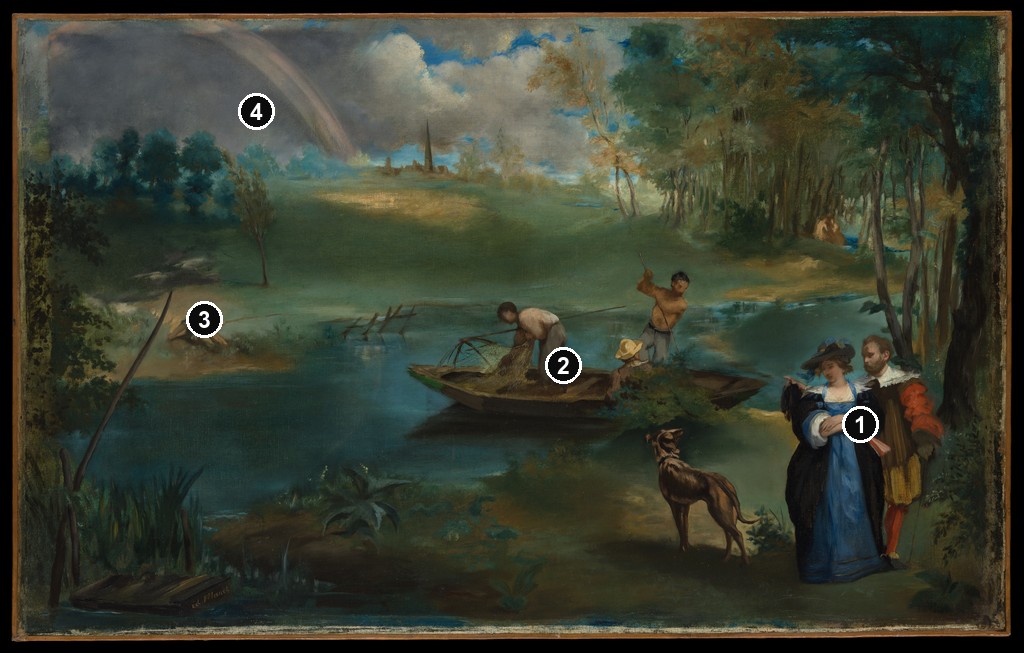
The river opens into a wide blue-green surface across the foreground. Its curving banks give the eye a route through the picture, from the reeds and dark shallows at the lower left towards the trees on the opposite side. The boat occupies the central stretch of water, well below the horizon. Above it, an open meadow separates the river from a distant cluster of buildings.
A narrow spire interrupts that low skyline. Its vertical line provides a distant counterpart to the much larger trunks rising along the right edge. These trees form a dark screen close to the viewer, while their more slender companions recede towards a brighter opening. Distance emerges through changes in scale and the alternation of dense foliage with open ground.
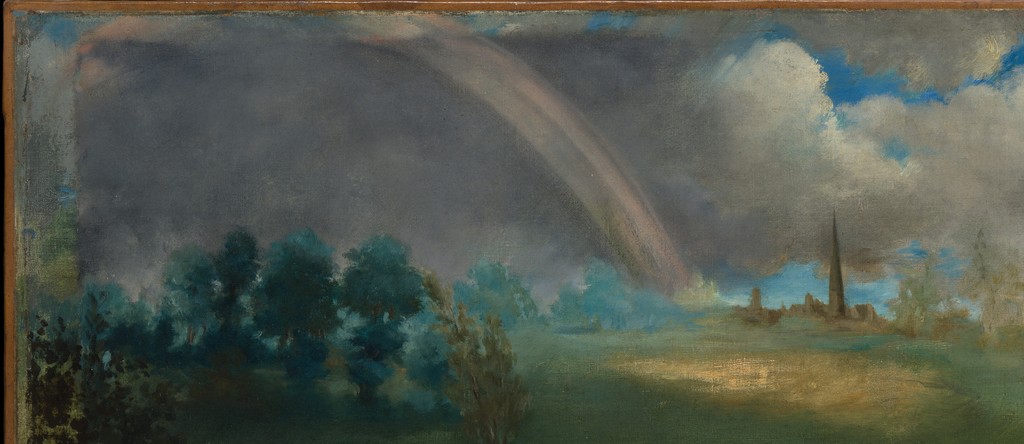
The sky introduces another kind of movement. Heavy grey clouds occupy much of its left side, with pale arcs of a rainbow crossing the darker mass. Near the middle, blue breaks through between the clouds. Below, a strip of warm light touches the distant field. These changes make the landscape less uniformly shaded than the dark foreground first suggests.
The subdued rainbow is easy to overlook while following the people below. Its broad pale curve extends across a much larger area than any of their gestures.
Fishing in the Middle of the Picture
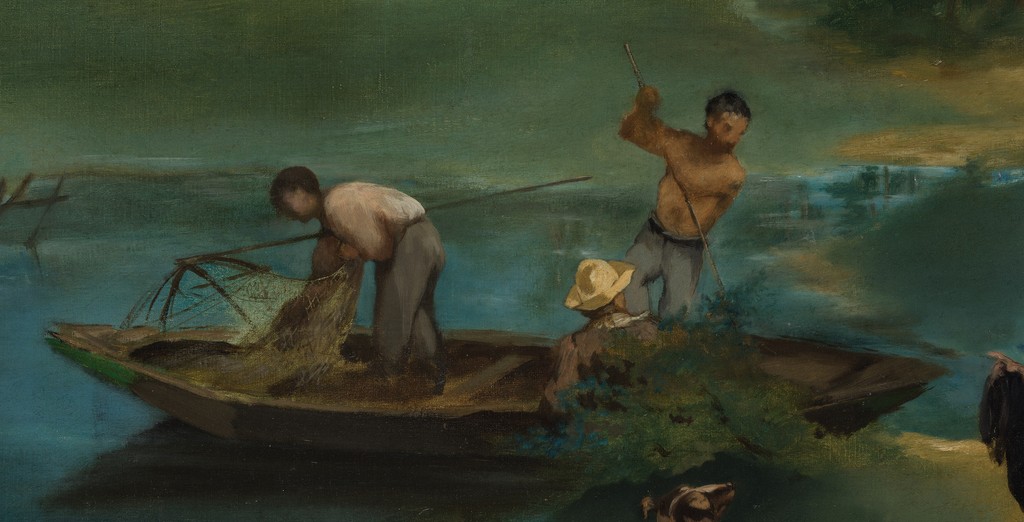
Three figures occupy the low boat. One bends forward over a spread of netting, another stands with an arm raised beside a long implement, and a third sits lower beneath a pale hat. Their different heights make a small sequence of movements across the boat. The curved hull contains them within a narrow strip between the surrounding banks.
The net is especially useful for understanding the activity. Its thin crossing lines contrast with the broader strokes of the water and clothing. The bent figure gathers or handles it near the left end of the boat, while the standing figure extends the action upwards. Manet gives the group enough definition to establish work without making every hand or piece of equipment equally clear.
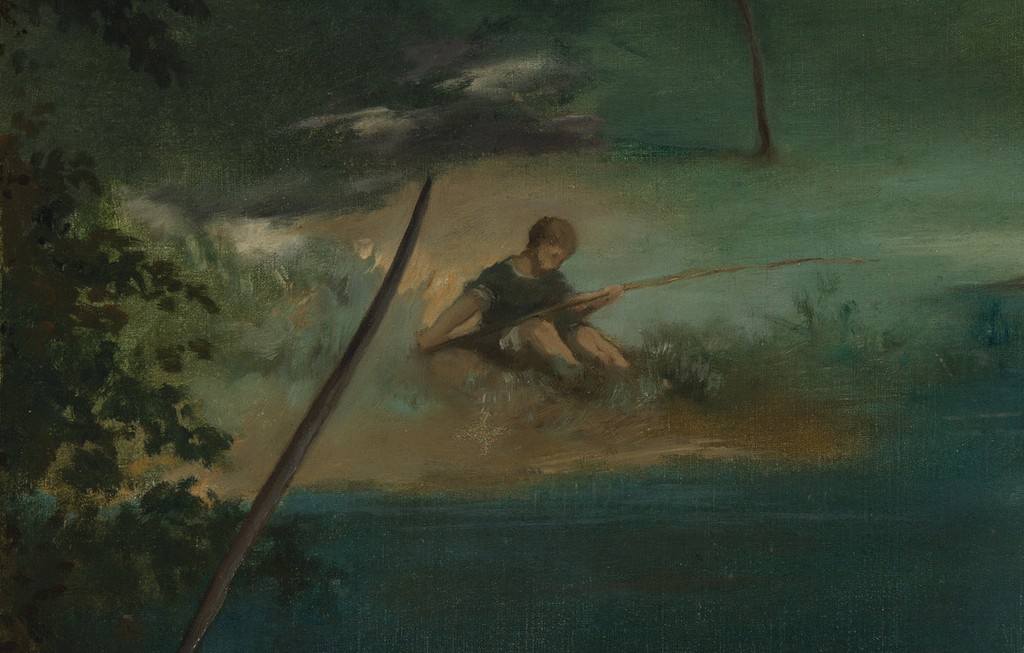
Across the water, a boy sits close to the bank with a long fishing rod. His position creates another point of activity away from the central group. The rod reaches across the quieter space beside him; its thin line connects the small figure to a much wider area of water.
The two fishing groups also establish the breadth of the river. The boy belongs to the farther bank, the boat occupies the intervening water, and the dressed couple stand close to us. Together they make the landscape's depth legible through people placed at different distances.
The Couple beside the Trees
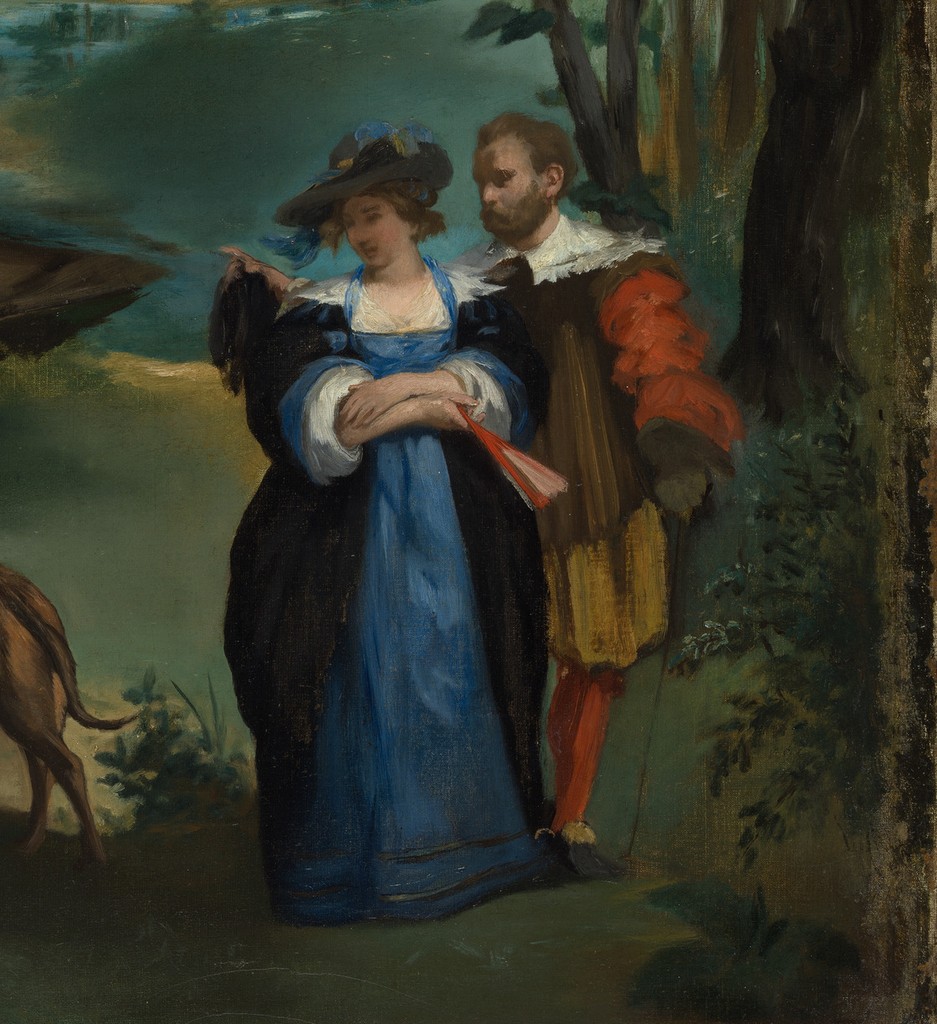
The woman’s blue dress forms the largest concentrated patch of bright colour in the foreground. White sleeves interrupt its dark outer covering, and her hands meet in front of her body. A broad hat shades the face. Beside her, the man’s red sleeve and pale collar stand out against the closely planted trees.
Their poses are quieter than those of the boatmen. The woman’s folded arms and the man’s upright body hold the pair together as a compact group. Their elaborate clothing also sets them apart from the lightly dressed workers. The contrast makes the couple look ceremonious, even though they occupy an informal riverbank.
The dog extends this group towards the water. Its long legs and narrow body stand against a relatively open patch of ground, making its outline unusually easy to follow. Its raised head turns away from the couple. This little interval between people, animal and river prevents the right-hand corner from becoming a single closed block.
The Met identifies the standing figures as Manet and Suzanne in seventeenth-century costume.[1] Their appearance therefore belongs to an act of historical dressing-up within a nineteenth-century painting. Recognising the artist changes this apparently incidental riverside pair into one of the picture’s principal subjects.
A Couple Borrowed from Rubens
The Met connects their poses with a Rubens landscape in Vienna.[1] The Kunsthistorisches Museum calls that painting The Park of a Castle and dates it to around 1632–35. Painted on oak, it shows groups of elegantly dressed people enjoying a park beside water, with a substantial castle beyond them.[2]
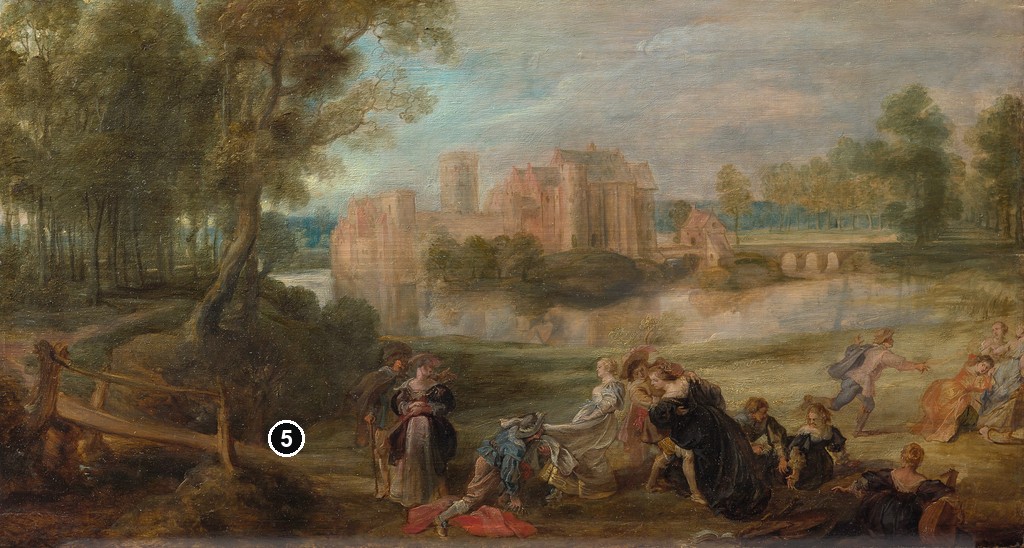
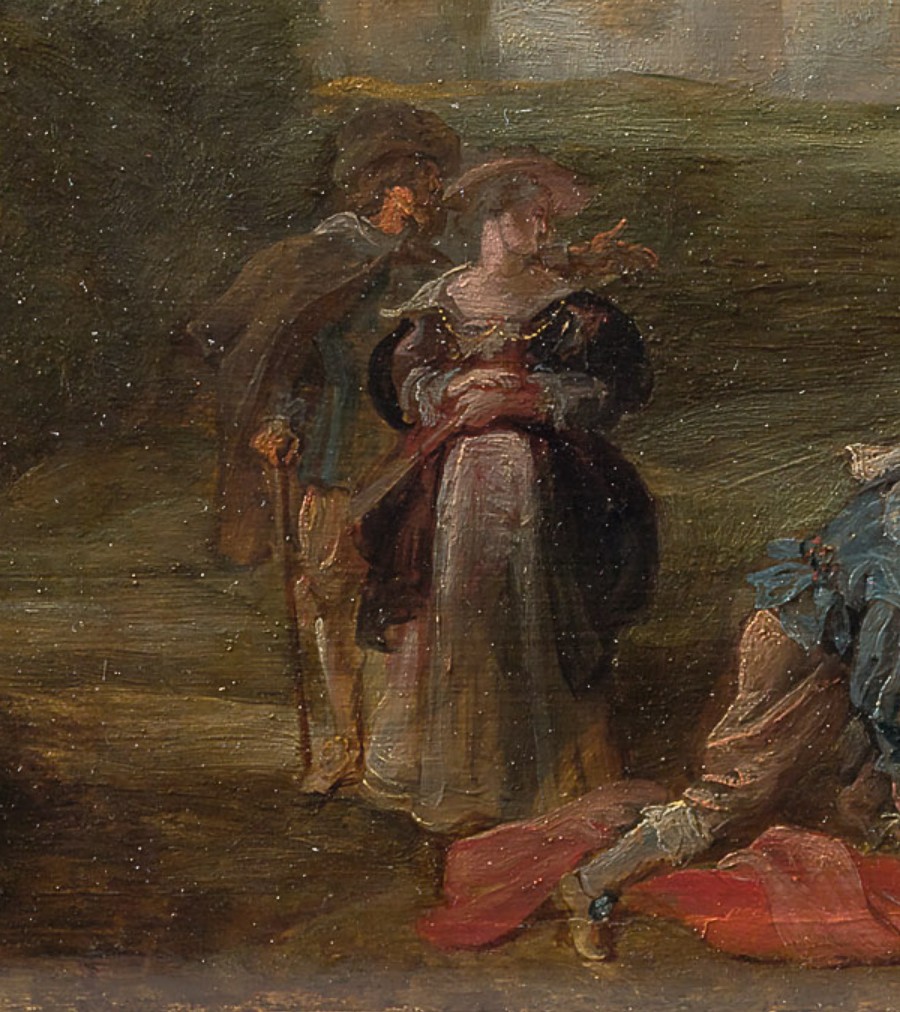
A standing couple towards the left offers the clearest comparison. The woman wears a broad hat and holds her hands together in front of her. A man stands close behind and beside her. Their dark garments, pale collars and arrangement as an overlapping pair have close counterparts in Manet’s figures.
Manet relocates this group to the opposite side of his composition. In the Rubens, other people sit or move across a broad foreground; in Fishing, the couple are more isolated beside their dog. The workers and the river take over much of the space that the earlier painting gives to leisure. Borrowing a pose becomes a way of organising a new relationship between figures and setting.
The connection extends beyond a single source. The Gardner Museum’s 2024 exhibition placed Fishing beside reproductions of Annibale Carracci’s painting of the same subject and a nineteenth-century wood engraving after Rubens’s Landscape with Rainbow.[3] Those comparisons situate Manet’s river, recreational figures and weather effects within a broader tradition of composed landscapes.
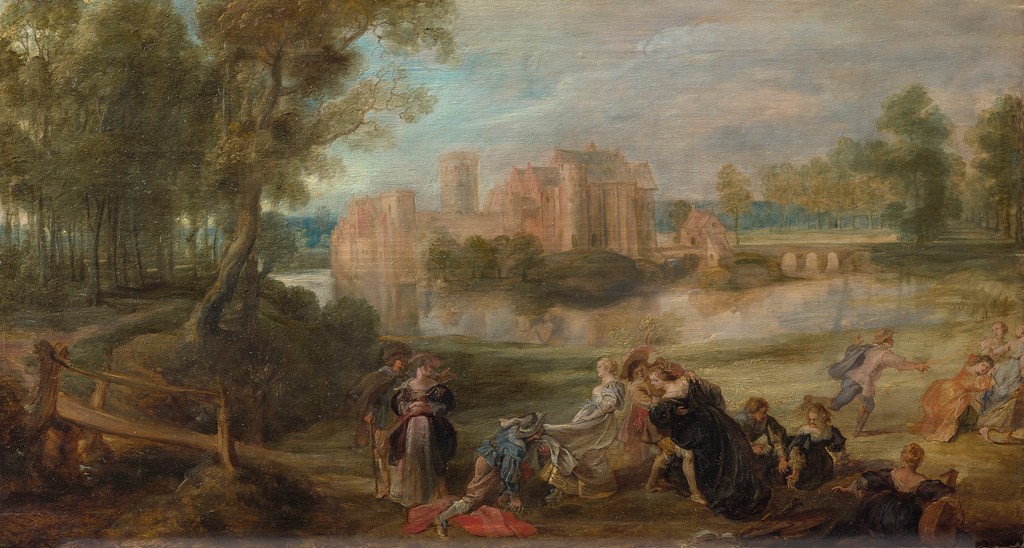
Peter Paul Rubens, The Park of a Castle, around 1632–35. Oil on oak, 52.5 × 97 cm. Kunsthistorisches Museum, Vienna, Gemäldegalerie 696. The standing couple towards the left provides a comparison with Manet’s foreground pair. Kunsthistorisches Museum, Vienna; faithful reproduction via Wikimedia Commons. Image source. Public domain.
Suzanne and a Possible Wedding Portrait
The Met interprets Fishing as a variation on a wedding portrait and considers it likely to have been made before Manet and Suzanne married in October 1863.[1] The association helps explain why the couple receive such a deliberate presentation at the front of the landscape, despite the activity suggested by the title.
The Gardner exhibition developed this reading by identifying Manet’s role with Rubens and Suzanne’s with Rubens’s wife, Helena Fourment.[3] The pair acquire the appearance of an earlier artist and his companion. Their clothes turn the riverside encounter into a connection between a personal relationship and an admired model from the history of painting.
Suzanne’s place in Manet’s family and circle of models makes this more than an anonymous costume study. Yet the approximate date and proposed marriage association should remain distinct from a record of a particular wedding day. The painting stages a relationship through dress, pose and setting.
The Boy on the Far Bank
The Gardner exhibition identifies the boy with the fishing rod as Léon.[3] He is a small presence, easily overshadowed by the boat and the richly dressed pair, but his placement gives him a distinct place within the scene. The water separates him from the foreground couple while the rod points back into the shared activity.
His distance invites a viewer to look across the whole picture rather than remain with its most conspicuous figures. It also makes a family interpretation more complicated than a conventional portrait of people gathered together. The figures occupy different parts of a working landscape instead of presenting themselves in a single group.
Léon’s biological paternity remains unresolved.[3] His position in the painting cannot settle that question.
Manet in the Role of Another Painter
The art historian Victor Ieronim Stoichita reads Fishing as Manet projecting himself into the history of art. In his interpretation, Manet assumes Rubens’s identity within the picture and presents himself as a modern successor to the Flemish master.[4]
This differs from the direct professional image of Self-Portrait with Palette. Here, the painter carries no working tools and stands within a landscape that he has made. His identity emerges through the historical role and the relationship between the two compositions. The reference allows a personal likeness to participate in an artistic comparison.
The subject also gives another form to Manet’s appearance among the people he painted. In Music in the Tuileries, he belongs to a recognisably contemporary gathering. In Fishing, costume and a borrowed pose take him into an imagined encounter with an earlier painter’s world.
The canvas entered the Metropolitan Museum of Art in 1957 through a purchase supported by Mr. and Mrs. Richard J. Bernhard.[1]
Annotated Details from Fishing
The numbered points identify visible features discussed in this article. Return from each detail to the whole composition. Each caption identifies the work shown.
Fishing
Édouard Manet, Fishing, about 1862–63. Oil on canvas, 76.8 × 123.2 cm. The Metropolitan Museum of Art, 57.10. Purchase, Mr. and Mrs. Richard J. Bernhard Gift, 1957. The Metropolitan Museum of Art, New York. Image source. CC0 / Public domain.
The Park of a Castle — Rubens
Peter Paul Rubens, The Park of a Castle, around 1632–35. Oil on oak, 52.5 × 97 cm. Kunsthistorisches Museum, Vienna, Gemäldegalerie 696. The standing couple towards the left provides a comparison with Manet’s foreground pair. Kunsthistorisches Museum, Vienna; faithful reproduction via Wikimedia Commons. Image source. Public domain. Numbers added to a separate resized whole supplied overview. Detail crops from the unchanged original; no enlargement, retouching or colour alteration.
Details from FISHING
Follow the numbered details back to the complete images above. Each caption identifies the work shown.
Fishing
The costumed couple
Blue fabric, white sleeves and a pale collar separate the standing pair from the dark trees. Their overlapping bodies and still poses hold them together as a compact group.
The boat and the net
A bent figure works beside the spread net while another stands higher in the boat. The pale hat belongs to a third figure seated lower between them.
The boy on the far bank
The small seated boy holds a long rod beside the water. The open river separates his bank from the larger figures in the foreground.
Clouds and the rainbow
A pale arc crosses the grey cloud mass above the trees. Blue sky and a distant strip of warmer ground create lighter openings beside it.
The Park of a Castle — Rubens
The Standing Couple at the Left
The two standing figures overlap beneath their hats, with the woman’s hands gathered before her.
Artworks directory
Explore selected paintings, drawings and prints by Édouard Manet. Search by title or another recorded name.
Frequently Asked Questions
The Met identifies them as Édouard Manet and Suzanne Leenhoff, his future wife, wearing seventeenth-century costume derived from a Rubens composition.[1]
The Met proposes that interpretation and dates the work to about 1862–63. Manet and Suzanne married in October 1863; the painting is not dated to an exact wedding day.[1]
The oil painting belongs to The Metropolitan Museum of Art, New York, accession 57.10. It measures 76.8 × 123.2 cm.[1]
Discussion
Look again at the images and ideas explored in Fishing by Édouard Manet. These editorial prompts invite your observations.
Reader Insights
Follow the boy, the boat and the couple in turn. How do their different sizes and positions help you judge distance?
Compare the standing pair with the couple in Rubens’s park. Which features remain recognisable after Manet moves them across the composition?
Compare the boatmen’s gestures with the stillness of the dressed pair. Where does your attention move when you switch between them?
Join the Conversation
Share a detail, comparison or question about Fishing by Édouard Manet below.
References
- The Metropolitan Museum of Art, Fishing, ca. 1862–63, 57.10; collection record, object facts and interpretation (in English). View source.
- Kunsthistorisches Museum, Peter Paul Rubens, The Park of a Castle, around 1632–35, Gemäldegalerie 696; collection record (in English). View source.
- Isabella Stewart Gardner Museum, Manet: A Model Family, 2024 large-print exhibition labels, pp. 2, 33–34; family context, Fishing and comparisons (in English). View source.
- Victor Ieronim Stoichita, “Manet raconté par lui-même”, Annales d’Histoire de l’art et d’Archéologie, no. 13, 1991, republished by Koregos in 2014; discussion of figure 6 (in French). View source.
- Splash image, Édouard Manet, Fishing, about 1862–63. Oil on canvas, 76.8 × 123.2 cm. The Metropolitan Museum of Art, 57.10. Purchase, Mr. and Mrs. Richard J. Bernhard Gift, 1957. The Metropolitan Museum of Art, New York. Image source. CC0 / Public domain.


