



 by Tom Gurney
Tom Gurney BSc (Hons) is an art history expert with over 20 years experience
Published on June 19, 2020 / Updated on October 30, 2026
Email: tomgurney1@gmail.com / Phone: +44 7429 011000
The Execution of Emperor Maximilian by Édouard Manet: Introduction
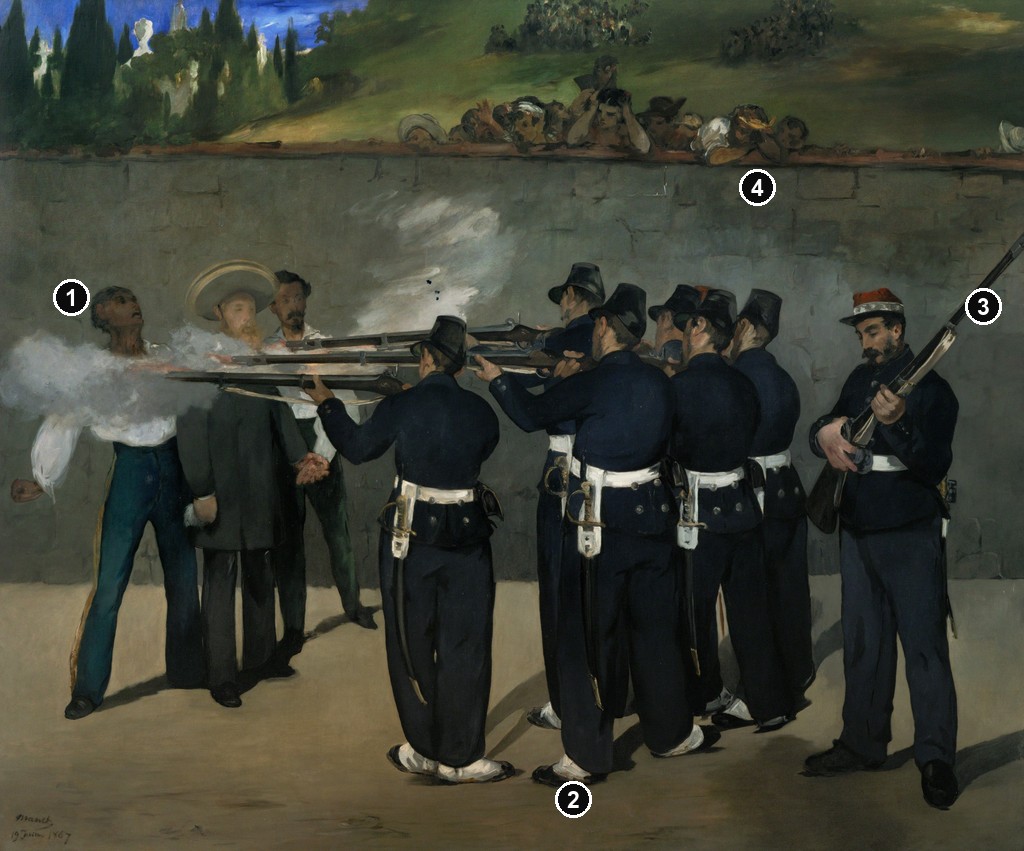
A line of rifles stretches across the picture, bringing the firing squad almost within touching distance of its victims. White smoke passes between the two groups. Above a grey wall, small figures lean forward to watch. At the far right, a soldier attends to the mechanism of his weapon, his lowered gaze creating a separate pocket of activity beside the collective act of firing.
This is the arrangement of Édouard Manet’s large Execution of Emperor Maximilian in Mannheim, painted in 1868–69.[1] The subject occupied him across three large canvases, a smaller oil study and a lithograph. Together, these works follow an artist trying to give a recently reported political catastrophe a durable pictorial form.[2]
The execution took place in Mexico on 19 June 1867.[3] Manet reconstructed it in France. His pictures bring an actual event into contact with studio models, reported information and the example of earlier art. Their power develops through that process of selection: the clothes become more uniform, the groups more closely opposed, and the setting more tightly enclosed.
At a Glance
- ArtistÉdouard Manet
- SubjectExecution of Maximilian, Miguel Miramón and Tomás Mejía, 19 June 1867
- Principal versionsThree large oil paintings, one small oil study and a lithograph
- Mannheim painting1868–69, oil on canvas, 252 × 302 cm, Kunsthalle Mannheim, M281[1]
- Boston painting1867, oil on canvas, 195.9 × 259.7 cm, Museum of Fine Arts, 30.444[4]
- London paintingAbout 1867–8, oil on canvas, surviving fragments mounted together, 193 × 284 cm, National Gallery, NG3294[5]
- Copenhagen studyCatalogued by SMK as 1867, oil on canvas, 48 × 58 cm, KMS3270[6]
- Met lithograph1868, published in 1884; lithograph on chine collé, first state of three, 21.48[7]
This work across Édouard Manet’s career
Contents
- What Happened in Mexico
- Turning Reports into a Picture
- The Mannheim Canvas: Almost No Distance
- The Soldier at the Right
- The Wall and Its Spectators
- Boston: The First Large Painting
- London: A Painting Seen through Its Losses
- The Small Copenhagen Study
- Goya and the Firing Squad
- French Uniforms and French Responsibility
What Happened in Mexico
Maximilian’s rule belonged to the history of French intervention in Mexico. Napoleon III supported the establishment of the empire, while Mexican Republicans continued to resist it. The withdrawal of French military support left Maximilian’s position increasingly exposed. His defeat therefore had consequences in France as well as in the country where he had attempted to reign.[2]
Mexican accounts place the final events within the struggle to restore the Republic. Forces under Mariano Escobedo captured Maximilian following the siege of Querétaro. A military tribunal tried him alongside the imperial generals Miguel Miramón and Tomás Mejía. The three were executed at the Cerro de las Campanas, outside Querétaro, on 19 June 1867.[8]
The Archivo General de la Nación preserves a transcription of the death register, naming the men and recording the place and date.[3] That administrative record gives the event a different emphasis from the painting. It belongs to the documentary aftermath of a Republican victory; Manet’s image concentrates on a brief encounter between armed men and those they are about to kill.
Both perspectives matter. Maximilian was a ruler supported by foreign intervention, and his execution became an international political shock. Miramón and Mejía had their own places in Mexico’s imperial cause. The firing squad belonged to the victorious Mexican Republic. Understanding those roles prevents the scene from shrinking into the solitary tragedy of a European prince.
Manet nevertheless makes the three condemned men appear together as vulnerable bodies. Their former authority offers no visible protection. They occupy a narrow strip of ground, with rifles directed at them from close range. The painting brings political defeat down to a relationship of bodies, weapons and space.
That concentration leaves much of the wider conflict outside the frame. There is no panoramic battle, procession of commanders or explanatory emblem of victory. The event must be understood through the opposed groups and the small watching crowd. Its historical circumstances give those shapes their specific meaning, while the arrangement makes the exercise of lethal power immediately legible.
Turning Reports into a Picture
News of the execution reached France after the event, and Manet began working from reports and photographic material. The National Gallery’s study describes the developing compositions in relation to the information available to him.[2] The successive works show that the subject remained open to reconsideration as he painted.
Théodore Duret’s later account recalls Manet obtaining soldiers as models and using photographic portraits for the emperor. Written in 1906, the passage is retrospective testimony about the artist’s working methods.[9] It helps explain how a distant event could become a substantial studio undertaking, with bodies and costumes studied close at hand.
A posed soldier could supply the fall of a coat, the angle of an elbow or the weight of a stance. A portrait could help establish an individual face. Neither would determine the whole scene. Manet still had to choose the number and distribution of figures, the distance between the groups, the extent of the smoke and the relation of the foreground to its surroundings.
Those decisions are visible when the versions are placed beside one another. Information about an event and the demands of a composition do different kinds of work. A detail can become more historically recognisable while the overall scene becomes more concentrated and artificial in its organisation. Manet’s images ask to be understood through both kinds of change.
The surviving group also resists the idea of one transparent record of what happened. We encounter several attempts, made at different scales and in different media. The subject remains identifiable across them, while the experience of looking changes substantially. Following those changes brings us closer to the painter’s work of reconstruction.
The Mannheim Canvas: Almost No Distance
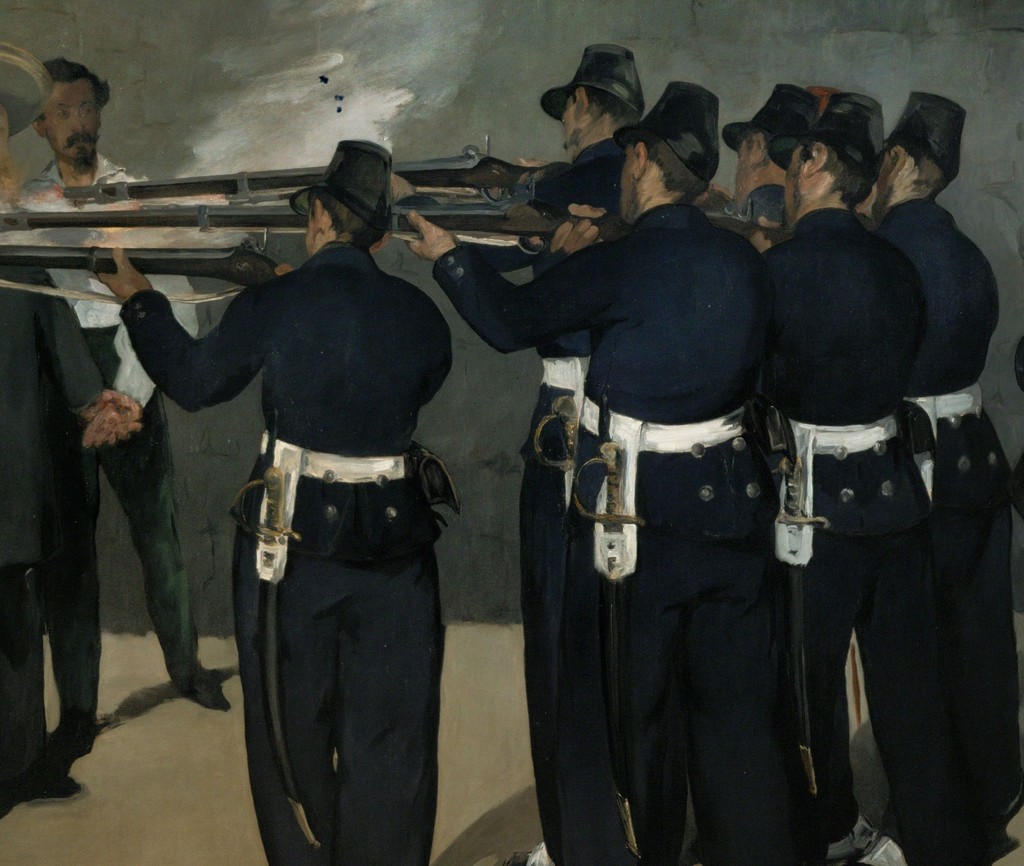
In the Mannheim painting, the rifles form the clearest connection between the two principal groups. Their long barrels carry the eye from the soldiers’ shoulders towards the victims’ upper bodies. There is little open ground between them. The instruments of execution seem to bridge that gap before the smoke makes its passage visible.
The soldiers largely present their backs and sides. Dark coats, pale belts and repeated trouser legs establish a strong collective pattern. Individual bodies overlap, so that a head, arm or rifle can be difficult to assign at first glance. The squad acquires the force of a single formation assembled from separate men.
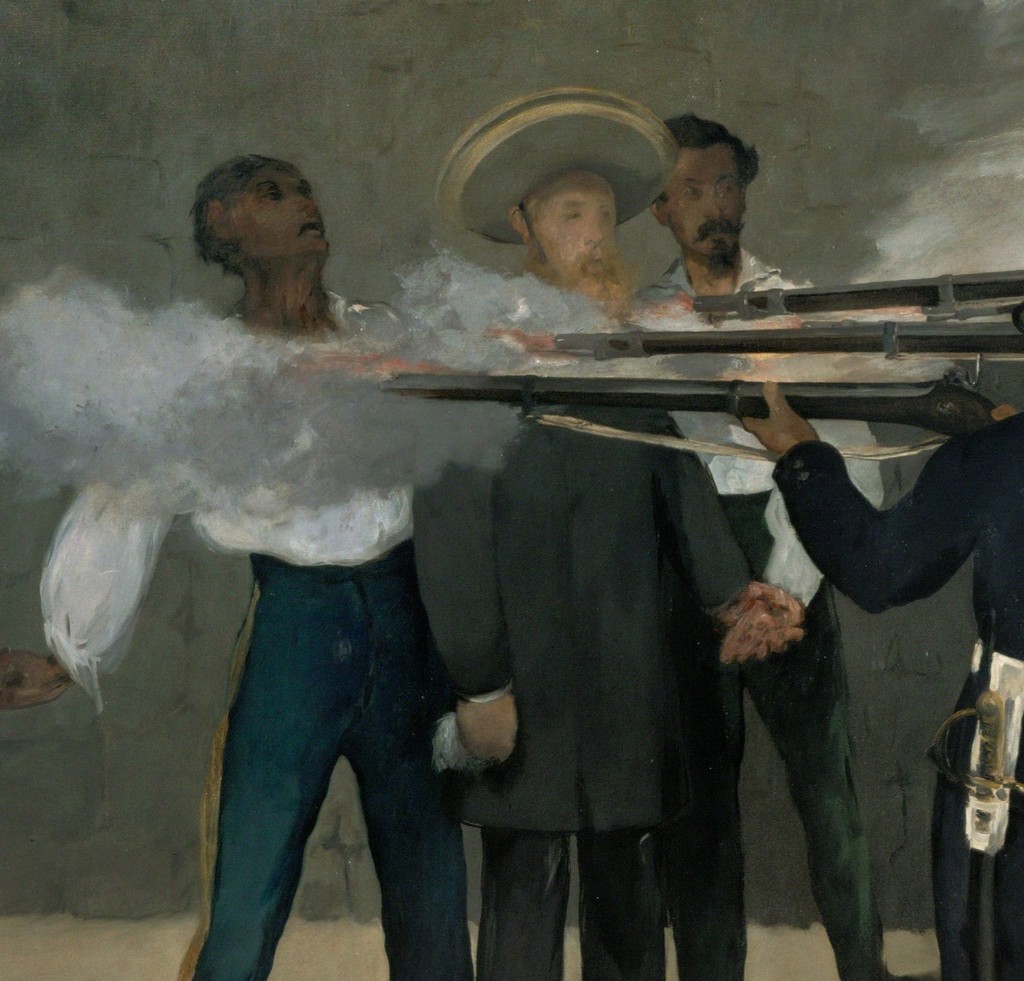
The condemned figures are more exposed. Their faces turn towards the area from which the shots come, and their clothes do not repeat the squad’s regular pattern. Maximilian’s pale, broad-brimmed hat gives his head a distinctive outline. The neighbouring figures hold different positions, but the close grouping binds them together.
Joined hands make that connection especially affecting. A small human contact survives within an arrangement dominated by the horizontal rifles. The gesture is low and comparatively unobtrusive. Once noticed, it gives a second direction to the scene: the victims connect with one another beneath the weapons that connect them to the squad.
Smoke interrupts the meeting of these two groups. It brightens the central passage while concealing parts of bodies and faces. We can follow the rifles towards the men, but their precise points of contact become uncertain. The painting lets us recognise the act while withholding a complete view of its physical consequences.
The pale foreground contributes to this exposure. There is enough visible ground to establish where the men stand, but little to distract from their relationship. Against it, dark boots and legs appear firm and emphatic. The bodies seem to occupy a shallow stage, with the wall restricting the space behind them.
The result is unusually close and difficult to escape imaginatively. The viewer has a clear view of the formation, yet the soldiers’ backs place a substantial barrier between us and the victims. We can see the direction of force more readily than the faces of those exercising it. Their collective action becomes the most stable structure in the picture.
The Soldier at the Right
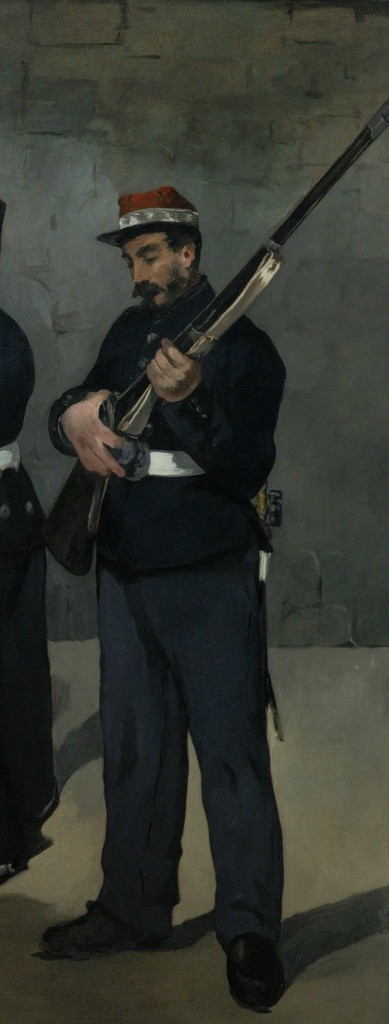
One soldier stands apart from that structure. At the right edge, his rifle slopes rather than joining the level row of barrels. His hands attend to it, and his head inclines towards the task. A red cap and the clearer view of his face distinguish him from the mass beside him.
His position gives the scene a second tempo. The squad’s action is simultaneous and directed outwards; his attention appears local and practical. The eye can move from the compressed firing line to this single man and find a different arrangement of arms, hands and weapon.
That contrast makes the execution feel like an organised activity with several constituent actions. The rifle is a long, commanding line when raised towards the victims. Held separately, it also becomes an object that has to be handled and made to function. The two appearances belong within the same machinery of force.
The man’s lowered gaze provides no secure account of his feelings. It is possible to experience his separation as chilling, absorbed or matter-of-fact, but the painted pose does not establish an inner confession. Its strongest effect comes from what it does within the composition: it gives an individual body room to be seen while the others merge into a group.
His presence also prevents the right edge from becoming a simple continuation of the firing line. The diagonal weapon turns attention back into the picture. The eye pauses with him, then returns to the nearly horizontal barrels and the smoke. A seemingly peripheral figure helps sustain the scene’s circulation.
The Wall and Its Spectators
The wall gives the Mannheim scene a broad, quiet background. Its grey surface reduces the amount of landscape visible behind the principal figures. Against that relatively continuous field, small changes in the angle of a rifle or the shape of a hat become conspicuous.
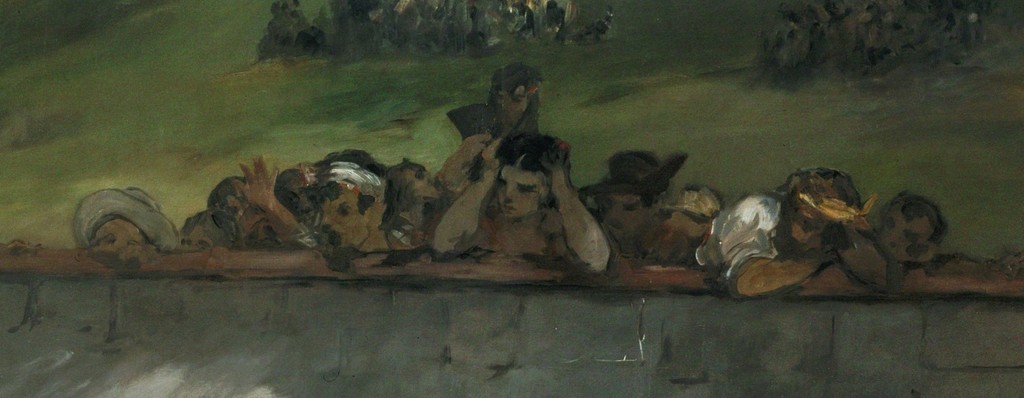
Above it, spectators break the line. Heads and upper bodies appear at different heights; some figures lean or raise themselves to obtain a view. Their irregular cluster contrasts with the disciplined repetition of the soldiers below. Watching produces a different kind of crowd from firing.
The spectators occupy a position that seems distant from the immediate danger, yet their scale makes the act of looking visible as a bodily effort. They have to reach, climb or lean towards the scene. The wall separates them from the foreground while simultaneously giving them a place from which to observe it.
Their presence extends the subject beyond the executioners and victims. The event has witnesses inside the image, people who turn it into something seen. We look at their looking as well as at the shooting. Their limited faces and small gestures allow no certain judgement about whether each person is curious, distressed or approving.
The viewer’s position differs from theirs. We face the scene at a much lower level and have a fuller view of its principal groups. At the same time, the squad obstructs our access to the victims. Both positions offer partial knowledge. Manet makes witnessing a matter of where bodies stand and what lies between them.
The landscape beyond the wall is slight but consequential. It establishes that the execution occurs within a larger world, one which the close arrangement has temporarily narrowed. The open distance above and the compressed action below coexist in the same canvas. The scene feels enclosed through the painter’s organisation of the view.
Annotated Details from The Execution of Emperor Maximilian: Figures, Rifles and Wall
The numbered points identify visible features discussed in this article. Return from each detail to the whole composition. Édouard Manet, The Execution of Emperor Maximilian, 1868–69. Kunsthalle Mannheim, M281. Kunsthalle Mannheim; faithful reproduction via Wikimedia Commons, Erich Lessing / Art Resource source. Image source. Public domain. Numbers added to a separate resized whole supplied overview. Detail crops from the unchanged original; no enlargement, retouching or colour alteration.
Details from THE EXECUTION OF EMPEROR MAXIMILIAN: FIGURES, RIFLES AND WALL
Compare the three condemned men, the rifle squad, the separate soldier and the spectators above the wall in the Mannheim painting.
Three Men, Smoke and Joined Hands
The three men stand close to the rifles, with joined hands visible below the smoke.
The Line of Rifles and Uniformed Backs
Rifle barrels cross above dark uniforms, interrupted by hands and pale belts.
The Separate Soldier at the Right
The soldier at the right looks down towards the weapon held across his body.
Faces above the Wall
Small faces and hands gather above the wall, watching from a different height.
Boston: The First Large Painting
The Museum of Fine Arts, Boston, holds the large painting dated 1867. Measuring 195.9 × 259.7 cm, it is already an ambitious undertaking, substantially larger than an ordinary study. It entered the museum in 1930 as a gift from Mr and Mrs Frank Gair Macomber.[4]
Its surface gives a very different initial impression from Mannheim. Dark figures overlap heavily, and smoke spreads across the upper part of the encounter. The victims are harder to separate from the surrounding atmosphere. The firing squad gathers into a dense, uneven mass, with broad-brimmed hats contributing to its broken upper edge.
There is less of the later canvas’s clear opposition between repeated uniforms and three distinct condemned men. In places, adjacent bodies nearly dissolve into shared darkness. A brownish jacket at the right introduces another large area within the group, while pale passages of smoke and ground interrupt the darker paint.
This handling gives the scene an immediate, unsettled force. It can take time to work out the exact passage from one figure to another. The eye searches through the paint, finding an arm, a trouser leg or the edge of a hat, then losing it in an adjoining area. Violence is experienced partly as difficulty of seeing.
The later Mannheim arrangement places greater weight on the repetition of the squad and the barrier of the wall. Boston makes overlap and atmosphere more insistent. The difference is larger than a change in costume or the addition of a background feature: it changes how quickly the event can be read.
The first painting also guards against treating the group as a smooth progression towards an inevitable solution. Its crowded darkness has an effect of its own. Looking back from Mannheim, we can recognise decisions that Manet would reconsider without dismissing the earlier work’s concentrated, turbulent character.
London: A Painting Seen through Its Losses
The National Gallery’s version survives as fragments mounted together. It is dated about 1867–8 and retains a large section of the squad, a separate passage with the soldier at the right, and narrower remnants of the victims. Areas of neutral support make the missing parts unmistakable.[5]
The main section gives an unusually close encounter with the executioners. Broad dark backs dominate it. Light belts divide their coats from their trousers, while shoulders, hands and weapons overlap across the top. A raised diagonal bayonet cuts through the sky above the nearly level rifles.
The mounted fragments at the left preserve details of the condemned group, including the clasped hands and part of a face. Their physical separation changes the experience of those details. A small surviving gesture can claim attention precisely because so much around it has disappeared. The loss makes us conscious of the labour of imagining a continuous scene.
That imaginative work has limits. The neutral gaps are evidence of the object’s damaged survival, and their shapes belong to its later history. They should not be read as pale spaces that Manet deliberately placed around the figures. The current presentation allows surviving pieces to be related without pretending to recover every painted passage.
The painting had already suffered damage by the time of an 1883 photograph. Degas later gathered the fragments, and the National Gallery acquired them from his collection in 1918.[5] His interest forms part of the work’s survival: another painter recognised value in sections of a composition whose integrity had been lost.
For the viewer, this version shifts attention towards the executioners more decisively than the intact Mannheim canvas. Their formation occupies the largest continuous painted field. The victims remain through interrupted evidence, particularly the joined hands. The balance of the original scene can be studied, but the present object also tells a story about what survives and what has to remain absent.
The distinction is useful when comparing reproductions. A photograph of the mounted fragments can look like an unusually sparse composition if its condition is overlooked. Once its losses are understood, the same image becomes a record of both Manet’s decisions and the later treatment of the canvas. Two different histories occupy its surface.
The Small Copenhagen Study
SMK’s collection records the small oil painting as 1867, measuring 48 × 58 cm. It is signed and dated, and entered the collection in 1914.[6] Older exhibition and National Gallery accounts place the study in 1868 or 1868–69.[2][10] Its dating therefore deserves care when the works are arranged into a chronological sequence.
At this scale, the whole action can be grasped at once. The pale foreground, dark uniforms and wide grey wall form large areas that contain the more rapidly indicated figures. Small spectators accumulate above the wall in a restless band, while smoke passes across the condemned men below.
The squad’s light belts create a broken horizontal rhythm. Their repeated pale strokes connect figures whose shoulders and heads overlap. Below them, dark legs meet the ground with relatively few changes of direction. The separate soldier at the right remains clear through his diagonal rifle and more isolated stance.
The painter’s abbreviated marks are particularly evident among the spectators. A touch can suggest a head or shoulder without describing a full person. Across the main action, larger strokes establish clothes and bodies, leaving the eye to complete their relationships. The painting gives enough information for the scene to hold together while allowing its making to remain visible.
The small canvas is valuable alongside the large paintings because it makes the overall design so readily available. One can move between the wall-top crowd and the foreground formation without losing the whole. Its scale changes the kind of attention the subject invites, offering a concentrated view of relationships that become bodily and imposing on the large canvases.
Goya and the Firing Squad
Goya’s The Third of May 1808 is the most compelling earlier comparison. Painted in 1814, it represents executions following the Madrid uprising against French forces in 1808.[11] The relationship is discussed in the National Gallery’s study and by Theodore Reff.[2][12] Both painters bring a group of condemned people into opposition with soldiers whose backs largely face the viewer.
Goya’s central victim raises his arms. His light shirt opens into a broad shape, giving his body a prominence reinforced by the lantern below. Fallen men occupy the foreground, and further victims wait within the darkness. Gesture, light and the sequence of bodies make the scene expand beyond the immediate confrontation.
Manet’s linked hands create a quieter horizontal connection. His victims have less space in which to spread their arms or establish a grand silhouette. The rifles appear close, the wall rises behind, and the squad fills a substantial portion of the view. The contact between the groups feels compressed into a narrow interval.
The different lighting also matters. Goya’s lantern makes illumination part of the event, gathering attention within a night scene. Manet’s daylight offers a more general visibility. The figures do not emerge from surrounding darkness in the same way; their confinement comes chiefly from spacing, overlap and the wall.
The comparison reveals how an inherited arrangement can sustain different kinds of intensity. Goya gives the raised arms an expressive centrality. Manet lets the repeated uniforms and nearly level rifles establish a collective pressure, while a smaller gesture binds the victims. Each painting makes the soldier’s back an obstacle between the viewer and the person facing death.
Manet’s engagement with Spanish painting also appears in works such as The Fifer, where a single figure stands against a reduced setting. Here, an older example helps him organise several bodies around an event of contemporary political consequence. The relationship with Goya becomes most interesting in the changes that the later painter makes to a recognisable pictorial problem.
French Uniforms and French Responsibility
The French appearance of the later squad has long shaped the political reading of these works. The Kunsthalle Mannheim describes the clothing as a kind of invented uniform with French associations.[1] The men should be understood in relation to the composition and its political implications, while the actual execution remains the work of Mexican Republican forces.
Uniform makes the group visually coherent. Similar coats, caps and belts allow a body seen from behind to join a repeated pattern. That pattern also recalls the appearance of a state’s organised military power. Clothes become a bridge between the individual model who may have posed in the studio and the institution suggested by the finished formation.
For a French audience, the resemblance could turn attention towards Napoleon III’s intervention and withdrawal of support. Responsibility could be pictured through an association in clothing, even though French troops had not carried out the shooting. Such a reading makes the execution a consequence of a policy whose author remains outside the painted scene.
The image offers no portrait of Napoleon III presiding over events and no written accusation within its setting. Its political charge can emerge through the way familiar uniforms occupy the position of the killers. The viewer supplies the historical connection. That indirection helps explain why close attention to costume matters without making every detail an exact documentary statement.
The detached soldier intensifies the question in another way. He is near enough to belong to the same formation, yet sufficiently separate to show one man carrying out an ordinary practical action. The picture permits collective power and individual participation to be considered together. Its severity comes partly from the ease with which those two scales of action fit beside one another.
The Lithograph and Its Public
The lithograph gave the composition another material life. The Metropolitan Museum’s impression is catalogued as 1868, published in 1884, on chine collé, and as the first of three states. Its image measures 34 × 43.8 cm.[7] The work belongs to the history of prints as well as to that of the painted versions.
Monochrome concentrates the contrasts. The soldiers’ dark bodies gather into emphatic masses, while white belts, shirts and smoke interrupt them. The wall becomes a broad tonal field, and the victims emerge through lighter areas at the left. Marks that remain visible on the printed surface give the scene a grain and urgency different from the oil paintings.
The smoke is especially effective in this medium. It can read as an opening in the dark structure of the image, with white paper carrying an active pictorial role. The eye follows the rifle barrels into that interruption and has to reconstruct bodies from passages that remain around it. The print uses absence of ink as forcefully as the oils use pale paint.
A print could also reach viewers through different circumstances of looking. It was smaller, reproducible and potentially distributable beyond the location of a single large canvas. That possibility made publication a significant part of the work’s meaning. An image of state violence could circulate as an object that readers encountered, discussed or retained.
The Met notes that the lithograph was intended for wide distribution and was suppressed by the state.[7] Its history gives practical weight to the question of who could see the execution. The spectators painted above the wall had found a place to watch; prospective viewers of the print depended on another set of permissions and obstacles.
Censorship in 1869
In early 1869, Manet wrote to Zola objecting to the authorities’ interference and seeking publicity for the affair. Victor Claass’s account for the Institut national d’histoire de l’art reproduces the letter. The printer had wanted to erase the lithographic stone, which was ultimately returned.[13]
Trial impressions already existed before suppression. The later publication date of 1884 records a posthumous stage in the image’s circulation, after Manet’s death in 1883.[7][13] Production, suppression and publication belong to different moments in its history.
Zola answered in La Tribune on 4 February 1869. In the passage reproduced by Claass, he mocked the historical absurdity implied by censorship: the authorities seemed to prefer a reassuring imaginary Mexico in which Maximilian remained alive and happy.[13] His satire made the suppression itself an accusation. The image was troublesome because the event could not be made harmless by wishing it away.
The painting faced related political constraints and was not submitted to the Salon in this episode.[13] A jury’s refusal of a painting and the suppression of a reproducible image were different ways in which public visibility could be restricted.
That distinction places this subject beside, yet apart from, the better-known disputes over Olympia and The Balcony. Those pictures were exhibited and argued over in public. The Maximilian works raised a sharper question about whether a particular account of a recent political event could be made publicly available at all.
Across the Atlantic and into Collections
The painting did obtain a public life during Manet’s lifetime outside France. Émilie Ambre took it to the United States, where it was shown in New York and Boston in 1879–80. The Art Institute of Chicago’s later account connects this journey with the singer’s American engagements.[14] Its history extends beyond the initial obstruction in Paris.
The surviving versions eventually entered different public collections. Mannheim acquired its canvas in 1910, with support from local donors.[1] The London fragments came from Degas’s collection in 1918.[5] Boston received the first large painting in 1930.[4] Their dispersal helps explain why the title can refer to noticeably different images in different museums.
Seeing them together, whether through exhibition or careful comparison, returns the subject to a sequence of decisions. Hats, coats, backgrounds, gestures and scale alter the encounter. The print introduces another surface and another means of circulation. Each object preserves a distinct way of making the event visible.
The Mannheim canvas remains especially forceful for its unequal distribution of space. The soldiers have room to form a repeated line and to attend to their weapons; the victims stand tightly grouped beneath the wall. A small clasp of hands persists against that larger order. It gives the eye somewhere to rest without releasing the pressure of the rifles.
Artworks directory
Explore selected paintings, drawings and prints by Édouard Manet. Search by title or another recorded name.
Frequently Asked Questions
The inscription commemorates the execution. The Kunsthalle Mannheim dates the painting itself to 1868–69.[1]
It survives in separate fragments. Damage was already visible in an 1883 photograph; Degas later collected the pieces, and the National Gallery acquired them in 1918.[5]
Discussion
Look again at the images and ideas explored in The Execution of Emperor Maximilian by Édouard Manet. These editorial prompts invite your observations.
Reader Insights
Compare the joined hands with the line of rifles above them.
Then move to the separate soldier at the right and the small spectators over the wall.
Each group has a different relation to the event, expressed through posture, spacing and the direction of attention.
Join the Conversation
Share a detail, comparison or question about The Execution of Emperor Maximilian by Édouard Manet below.
References
- Kunsthalle Mannheim. “L’Exécution de l’empereur Maximilien,” 1868/1869, M281. Current oil-painting record, dimensions, inscription, interpretation and acquisition. View source. (in German).
- National Gallery, London. “In the Line of Fire: Manet’s The Execution of Maximilian.” In-depth study, parts 1–6, on the versions, historical circumstances, sources and exhibition history. View source.
- Archivo General de la Nación, Mexico. “El 150 aniversario del triunfo de la República liberal,” 19 June 2017. Historical account including a transcription of the death register. View source. (in Spanish).
- Museum of Fine Arts, Boston. “Execution of the Emperor Maximilian,” 1867, 30.444. Collection commentary and provenance. View source.
- National Gallery, London. “The Execution of Maximilian,” about 1867–8, NG3294. Object record and account of the surviving fragments. View source.
- SMK — National Gallery of Denmark. “The Execution of Emperor Maximilian,” KMS3270. Current collection record and collection data, dated 1867. View source.
- The Metropolitan Museum of Art. “The Execution of Maximilian,” 1868, published 1884, 21.48. Lithograph record, state, dimensions and publication context. View source.
- Secretaría de la Defensa Nacional, Mexico. “19 de junio de 1867, Fusilamiento de Maximiliano de Habsburgo y los Generales Miramón y Mejía,” 1 January 2025. View source. (in Spanish).
- Théodore Duret. Histoire d’Édouard Manet et de son œuvre. 1906, pp.114–115. Retrospective discussion of the subject and studio preparation. View source. (in French).
- The Museum of Modern Art. “Manet and the Execution of Maximilian.” Exhibition press release, 19 October 2006, pp.1–5. Overview of the principal compositions and contemporary sources. View source.
- Manuela B. Mena Marqués / Museo Nacional del Prado. “3 de mayo de 1808 en Madrid: los fusilamientos de patriotas madrileños, El [Goya].” Encyclopedia entry, historical opening. View source. (in Spanish).
- Theodore Reff. Manet and Modern Paris. National Gallery of Art, 1982, especially pp.204–206 and 208–209; Goya reproduction, fig.101. Selected discussions of the firing-squad motif and lithograph. View source.
- Victor Claass / Institut national d’histoire de l’art. “L’exécution de Maximilien de Manet, un chef-d’œuvre empêché,” 18 October 2024. Includes extracts from Manet’s correspondence and Zola’s article of 4 February 1869. View source. (in French).
- The Art Institute of Chicago. “Edouard Manet Exhibition.” Calendar, vol.61, no.1, 1966, pp.8–16; passage on Émilie Ambre and the American showing. View source.
- Splash image, Édouard Manet, The Execution of Emperor Maximilian, 1868–69. Kunsthalle Mannheim, M281. Kunsthalle Mannheim; faithful reproduction via Wikimedia Commons, Erich Lessing / Art Resource source. Image source. Public domain. Whole supplied faithful public-domain reproduction resized within native dimensions. No enlargement, retouching or colour alteration.


