



 by Tom Gurney
Tom Gurney BSc (Hons) is an art history expert with over 20 years experience
Published on June 19, 2020 / Updated on October 30, 2026
Email: tomgurney1@gmail.com / Phone: +44 7429 011000
The Spanish Singer by Édouard Manet: Introduction
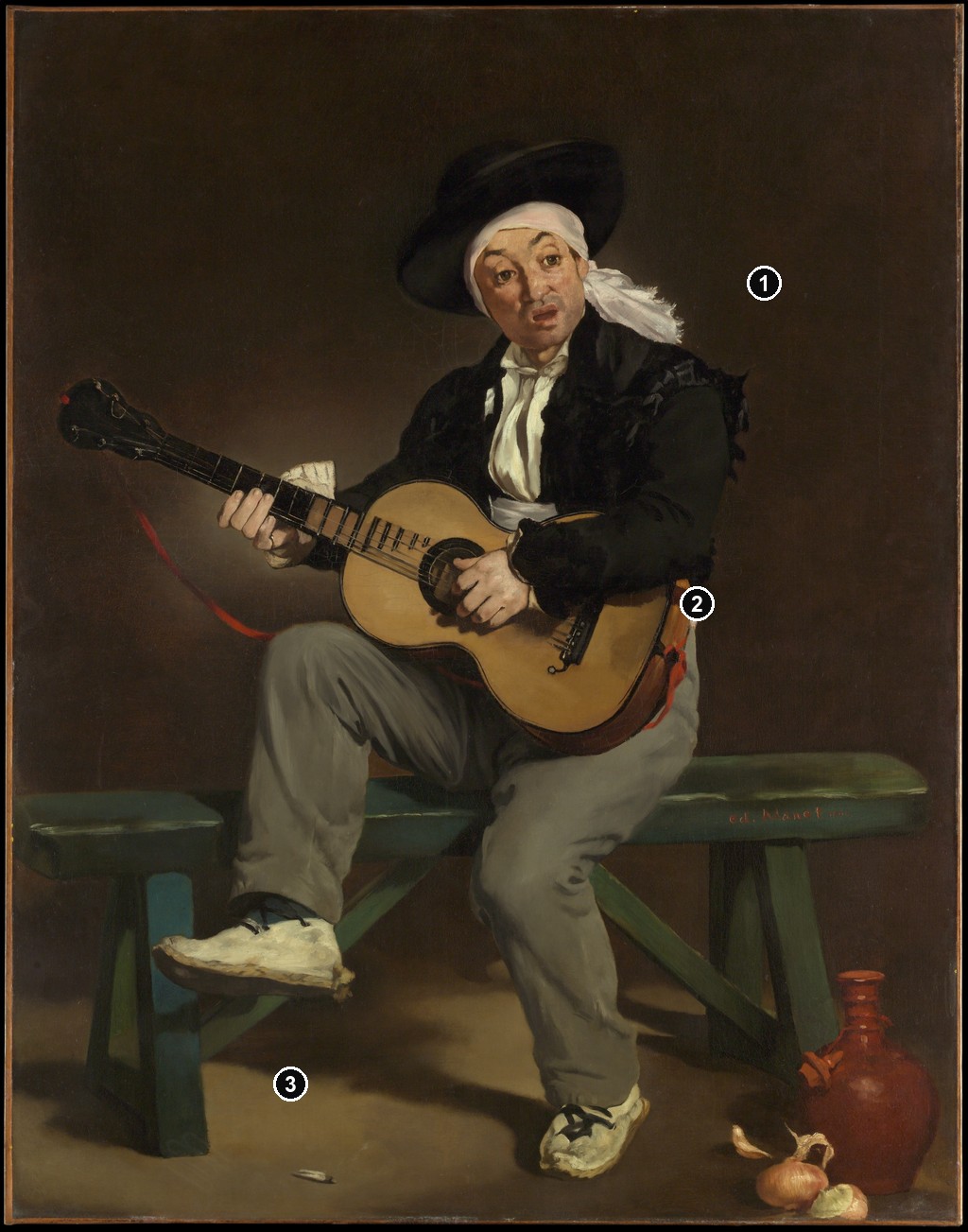
A man sits on a green wooden bench with a guitar across his body, his mouth open in the middle of a song. The broad hat, pale headcloth and small earthenware jug suggest a Spanish performer, but the setting offers no street, tavern or audience. Brown shadow surrounds him. His raised leg, turning shoulders and angled instrument supply almost all the movement the painting needs.
Édouard Manet painted The Spanish Singer in 1860, before his visit to Spain. When it appeared at the Paris Salon the following year, it brought him an honourable mention and attracted fellow painters to his work. Its success belongs to an important early moment in his career: a public welcomed the artist who would soon provoke it with Le Déjeuner sur l’herbe and Olympia.[1][2][3]
The painting brings together a costumed studio model, a French enthusiasm for Spanish art and an unusually assured arrangement of colour. Even the awkward handling of the guitar helps reveal how it was made. Manet presents the act of performance with conviction while allowing the materials of his own performance as a painter to remain visible.
At a Glance
- ArtistÉdouard Manet
- TitleThe Spanish Singer
- Other historic titlesEspagnol jouant de la guitare, Le Chanteur espagnol and The Guitar Player
- Date1860
- MediumOil on canvas
- Dimensions147.3 × 114.3 cm
- CollectionThe Metropolitan Museum of Art, New York
- Object number49.58.2
- AcquisitionGift of William Church Osborn, 1949
- First Salon appearance1861, when the painting received an honourable mention[1][2]
This work across Édouard Manet’s career
Contents
- A Figure Held Together by Movement
- Colour and the Work of the Brush
- Spain Imagined in a Paris Studio
- Learning from Spanish Painting
- Success at the Salon of 1861
- The Guitar and the Black Mirror
- From Painting to Print
- Collectors and the Journey to New York
- An Early Success Viewed through Later Paintings
- Annotated details
A Figure Held Together by Movement
The singer’s pose gives a stationary figure the energy of an unfolding action. One foot rises onto the bench while the other rests near the foreground. His legs point in different directions, opening a space beneath the guitar. Above them, his upper body turns towards the instrument. The neck of the guitar cuts across the dark background, carrying the eye away from the face and towards the hand on its strings.
These movements are held within a simple upright format. The broad shape of the hat anchors the top of the figure, and the bench stretches across the lower part of the canvas. Its horizontal line checks the diagonal of the guitar. Underneath, the wooden supports introduce sharper angles that repeat the bends of the knees. Each element has a practical place in the scene and a second role in organising the picture.
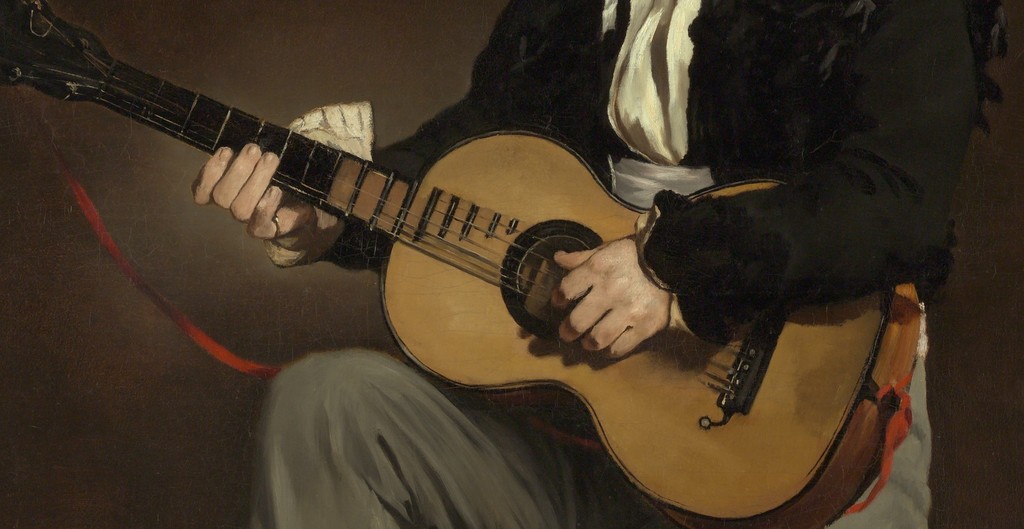
The instrument occupies the centre. Its rounded body overlaps the jacket and trousers, joining areas that would otherwise separate into dark upper clothing and pale legs. The opening in its soundboard gives this broad warm shape a dark centre. Manet places the hands around it, then returns attention to the face through the pale shirt and cloth at the neck.
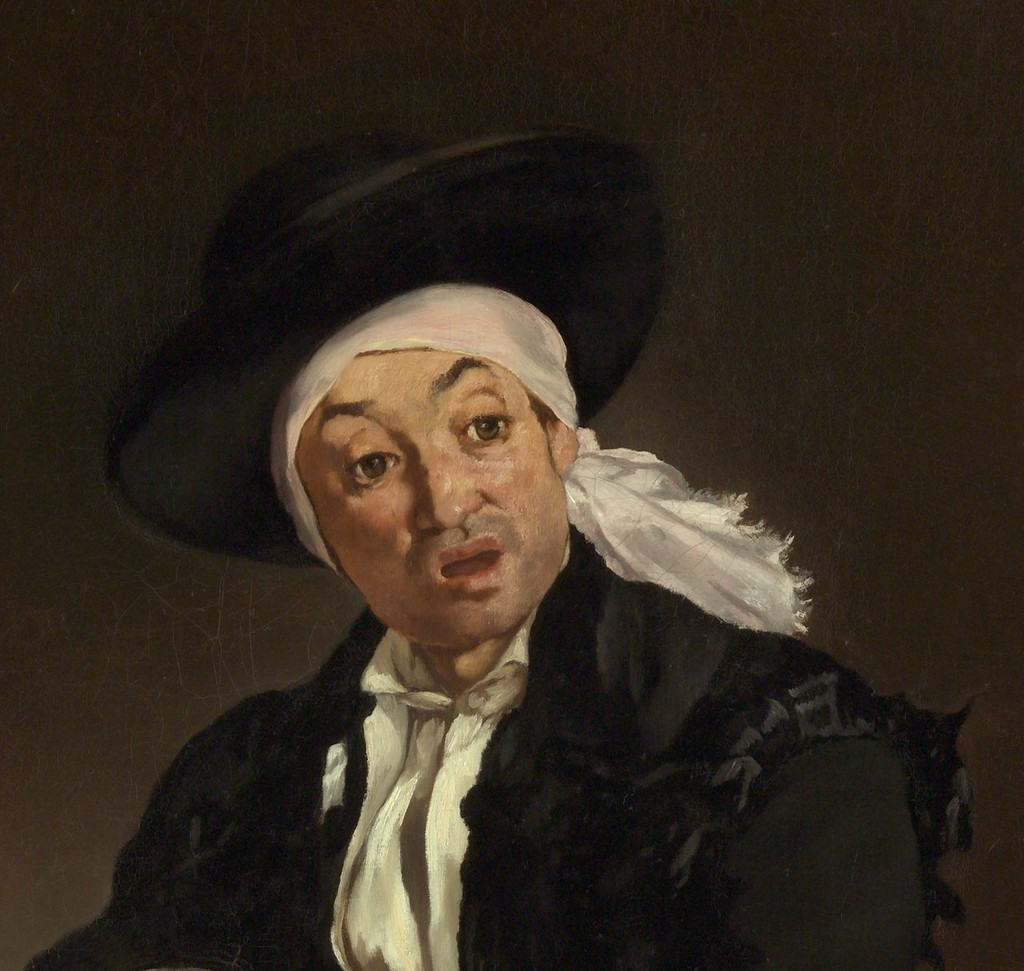
The open mouth makes the subject immediately legible as a singer, yet the painting leaves the song to our imagination. There is no written music or clearly identified performance to reconstruct. The lifted face and active hands provide enough information to make sound feel possible. They also keep the figure from settling into the stillness of a conventional seated portrait.
The space is close. The projecting shoe and the objects beside the bench bring the action towards the bottom edge, near the viewer. Behind the singer, there is little to measure distance. The body feels substantial, but the room remains indefinite. This balance allows Manet to give a lone performer the visual presence of a much more elaborate scene.
Colour and the Work of the Brush
At first, the palette seems restrained. Black clothing and a dark hat stand against a brown ground. Gray trousers occupy much of the lower figure. Within this limited range, the white shirt and headcloth become exceptionally bright. Their irregular edges and folded surfaces keep the strongest lights active around the face and hands.
Manet varies the character of the darks. The hat forms a broad, firm silhouette, while the jacket breaks into folds, reflections and deep recesses. Some edges remain distinct; others disappear into the surrounding brown. The figure holds together even where its outline fades. The Met’s account relates this combination of a restricted palette and lively handling to the Spanish painters Manet admired.[1]
The gray of the trousers is especially rewarding to follow. It changes as the fabric bends around the raised knee and falls down the other leg. Lighter strokes describe ridges, while broader dark passages carry the weight of folds. The paint communicates cloth through changes of direction and value, giving a loose garment a clear structure.
Green, red and warm ochre make the quieter colours more expressive. The bench supplies a cool horizontal foundation. A narrow red strap moves around the guitar and disappears behind the figure. The instrument’s yellow-brown surface and the reddish jug create warm accents at different heights. Small passages of colour can therefore affect the entire composition without competing with the pale shirt.
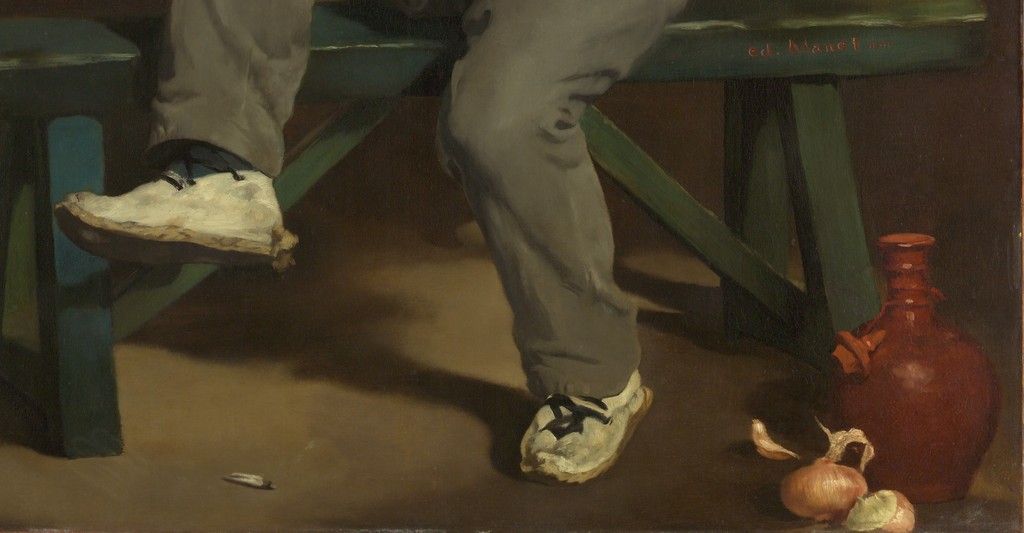
The objects at the singer’s feet complete this arrangement. The jug has a rounded body and a narrow neck; the onions introduce smaller, irregular forms nearby. Their warm tones answer the guitar, while their low position draws the composition towards the foreground. They give the performer a material setting, even though they tell us little about a specific place.
The effect depends on how differently the paint behaves across the canvas. A broad area of brown gives the white cloth room to shine; a short dark mark can secure a fold or a feature. Much of the pleasure comes from moving between the figure and the strokes that make it convincing. The image reads easily at a distance and becomes more various as one looks closely.
Spain Imagined in a Paris Studio
The costume establishes a Spanish identity quickly, but its elements came from Manet’s studio collection. The Met describes a model dressed with clothing and accessories that recur elsewhere in his work. Juliet Wilson-Bareau’s catalogue account notes that Théophile Gautier recognised a Marseille-style vest among the outfit’s mixed components. The figure’s appearance was persuasive as a painted invention without being an exact record of regional Spanish dress.[1][2]
Spanish subjects appeared in Parisian painting, literature and performance, and French artists were looking closely at Spanish masters. A guitar and broad-brimmed hat could make a subject recognisable within that shared enthusiasm. The viewer did not need to identify a particular musician to understand the type of scene being offered.
Émile Zola later explained Manet’s Spanish subjects through the costumes he kept and the colours that interested him. That explanation directs attention back to practical choices in the studio: a dark jacket beside a white shirt, the shape of a hat, the warm curve of a guitar. Costume allowed Manet to construct a compelling figure from things available to him.[4]
The props had lives beyond this canvas. In the 1862 Still Life with Spanish Hat and Guitar, now in Avignon, Manet brought related studio materials together without a performer. Hats, clothing and instruments also entered frontispieces for his prints. Seen alongside these works, the singer becomes part of a larger exploration of how a few objects can suggest a world.[2]
The Spanish appearance should not be confused with the model’s documented identity. The painting supplies a role, a costume and a gesture. It does not establish the sitter’s nationality, musical training or personal history. Its interest lies in the encounter between a particular human presence and the character Manet has asked him to perform.
Learning from Spanish Painting
Manet’s engagement with Velázquez and Goya began before he travelled to Spain in 1865. Works, copies, prints and critical discussion brought Spanish painting into the French artistic world. The Galerie espagnole installed at the Louvre between 1838 and 1848 was one important part of that history, helping establish a wider appetite for artists whose reputations and methods offered alternatives to established French preferences.[5]
In The Spanish Singer, the connection involves the treatment of the figure as much as its costume. A person emerges with unusual force from a subdued background. Dark clothing becomes a substantial part of the colour scheme. Familiar objects and an everyday activity receive the scale and attention associated with more prestigious subjects. Manet adapts these possibilities to his own model and materials.[1][2]
Wilson-Bareau connects the painting with both Murillo’s Beggar Boy and the Gathering of Gentlemen then associated with Velázquez. The comparison helps explain the combination of accessible objects in the foreground, a strongly presented figure and a setting that remains less defined. Manet draws on these earlier pictures while changing their figures, objects and arrangement.[2]
The later Madrid journey sharpened Manet’s admiration. In a letter to Baudelaire dated 14 September 1865, he praised Velázquez with extraordinary enthusiasm. By then, The Spanish Singer had already been painted and exhibited. The painting grew from Spanish art encountered and imagined in France, before his direct experience of the Prado.[5]
The painting also belongs beside Manet’s Boy with a Sword. Both works give a studio figure a striking presence through costume, a prominent object and a restrained setting. Their success helped establish a way of painting that Manet would subsequently make less comfortable for his audience. The early pictures already contain the close attention to large shapes and sharp contrasts that would become central to his later work.[2][4]
Success at the Salon of 1861
The Salon offered Manet access to a large public and to the judgement of critics and fellow artists. In 1859, the jury had rejected his Absinthe Drinker. Two years later, it accepted both The Spanish Singer and his portrait of his parents. The honourable mention awarded to the singer gave him an early measure of official recognition.[2][3]
The painting’s position in the exhibition improved as its success became apparent: Wilson-Bareau records that it was brought down from a high hanging position to a more favourable level. That change matters for a work whose impact depends on the bodily presence of a single figure. The scale of the performer and the directness of the arrangement were easier to appreciate when the picture could be encountered more closely.[2]
Gautier’s response joined praise for Manet’s handling to comparisons with Velázquez and Goya. He could find the costume inauthentic and still admire the figure’s vitality. His judgement shows how realism operated here as a quality of painting, rather than a guarantee that every accessory or action was an exact report of life. A convincing presence could survive an invented outfit.[2]
The work also attracted younger artists, including Fantin-Latour, Alphonse Legros and Carolus-Duran. Accounts discussed by Gary Tinterow and Wilson-Bareau connect their admiration with visits to Manet’s studio. They recognised something in his treatment of paint that made an unfamiliar name worth seeking out. This response gives the picture a place in the formation of his artistic circle as well as in the history of his public reputation.[2][6]
Success was not unanimous agreement. Some contemporary objections concerned the weight or realism of the paint itself. The picture could appear vigorous and fresh to one viewer, excessively forceful to another. Those differences anticipate the arguments that would surround Manet’s more challenging paintings, even though this subject proved comparatively easy for the Salon public to accept.[2]
The Guitar and the Black Mirror
The instrument introduces a small but telling inconsistency. The Met identifies the figure as a left-handed player holding a guitar strung for someone playing with the right hand. His fingering also suggests a model posing with an instrument he did not know how to play. The musical action is convincing at first glance, but it does not withstand the same kind of practical inspection as the folds of the trousers.[1]
That discrepancy need not unravel the painting. The placement of the guitar creates a broad warm shape across the body and sends its neck into the empty background. The hands connect the model to the object, while the open mouth announces the song. These pictorial functions remain effective even when the instrument’s configuration is recognised as awkward.
Antonin Proust later recalled Manet discussing the reversed arrangement and boasting that he had painted the head in a single session, checking its effect in a small black mirror. Wilson-Bareau quotes this recollection in her catalogue entry. It is a vivid account of Manet’s confidence in the result, but it concerns the head and comes from a witness writing long after the event. It does not establish that the entire canvas was completed in two hours.[2]
The anecdote is most useful when it sends attention back to the face: its compact lights, parted lips and quick relation to the cloth beneath the hat. Those passages have to carry expression without the support of an elaborate narrative. Manet’s pride in them fits a painting whose force rests on the arrangement of paint, even where its performed action contains a mistake.
Annotated Details from The Spanish Singer: Face, Guitar and Foreground Objects
The numbered points identify visible features discussed in this article. Return from each detail to the whole composition. Édouard Manet, The Spanish Singer, 1860. The Metropolitan Museum of Art, New York, 49.58.2. Image source. CC0 / Public domain. Numbers added to a separate resized whole provided overview. Detail crops from the immutable original; no enlargement, retouching or colour alteration.
Details from THE SPANISH SINGER: FACE, GUITAR AND FOREGROUND OBJECTS
Follow the pale headcloth and face to the two hands around the guitar, then look down to the shoes, green bench and foreground objects.
Face, Headcloth and Broad Hat
The open mouth and pale headcloth sit beneath the broad dark hat, with the face turned towards the viewer.
Two Hands around the Guitar
One hand meets the neck while the other rests near the round sound hole. The warm guitar crosses the dark jacket.
Shoes, Bench and Foreground Objects
Pale shoes and grey trousers stand against the green bench, beside the rounded jug and onions.
From Painting to Print
Manet returned to the singer in an etching. The change of medium gave the image another kind of life: a large coloured canvas could become a smaller sheet, circulated and collected beyond the place where the original hung. The subject became part of his early public identity as a printmaker as well as a painter.[2]
The Met owns an impression dated 1861–62, catalogued as etching and bitten tone, accession 52.608.2. It is a separate object from the painting, with its own dimensions, printing history and condition. In the printed image, the composition is reversed, and contrasts of ink and paper carry relationships that colour had established in the canvas.[2][7]
The print appeared in Manet’s early publishing activity in 1862 and in his portfolio Huit gravures à l’eau-forte. Wilson-Bareau also discusses early proofs offered to friends. This movement between private gifts and published impressions shows how the successful subject could support different kinds of exchange, from personal association to a wider market.[2]
An impression in the National Museum of Western Art, Tokyo, is catalogued as The Spanish Singer or Le Guitarrero, dated 1861. Its record describes dark-brown ink, wiping effects and work with roulette, a tool used to create a textured surface on the plate. Such details remind us that a print’s appearance depends on making and printing decisions, not only on the design it shares with a painting.[8]
The two museums describe their impressions through their own state classifications. A state records a stage in the working of a printing plate; it should not be mistaken for a different version of the oil painting. Comparing the sheets is most rewarding when the exact impression remains in view, allowing changes of tone, line and surface to emerge on their own terms.[7][8]
Collectors and the Journey to New York
The painting remained important to Manet after its Salon appearance. It was shown under changing titles, including Le Chanteur espagnol in his independent exhibition of 1867. The different names emphasise singing, nationality or the instrument, but they belong to the history of this same canvas.[2]
Its later ownership connects it with two figures central to the market for Manet’s work. Paul Durand-Ruel bought it from the artist in January 1872. The following January, the opera singer and collector Jean-Baptiste Faure acquired it from the dealer. Faure would assemble a substantial group of Manet’s paintings, making this image of a performer part of a collection formed by a performer.[2]
Durand-Ruel bought the canvas again in 1906, and William Church Osborn acquired it in 1907. Osborn gave it to the Metropolitan Museum in 1949. That gift is recorded in the painting’s present accession number, 49.58.2. The work’s place in New York therefore follows a history of studio ownership, dealers and private collecting that began long before it entered a museum.[1][2]
An Early Success Viewed through Later Paintings
By 1867, Zola could describe The Spanish Singer and Boy with a Sword as admired early pictures that people used against Manet’s newer work. His own preference lay with the stronger oppositions and less accommodating forms of Olympia. The comment catches a familiar difficulty in an artist’s career: yesterday’s success can become the standard that makes tomorrow’s experiment unwelcome.[4]
This history gives the singer more interest than a simple role as a youthful triumph. Its clarity and accessible action helped win an audience, but its concentrated colour and visible handling also pointed towards later decisions. The picture belongs to the development of Manet’s painting without needing to predict every controversy that followed.
Return to the green bench, the white cloth and the curved guitar, and the attraction of the work remains immediate. A few well-placed objects and changes of colour sustain a figure who seems occupied with something beyond posing. The song is silent, the room scarcely described, yet the performer holds the space with ease. That economy made the painting memorable to its first audience and continues to reward close looking.
Artist Up Close
Manet’s early career combined ambition for the Salon with an appetite for the work of earlier painters. The Spanish Singer joins these interests in a subject that could be readily understood and a manner that fellow artists found exciting. It also introduces a practical habit that runs through his career: returning to a successful motif across paintings, drawings and prints, changing what the image can do as it passes from one medium to another.[2][3]
Artworks directory
Explore selected paintings, drawings and prints by Édouard Manet. Search by title or another recorded name.
Frequently Asked Questions
The figure plays left-handed with a guitar strung for a right-handed player. The Met also notes that the fingering suggests unfamiliarity with the instrument.[1]
It belongs to the Metropolitan Museum of Art in New York, which received it as a gift from William Church Osborn in 1949.[1]
Discussion
Look again at the images and ideas explored in The Spanish Singer by Édouard Manet. These editorial prompts invite your observations.
Reader Insights
Begin with the cloth around the head and the white shirt, then follow the lighter passages down through the trousers and shoes. Notice how this route connects the face to the whole body.
Consider the singer’s musical action alongside Manet’s visible brushwork. The guitar can be awkward as an instrument while remaining essential to the arrangement of the painting.
Compare the painting with the related etching. Follow the reversal of the figure, then consider what happens when the warm guitar and cool bench must be translated into ink and paper.
Join the Conversation
Share a detail, comparison or question about The Spanish Singer by Édouard Manet below.
References
- The Metropolitan Museum of Art, The Spanish Singer, 1860, object 49.58.2; collection record and audio transcript. View source.
- Juliet Wilson-Bareau, “Manet and Spain,” relevant passages pp.217–218, 220, 237 and 250; catalogue entries 131, 132 and 163, pp.485–486 and 505, in Gary Tinterow and Geneviève Lacambre, eds., Manet/Velázquez: The French Taste for Spanish Painting, Metropolitan Museum of Art, 2003. View source.
- Rebecca Rabinow, “Édouard Manet (1832–1883),” Heilbrunn Timeline of Art History, Metropolitan Museum of Art, 1 October 2004. View source.
- Émile Zola, Édouard Manet: étude biographique et critique, Paris, E. Dentu, 1867, section II, “Les Œuvres.”. View source. (in French).
- Musée d’Orsay, Manet… Velázquez… La manière espagnole au XIXe siècle, exhibition account, 2002–03. View source. (in French).
- Gary Tinterow, “Raphael Replaced: The Triumph of Spanish Painting in France,” relevant passage p.48, in Manet/Velázquez: The French Taste for Spanish Painting, Metropolitan Museum of Art, 2003. View source.
- The Metropolitan Museum of Art, The Spanish Singer, 1861–62, etching and bitten tone, object 52.608.2. View source.
- The National Museum of Western Art, Tokyo, The Spanish Singer or Le Guitarrero, 1861, object G.2020-0101; Japanese and English collection record. View source.
- Splash image, Édouard Manet, The Spanish Singer, 1860. The Metropolitan Museum of Art, New York, 49.58.2. Image source. CC0 / Public domain. Whole supplied reproduction resized within native dimensions; no enlargement, retouching or colour alteration.


