



 by Tom Gurney
Tom Gurney BSc (Hons) is an art history expert with over 20 years experience
Published on June 19, 2020 / Updated on October 30, 2026
Email: tomgurney1@gmail.com / Phone: +44 7429 011000
The Lady with Fans by Édouard Manet: Introduction
The Lady with Fans, also known as La Dame aux éventails or Woman with Fans, shows Nina de Callias reclining among cushions beneath a wall of Japanese fans. Édouard Manet painted the work in 1873; it is now in the Musée d'Orsay.[1] The broad canvas brings together a named sitter, an elaborate costume and a setting crowded with decorative shapes.
At a Glance
- ArtistÉdouard Manet
- TitleLa Dame aux éventails
- Date1873
- MediumOil on canvas
- Dimensions113 × 166.5 cm
- CollectionMusée d'Orsay, Paris
- Inventory numberRF 2850
- SitterNina de Callias.[1]
This work across Édouard Manet’s career
Contents
- Nina de Callias and Her Salon
- A Reclining Figure
- Face, Hand and Hat
- Dark Clothing and Pale Cushions
- The Fans and the Studio Wall
- Nina as a Parisienne
- From the Studio to the Museum
- Annotated details
Nina de Callias and Her Salon
Nina was a pianist and poet whose salon brought together writers and artists. She participated in the literary world of the Parnassians, and Charles Cros was among the figures closely associated with her gatherings.[2] Her place in this cultural circle gives the painting a more particular subject than its descriptive title initially suggests.
She was born Marie-Anne Gaillard and was also known as Nina de Villard.[1] Manet presents her without a musical instrument, a book or the activity of entertaining guests. The portrait makes its impression through the clothes she wears and the space occupied by her body.
A Reclining Figure
Nina stretches almost across the width of the canvas. Her head rises at the right, while her slippers extend towards the lower left. Between them, the dark skirt spreads into a broad diagonal, ending close to the bottom edge. This arrangement makes the figure seem comfortably extended, yet the wide dress also gives her a substantial presence in the foreground.
The two arms take different directions. One elbow rests on a blue cushion, and the bent forearm lifts a hand to the temple. The other arm slopes down towards the skirt. Following these limbs reveals how the pose is supported: the raised arm steadies the head, while the lower one connects the upper body with the long sweep of clothing.
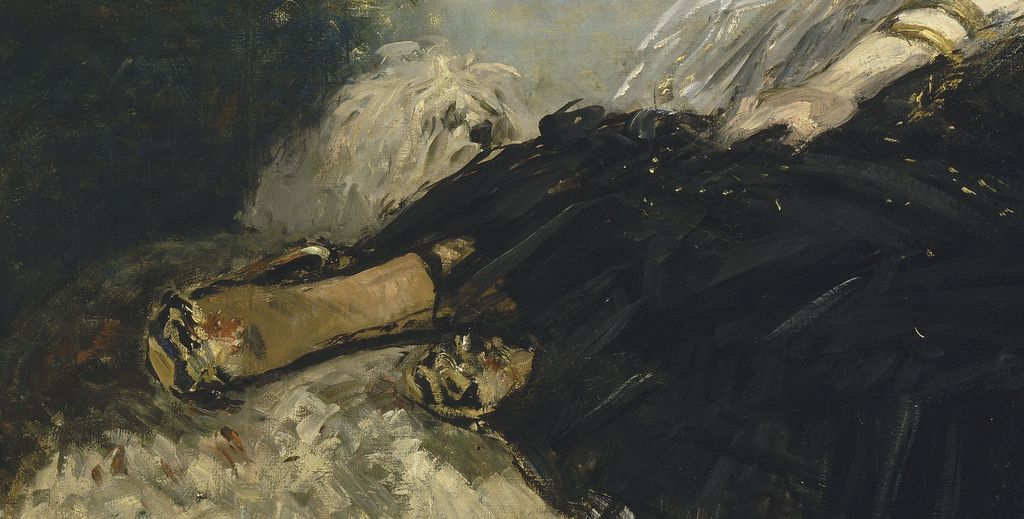
A small pale dog nestles near the feet. Its shaggy head emerges between the black dress and the darker area behind the sofa. The dog is easy to overlook beside the brighter slippers, but its compact shape gives this end of the composition a second point of attention. The scattered light marks describing its coat differ from the broader folds of fabric around it.
Face, Hand and Hat
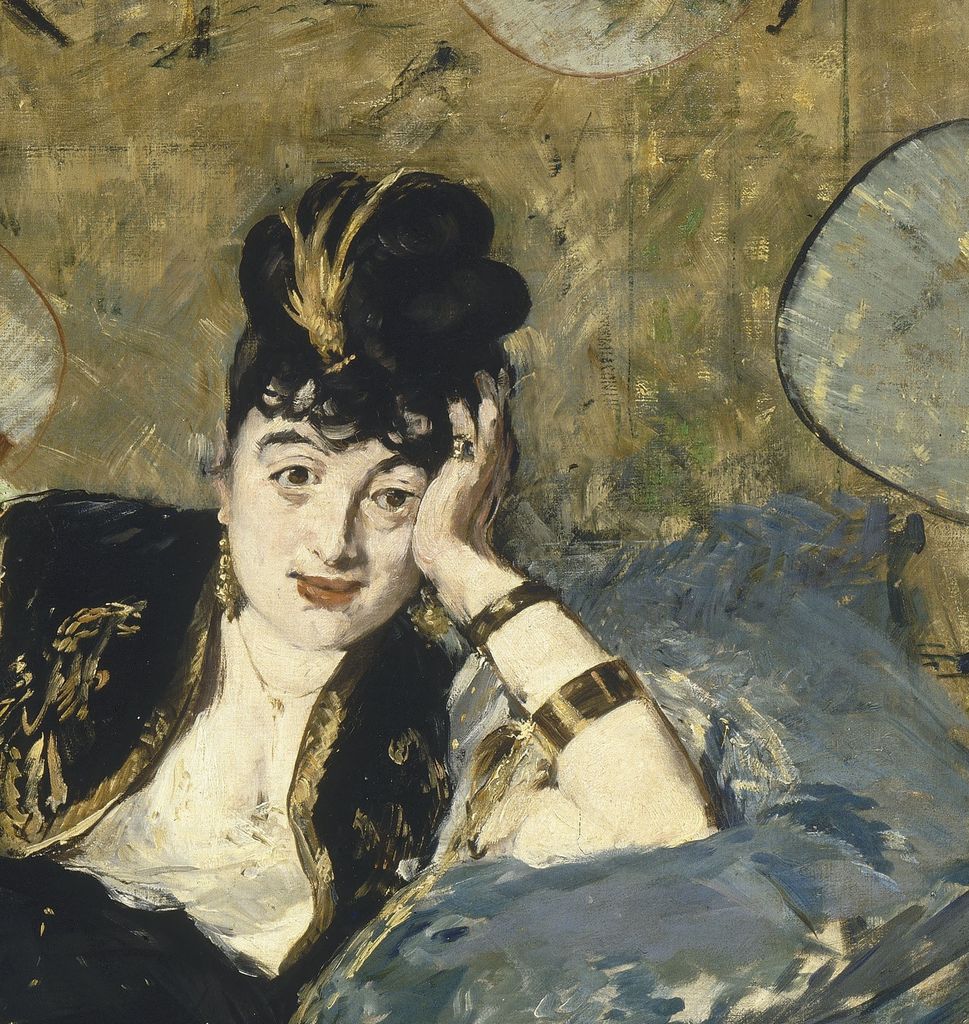
The face occupies a relatively small part of this large painting. Its pale oval becomes conspicuous because dark curls and the hat surround it. Small reddish touches define the mouth, while firmer dark marks establish the brows and eyes. Nina looks outward, maintaining contact with the viewer despite the sideways extension of her body.
Her hand cups the side of the head. The pale fingers and cheek come close together, separated by narrow shadows. Below them, dark and warm-coloured wrist bands interrupt the forearm. This succession of face, hand, wrist and elbow creates a more tightly articulated passage than the broad skirt below.
Above the forehead, the hat rises in an irregular dark mass. A warm plume breaks across it, carrying a little of the colour found elsewhere in the costume into the space above the face. Its upward movement counters the body's long horizontal direction.
Dark Clothing and Pale Cushions
The Musée d'Orsay describes Nina's clothing as an Algerian-style costume of the kind she liked to wear when receiving visitors.[1] A pale blouse opens beneath a dark jacket edged and patterned with warm, looping marks. These details distinguish the upper clothing from the much larger expanse of skirt.
Black has considerable variety here. Some passages appear solid black, while others admit cooler streaks that suggest folds. Scattered warm touches keep the dress from becoming a single uninterrupted silhouette. In its 2013 exhibition on painting and fashion, the Metropolitan Museum of Art placed Nina among examples of black clothing's association with worldly elegance.[3]
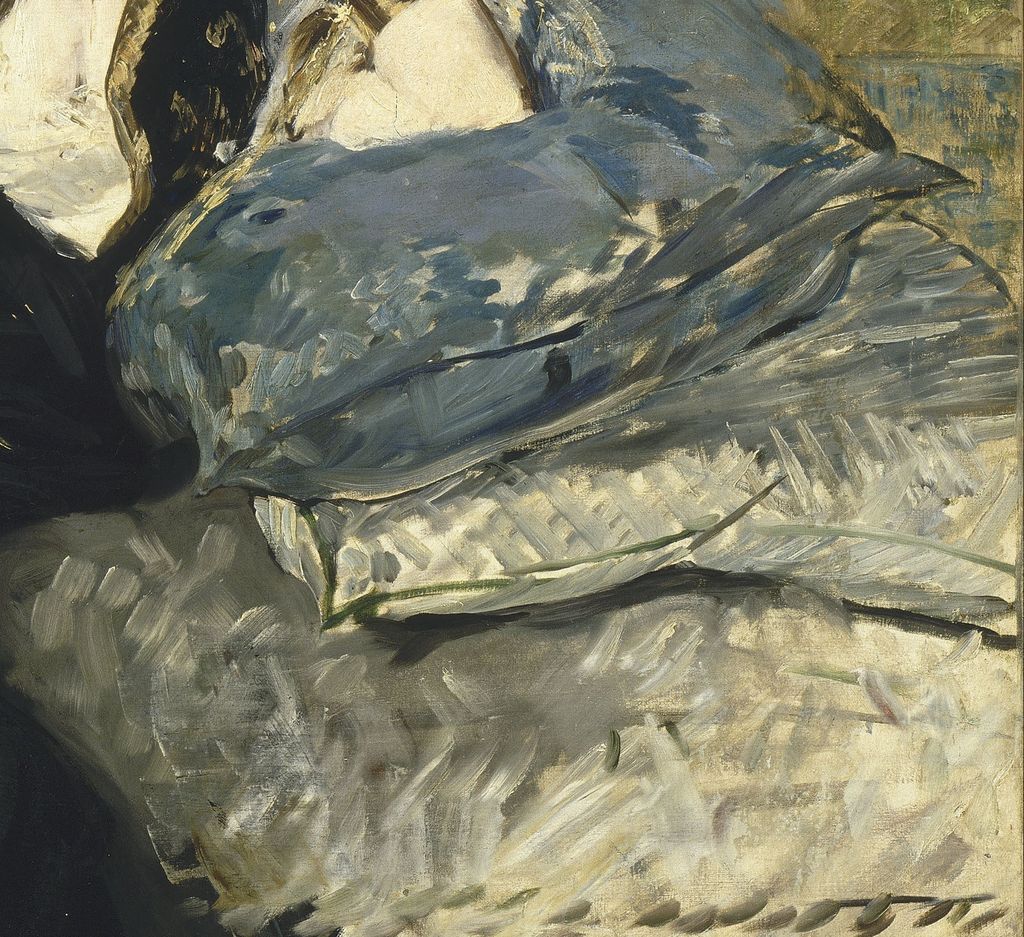
Around the figure, pale upholstery answers the darkness of the dress. Gray and blue strokes run through the white areas, changing direction where the fabric bunches or turns. At the right, a blue cushion projects beneath the elbow. Its pointed corner and broken pattern give a firmer shape to the otherwise loosely gathered cloth. These different textures are built from visible variations in the painted marks.
The Fans and the Studio Wall
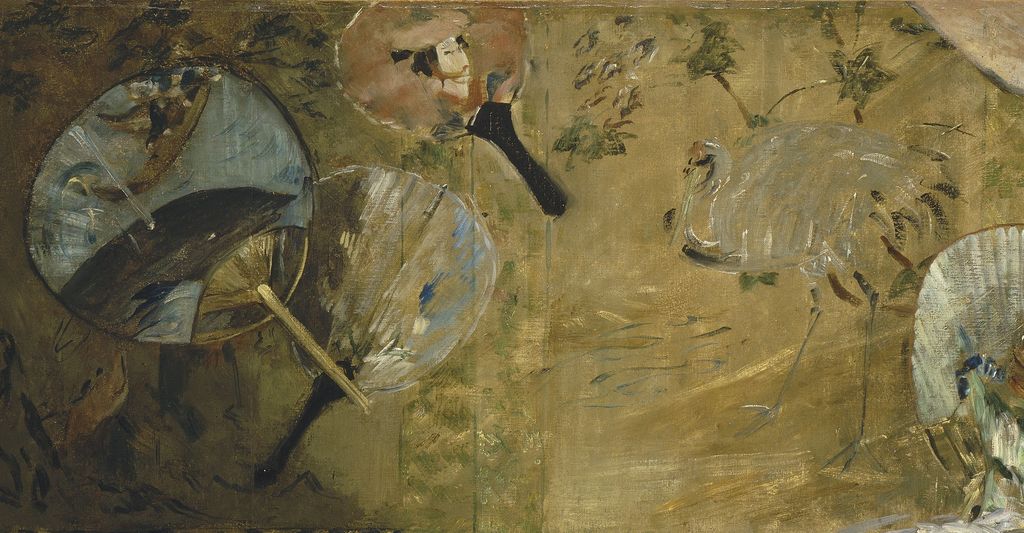
The fans occupy much of the upper half of the picture, where the body leaves a large space open. Their rounded forms spread across an ochre-green field. Some overlap, while others are cut by the upper or side edges. Dark handles give the pale shapes a direction, preventing them from reading simply as circles placed along the wall.
Within the fans, figures and patches of colour appear at different degrees of clarity. The larger decorative field is similarly restless, combining loose strokes with more recognizable motifs. A horizontal patterned band runs behind the sitter, separating this busy upper area from the lower setting of cushions and sofa.
Orsay identifies the wall hanging as part of Manet's studio and notes its appearance in Stéphane Mallarmé and Nana.[1] The repeated furnishing connects these different subjects with a setting the painter could arrange.
The museum treats the fans primarily as decoration rather than as an established emblem.[1] They also have a clear compositional role. Their pale, rounded surfaces distribute attention around the darker figure, while the irregular intervals between them preserve a sense of movement across the wall.
Annotated Details from The Lady with Fans
The numbered points identify visible features discussed in this article. Return from each detail to the whole composition. Édouard Manet, La Dame aux éventails (The Lady with Fans), 1873. Oil on canvas, 113 × 166.5 cm. Musée d’Orsay, RF 2850. Gift of M. and Mme Ernest Rouart, 1930. Musée d’Orsay; faithful reproduction via Google Art Project and Wikimedia Commons. Image source. Public domain. Numbers added to a separate overview. Four detail crops from the supplied faithful reproduction; no enlargement, recolouring or retouching.
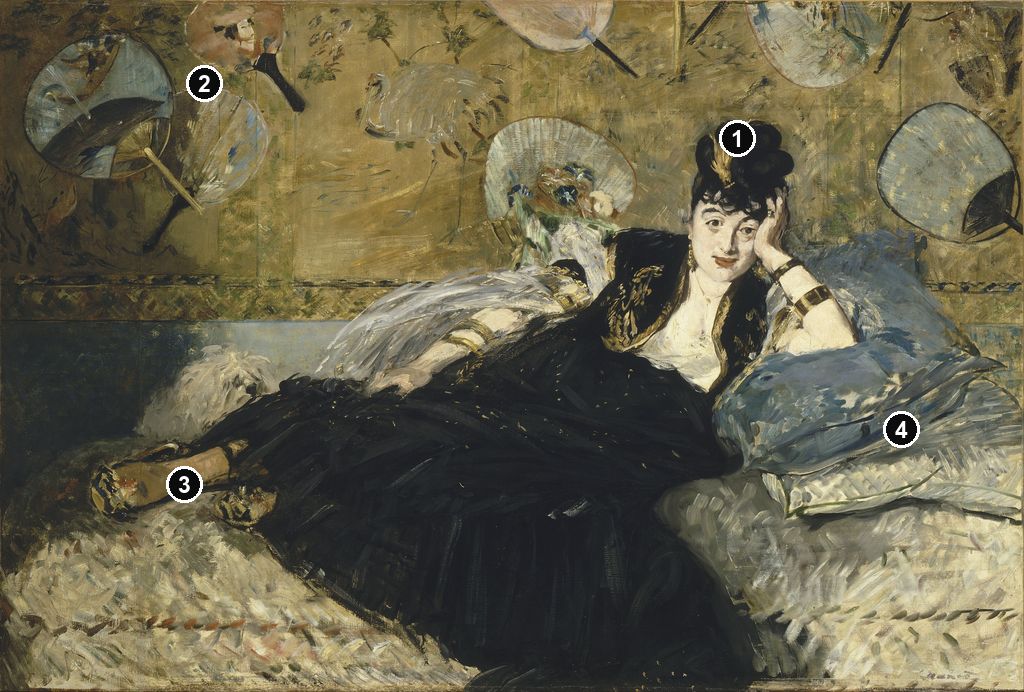
Details from THE LADY WITH FANS
Compare the face and raised hand with the fans above, then follow the reclining figure towards the dog, slippers and cushions.
The face, hand and hat
Dark curls and the hat surround the pale face. The bent hand meets the temple, with dark and warm-coloured bands crossing the raised wrist.
The fans on the wall
Overlapping round fans and their dark handles interrupt the warm decorative field. Looser marks continue between the more clearly outlined shapes.
The dog and slippers
The small pale dog rests beside the dark skirt. Warm slippers extend towards the left, standing out against the pale upholstery.
The blue cushions
A blue cushion supports the elbow. Its pointed corner and broken pattern meet the gray and blue strokes in the pale cloth below.
Nina as a Parisienne
Another image presents Nina in fashionable Parisian dress. La Parisienne II, a wood engraving by Alfred Prunaire after Manet's design, dates from 1873–74. The Bibliothèque nationale de France records an impression in which a fan bearing a Japanese figure appears beside the sitter.[4]
Here, the view is closer. Nina wears a dark dress with a pale ruff and a tall hat; one arm bends behind her head. Patterned upholstery surrounds her, but the single fan offers a simpler counterpart to the crowded wall in the oil painting. The contrast makes the different clothes and framing especially noticeable.
The two images bring the same named woman into different arrangements of costume and decoration. In the canvas, her body extends across a large horizontal space, with the dog and slippers completing the reclining figure. In the print, the face, hat and lifted arm become more concentrated features.
From the Studio to the Museum
According to Orsay's account, Manet kept the painting in his studio and did not exhibit it during his lifetime. It appeared in the retrospective held in 1884, the year after his death.[2]
The painting entered the French national collections in 1930 as a gift from M. and Mme Ernest Rouart. Initially assigned to the Louvre, it later belonged to the collection displayed at the Jeu de Paume before its assignment to the Musée d'Orsay in 1986.[1]
Artworks directory
Explore selected paintings, drawings and prints by Édouard Manet. Search by title or another recorded name.
Frequently Asked Questions
The painting belongs to the Musée d'Orsay in Paris, under inventory number RF 2850. It entered the French national collections through the Rouarts' gift in 1930.[1]
Orsay's exhibition account says that he kept it in his studio. It appeared at the retrospective held in 1884, after his death.[2]
Discussion
Look again at the images and ideas explored in The Lady with Fans by Édouard Manet. These editorial prompts invite your observations.
Reader Insights
Follow the two arms in different directions. How do they connect the face with the long sweep of the skirt?
Compare the marks in the black dress, pale upholstery and blue cushion. Which changes describe folds, and which describe pattern?
Look at their handles, overlaps and cropped edges. How do these details vary the rhythm of their rounded shapes?
Join the Conversation
Share a detail, comparison or question about The Lady with Fans by Édouard Manet below.
References
- Musée d'Orsay, La Dame aux éventails, 1873, RF 2850, collection record, commentary and provenance. French. View source.
- Musée d'Orsay, La dame aux éventails — Nina de Callias, modèle de Manet, exhibition presentation, 18 April–16 July 2000. French. View source.
- The Metropolitan Museum of Art, Galleries Three and Four—The White Dress and the Black Dress, Impressionism, Fashion, and Modernity, 2013. View source.
- Bibliothèque nationale de France, La Parisienne II [Nina de Callias], Alfred Prunaire after Édouard Manet, 1873–74, catalogue record and impression ESTNUM 2022-2512. French. View source.
- Splash image, Édouard Manet, La Dame aux éventails (The Lady with Fans), 1873. Oil on canvas, 113 × 166.5 cm. Musée d’Orsay, RF 2850. Gift of M. and Mme Ernest Rouart, 1930. Musée d’Orsay; faithful reproduction via Google Art Project and Wikimedia Commons. Image source. Public domain. Whole supplied image resized without cropping or enlargement; no recolouring or retouching.


