



 by Tom Gurney
Tom Gurney BSc (Hons) is an art history expert with over 20 years experience
Published on June 19, 2020 / Updated on October 30, 2026
Email: tomgurney1@gmail.com / Phone: +44 7429 011000
The Bugler by Édouard Manet: Introduction
A brass instrument stretches towards the left, its narrow mouthpiece meeting a face beneath a red cap. The figure’s dark blue coat occupies much of the canvas, surrounded by broad grey and beige strokes. In Édouard Manet’s The Bugler, the poised instrument and turned head give a loosely painted figure a clear, concentrated action.
The Dallas Museum of Art identified the painting as The Bugler, dated 1882, in a publication from 2012. Its caption recorded a loan from the Pauline Allen Gill Foundation, numbered 57.2006.8.[1] The French title Le Clairon likewise places the musician’s instrument at the centre of the subject.
At a Glance
- ArtistÉdouard Manet
- TitleThe Bugler / Le Clairon
- Date1882.[1][2]
- MediumOil on canvas.[2]
- Published collection recordDallas Museum of Art, 2012: lent by the Pauline Allen Gill Foundation, 57.2006.8.[1]
- Catalogue numberRouart and Wildenstein 392.[2]
This work across Édouard Manet’s career
Contents
- A Red Cap above a Turned Face
- Mouthpiece, Tubing and Bell
- Red Cords across the Bent Arm
- Blue Coat, Belt and Lower Hand
- A Figure among Diagonal Strokes
- A Professional Model and a Sketched Figure
- Beside The Fifer
- Collection History and the Dallas Record
- Annotated details
A Red Cap above a Turned Face
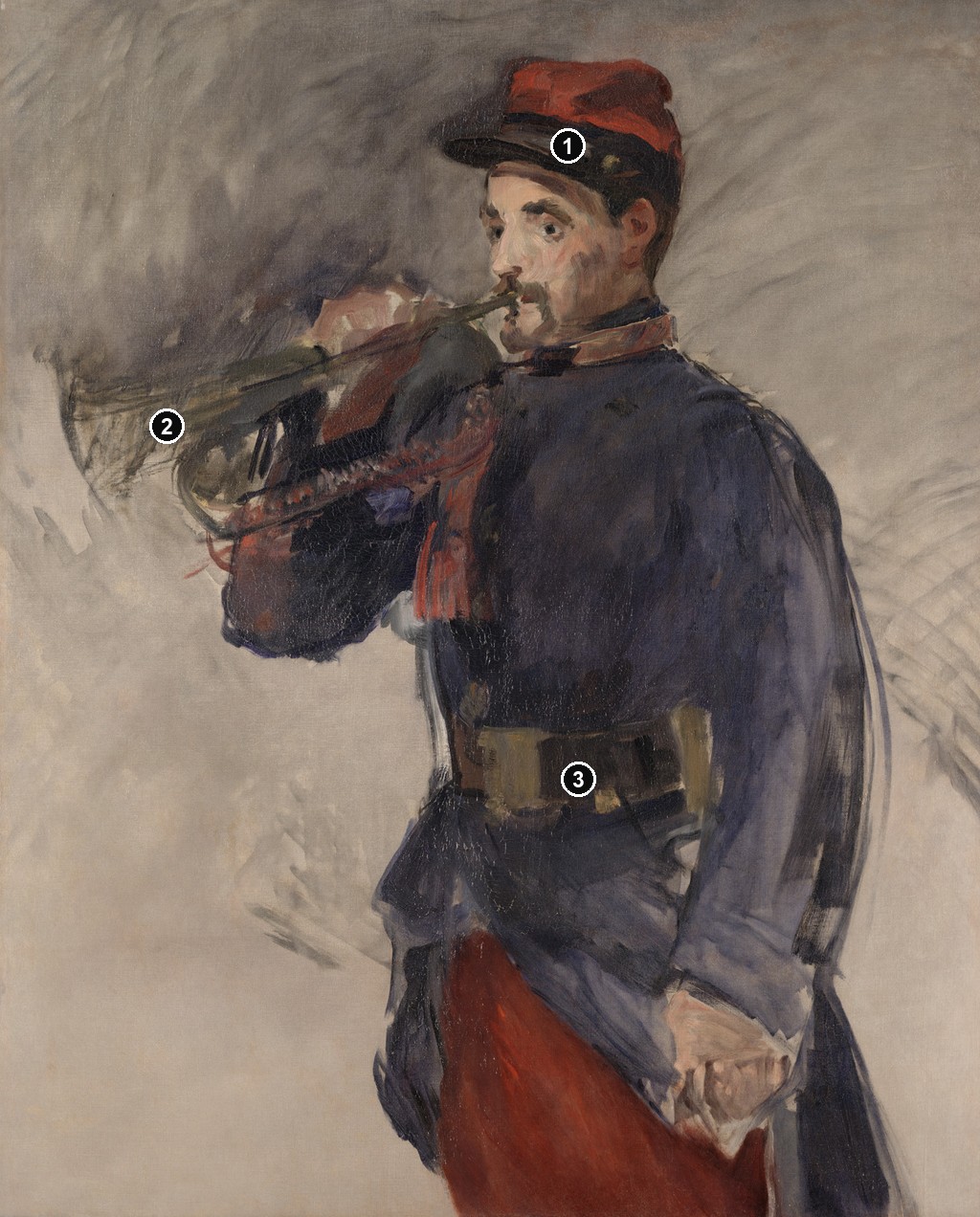
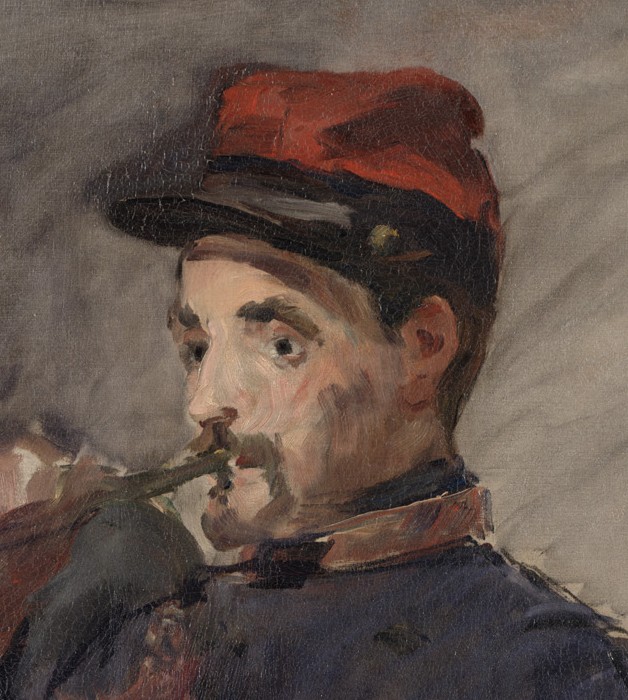
The cap combines a broad red crown with a dark band and projecting peak. Black and brown strokes overlap beneath the red, making the lower part look heavier than the brighter upper shape. A small warm-coloured mark appears near the temple, where the dark cap meets the hair.
Below it, the forehead slopes towards the nose, and the mouth presses close to the instrument. The head turns to the left, while the nearer eye looks outward.
The features emerge through distinct touches of paint. Dark eyebrows contrast with the light forehead; warmer pink marks appear beside the nose and cheek. Brown and grey shapes surround the mouth and chin. The ear remains visible on the right, between the cap and the rising collar.
The collar forms a narrow boundary beneath the face. Its warmer edging separates the light neck from the dark blue torso, helping the head remain distinct within the larger mass of the uniform.
Mouthpiece, Tubing and Bell
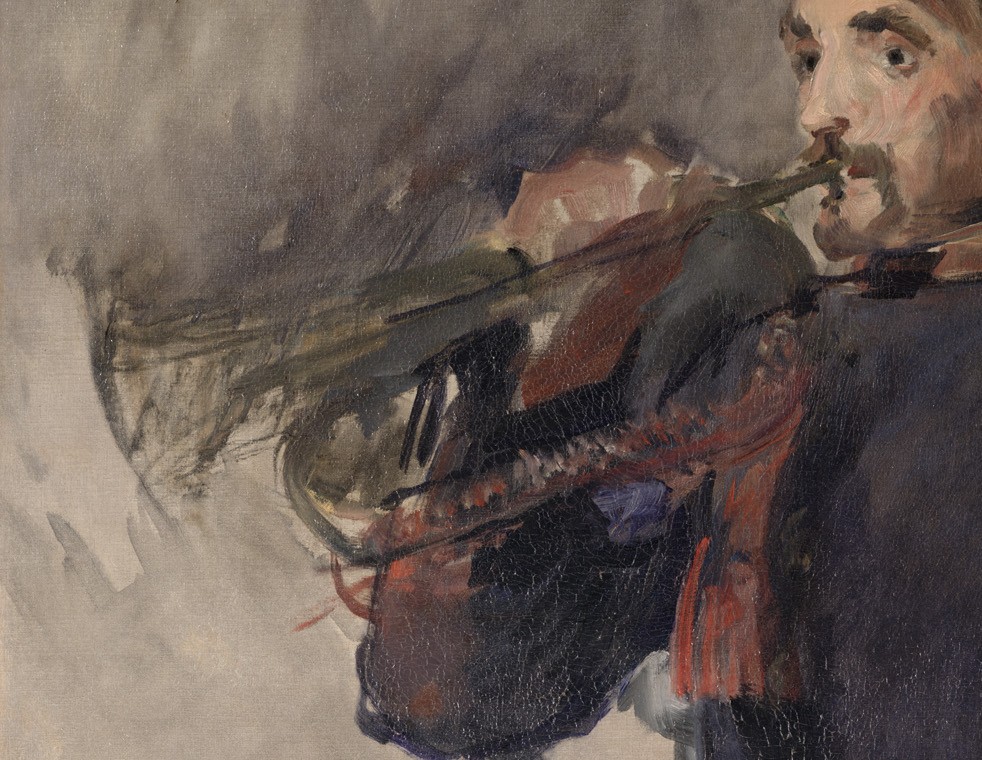
The bugle connects that compact head to a much wider area on the left. Starting at the lips, a narrow length of tubing runs across the raised hand towards the flared bell. Beneath it, another curve turns back towards the body. The instrument’s loop encloses a dark opening above the bent arm.
Its painted colour varies from muted green-brown to warmer yellow and pale highlights. Long strokes follow the tubing, while shorter marks interrupt the bell’s widening surface. At the far left, the opening is described by a curved dark edge and a cluster of lighter strokes. The bell approaches the edge of the canvas but remains inside it.
The raised hand appears behind the upper tube. Light, angular touches suggest fingers curling around the instrument, with warmer red passages beneath. These small forms bring the musician’s body into contact with the brass, linking the broad painted sleeve to the much narrower mouthpiece.
The instrument also establishes a strong direction across the composition. Its upper tube draws the eye from the face towards the left, while the lower loop returns attention to the arm and chest.
Red Cords across the Bent Arm
Red cords run below the instrument and across the raised arm. Their thin lines stand out against the darker sleeve, sometimes separating into individual strokes and sometimes gathering into denser passages. Near the chest, they end in a hanging tassel with a pale lower edge.
The cords introduce a different kind of line from the bugle’s relatively firm tubing. They curve and dip around the arm, with loose ends extending into the lighter background. Their red connects the upper body with the cap above and the trousers below.
Blue Coat, Belt and Lower Hand
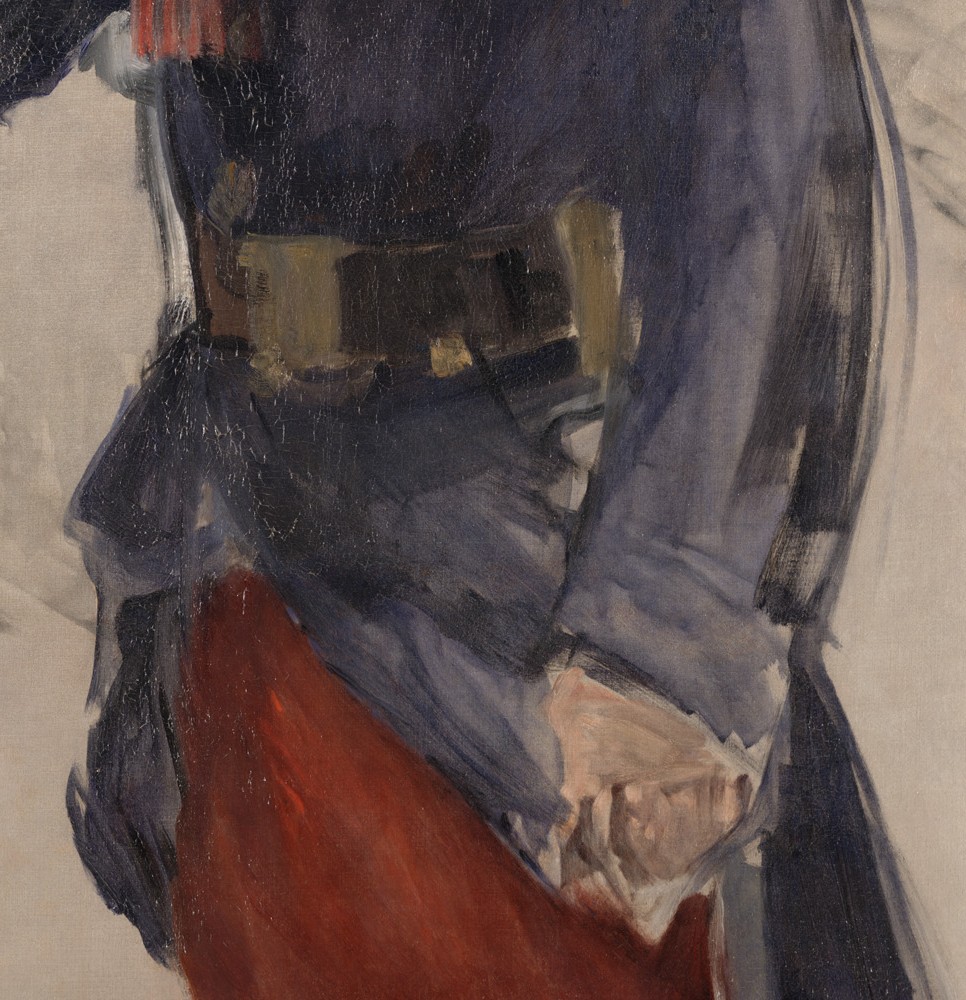
The coat provides the painting’s largest dark form. Blue, black and grey passages describe the chest and the long sleeve on the right. Some strokes follow the arm’s downward direction, while others cross the torso more obliquely. The outline changes from a comparatively firm shoulder curve to more broken marks near the lower coat.
A belt cuts across the waist. Its dark band carries several lighter rectangular shapes, with warm brown and yellow touches suggesting fittings. This horizontal interruption gives the torso a clear division before the coat opens over the red trousers.
The lower hand forms a pale patch near the right hip. Broad strokes describe the knuckles and curled fingers around a light folded shape, which creates a sharp change beside the blue sleeve and red fabric.
The two hands occupy very different positions. One is raised and partly concealed by the instrument; the other hangs low and is more exposed against the clothing. Together they give the pose its asymmetry, balancing the projecting bugle with a quieter form near the opposite lower corner.
A Figure among Diagonal Strokes
The surrounding field offers little indication of a specific setting. Grey, beige and darker brown strokes move diagonally around the figure, particularly beside the cap, shoulder and bell. Some overlap loosely, while other passages leave a more open, light-coloured area.
The background changes the emphasis of the silhouette. On the right, a long dark contour distinguishes the sleeve from the pale field. Beside the instrument, darker strokes make the surrounding space more active and the edge of the bell less isolated. The figure appears through these shifting relationships between solid clothing, thin lines and open areas.
The lower framing is close. The trousers and coat continue beyond the canvas, leaving the head, arms and instrument to establish the pose. With no feet or definite ground line in view, the painting concentrates on the upper body and the act of holding the bugle.
A Professional Model and a Sketched Figure
Denis Rouart and Daniel Wildenstein’s 1975 catalogue lists the painting as Le Clairon, number 392, and describes it as sketched in 1882 after a professional model.[2] That statement identifies the sitter’s role in the making of the image; the uniform and instrument give him the part represented within it.
The description also suits the visible differences in handling. The face contains closely placed, contrasting touches, while the coat and background spread into broader strokes. The instrument joins long lines with more open passages around its bell.
Beside The Fifer
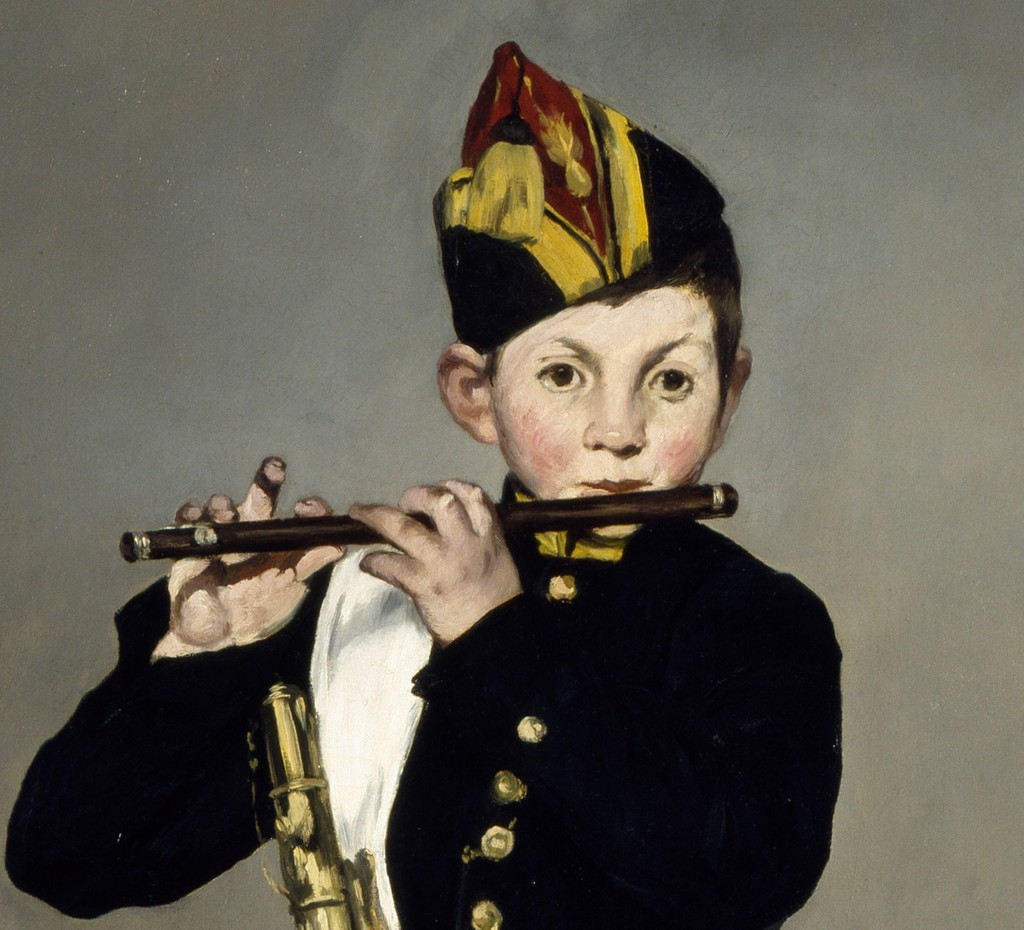
Manet had painted another uniformed musician in The Fifer in 1866. The Musée d’Orsay identifies that work as an oil on canvas, inventory RF 1992, showing an anonymous military child. Its commentary stresses the simplified dark areas of the clothing and the shallow grey setting.[3]
The two paintings invite a comparison of instruments and framing. The fifer stands full length, facing almost directly towards the viewer, with a slender transverse flute across his mouth. His shoes and separated feet establish the bottom of the figure. The bugler is seen more closely, with a turned torso and an instrument whose loop and flared bell occupy a much larger space.
Red and dark clothing appear in both works, but their distribution differs. The fifer’s red trousers extend towards the shoes, while a light diagonal sash crosses his body. In The Bugler, red cords gather around the bent arm and the blue sleeve descends towards the lower hand. Each composition makes the musician recognisable through a different arrangement of costume, gesture and instrument.
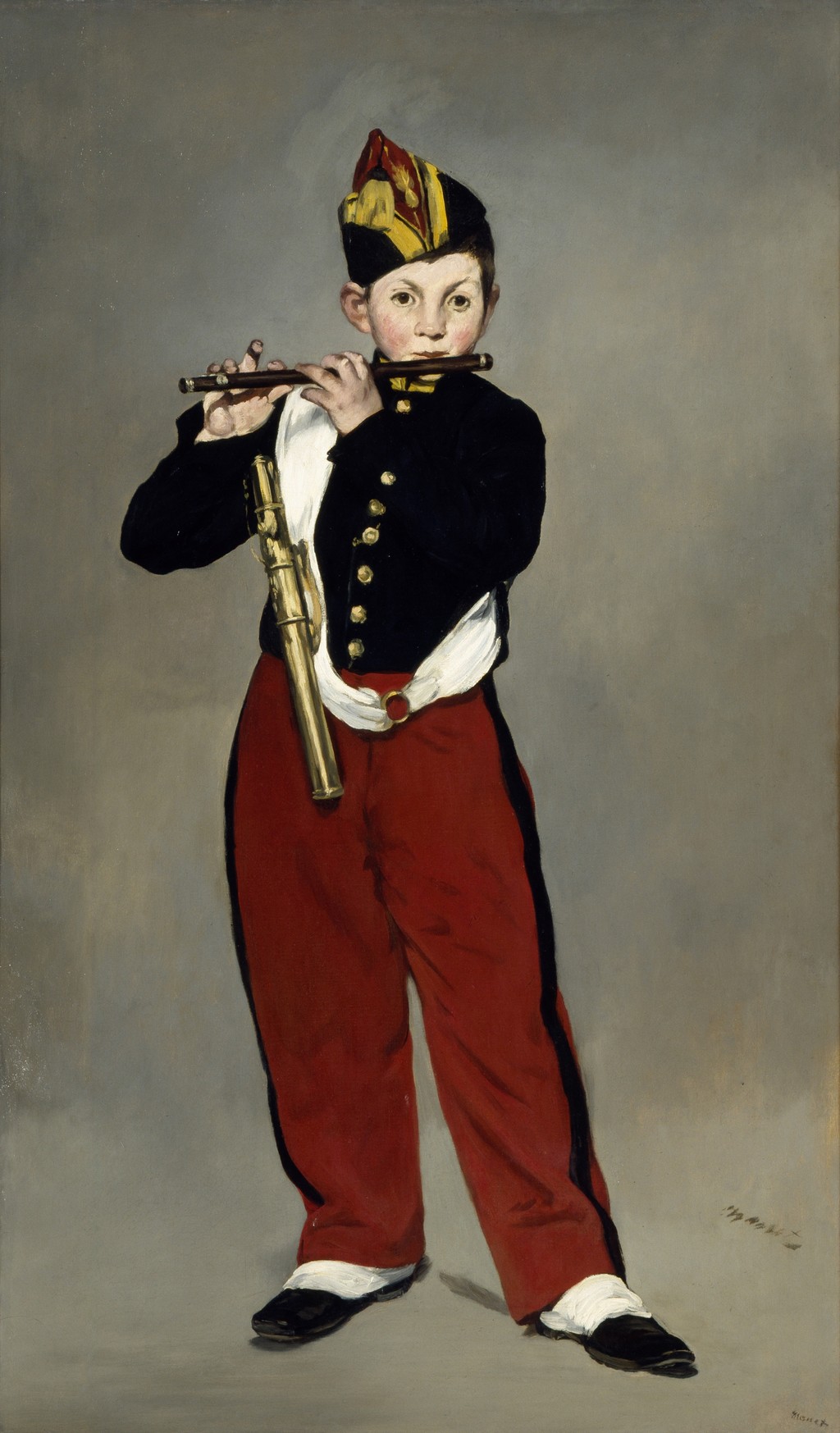
Édouard Manet, The Fifer (Le Fifre), 1866. Oil on canvas, 160.5 × 97 cm. Musée d’Orsay, Paris, RF 1992; bequest of Count Isaac de Camondo, 1911. The Yorck Project / DIRECTMEDIA, via Wikimedia Commons. Image source. Public domain.
Collection History and the Dallas Record
The 1975 catalogue’s provenance begins with Manet’s estate and then records the painting with George Moore, Sir Abdy and the dealer Hugo Perls. Its later entries include Guy Stein and Stanley N. Barbee, whose collection sale at Parke-Bernet in New York on 20 April 1944 listed the work as number 29.[2]
The Dallas Museum of Art’s 2012 publication gives the later documented connection with the Pauline Allen Gill Foundation through its loan credit.[1] The painting appeared there among works selected during a gallery exercise encouraging sustained looking and personal responses to art.
Annotated Details from The Bugler
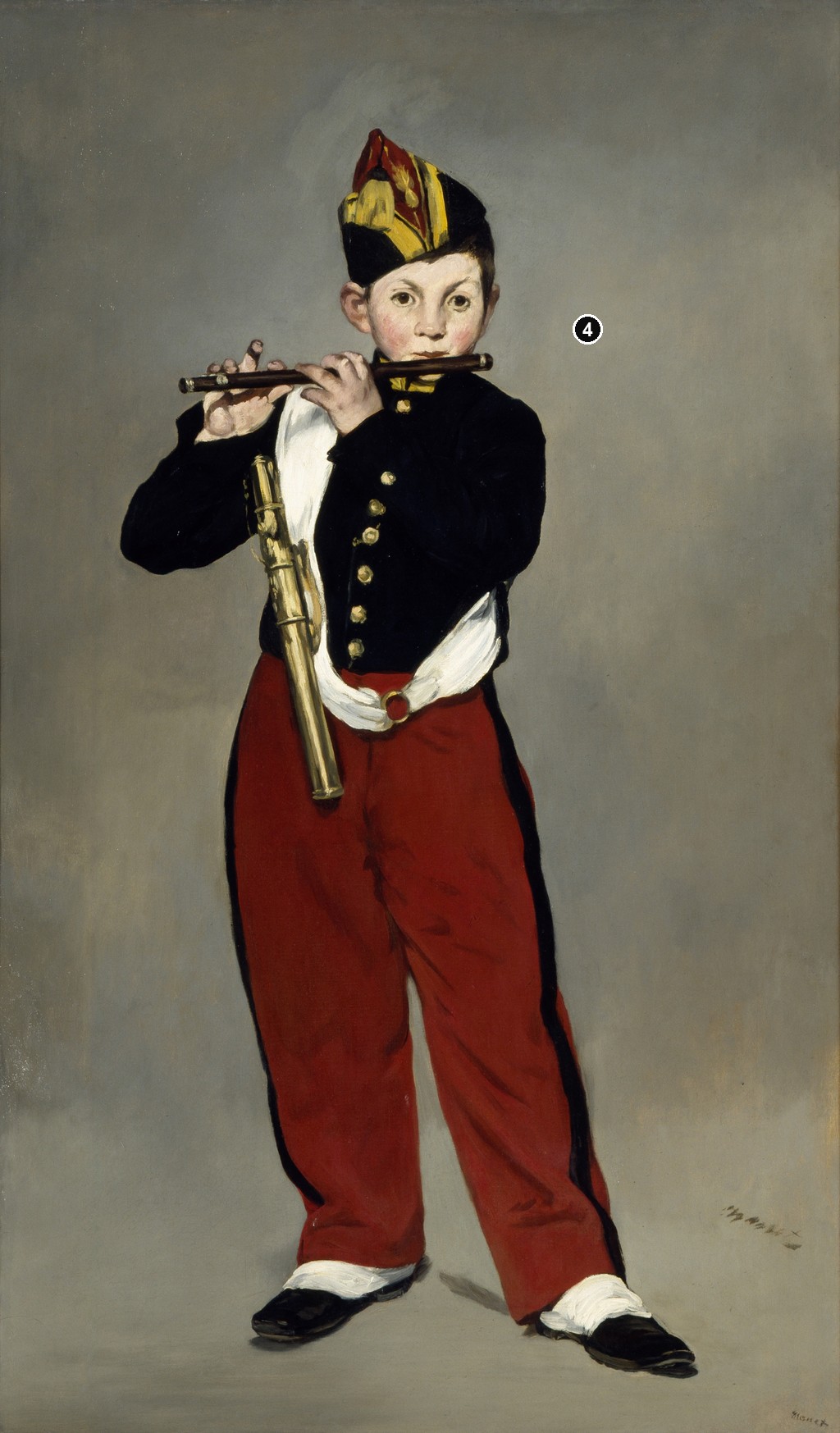
The numbered points identify visible features discussed in this article. Return from each detail to the whole composition. Each caption identifies the work shown.
The Bugler
Édouard Manet, The Bugler (Le Clairon), 1882. Oil on canvas. Recorded by the Dallas Museum of Art in 2012 as lent by the Pauline Allen Gill Foundation, 57.2006.8. Dallas Museum of Art; Pauline Allen Gill Foundation loan credit (2012); reproduction via Wikimedia Commons. Image source. Public domain.
The Fifer
Édouard Manet, The Fifer (Le Fifre), 1866. Oil on canvas, 160.5 × 97 cm. Musée d’Orsay, Paris, RF 1992; bequest of Count Isaac de Camondo, 1911. The Yorck Project / DIRECTMEDIA, via Wikimedia Commons. Image source. Public domain. Numbers added to a separate resized whole overview retaining the supplied edges and margins. Detail crops from the immutable original; no enlargement or retouching.
Details from THE BUGLER
Follow the numbered details back to the complete images above. Each caption identifies the work shown.
The Bugler
Cap, face and collar
The red crown rises above a dark band and peak. Beneath it, separate light and dark touches describe the face, while warmer collar edging separates the neck from the coat.
Bugle, hand and cords
The upper tube runs from the mouth towards the flared bell. The lower curve turns back above the bent arm, where red cords cross the dark sleeve and gather into a tassel.
Belt, sleeve and lower hand
Lighter rectangular shapes interrupt the dark belt. The long blue sleeve descends towards the pale lower hand and folded material beside the red trousers.
The Fifer
The Cap, Face and Fife
The decorated cap rises above the direct gaze. Pale fingers gather around the dark fife crossing the lower face.
Artworks directory
Explore selected paintings, drawings and prints by Édouard Manet. Search by title or another recorded name.
Frequently Asked Questions
Rouart and Wildenstein describe a professional model. Their entry does not give the sitter’s name.[2]
The Dallas Museum of Art recorded it in 2012 as lent by the Pauline Allen Gill Foundation, number 57.2006.8.[1]
Discussion
Look again at the images and ideas explored in The Bugler by Édouard Manet. These editorial prompts invite your observations.
Reader Insights
Follow the bugle from its bell to the mouthpiece. How do the tubing, raised hand and lips connect the large instrument to the small facial features?
Compare the cap, cords and trousers. How do their different sizes and shapes distribute colour around the figure?
Compare the closer framing of The Bugler with the full-length Fifer. How does seeing or concealing the feet change your sense of each pose?
Join the Conversation
Share a detail, comparison or question about The Bugler by Édouard Manet below.
References
- Shannon Karol, Dallas Museum of Art, “The Personal Response Tour,” 11 October 2012; complete short museum article, including the painting’s date, lender and loan number (in English). View source.
- Denis Rouart and Daniel Wildenstein, Édouard Manet: catalogue raisonné, tome I, 1975, p. 288, no. 392, Le Clairon, and facing plate on p. 289; complete bounded entry and plate through the Wildenstein Plattner Institute reader, pages 304–305 (in French). View source.
- Musée d’Orsay, Le Fifre, RF 1992; current object facts and collection commentary for the comparison (in French). View source.
- Splash image, Édouard Manet, The Bugler (Le Clairon), 1882. Oil on canvas. Recorded by the Dallas Museum of Art in 2012 as lent by the Pauline Allen Gill Foundation, 57.2006.8. Dallas Museum of Art; Pauline Allen Gill Foundation loan credit (2012); reproduction via Wikimedia Commons. Image source. Public domain.


