



 by Tom Gurney
Tom Gurney BSc (Hons) is an art history expert with over 20 years experience
Published on June 19, 2020 / Updated on October 30, 2026
Email: tomgurney1@gmail.com / Phone: +44 7429 011000
Dead Toreador by Édouard Manet: Introduction
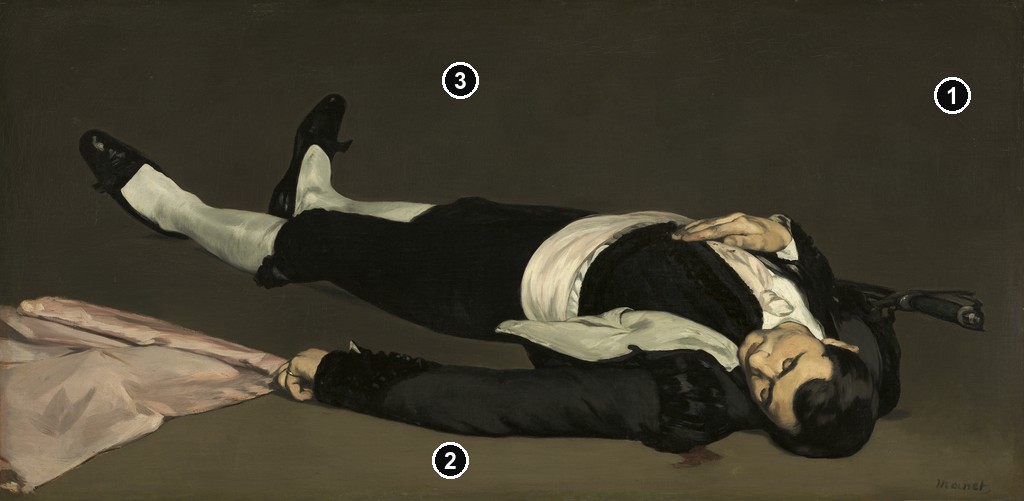
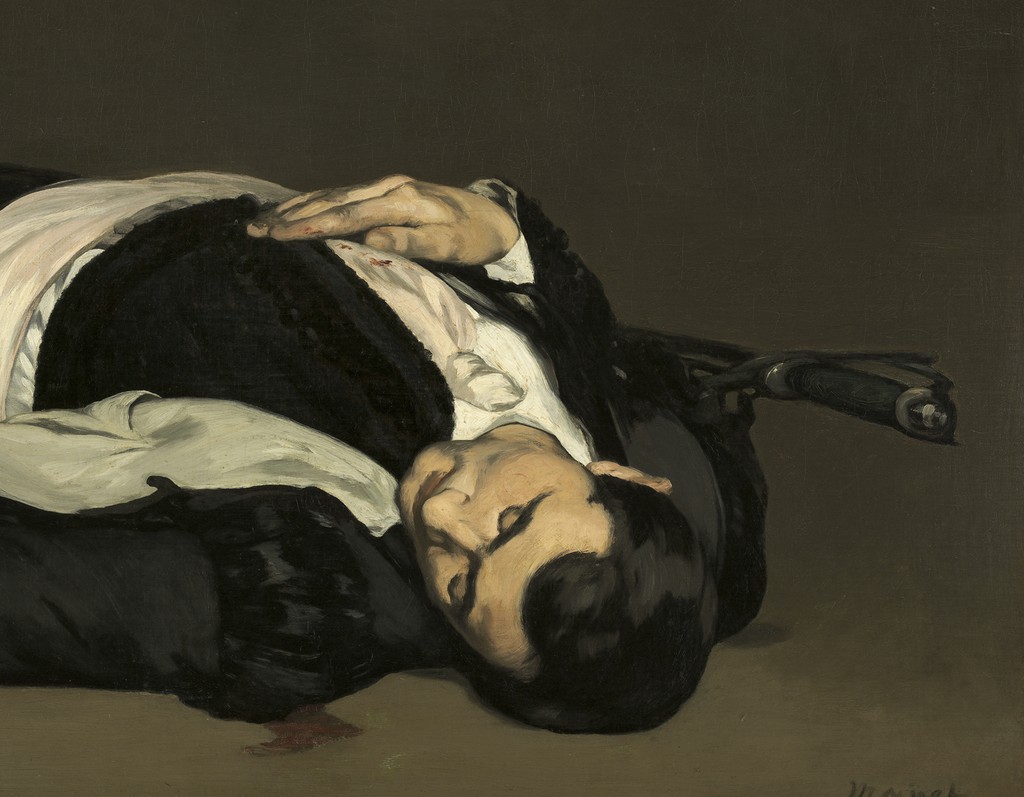
A bullfighter lies across almost the entire width of the canvas. His black shoes point towards the upper left, while his head falls close to the lower-right edge. One hand rests on his chest; the other reaches along the ground towards a pale pink cape. Around him, there is no crowd, no barrier and no visible bull.
Édouard Manet's The Dead Toreador, dated probably 1864 by the National Gallery of Art in Washington, is an oil painting measuring 75.9 × 153.3 cm.[1] Its apparent simplicity emerged from a much more crowded picture. Manet cut the figure from a large bullfight composition, then repainted its surroundings. The silence of the surviving work was made through that transformation.
At a Glance
- ArtistÉdouard Manet
- TitleThe Dead Toreador, also exhibited as L'Homme mort
- DateProbably 1864
- MediumOil on canvas
- Dimensions75.9 × 153.3 cm, height × width
- CollectionNational Gallery of Art, Washington
- Accession number1942.9.40
- CreditWidener Collection.[1]
This work across Édouard Manet’s career
Olympia
1863Dead Toreador by Édouard Manet (current article)
Probably 1864The Fifer
1866The Balcony
1868–69The Railway
1873Asparagus
1880Contents
- A Body Seen from Close to the Ground
- Black, White and Pale Pink
- The Larger Painting at the Salon of 1864
- Cutting and Repainting
- The Companion Fragment: The Bullfight
- What X-rays Reveal about the Lost Composition
- Spain Imagined before the Journey
- Zola on the Painting's Close Finish
- The Connection with A Dead Soldier
- The Dead Man in Etching and Aquatint
A Body Seen from Close to the Ground
The low viewpoint brings us unusually close to the fallen man. His head is nearer than his feet, and we see the dark crown of his hair before looking across the face turned towards his shoulder. The closed eyes and slack position of the limbs give the figure its stillness. He occupies the foreground so fully that there is little room to imagine stepping around him.
His body follows a diagonal, but its different parts resist becoming a single straight line. One leg extends towards the left corner. The other bends, raising a shoe into the darker field above the thighs. His near arm stretches almost horizontally along the lower part of the painting, while the far hand lies higher, against the chest. These changes of direction spread his weight across the canvas.
The pose also makes the distance from head to feet difficult to judge at first. The nearer face and shoulder are substantial, yet the legs turn away and rise towards the upper border. Manet combines a close encounter with a body receding into space. The shallow, almost featureless setting offers few other objects against which to measure it.
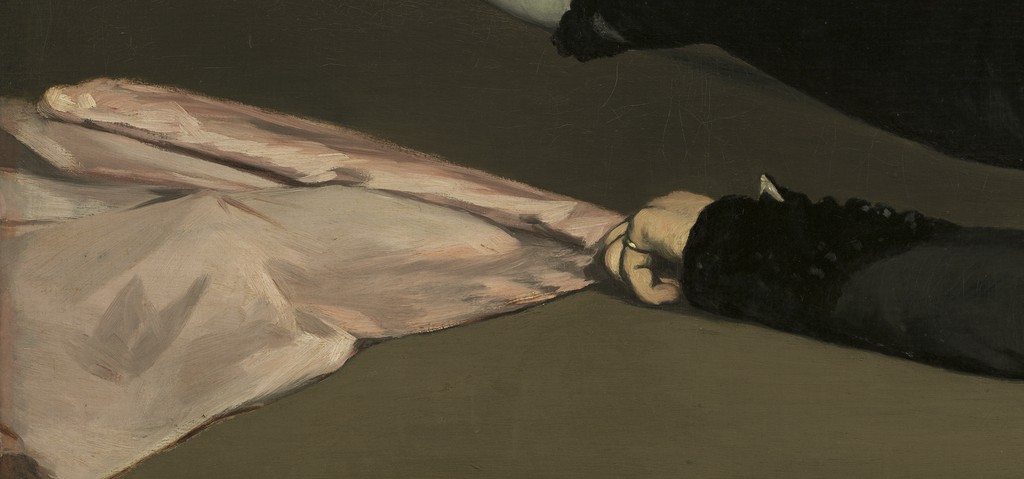
The exposed hands make this arrangement more intimate. A small gold ring catches the light on the hand beside the cape. The fingers at the chest are carefully distinguished, their warm colour set against the black jacket and white fabric. They retain the particularity of a person's hands even within the broad pattern of the costume.
The title identifies the man through his occupation and death. The painting gives us no named individual or account of the fatal encounter. Its attention stays with the fallen figure and the objects immediately beside him.
Black, White and Pale Pink
The black jacket and knee breeches form the largest dark mass. Their edges are clear against the ground, but the clothing is not a uniformly filled silhouette. Small changes of tone describe folds, sleeves and the rounded shoulder. Light catches the shoes at the opposite end of the body, linking those remote, polished surfaces with the more softly painted hair.
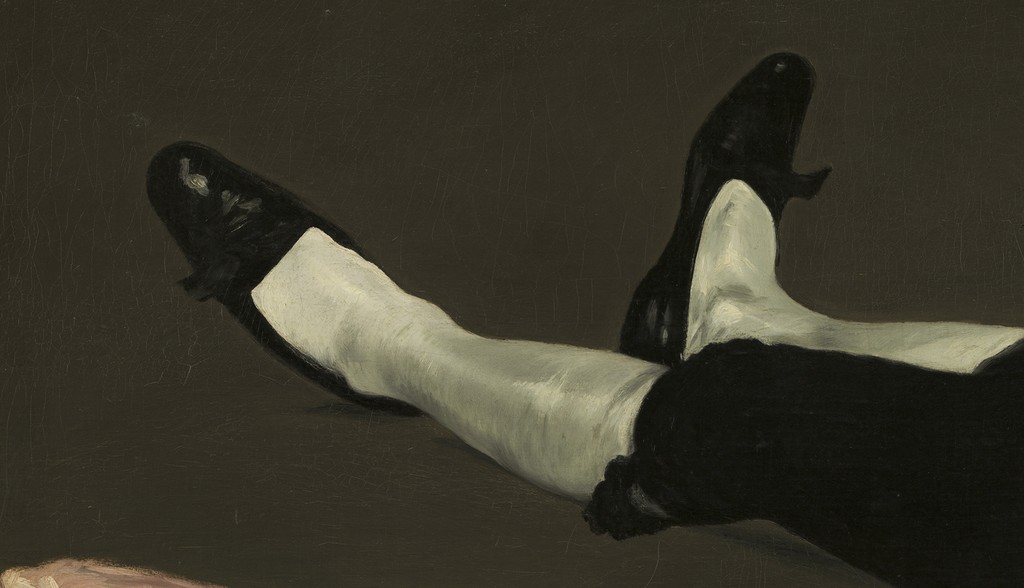
White cloth crosses and interrupts the black. The stockings make the legs unusually conspicuous, while the broad sash curves around the waist. Shirt and jacket lining gather nearer the head. Each white area changes character: the stockings follow the limbs closely, the sash wraps the torso, and the loose lining opens out beside the extended arm.
Cream, grey and pale warm strokes give these fabrics substance. Their brightness helps establish the body's separate parts without requiring a strongly described arena around them. The eye can move from feet to waist to chest through the white passages, then return along the dark sleeve towards the hand.
The cape adds a third, quieter colour. Its pale pink fabric spreads into the lower-left corner in broad, uneven folds. It lies beside the outstretched hand, its soft surface contrasting with the taut stockings and gleaming shoes. The cape also carries the composition beyond the body, joining the nearer hand to the edge of the picture.
Blood appears sparingly. There are small red marks around the hand and white fabric at the chest, and a darker patch beside the shoulder on the ground. A weapon's dark hilt is visible near the far elbow. These details establish violence without filling the foreground with its effects. The restraint leaves the large black-and-white figure dominant.
The Larger Painting at the Salon of 1864
The original composition was shown at the official Paris Salon in 1864 as Épisode d'une course de taureaux, usually translated as Incident in a Bullfight. Manet exhibited it alongside The Dead Christ with Angels.[2] Both works confronted viewers with a dead man, but the bullfight picture originally placed its body within a larger public spectacle.
Juliet Wilson-Bareau's catalogue account describes objections to the composition's perspective and relative scale: a bull appeared too small beside the toreros farther back.[2] The problem concerned the relationship between figures and their setting, rather than simply the realism of the dead man. Distances that should have been legible across an arena became a source of confusion and ridicule.
The work had passed the Salon jury and reached the exhibition. Its criticism therefore belongs to the reception of an accepted painting, rather than to the rejection that had sent Manet's pictures to the Salon des Refusés the previous year. Keeping those events separate makes the bullfight's subsequent transformation easier to follow.
After the Salon, Manet divided the canvas. The isolated dead man was exhibited at Galerie Martinet by February 1865, and appeared in Manet's own 1867 exhibition as L'Homme mort, or The Dead Man.[1] The change of title widened its emphasis: the costume still belongs to the bullring, but the remaining scene gives little attention to the spectacle itself.
Cutting and Repainting
The surviving painting resulted from more than cutting away unwanted canvas. Manet also changed what remained within its borders. Theodore Reff's published account describes the suppression of the bull and the repainting of the arena's yellow-tan ground in olive-green tones.[3] The dark emptiness above the figure is therefore part of the work's revision.
That change alters how the body can be read. In a crowded arena, a fallen bullfighter would be one participant in an unfolding event. Here, the eye has no competing action to follow. The surrounding field recedes through gradual changes of darkness, while the costume and flesh keep their more definite forms. What has been removed matters as much as what remains visible.
Criticism may have encouraged Manet to dismantle the original, but it does not provide a complete account of his decision. Reff also allows the possibility that the painter recognised a stronger image in the isolated figure.[3] The evidence establishes the transformation more securely than it establishes a single motive for it.
The Companion Fragment: The Bullfight
Another portion survives as The Bullfight in the Frick Collection, New York. The museum dates it 1864 and records its dimensions as 47.9 × 108.9 cm. It came from the upper part of the larger composition and, like The Dead Toreador, was reworked as a separate painting.[4]
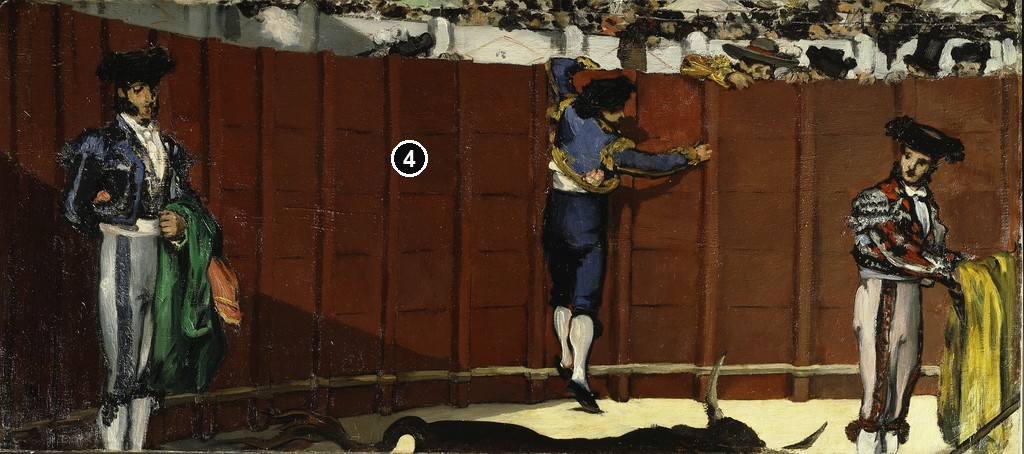
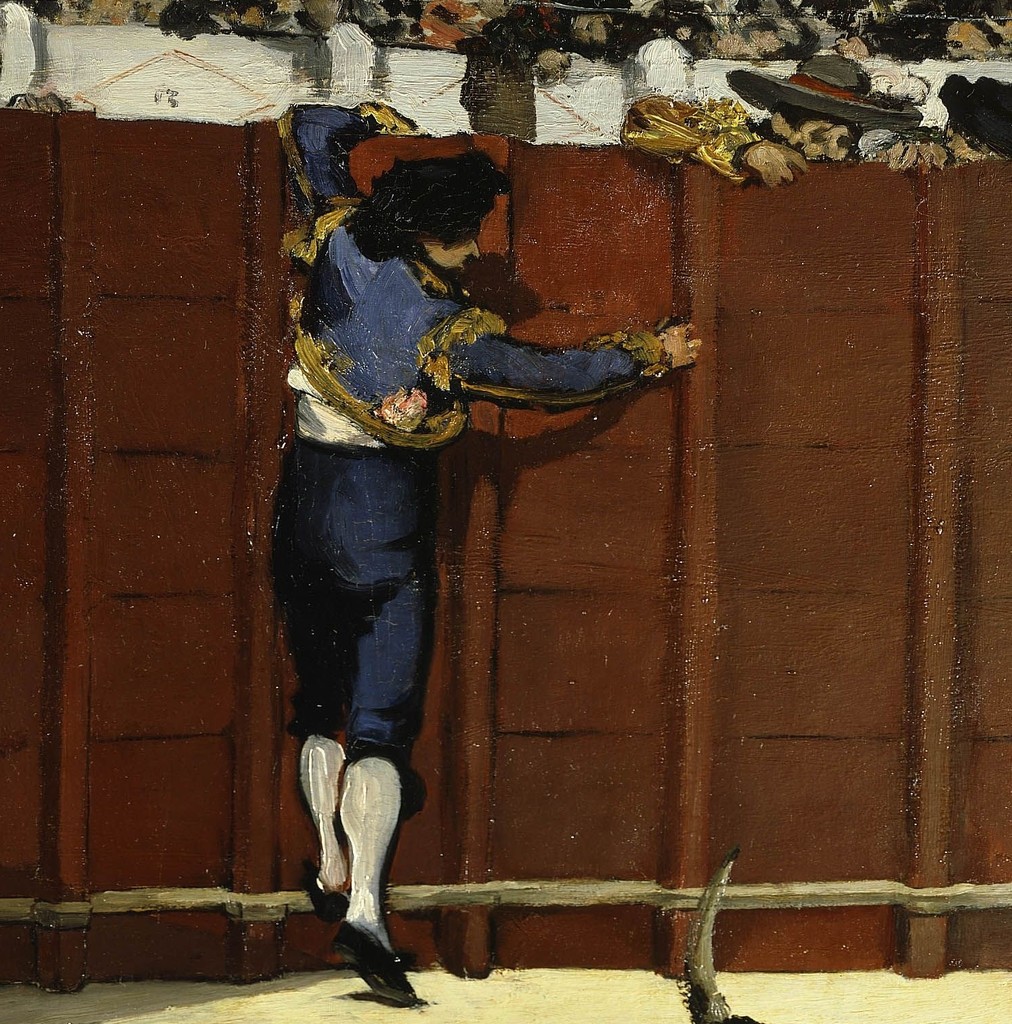
Three costumed men stand before a red-brown wooden barrier. Above them, spectators appear in quick touches of light and dark paint. Below, only parts of the bull remain within the picture: its dark body runs along the lower edge, with head and horns towards the right. The confined band of sand leaves little space between the figures and that abruptly interrupted animal.
The central man turns towards the barrier and raises an arm against it. The men at either side face more towards us, their decorated jackets and pale stockings punctuating the horizontal wall. Green and yellow fabrics introduce stronger colour accents than the muted cape beside the dead man. The standing figures are spread across the scene, each occupying a different position along the barrier.
The two paintings now organise attention in different ways. In the Frick work, the barrier, spectators and clipped bull keep the arena present. The men form a sequence across the canvas. In Washington, the single body occupies the space continuously, and the background offers no comparable architectural division. One retains the surrounding spectacle; the other concentrates on its human consequence.
Calling them the two halves of one painting can be misleading. The Frick section is narrower and came from above and to the right of the longer dead-man fragment. Both have been altered. Their present painted surfaces cannot simply be placed together to restore what Salon visitors saw.
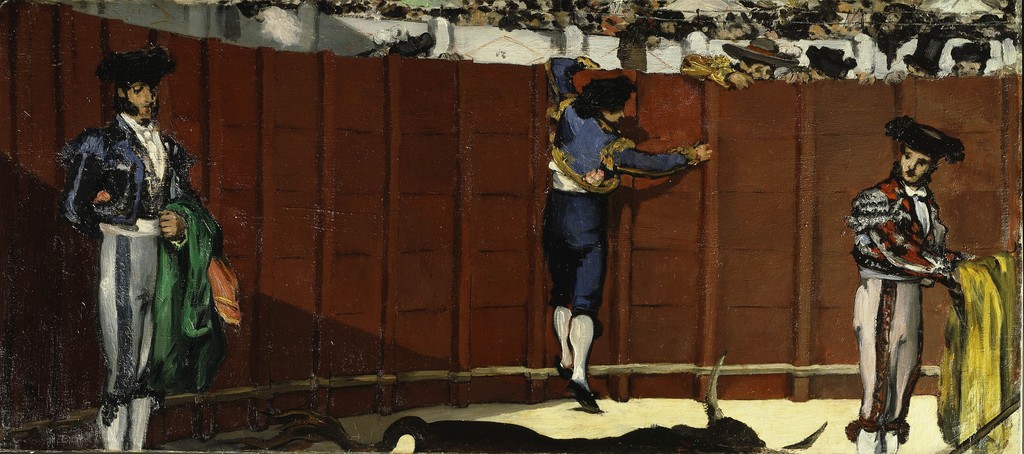
Édouard Manet, The Bullfight, 1864. The Frick Collection, New York, 1914.1.86. Revised companion fragment of the larger bullfight composition. The Frick Collection; faithful public-domain reproduction via Wikimedia Commons. Image source. Public domain. Whole supplied reproduction resized within native dimensions; no enlargement, retouching or colour alteration.
Annotated Details from The Dead Toreador: Body, Companion Fragment and Print
The numbered points identify visible features discussed in this article. Return from each detail to the whole composition. Each caption identifies the work shown.
The Dead Toreador — Painting
Édouard Manet, The Dead Toreador, probably 1864. National Gallery of Art, Washington, 1942.9.40. Widener Collection. National Gallery of Art, Washington; reproduction via Wikimedia Commons. Image source. CC0 / Public domain. Numbers added to a separate resized whole supplied overview. Detail crops from the unchanged original; no enlargement, retouching or colour alteration.
The Bullfight — Separate Frick Fragment
Édouard Manet, The Bullfight, 1864. The Frick Collection, New York, 1914.1.86. Revised companion fragment of the larger bullfight composition. The Frick Collection; faithful public-domain reproduction via Wikimedia Commons. Image source. Public domain. Numbers added to a separate resized whole supplied overview. Detail crops from the unchanged original; no enlargement, retouching or colour alteration.
Dead Toreador — Final-State Impression, 1905 Edition
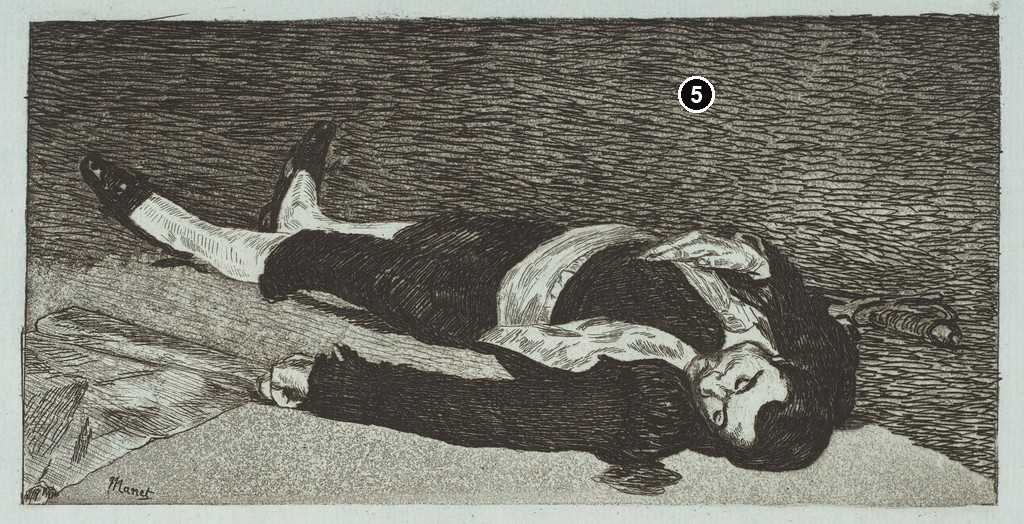
Édouard Manet, Dead Toreador, design 1867–68; impression from the posthumous 1905 Strölin edition, final state. Etching and aquatint on blue laid paper. The Metropolitan Museum of Art, New York, 21.76.10. Supplied image view; not a complete physical-sheet reproduction. Image source. CC0 / Public domain. Numbers added to a separate resized whole supplied image view; this is not a complete physical-sheet reproduction. Detail crop from the unchanged original; no enlargement, retouching or colour alteration.
Details from THE DEAD TOREADOR: BODY, COMPANION FRAGMENT AND PRINT
Look across the body, hands and shoes, then compare the separate Frick companion fragment and the Met’s final-state print impression.
The Dead Toreador — Painting
Head, Hat and Hand on the Chest
The face turns towards us beneath dark hair, while one hand lies above the chest and the black hat extends to the right.
Outstretched Hand and Pink Cloth
The extended arm leads to a closed hand beside pale pink folds at the edge of the composition.
Pale Stockings and Black Shoes
Pale stockings carry the legs towards two dark shoes set at different angles.
The Bullfight — Separate Frick Fragment
Climbing Figure and Red Barrier
In the separate revised companion fragment, a blue-clad figure reaches across the red barrier.
Dead Toreador — Final-State Impression, 1905 Edition
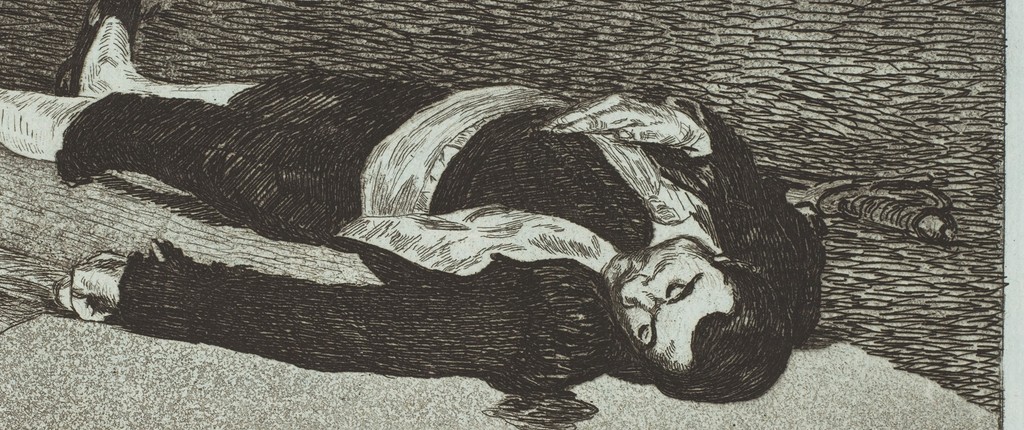
Head, Hands and Hat in the Etching
Dark lines reshape the head, two hands and hat in this separate final-state impression.
What X-rays Reveal about the Lost Composition
The relationship between the fragments became clearer through technical examination. In his 1982 catalogue, Reff published a composite X-ray photograph in which images of the two paintings were aligned at the same scale. Parts of the bull and earlier figures connect across their adjoining areas.[3] The concealed forms supply evidence that their present appearances alone cannot provide.
The Frick painting also contains an earlier arrangement with a mounted picador and smaller bullfighters. Reff explains that these discoveries once complicated its identification as a fragment. Bringing the two radiographic images together supported their shared origin, while also revealing how much Manet had changed the figures and setting.[3]
The technical evidence does not settle every stage. Reff explicitly leaves open whether some of the smaller figures were painted before or after the Frick portion was separated.[3] The distinction matters: a buried form can demonstrate revision without telling us the precise moment when that revision occurred.
The Frick's account of the fragments' 1999 reunion records a discarded central strip. It also notes that no photograph or reproductive print preserves the intact original; contemporary caricatures offer indications of its appearance.[5] Those satirical images help recover its general arrangement, but their exaggerations make them different from a faithful photographic record.
The original painting can consequently be discussed through surviving material, descriptions and caricatures, while its complete appearance remains uncertain.
Spain Imagined before the Journey
Manet painted the 1864 composition before visiting Spain. As the Frick's account explains, his interest in Spanish painting was already strong, including the work of Velázquez, Goya and Murillo.[4] The bullfight subject entered his art through that earlier fascination, before he could draw on experience of Madrid's arena.
His Spanish journey followed in 1865.[4] The Dead Toreador thus began within an imagined spectacle already shown in Paris. Its costume and subject do not make it an eyewitness report of a particular death. Pictorial sources are especially important to discussions of the prone figure.
Zola on the Painting's Close Finish
Writing in 1867, Émile Zola singled out the dead man preserved from the bullfight composition. He compared its handling with Manet's Boy with a Sword, praising the detailed, closely worked quality of the painting.[6] This is a useful contemporary response to the fine distinctions visible in the hands, face and white costume.
Zola anticipated that the picture would appeal to viewers who liked to look closely, but preferred the bolder treatment of The Dead Christ with Angels.[6] He could admire the Toreador's care while finding more of Manet's daring elsewhere.
His account was written three years after the Salon showing of the intact composition. It concerns the surviving figure and its particular manner of painting, rather than reproducing the objections made to the original arena's perspective. The change in the work had also changed what a critic could discuss.
The Connection with A Dead Soldier
A frequently discussed comparison is A Dead Soldier, now in the National Gallery, London. During Manet's lifetime it was attributed to Velázquez. The museum currently catalogues it as seventeenth-century Italian, with its painter's identity unresolved.[7] Describing it simply as a Velázquez would confuse the attribution Manet's contemporaries knew with the judgement attached to the work today.
The older painting presents a dead man receding diagonally, with a hand laid against his chest. These affinities make the comparison more specific than a general resemblance between dark paintings. The National Gallery considers it probable that Manet saw the work in Paris, although that does not establish exactly how or when he encountered it.[7]
Its surrounding objects also create a different setting for death. The museum identifies a skull and bones, an extinguished lamp and fragile bubbles as reminders of life's brevity.[7] Manet's surviving picture has no comparable group of emblems. Costume, blood, cape and weapon keep its meaning attached to the figure and his profession, even after the arena has disappeared.
The Dead Man in Etching and Aquatint
Manet later returned to the isolated figure in printmaking. The Metropolitan Museum of Art dates its Dead Toreador design to 1867–68 and identifies its impression as part of the posthumous 1905 Strölin edition. It is an etching and aquatint on blue laid paper, in the final state, numbered VI.[8] The design's date and the edition's date describe different parts of the print's history.
The print keeps the painting's overall orientation, with feet at the left and head at the right. Its dense linear marks make the dark costume and surrounding field more visibly worked. The pale sash and stockings remain strong interruptions within this darkness, while the cape becomes a spread of fine lines and lighter tone.
A diagonal division separates the darker upper field from the lighter foreground. It follows the general direction of the body, giving the setting a more emphatic graphic structure than the oil's gradual changes of colour. The signature moves to the lower left. Familiar forms have been reconsidered through a medium whose lines and tonal areas remain conspicuous.
The Met records the plate as 15.2 × 22.4 cm, far smaller than the oil painting.[8] Its concentrated scale invites a different encounter with the pose and costume. It reproduces the subject of the isolated man, rather than preserving the lost arrangement of the entire bullfight.
The oil entered the National Gallery of Art through the Widener gift in 1942.[1]
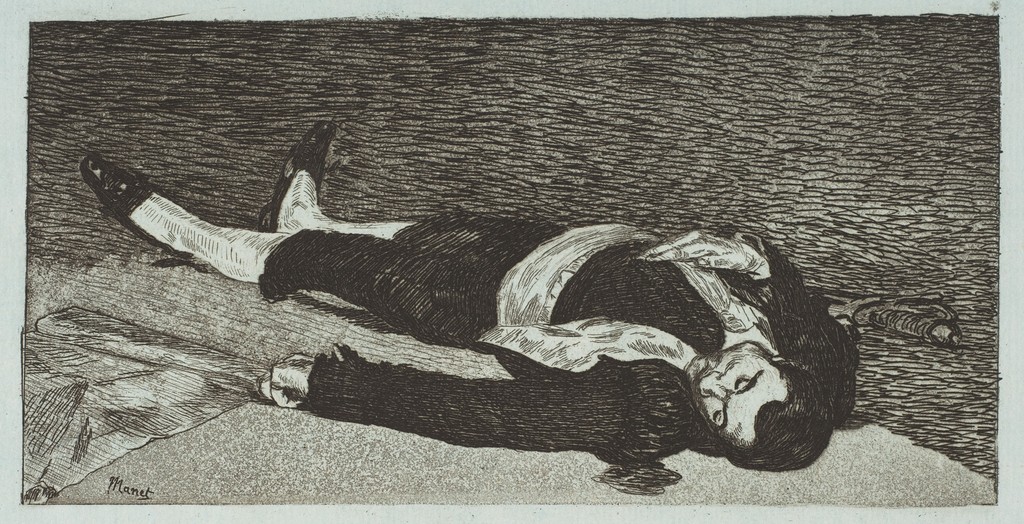
Édouard Manet, Dead Toreador, design 1867–68; impression from the posthumous 1905 Strölin edition, final state. Etching and aquatint on blue laid paper. The Metropolitan Museum of Art, New York, 21.76.10. Supplied image view; not a complete physical-sheet reproduction. Image source. CC0 / Public domain. Whole supplied reproduction resized within native dimensions; no enlargement, retouching or colour alteration.
Artworks directory
Explore selected paintings, drawings and prints by Édouard Manet. Search by title or another recorded name.
Frequently Asked Questions
The National Gallery of Art dates it to probably 1864.[1]
It belongs to the National Gallery of Art in Washington, Widener Collection, accession 1942.9.40.[1]
Discussion
Look again at the images and ideas explored in Dead Toreador by Édouard Manet. These editorial prompts invite your observations.
Reader Insights
Trace the body from the shoes at the left to the head at the right. Notice how its diagonal crosses the long, quiet field around it.
Compare the dark costume with the pale stockings, sash and pink cape. Which small changes of tone help separate one form from another?
Compare the isolated body with The Bullfight. Look at how the barrier and spectators organise the companion fragment, while keeping its later revisions in mind.
Join the Conversation
Share a detail, comparison or question about Dead Toreador by Édouard Manet below.
References
- National Gallery of Art, The Dead Toreador, probably 1864, 1942.9.40; current object details, visual description and exhibition history. View source.
- Juliet Wilson-Bareau, Dead Toreador, catalogue 141, in Manet/Velázquez: The French Taste for Spanish Painting, 2003, p.492; original Salon composition and early exhibition history. View source.
- Theodore Reff, Manet and Modern Paris, 1982, catalogue 77, pp.214–215, and catalogue 80, p.220; fragments, published composite X-ray, repainting and print development. View source.
- The Frick Collection, The Bullfight, 1864, 1914.1.86; object details, commentary from The Frick Collection: Essential Guide (2024), and audio commentary 239. View source.
- The Frick Collection, Schedule of Exhibitions: Winter 1999 to Winter 2000, press announcement, 1 March 1999, PDF p.4; section on the reunion of the Manet fragments. View source.
- Émile Zola, Édouard Manet: étude biographique et critique, 1867; passage discussing the 1864 exhibits and the surviving L'Homme mort (in French). View source.
- National Gallery, London, Italian: A Dead Soldier, seventeenth century, NG741; current attribution and commentary on the relationship with Manet. View source.
- Metropolitan Museum of Art, Dead Toreador, 1867–68, 21.76.10; 1905 Strölin edition, final-state etching and aquatint. View source.
- Splash image, Édouard Manet, The Dead Toreador, probably 1864. National Gallery of Art, Washington, 1942.9.40. Widener Collection. National Gallery of Art, Washington; reproduction via Wikimedia Commons. Image source. CC0 / Public domain. Whole supplied reproduction resized within native dimensions; no enlargement, retouching or colour alteration.


