


 by Tom Gurney
Tom Gurney BSc (Hons) is an art history expert with over 20 years experience
Published on June 19, 2020 / Updated on October 30, 2026
Email: tomgurney1@gmail.com / Phone: +44 7429 011000
Édouard Manet Drawings: Introduction
A cat curled into a ball, a few monks copied from an Italian fresco, a seated woman barely outlined in pencil: Manet's drawings give familiar subjects very different degrees of definition. Some sheets preserve a compact observation. Others develop an idea for another work, record something worth remembering or turn a letter into a small visual gift.
Manet worked across a broad range of graphic techniques. In its account of his drawings and pastels, the Musée d'Orsay describes a practice that extends from brief outlines to more developed images, using pencil, red chalk, ink, watercolour and pastel.[1] This variety matters because drawing served several purposes in his career. Looking closely at particular sheets helps distinguish their materials, their visual effects and the uses for which they may have been made.
At a Glance
- ArtistÉdouard Manet
- Principal graphic mediaGraphite and other pencils, red chalk, brush and ink, watercolour, gouache and pastel
- Uses explored hereObservation, copying, notebooks, preparation, portraiture and illustrated correspondence
- Useful distinctionsA drawing may be a study or a work in its own right; a printed image and an oil sketch have different material identities.[1]
Contents
- Looking at a Small Graphite Drawing
- Learning from Earlier Artists
- The Notebook as a Working Record
- A Separate Sketchbook Leaf
- A Drawing Intended for Graphic Reproduction
- A Plum in a Letter
- Pastel and the Collected Portrait
- Drawings by Manet and Portraits of Manet
- Annotated details
Looking at a Small Graphite Drawing
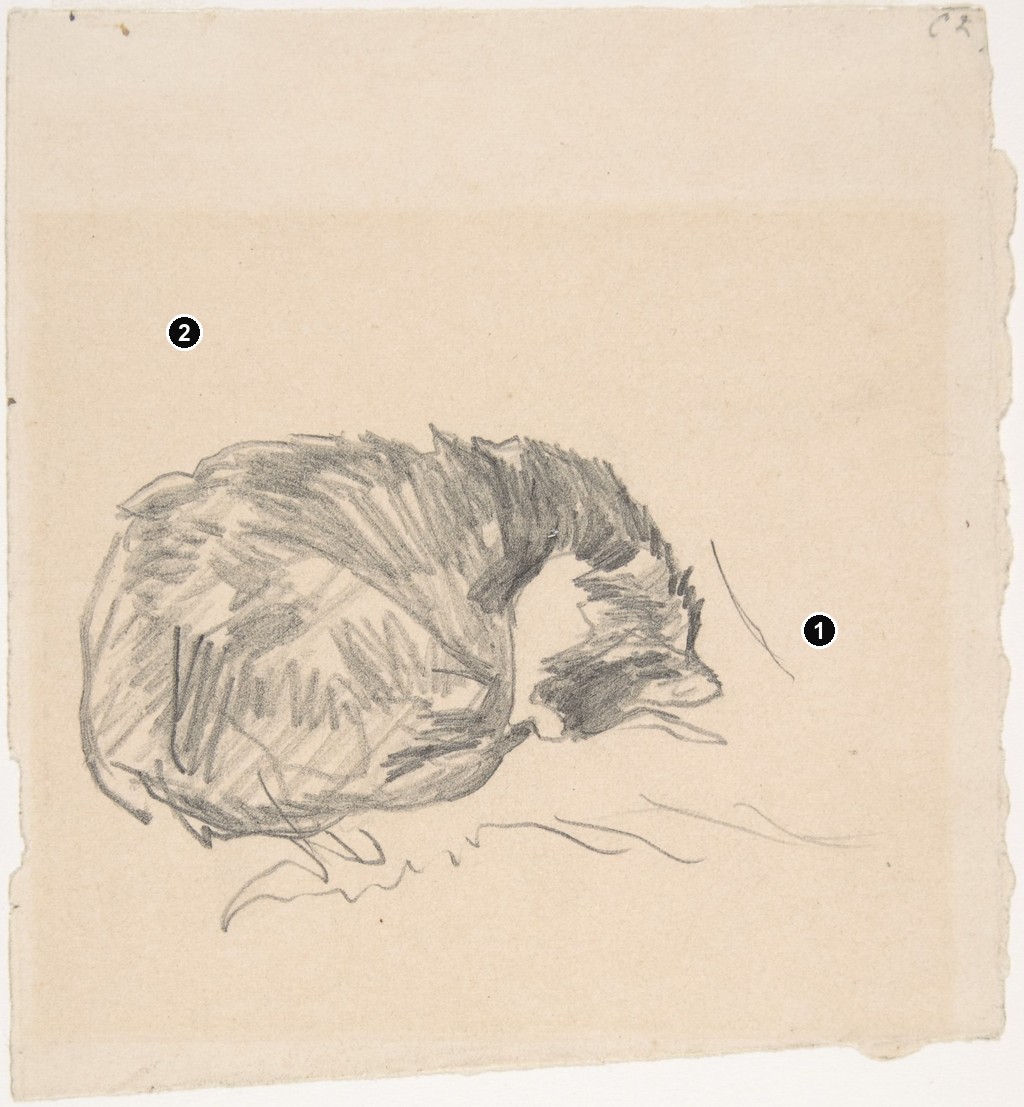
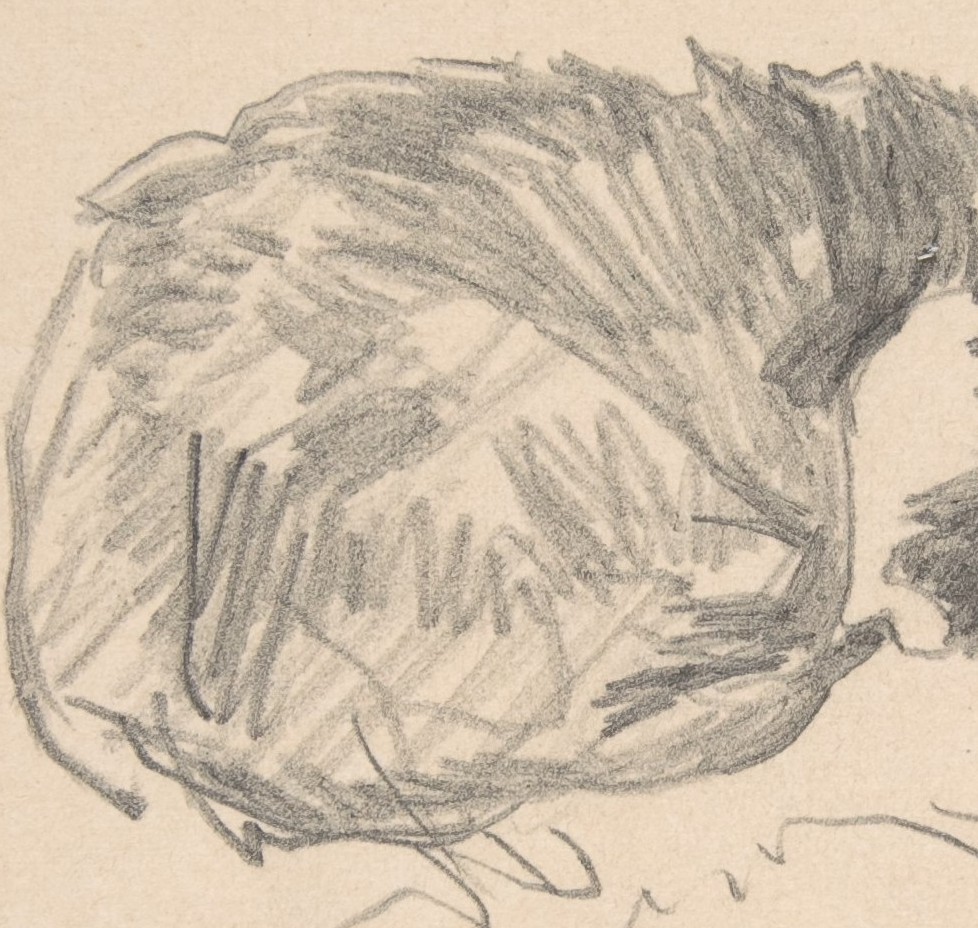
A Cat Curled Up, Sleeping, dated 1861, is a graphite drawing in the Metropolitan Museum of Art. Its sheet measures only 11.7 × 10.8 cm.[2] The cat occupies the lower part, leaving a broad area above it almost empty. Its body makes a rounded shape, with the head tucked towards the right and the limbs gathered into the curve.
The outer edge is far from uniform. In places a firm line establishes the back or flank; elsewhere several shorter marks break the boundary into fur. Inside the body, close strokes follow different directions. Some gather into dark patches, while lighter passages allow the paper to remain conspicuous. The animal's volume emerges from these changes rather than from an even covering of tone.
The head has its own compact arrangement. A few angular marks suggest the ear and the folded position of the neck, while dark strokes bring the face into relation with the surrounding body. Loose lines beneath and beside the cat lightly anchor it. The drawing gives enough information to recognise the posture without building a detailed interior around it.
Much of its character comes from that economy. The open paper around the cat lets its closed, rounded form remain distinct. Variations in tone and the grouping of strokes supply both the impression of fur and the weight of a resting body. A small subject becomes an opportunity to observe how much a pencil can establish with a limited number of marks.
The sheet can be appreciated on those terms without assigning it to a particular later painting. Its visible interest lies in the cat's posture and in the changing density of the graphite. The scale invites a close encounter with the subject, one in which an ordinary animal is substantial enough to occupy the artist's attention.

Édouard Manet, A Cat Curled Up, Sleeping, 1861. Graphite. The Metropolitan Museum of Art, New York, 1995.493. Image source. CC0 / Public domain.
Selected Drawings and Illustrated Letters
A Cat Curled Up, Sleeping (1861)
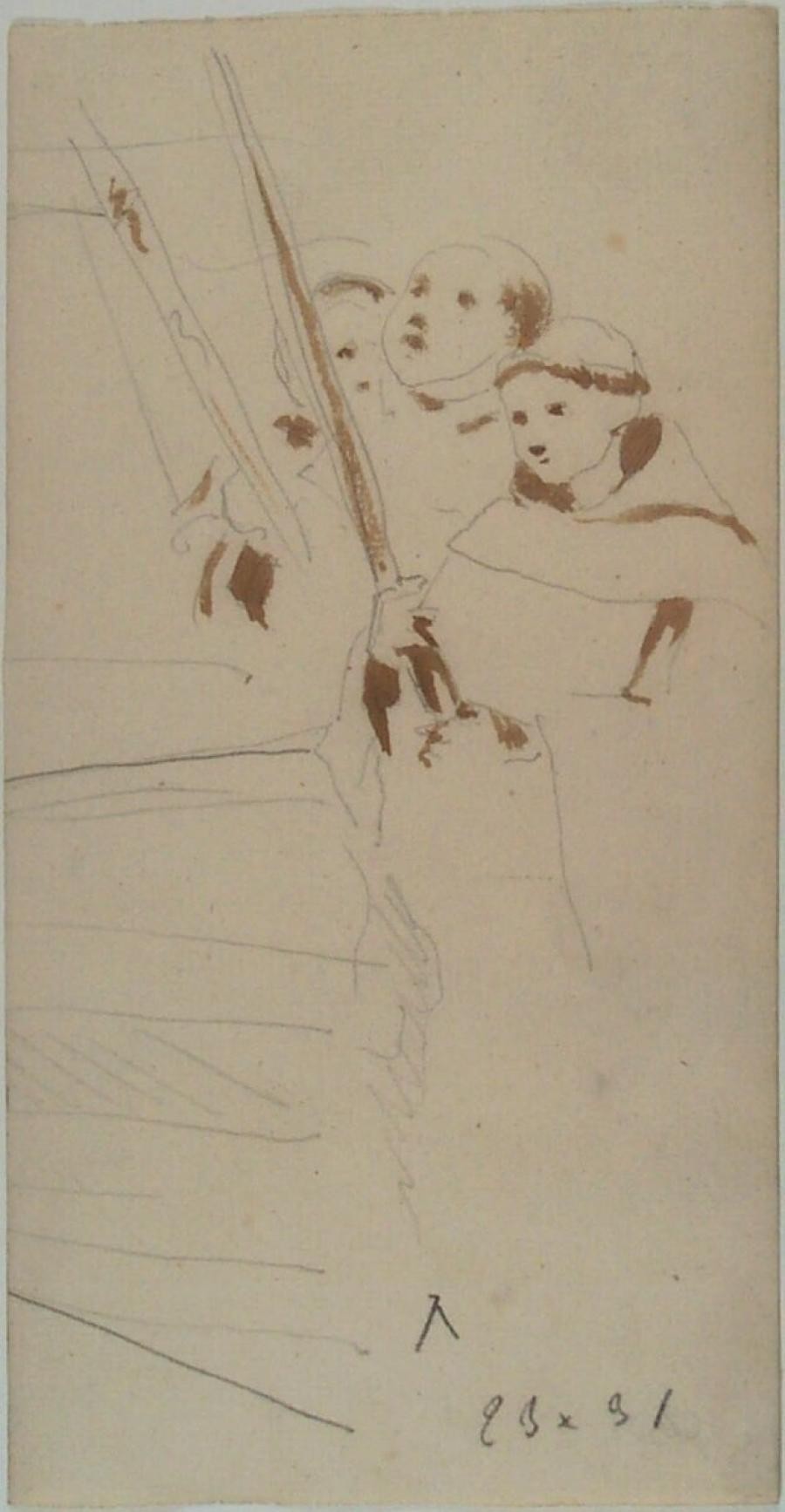
Study of Three Monks (1853–56)
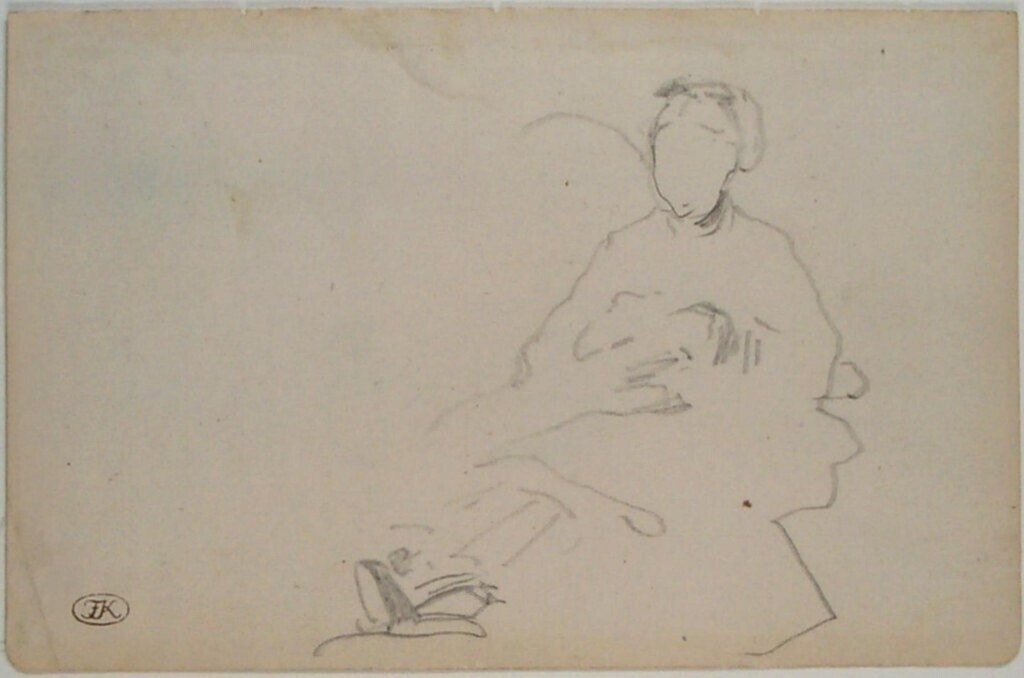
Sketch of a Seated Woman (c. 1864–68)
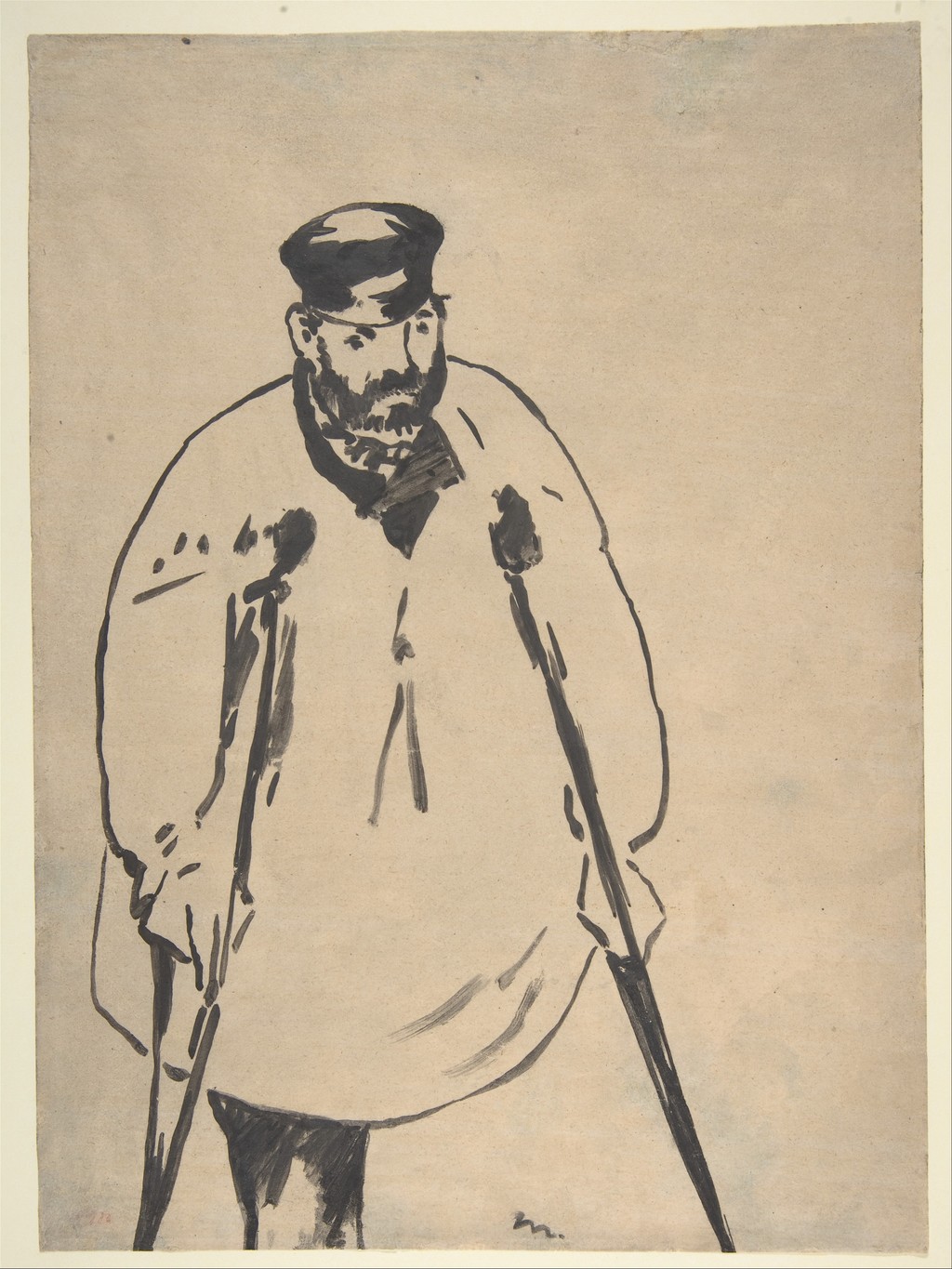
A Man on Crutches (1878)
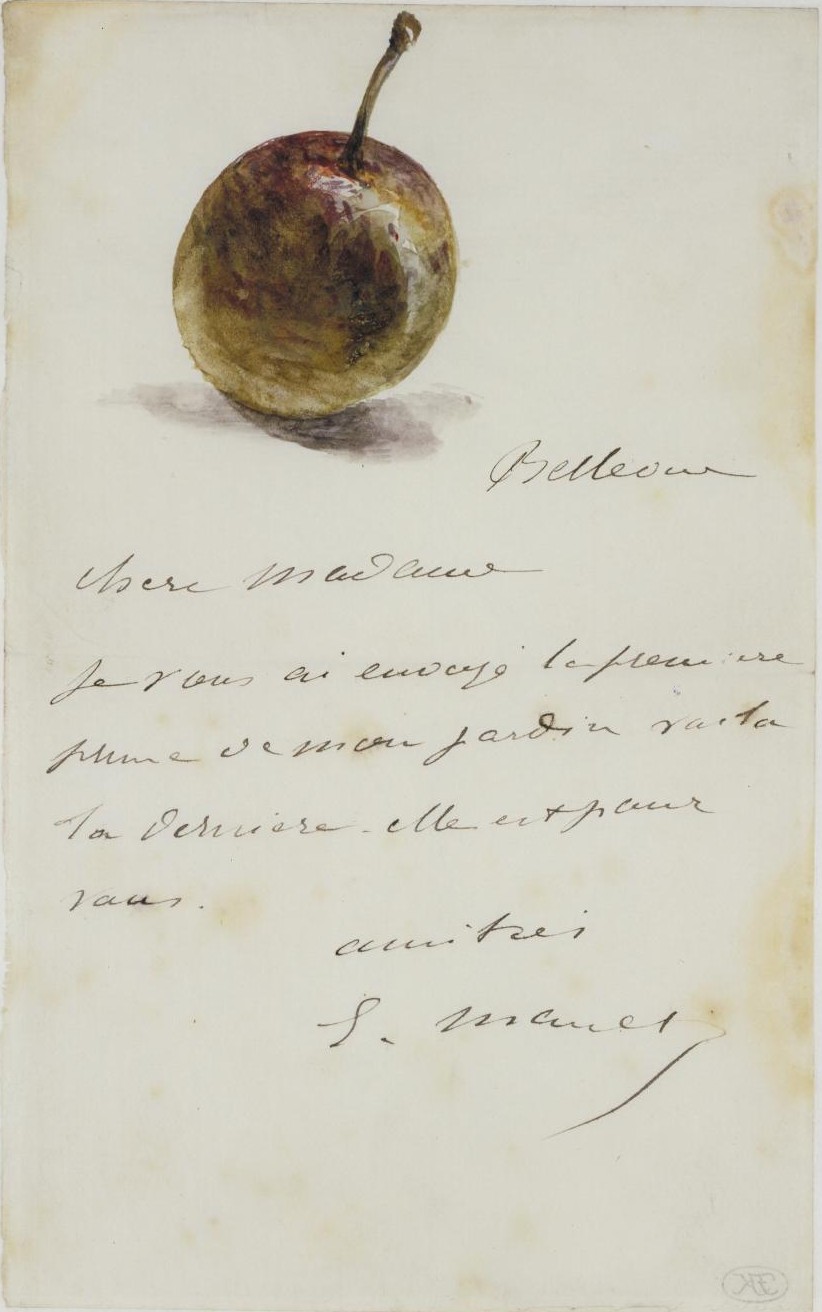
A Plum with an Accompanying Letter (1880)
Learning from Earlier Artists
Drawing also allowed Manet to study figures already arranged by another painter. His Study of Three Monks, in the Museum Boijmans Van Beuningen, copies figures from Ghirlandaio's fresco in the Sassetti Chapel of Santa Trinita, Florence. The museum dates it to 1853–56 and identifies its materials as pencil and brush in brown ink.[3]
The narrow sheet is 22 cm high by 11.4 cm wide. Three heads gather towards its upper right, close to strong diagonal lines at the left. Dark brown touches mark eyes, mouths, hair or the edges of garments. Much of the clothing is described through thin outlines, with selected areas strengthened by brushwork.
The contrast between these marks gives the group its emphasis. Heads and hands receive small dark accents, while broad stretches of drapery remain open. Instead of giving every fold the same weight, the drawing concentrates attention on the parts that make the figures legible. The space between the marks contributes to the structure as much as the dark ink itself.
Copying here involves selection. A group within a fresco becomes a small drawing in a different medium and format. The figures can be studied as an arrangement of heads, gestures, garments and intervening spaces. That translation gives Manet a practical way to consider another artist's construction, beyond simply remembering the subject of the larger work.
The drawing is on loan from the Stichting Museum Boijmans Van Beuningen as part of the former Koenigs collection, with the loan recorded in 1940.[3] Its later collecting history is separate from its use as an early exercise in looking at Italian art. The sheet preserves both a relationship with an older composition and the particular choices made in reducing it to a few graphic elements.
Édouard Manet, Study of Three Monks, 1853–56. Pencil and brush in brown ink. Museum Boijmans Van Beuningen, F II 45. Museum Boijmans Van Beuningen; faithful public-domain reproduction via Wikimedia Commons. Image source. Public domain.
The Notebook as a Working Record
Manet's personal notebook of 1860–62, now in the Morgan Library & Museum, brings drawing into contact with the practical organisation of an artist's life. Colin B. Bailey describes sketches among names and addresses of models, publishers, framers and collectors, together with accounts and amounts owed. Such entries place visual ideas beside the people and transactions through which paintings were made and circulated.[4]
One particularly useful example concerns a small seated girl. Bailey identifies the sketch on page 95, also numbered folio 107, as preparation for a figure in Children in the Tuileries Gardens, about 1861–62, now in the RISD Museum. This corrects an earlier identification by Adolphe Tabarant, who associated it with Music in the Tuileries.[4]
The correction shows why a notebook requires interpretation as well as recognition. Later annotations can help locate a drawing but may also introduce a mistaken relationship. A proposed connection with a painting depends on the particular figure and composition, rather than on a shared place name alone.
Tabarant added notes and identification sheets to the notebook after it had left Manet's hands. Bailey distinguishes these interventions from the artist's own entries.[4] The book therefore preserves several layers of use: Manet's working record, later attempts to identify its contents, and subsequent scholarly reassessment.
This mixture makes the notebook valuable beyond any single preparatory sketch. It connects the work of drawing with appointments, models, suppliers and collecting. The everyday organisation of a studio and the development of pictorial ideas occupy the same portable object.
A Separate Sketchbook Leaf
The Sketch of a Seated Woman in Rotterdam is a different object. Dated about 1864–68, it is a pencil drawing on a sketchbook leaf, catalogued as F II 46 verso. The sheet measures 12 × 18.5 cm.[5] Its broader, horizontal format offers a different balance from the upright group of monks.
The woman occupies mainly the right half. Her head, shoulders and the broad curve of her clothing are indicated with light lines, while a few darker touches gather around her lap. The left side remains comparatively empty. Small changes of direction give the figure a seated posture without filling in a surrounding room.
The drawing's spareness makes the placement of each mark especially noticeable. A broken contour can still connect the shoulder to the arm; a short dark accent can suggest the relationship between hands and clothing. The large rounded lower shape provides breadth, even though the details within it are only lightly established.
This leaf should be considered in its own identity, rather than being folded into the Morgan's earlier notebook. Its date, format and collection record belong to a separate surviving sheet.[5] Nor does the abbreviated face provide a secure name for the sitter. The drawing can show how Manet organised a pose without becoming evidence for an invented encounter or a particular finished portrait.
Placed beside the cat, it reveals a useful difference within pencil work. The animal is built from many close strokes that describe fur and rounded mass. The woman depends more on a few contours and selected darker accents. Both use open space, but they distribute information differently across it.
Édouard Manet, Sketch of a Seated Woman, about 1864–68. Pencil on a separate sketchbook leaf. Museum Boijmans Van Beuningen, F II 46 verso. Museum Boijmans Van Beuningen; faithful public-domain reproduction via Wikimedia Commons. Image source. Public domain.
A Drawing Intended for Graphic Reproduction
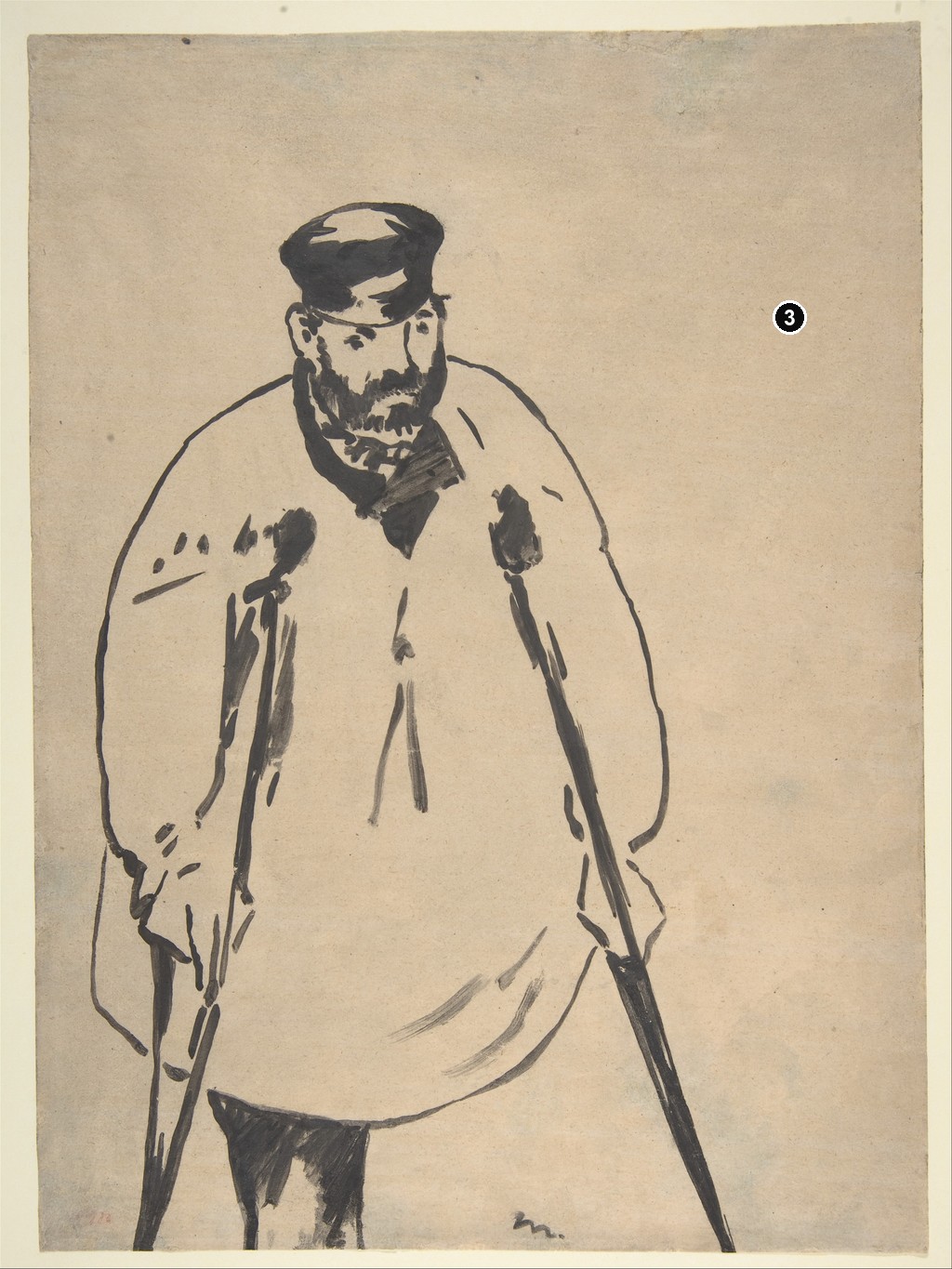
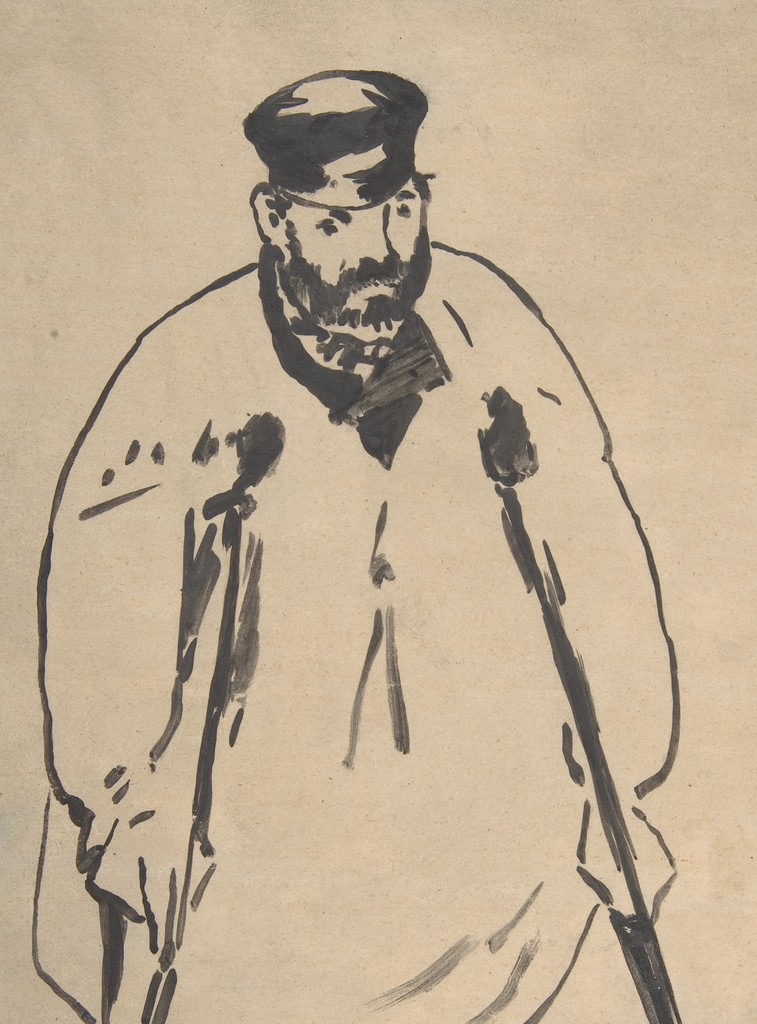
Manet's A Man on Crutches, dated 1878, brings the brush into a much stronger role. The Metropolitan Museum records its medium as brush and lithographic ink on transfer paper, and classifies the object as a drawing. It measures 27.1 × 19.7 cm.[6]
The man faces towards the viewer, his cap, beard and loose blouse set out through emphatic black marks. Two crutches descend towards the lower corners. The outline of the shoulders gives the body breadth, while comparatively little ink is needed to indicate folds or changes within the clothing. Large areas of the support remain light.
The face is more densely worked than much of the blouse. Dark touches gather beneath the cap and around the cheeks and chin, giving the head a concentrated presence above the broader body. The crutches provide long, firm directions on either side. Their relationship with the shoulders and arms makes the figure's means of support immediately apparent.
This graphic effect is connected with a possible route into print. Juliet Wilson-Bareau places the rue Mosnier drawings, including the man on crutches, within an unfulfilled print project. She explains that these works could have circulated as lithographs or through reproduction in a newspaper or journal.[7] The transfer-paper drawing remained a drawing; an intended printed destination does not make the surviving sheet a published lithograph.
It also has a relationship with Manet's painted views of the rue Mosnier, where a man on crutches appears from behind. The viewpoints differ. The brush drawing isolates the figure and gives his face and clothing greater prominence, while the painting places a figure within a street scene. A shared subject allows comparison without establishing an exact sequence in which one work must have been made before the other.
The example broadens the meaning of preparation. A drawing might test the graphic possibilities of a subject for a wider audience, as well as develop a form for a canvas. Manet's prints belong to that larger exchange between images conceived, drawn and reproduced through different processes.
Édouard Manet, A Man on Crutches, 1878. Brush and lithographic ink on transfer paper. The Metropolitan Museum of Art, New York, 48.10.2. Harris Brisbane Dick Fund, 1948. Image source. CC0 / Public domain.
A Plum in a Letter
In A Plum with an Accompanying Letter, the image shares its sheet with handwriting. The Boijmans collection dates it to 1880 and records pen in brown ink and watercolour. Its commentary places the letter probably in the period when Manet was staying at Bellevue and associates it with Madame Jules Guillemet, to whom he offers the last plum from his garden.[8]
The fruit occupies the upper part of the page. Its rounded body contains patches of purple, brown, yellow and green, with a pale area catching the light. A long stalk rises above it. Beneath the plum, a grey-violet shadow gives it a sense of resting on a surface, even though the rest of that setting is left undescribed.
The writing begins below and beside the image. Its sloping lines and the extended strokes of the signature introduce another rhythm across the paper. The plum has a compact physical presence; the handwriting carries the message onwards. Image and text occupy different areas while remaining part of one gesture of correspondence.
Colour does much of the work here. The fruit's roundness emerges through the distribution of darker and lighter passages, rather than through an emphatic enclosing line like the brush contour of the man on crutches. The delicate shadow is enough to suggest a place for the plum within the otherwise open page.
This sheet has a destination within a relationship between people. The image supplements the offer made in the letter, allowing the recipient to encounter the fruit through Manet's marks. Its purpose can be understood within that act of communication, without assigning it the role of a study for a larger still life.
Édouard Manet, A Plum with an Accompanying Letter, 1880. Watercolour and brown pen and ink. Museum Boijmans Van Beuningen, F II 73. Museum Boijmans Van Beuningen; faithful public-domain reproduction via Wikimedia Commons. Image source. Public domain.
Pastel and the Collected Portrait
Graphic work could also become a substantial portrait collected as an artwork. The Musée des Beaux-Arts de Dijon holds Manet's Portrait of Méry Laurent, dated 1882, in pastel on canvas. Measuring 56 × 46.3 cm, it was acquired from the artist by Albert Robin and entered the museum through his bequest in 1930.[9]
The object brings two useful distinctions into focus. Pastel allows a portrait to be developed through colour, and the support in this case is canvas. The category of graphic art therefore extends beyond small monochrome sketches on paper. A drawing practice can encompass an illustrated message, a fragment of observation and a portrait with its own collecting history.
Laurent's pastel is a separate work from Manet's oil portrait of her as Autumn. Its medium, dimensions and provenance belong to this particular object.[9] Keeping those identities clear allows the different media to be compared without treating one as an automatic preliminary stage of the other.
Drawings by Manet and Portraits of Manet
Manet was also the subject of drawings by his contemporaries. Degas's Édouard Manet, Seated, Holding His Hat, about 1868, is a graphite and black chalk portrait in the Metropolitan Museum of Art.[10] It represents Manet but belongs to Degas's work as a draughtsman.
The distinction is useful when moving among portraits, studies and related works. A title may name the person represented; the artist's name identifies whose drawing is being considered. Attention to both makes it possible to place images of Manet beside his own graphic work while preserving the separate contribution of each artist.
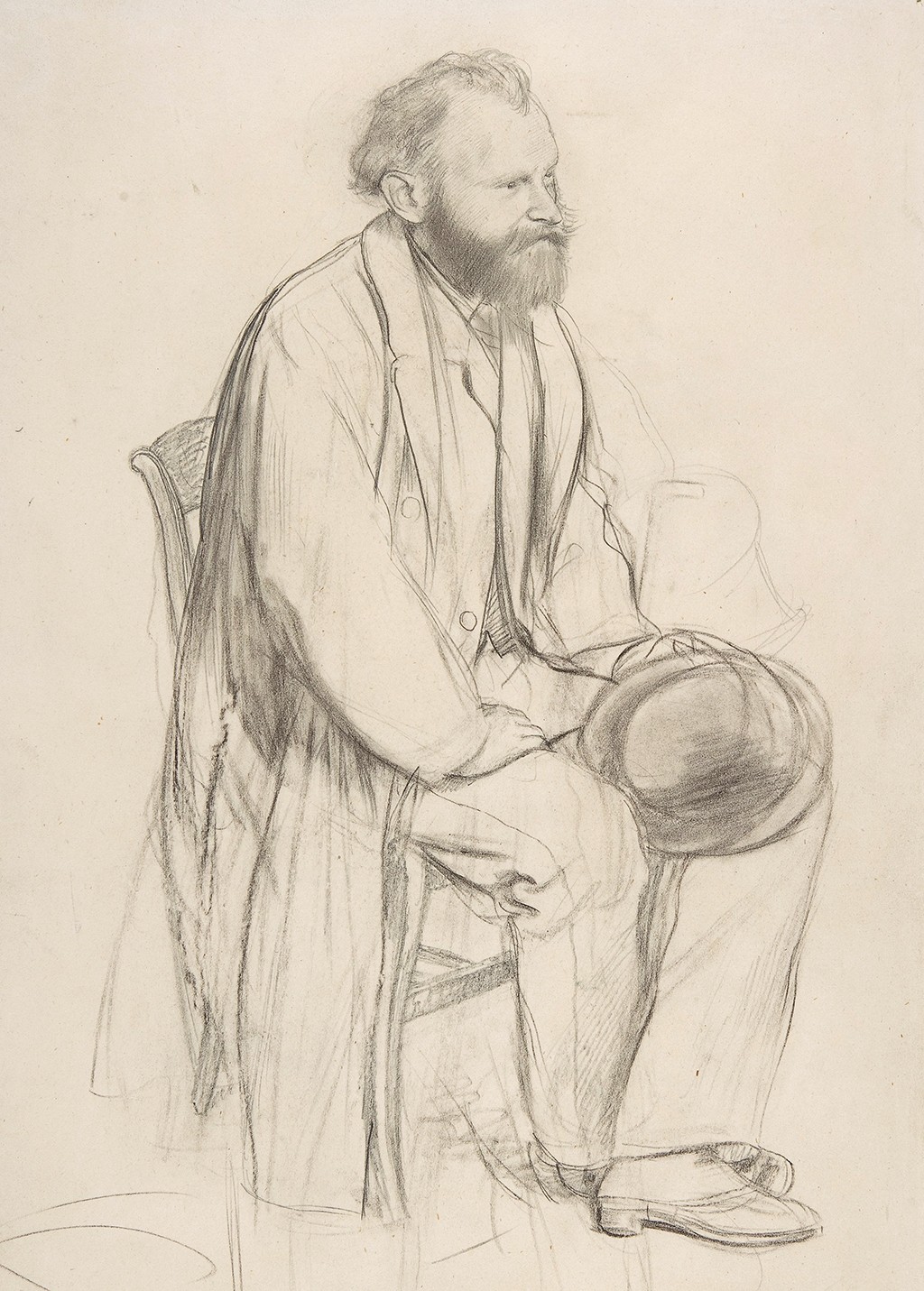
Edgar Degas, Édouard Manet, Seated, Holding His Hat, about 1868. Graphite and black chalk. The Metropolitan Museum of Art, New York, 19.51.7.
Annotated Details from Manet’s Drawings
The numbered points identify visible features discussed in this article. Return from each detail to the whole composition. Each caption identifies the work shown.
A Cat Curled Up, Sleeping
Édouard Manet, A Cat Curled Up, Sleeping, 1861. Graphite. The Metropolitan Museum of Art, New York, 1995.493. Image source. CC0 / Public domain. Numbers added to a separate resized whole supplied overview. Detail crops from the unchanged original; no enlargement, retouching or colour alteration.
A Man on Crutches — Met Drawing
Édouard Manet, A Man on Crutches, 1878. Brush and lithographic ink on transfer paper. The Metropolitan Museum of Art, New York, 48.10.2. Harris Brisbane Dick Fund, 1948. Image source. CC0 / Public domain. Number added to a separate resized whole supplied drawing overview retaining paper colour and the provided lower cut through the crutch shafts. One upper-body detail crop from the immutable original; no enlargement, whitening, retouching or reconstruction.
Details from MANET’S DRAWINGS
Follow the numbered details back to the complete images above. Each caption identifies the work shown.
A Cat Curled Up, Sleeping
Head and Overlapping Lines
Short dark lines collect around the lowered head beside paler overlapping outlines.
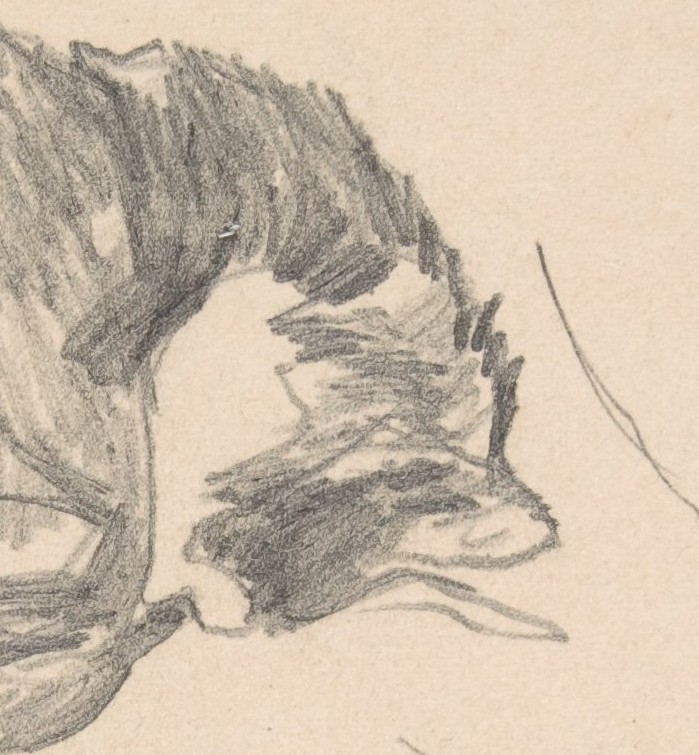
Curved Back and Crossed Strokes
Short diagonal strokes form darker bands inside the larger curved outline of the body.
A Man on Crutches — Met Drawing
Cap, Beard and the Two Crutch Grips
A dark cap and beard sit above the spare coat outline. Both hands meet the long crutches in the supplied drawing.
Artworks directory
Explore selected paintings, drawings and prints by Édouard Manet. Search by title or another recorded name.
Frequently Asked Questions
It is a graphite drawing by Manet, dated 1861, in the Metropolitan Museum of Art, accession 1995.493.[2]
Edgar Degas made that portrait of Manet about 1868. Manet is its sitter, while Degas is its artist.[10]
Discussion
Look again at the images and ideas explored in Édouard Manet Drawings. These editorial prompts invite your observations.
Reader Insights
Compare the changing density of the graphite around the sleeping cat. Notice where a firm outline gives way to shorter marks and open paper.
Look between the seated woman and the three monks. How do faint pencil lines and darker ink marks establish different degrees of definition?
Compare a drawing made by Manet with Degas’s portrait of him. What changes when the person named in the title is the sitter rather than the artist?
Join the Conversation
Share a detail, comparison or question about Édouard Manet Drawings below.
References
- Musée d'Orsay, Manet: Pastels and Drawings, exhibition archive, 23 October 1990–13 January 1991; range of techniques and uses, curator Arlette Sérullaz (in English). View source.
- The Metropolitan Museum of Art, A Cat Curled Up, Sleeping, 1861, 1995.493; medium, dimensions and object commentary (in English). View source.
- Museum Boijmans Van Beuningen, Studie van drie monniken, 1853–56, F II 45 (PK); source fresco, technique, dimensions and loan credit (in Dutch). View source.
- Colin B. Bailey, “Introduction,” Édouard Manet's Notebook, 1860–62, The Morgan Library & Museum, September 2019; notebook entries, later annotations and the seated girl's relationship to Children in the Tuileries Gardens (in English). View source.
- Museum Boijmans Van Beuningen, Schets van een zittende vrouw, about 1864–68, F II 46 verso (PK); sketchbook leaf, pencil, dimensions and collection identity (in Dutch). View source.
- The Metropolitan Museum of Art, A Man on Crutches, 1878, 48.10.2; brush and lithographic ink on transfer paper (in English). View source.
- Juliet Wilson-Bareau, Manet, Monet, and the Gare Saint-Lazare, National Gallery of Art, Washington, 1998, pp.141 and 143; the rue Mosnier drawings and the unfulfilled print project (in English). View source.
- Museum Boijmans Van Beuningen, Een pruim met een begeleidende brief, 1880, F II 73 (PK); materials, letter and probable Bellevue context (in Dutch). View source.
- Dijon Musées, Portrait de Méry Laurent, 1882, 2958 a; pastel on canvas, dimensions and Albert Robin provenance (in French). View source.
- The Metropolitan Museum of Art, Edgar Degas, Édouard Manet, Seated, Holding His Hat, about 1868, 19.51.7; artist, sitter, date and medium (in English). View source.
- Splash image, Édouard Manet, A Cat Curled Up, Sleeping, 1861. Graphite. The Metropolitan Museum of Art, New York, 1995.493. Image source. CC0 / Public domain.


