



 by Tom Gurney
Tom Gurney BSc (Hons) is an art history expert with over 20 years experience
Published on June 19, 2020 / Updated on October 30, 2026
Email: tomgurney1@gmail.com / Phone: +44 7429 011000
Christ as a Gardener by Édouard Manet: Introduction
A pale hand rises from a dark sleeve, while a long shaft crosses the figure’s shoulder. Above the hands, a golden halo surrounds a lowered head. Édouard Manet gives Christ as a Gardener the closeness of a portrait, bringing face, clothing and gesture into a compact religious image. The dealer M.S. Rau dates the oil painting to about 1856–1859.[1]
At a Glance
- ArtistÉdouard Manet
- TitleChrist as a Gardener
- DateAbout 1856–1859 in the M.S. Rau dossier.[1]
- MediumOil on canvas.[1]
- CollectionPrivately held in published accounts.[1]
- Catalogue numberRouart–Wildenstein I, 14.[2]
This work across Édouard Manet’s career
Christ as a Gardener by Édouard Manet (current article)
About 1856–1859Olympia
1863The Fifer
1866The Balcony
1868–69The Railway
1873Asparagus
1880Contents
- The Turning Figure
- Face and Downward Gaze
- Halo and Sky
- The Raised Palm
- The Tool across the Shoulder
- Robe and Broad Folds
- An Early Religious Study
- The Absent Mary Magdalene
- An Earlier Reproduction
- Annotated details
The Turning Figure
Christ’s upper body fills most of the oval image. One shoulder projects towards the left, while the other recedes towards the hand holding the tool at the right. The clothing makes this turn clear: a broad brown expanse covers the nearer arm, then narrows towards the opposite side of the chest.
His head turns and lowers towards the left of the picture. This movement carries the face away from the direction of the shaft across his shoulder. Looking between those directions makes the pose feel less settled than a straightforward frontal likeness. Their arrangement leaves the figure poised between carrying something and addressing someone beyond the image.
Face and Downward Gaze
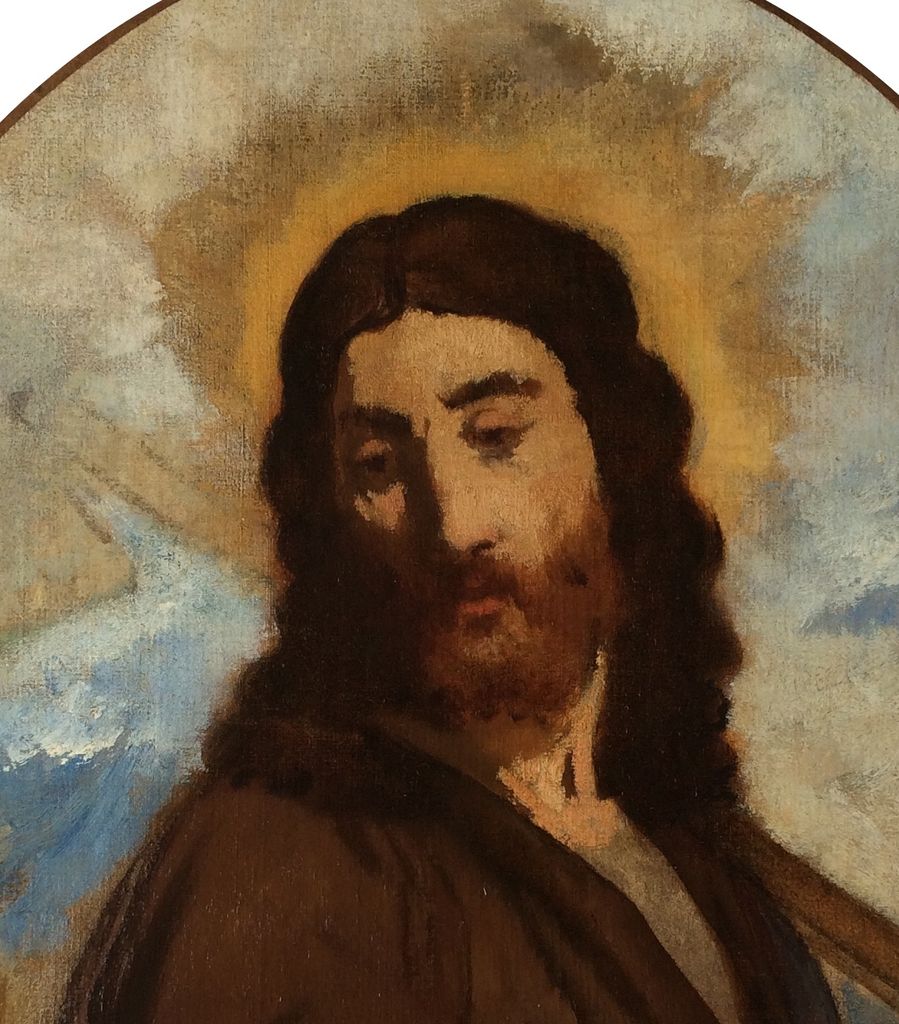
Long dark hair frames the face and reaches the shoulder. Its outer shape is relatively simple, but small changes in the contour distinguish the crown, the waves beside the cheek and the ends against the robe. Below, a reddish-brown beard joins the moustache and the darker area beneath the mouth.
The face is unevenly lit. One cheek and the bridge of the nose are comparatively pale; the opposite side falls into a substantial dark patch. Heavy brows and lowered eyelids give the eyes a downward direction. These are small marks within a large surrounding mass of hair, yet they strongly affect how the whole figure faces us. The gaze does not meet ours, even though the open hand turns towards the foreground.
Halo and Sky
A warm golden area surrounds the head, spreading beyond the dark hair into the lighter background. It has a broad, irregular outer boundary. The contrast makes the head conspicuous without enclosing it in a sharply drawn circular line. The gold occupies a region of its own between the figure and the sky.
Blue patches cross the background below and beside the halo. Pale cloudlike areas break their edges, while warmer tones appear towards the left. The changing light and dark patches give the background movement, but remain broad enough to leave the face legible. There is no elaborate garden architecture or distant crowd competing with the figure.
The Raised Palm
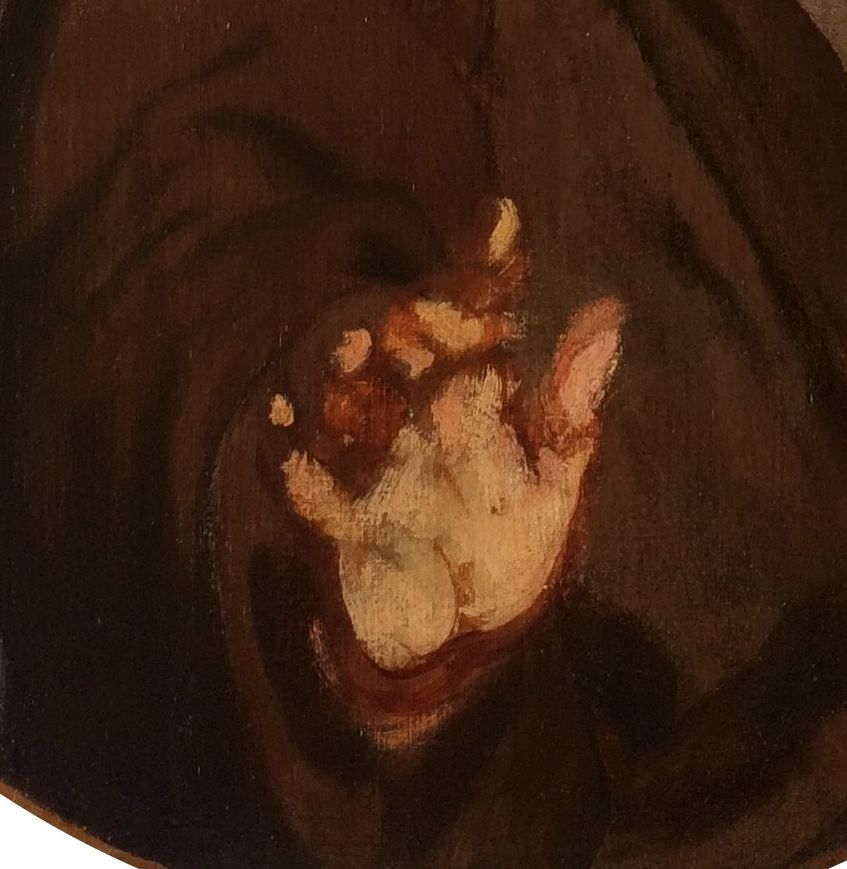
The nearer hand emerges from a loose sleeve in the lower part of the image. Its palm faces outwards, and the fingers bend and separate rather than forming a flat, regular fan. Pale strokes describe the rounded pads and changing surfaces. Warm reddish-brown marks sit between them and around the wrist, joining the hand to the darker clothing.
This small light shape interrupts the much larger brown area of the torso. It also brings the action towards us: the projecting palm occupies a different plane from the shoulder and lowered face. The sleeve expands behind it, so the hand seems to arrive at the end of a substantial covered arm. Seen before considering the subject’s story, the gesture already creates a boundary in front of the figure.
The Tool across the Shoulder
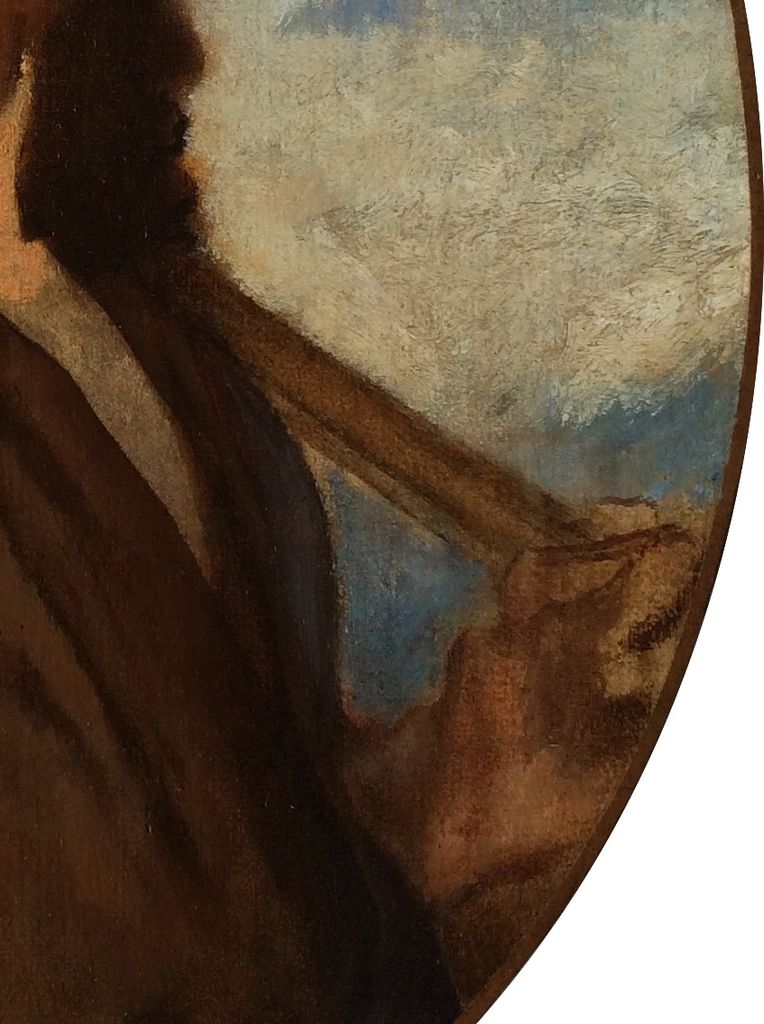
The second hand has a different task. At the right, fingers close around a long shaft that passes across the shoulder and continues behind the head towards the left. Its oblique course crosses the downward movement of the face. The shaft’s lighter strip remains visible against the surrounding blue and brown areas.
This implement is central to the gardener identification. Rouart and Wildenstein recorded both Le Christ jardinier and Le Christ à la Pioche as alternative titles to Tête de Christ in their catalogue.[2] The working object brings an ordinary physical action into the religious image. The gripping hand and the outward-facing palm make a telling contrast: one holds the carried object firmly, while the other opens into the space before Christ.
Robe and Broad Folds
Brown clothing spreads across the lower half of the composition. Darker lines follow the nearer arm and gather around the elbow and waist, breaking that broad area into folds. Some edges remain clear, especially where the sleeve meets the pale hand; elsewhere neighbouring brown passages merge. The different degrees of definition keep the robe substantial without describing every seam.
A blue-grey strip follows the outer shoulder at the left. Near the neck, a narrow pale opening separates the beard from the darker crossing fabric. These smaller areas interrupt the robe’s dominant colour and help the eye travel through it.
Annotated Details from Christ as a Gardener
The numbered points identify visible features discussed in this article. Return from each detail to the whole composition. Édouard Manet, Christ as a Gardener, about 1856–1859. Oil on canvas. Privately held in published accounts; Rouart–Wildenstein I, 14. Bellecour1, via Wikimedia Commons. Image source. CC BY-SA 4.0. Numbered overview resized and annotated from Bellecour1’s photograph; detail crops made from the same photograph. Overview and crop image derivatives: CC BY-SA 4.0.
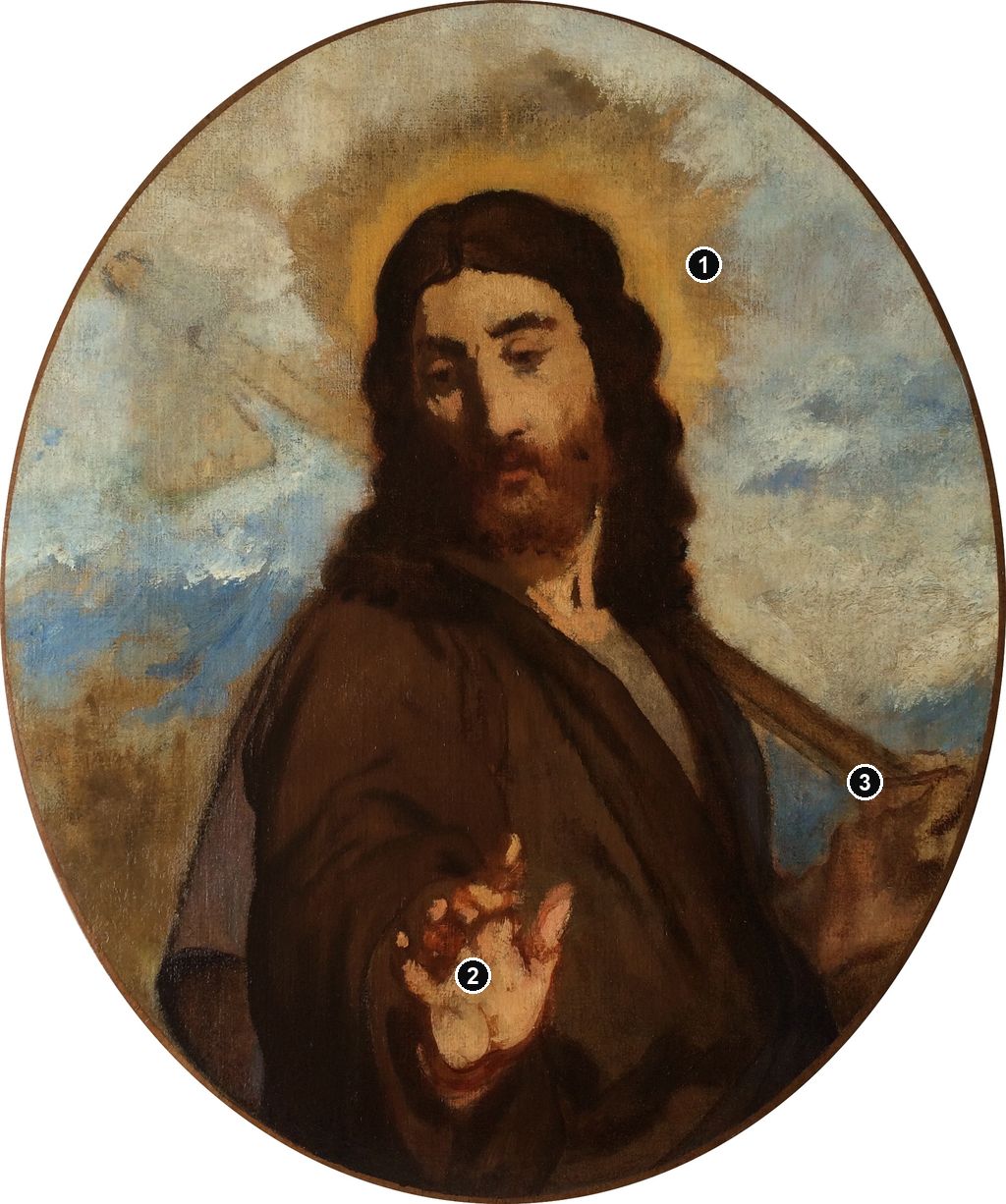
Details from CHRIST AS A GARDENER
Compare the lowered face and halo with the open palm, then follow the shaft towards the gripping hand at the right.
Head and halo
Dark hair frames the lowered face. A warm golden area surrounds the head, with blue and pale patches of sky beyond its irregular outer edge.
The raised palm
The pale palm turns outwards from a loose dark sleeve. Separated, bent fingers make an irregular light shape against the larger brown robe.
The hand and diagonal shaft
Fingers close around the long shaft at the right. Its diagonal course crosses the shoulder and continues behind the head, contrasting with the open foreground hand.
An Early Religious Study
Rouart and Wildenstein dated the painting to about 1856 and described it as a study for an abandoned picture.[2] Their account places it among Manet’s early experiments with religious subjects. The later M.S. Rau dossier uses the broader approximate range 1856–1859.[1] These datings locate the work in the same early period without establishing a precise year of completion.
The different titles also draw attention to different aspects of the image. Tête de Christ emphasises the head and its portrait-like presence; the gardener titles direct attention towards the implement and the possible narrative. Both approaches suit a painting that combines an individually described face with the halo, clothing and gesture of a religious figure.
The Absent Mary Magdalene
The gardener subject belongs to Mary Magdalene’s encounter with the risen Christ, commonly called Noli me tangere, or “Touch me not.”[1] Mary herself is absent from this image. The lifted hand therefore addresses an open space rather than another figure whose answering movement we can see.
Nancy Locke connects this study with an apparently uncompleted Noli me tangere project. She interprets the viewer as occupying the Magdalen’s position, with Christ’s prohibitive hand creating a charged relationship across the picture’s boundary. She also draws attention to the contrast between the gaze here and the more focused expression in Manet’s early Christ with a Reed.[3] Her reading makes the combination of an averted face and an outward gesture particularly significant: the figure remains close to us while establishing distance through his hand.
An Earlier Reproduction
The rectangular black-and-white view reproduced in the 1975 catalogue shows more surrounding space than the oval colour image. The same central figure, raised hand and diagonal tool remain recognisable, but additional background opens around the head and shoulders. A separate digital reproduction of this view is attributed to the photographer Lochard.[2][4]
The comparison changes how the composition feels. In the rectangle, the figure stands within a broader setting; the oval brings its curved boundary close to the shoulder, hair and hands. These reproductions alone do not establish a history of physical cutting or alteration. They do show how strongly the surrounding space affects the balance between a religious scene and the concentrated presence of a single figure.
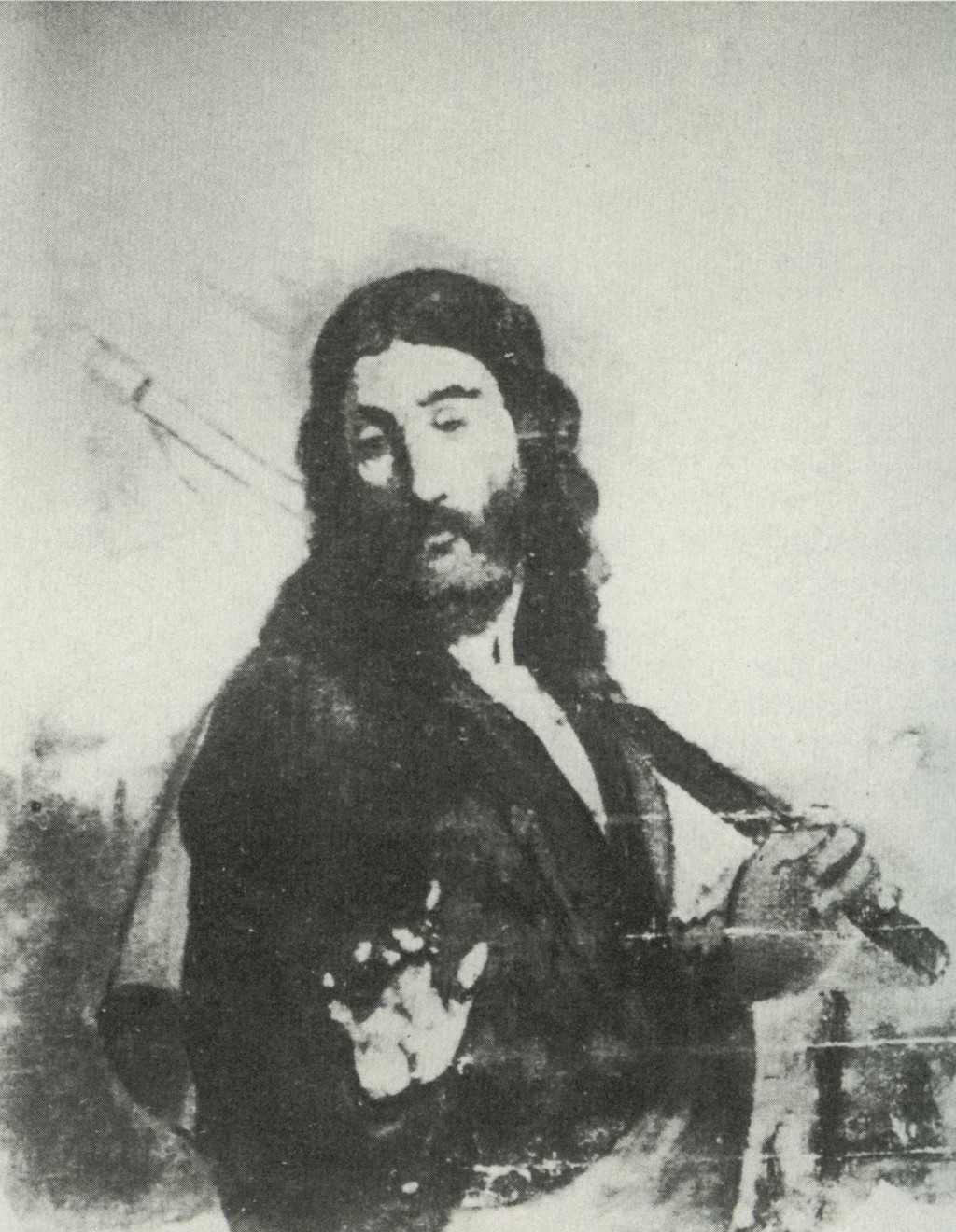
Édouard Manet, Christ as a Gardener, earlier rectangular reproduction corresponding to Rouart–Wildenstein I, 14. The photograph is attributed to Lochard in the Wikimedia Commons record. Historical photograph attributed to Lochard; uploaded by Rlbberlin, via Wikimedia Commons. Image source. Public domain. Historical reproduction resized without cropping.
Artworks directory
Explore selected paintings, drawings and prints by Édouard Manet. Search by title or another recorded name.
Frequently Asked Questions
No. Nancy Locke interprets the viewer as taking her position before the figure and his raised hand.[3]
Discussion
Look again at the images and ideas explored in Christ as a Gardener by Édouard Manet. These editorial prompts invite your observations.
Reader Insights
Compare the open foreground palm with the hand holding the shaft. How does each action affect your sense of distance from the figure?
Follow the boundaries between dark hair, warm gold and pale sky. Which edge first draws your attention towards the face?
Compare the oval colour image with the earlier rectangular reproduction. How does the additional background change the figure’s apparent scale?
Join the Conversation
Share a detail, comparison or question about Christ as a Gardener by Édouard Manet below.
References
- M.S. Rau, Christ as a Gardener, object facts and subject discussion, pp.2–5. Public painting dossier. View source.
- Denis Rouart and Daniel Wildenstein, Édouard Manet: Catalogue raisonné, tomeI,1975,p.38,no.14 and accompanying illustration. Wildenstein Plattner Institute digitisation. French. View source.
- Nancy Locke, Manet and the Family Romance, Princeton University Press,2001,p.136,figs.67–68; page reproduced on p.12 of the M.S. Rau dossier. Publication details. View source 1. View source 2.
- Le Christ jardinier, historical rectangular reproduction attributed to Lochard, uploaded by Rlbberlin. Wikimedia Commons file and image history. View source.
- Splash image, Édouard Manet, Christ as a Gardener, about 1856–1859. Oil on canvas. Privately held in published accounts; Rouart–Wildenstein I, 14. Bellecour1, via Wikimedia Commons. Image source. CC BY-SA 4.0. Photograph resized without cropping. Image derivative: CC BY-SA 4.0.


