



 by Tom Gurney
Tom Gurney BSc (Hons) is an art history expert with over 20 years experience
Published on June 19, 2020 / Updated on October 30, 2026
Email: tomgurney1@gmail.com / Phone: +44 7429 011000
The Ham by Édouard Manet: Introduction
A cut ham stands on an oval platter, with a knife laid across the pale cloth in front. Its broad face fills the centre of the picture, surrounded by a dark rind that curves into the patterned background. Édouard Manet makes this compact arrangement depend on differences of colour, shape and surface. The painting belongs to the Burrell Collection in Glasgow and was shown in the 2023 Manet/Degas exhibition with a date of about 1875–80.[1]
At a Glance
- ArtistÉdouard Manet
- TitleThe Ham; Le Jambon
- DateAbout 1875–80.[1]
- MediumOil on canvas
- Dimensions32.4 × 41.2 cm.[2]
- CollectionThe Burrell Collection, Glasgow, 35.308.[1]
This work across Édouard Manet’s career
Olympia
1863The Fifer
1866The Balcony
1868–69The Railway
1873The Ham by Édouard Manet (current article)
About 1875–80Asparagus
1880Contents
- The Cut Face of the Ham
- The Oval Platter
- A Knife across the Foreground
- Pale Cloth and a Dark Background
- Dates Assigned to the Painting
- In Degas’s Collection
- Gauguin’s Different Arrangement
- Annotated details
The Cut Face of the Ham
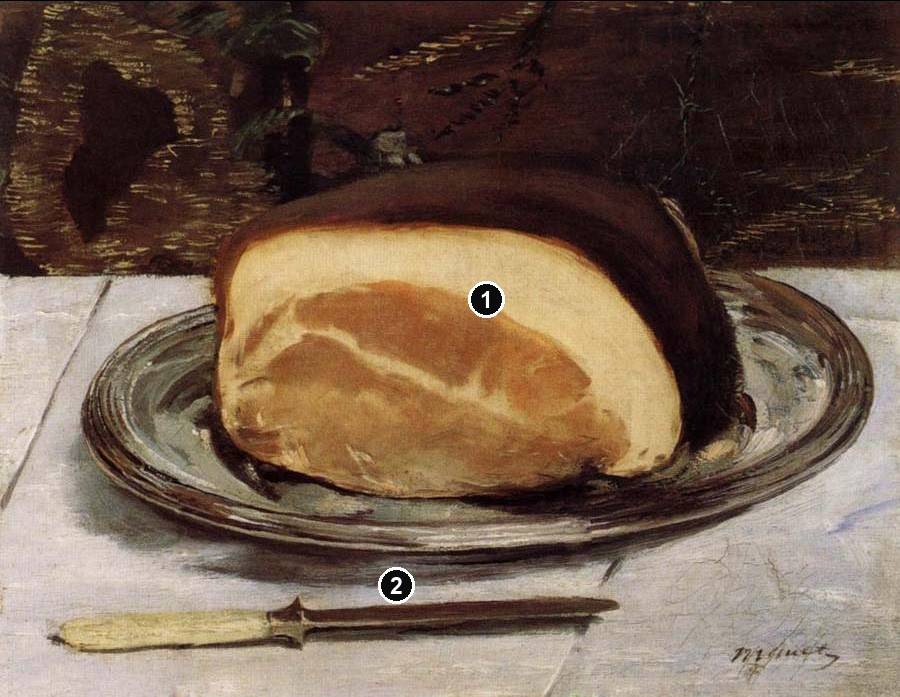
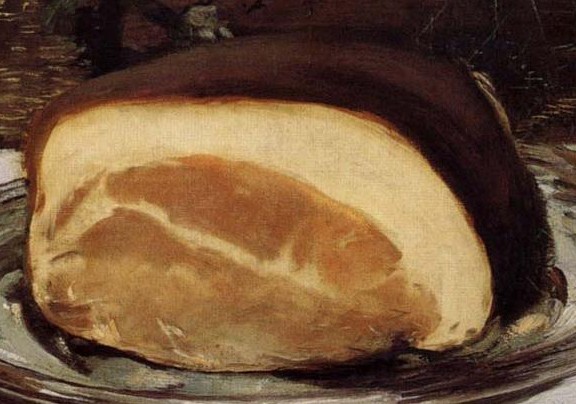
The cut surface faces us almost squarely. Its upper edge forms a shallow arch, while the lower edge rests close to the plate. A wide, creamy band surrounds the warmer meat, giving the front a clear outline within the dark outer rind. The pale area is particularly broad at the upper right, where it turns down towards the platter.
Inside this border, brown, orange and ochre passages form irregular divisions. Narrower pale lines pass between them. Their unequal shapes keep the surface from appearing like an evenly filled block: the eye follows a branching pattern across the centre before reaching the lighter band around it.
The rind changes the object’s silhouette. It rises above the cut face in a dark rounded curve, then broadens into an almost black passage at the right. Here the ham’s thickness becomes easier to judge. The front and the outside are described through strongly different colours, yet their edges meet to form one substantial piece.
The Oval Platter
The platter gives this central mass a wider base. Its far rim appears on either side of the ham, and its nearer edge sweeps across the lower part of the painting. The oval surrounds the cut surface without exactly repeating its shape. It is flatter, longer and less regular in the way its edges are painted.
Several bands of light and dark follow the rim. At the left, short pale strokes interrupt a brown-grey curve; towards the front, darker lines run almost continuously beneath the ham. Lighter marks then reappear near the right. These changes make the plate seem reflective without describing every part of it with the same degree of clarity.
The plate’s centre is more mixed in colour. Warm brown from the ham joins grey, cream and darker passages beneath it. The object therefore sits within a surrounding field of reflections and shadows, rather than resting on a uniformly bright disc.
A Knife across the Foreground
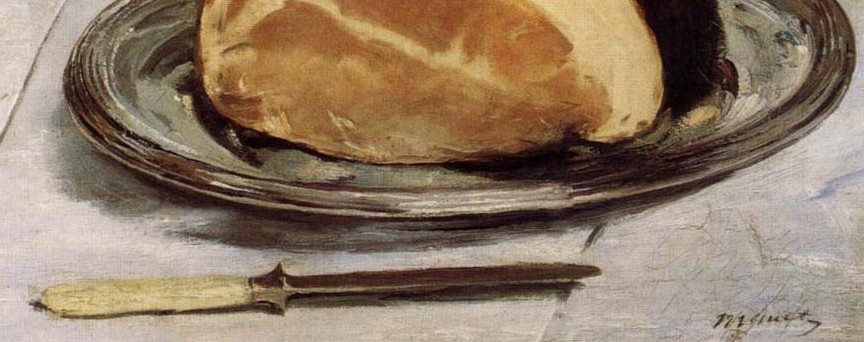
Below the platter, a knife lies roughly parallel to the bottom of the canvas. Its pale handle extends towards the left, while the dark blade points to the right. A small projecting shape marks the junction between the two. The handle catches more light than the blade, making this ordinary utensil a distinct combination of contrasting surfaces.
The knife is separated from the plate by a narrow interval of cloth. It introduces a nearly straight line beneath the platter’s curve, and its long horizontal shape slows the movement towards the lower edge. The pointed blade ends well before the right corner, where Manet’s signature appears.
Pale Cloth and a Dark Background
The cloth occupies most of the lower half. Broad light passages leave room around the platter, particularly at the lower left. A diagonal grey line descends beside it, while shorter strokes and narrow folds interrupt the area on the right. These few divisions suggest a surface extending underneath the objects without covering it in equally detailed creases.
Above, reddish brown and dark grey replace the pale cloth. Gold-coloured strokes trace broken bands and irregular decorative forms. Some passages are quite dark and solid; others are picked out through repeated small marks. The upper setting is therefore busier than the table, although its low, warm colours allow the bright face of the ham to remain prominent.
A description in Degas’s handwritten collection record, reproduced by the Metropolitan Museum, calls the platter silver and identifies the background as Cordoba leather.[1] This gives a more specific name to the decorated material behind the food. The painted pattern, however, remains only partly legible: its fragments spread across the top and disappear behind the curved rind.
Dates Assigned to the Painting
The picture’s published dates have varied. In their 1975 catalogue raisonné, Denis Rouart and Daniel Wildenstein placed Le Jambon around 1880.[3] The Metropolitan Museum’s 1997 catalogue of Degas’s collection instead used about 1875–78.[2] Its 2023 Manet/Degas exhibition adopted the broader range of about 1875–80.[1]
These estimates place the still life within the same later period of Manet’s career, while leaving its precise year open. Its small scale is easier to establish: at 32.4 × 41.2 cm, the canvas offers a close view of a few objects, with the plate and ham occupying much of its width.[2]
In Degas’s Collection
Rouart and Wildenstein record that Eugène Pertuiset bought the painting from Manet’s studio in 1882, and that it subsequently appeared in Pertuiset’s 1888 sale.[3] Degas later acquired it from Manzi in exchange for a pastel and a small painting valued together at 3,000 francs.[2] The transaction brought this still life into another painter’s private surroundings.
The Metropolitan Museum’s exhibition label describes its privileged place in the successive arrangements of Degas’s collection.[1] The still life formed part of Degas’s private domestic surroundings. After his death, it was sold from his collection to Bernheim Jeune in 1918.[2][3]
The work eventually entered the Burrell Collection. Sir William and Lady Burrell gave it to the City of Glasgow in 1944.[1]
Gauguin’s Different Arrangement
Paul Gauguin also painted a work called The Ham. His 1889 canvas belongs to the Phillips Collection in Washington, DC.[4] The shared subject makes the differences between the two arrangements especially apparent.
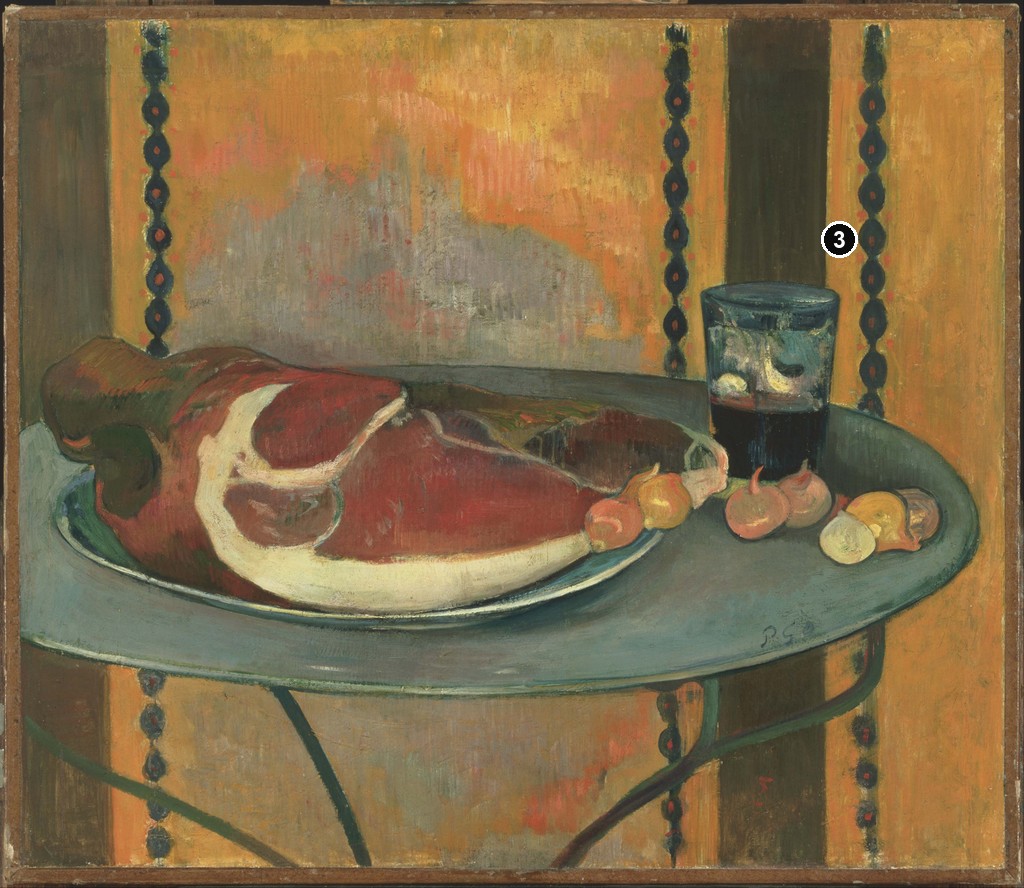
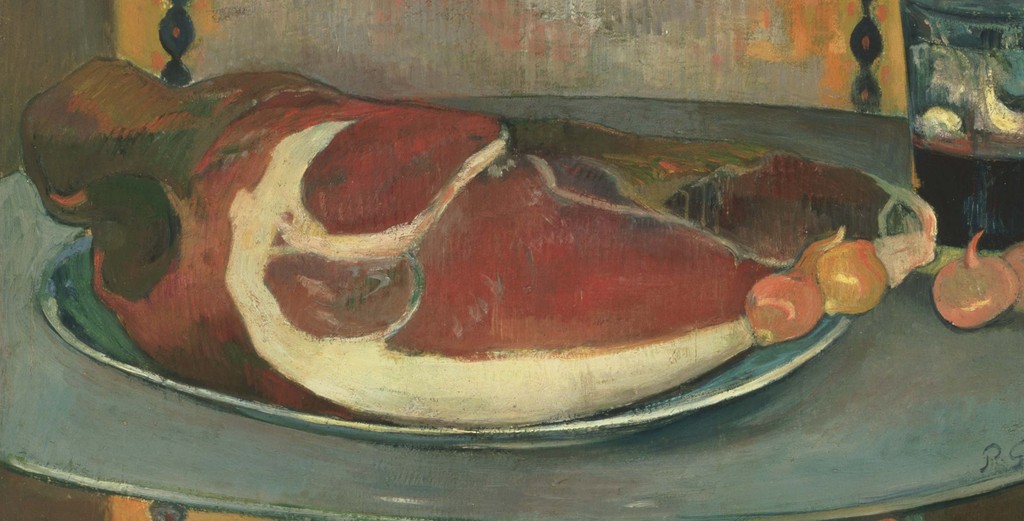
Gauguin lays a much longer piece of ham across a green-grey platter and table. The cut face occupies the left, with the rest extending towards a group of onions. A dark glass stands behind them. The table’s edge curves broadly across the foreground, and its legs continue down into the lower part of the picture.
Orange-yellow bands and dark linked shapes run vertically through the background. The Phillips Collection draws attention to the repeated curves in the food, dish and table against these stripes.[4] Manet’s plate is more tightly enclosed within the pale cloth and dark upper setting. His knife creates a separate horizontal below it; Gauguin gives more space to surrounding objects and to the furniture supporting them. The comparison shows how the same kind of food can organise two quite different painted spaces.
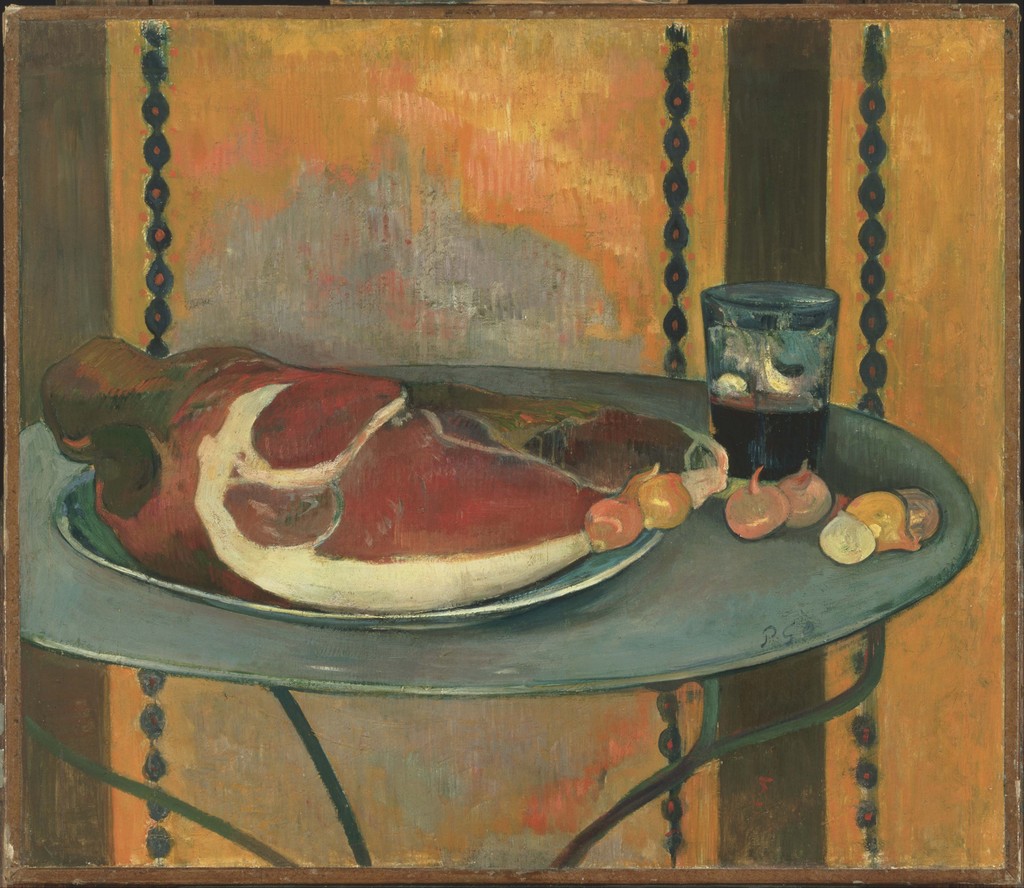
Paul Gauguin, The Ham, 1889. Oil on canvas, 50.2 × 57.8 cm. The Phillips Collection, Washington, DC, 0761. The Phillips Collection / Google Art Project / Wikimedia Commons. Image source. Public domain. Resized without cropping from the supplied reproduction; its provided border is retained.
Annotated Details from The Ham
The numbered points identify visible features discussed in this article. Return from each detail to the whole composition. Each caption identifies the work shown.
The Ham
Édouard Manet, The Ham, about 1875–80. Oil on canvas, 32.4 × 41.2 cm. The Burrell Collection, Glasgow, 35.308. Gifted by Sir William and Lady Burrell to the City of Glasgow, 1944. Édouard Manet / Burrell Collection, Glasgow, via Wikimedia Commons. Image source. Public domain. Numbers added to a separate overview. Two broad detail crops from the supplied reproduction; no enlargement, recolouring or retouching.
The Ham — Gauguin
Paul Gauguin, The Ham, 1889. Oil on canvas, 50.2 × 57.8 cm. The Phillips Collection, Washington, DC, 0761. The Phillips Collection / Google Art Project / Wikimedia Commons. Image source. Public domain. Numbers added to a separate resized whole supplied overview. Detail crops from the unchanged original; no enlargement, retouching or colour alteration.
Details from THE HAM
Follow the numbered details back to the complete images above. Each caption identifies the work shown.
The Ham
The cut face and dark rind
The broad pale band surrounds the irregular warmer divisions of the cut face. The dark rind curves above it and continues down the right.
The knife below the platter
The pale handle and dark blade form a nearly straight horizontal beneath the platter’s curved lower rim. A narrow interval of cloth separates the two objects.
The Ham — Gauguin
Ham and Oval Dish
The red cut surface and pale curved band of the ham sit within the oval dish.
Artworks directory
Explore selected paintings, drawings and prints by Édouard Manet. Search by title or another recorded name.
Frequently Asked Questions
It belongs to the Burrell Collection in Glasgow, with inventory number 35.308.[1]
Yes. He acquired it from Manzi in exchange for a pastel and a small painting.[2]
Discussion
Look again at the images and ideas explored in The Ham by Édouard Manet. These editorial prompts invite your observations.
Reader Insights
Follow the platter around the ham. Where do its pale reflections become dark lines, and where does the edge almost disappear?
Compare the knife with the front of the plate. How does their narrow separation affect the space on the cloth?
Compare Manet’s still life with Gauguin’s. What changes when the table, glass and onions occupy more of the picture?
Join the Conversation
Share a detail, comparison or question about The Ham by Édouard Manet below.
References
- The Metropolitan Museum of Art, Manet/Degas, 2023, official large-print exhibition text, PDF p.178, The Ham, lender credit and Degas’s collection record. View source.
- Colta Ives, Susan Alyson Stein, Julie A. Steiner et al., The Private Collection of Edgar Degas: A Summary Catalogue, The Metropolitan Museum of Art, 1997, no.797, p.87, entry and numbered illustration. View source.
- Denis Rouart and Daniel Wildenstein, Édouard Manet: Catalogue raisonné, tome I, 1975, no.351, pp.266–267, Le Jambon. Digitised catalogue, Wildenstein Plattner Institute. French. View source.
- The Phillips Collection, The Ham, Paul Gauguin, 1889, 0761, collection record and commentary. View source.
- Splash image, Édouard Manet, The Ham, about 1875–80. Oil on canvas, 32.4 × 41.2 cm. The Burrell Collection, Glasgow, 35.308. Gifted by Sir William and Lady Burrell to the City of Glasgow, 1944. Édouard Manet / Burrell Collection, Glasgow, via Wikimedia Commons. Image source. Public domain. Prepared without cropping or enlargement from the supplied reproduction.


