



 by Tom Gurney
Tom Gurney BSc (Hons) is an art history expert with over 20 years experience
Published on June 19, 2020 / Updated on October 30, 2026
Email: tomgurney1@gmail.com / Phone: +44 7429 011000
Woman with a Cigarette by Édouard Manet: Introduction
A woman rests her head against one hand while the other lies at her hip. A cigarette projects from her lips, and two horses crowd the space behind her colourful clothes. Édouard Manet brings these overlapping forms close to the viewer, leaving a broad opening of blue sky above. The painting, formerly known as Gypsy with a Cigarette, belongs to the Princeton University Art Museum, which now calls it Woman with a Cigarette and dates it about 1878–80.[1]
At a Glance
- ArtistÉdouard Manet
- TitleWoman with a Cigarette; formerly Gypsy with a Cigarette
- DateAbout 1878–80.[1]
- MediumOil on canvas
- Dimensions92 × 73.5 cm.[1]
- CollectionPrinceton University Art Museum, y1979-55.[1]
This work across Édouard Manet’s career
Contents
- The Tilted Head and Cigarette
- Two Different Arm Positions
- The Garment and the Black Sash
- Horses Close behind the Figure
- The Blue Opening above
- Names Given after Manet’s Death
- The Possible Connection with Carmen
- From Degas to Princeton
- Annotated details
The Tilted Head and Cigarette
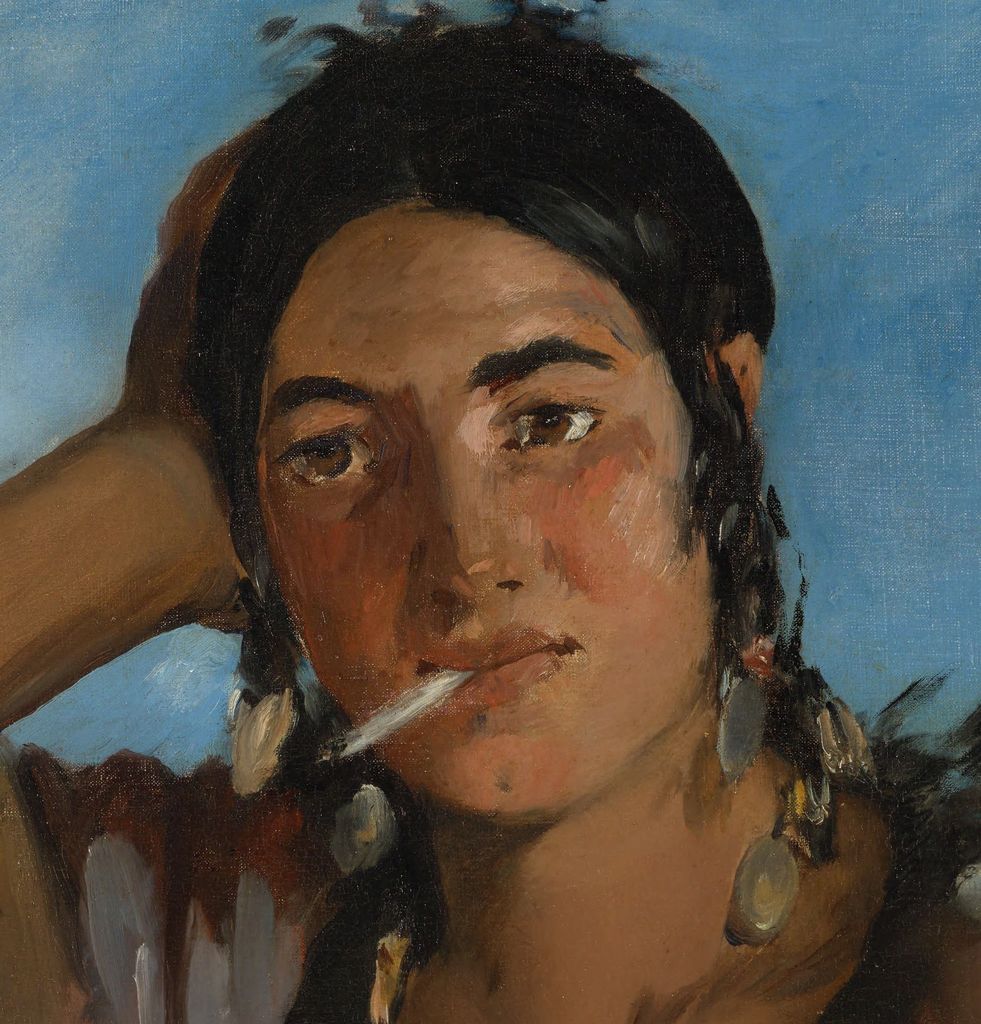
The head leans towards the raised hand at the left of the image. Dark hair forms a substantial shape above the forehead, while loose strokes break its upper edge against the sky. The face is more firmly articulated: darker marks define the eyebrows and eyes, and warmer red-brown passages cross the cheeks. Her glance goes slightly to one side, rather than meeting us squarely.
A short pale cigarette runs diagonally from the mouth towards the lower left. Its narrow shape stands out against the darker area beside the face, making this small object easy to find. The line also carries the eye away from the lips towards the shoulder, where pale ornaments hang beside the hair.
These oval, pendant-like shapes vary from light grey to brown and dark grey. Their broken edges and small highlights distinguish them from the larger passages of skin and fabric.
Two Different Arm Positions
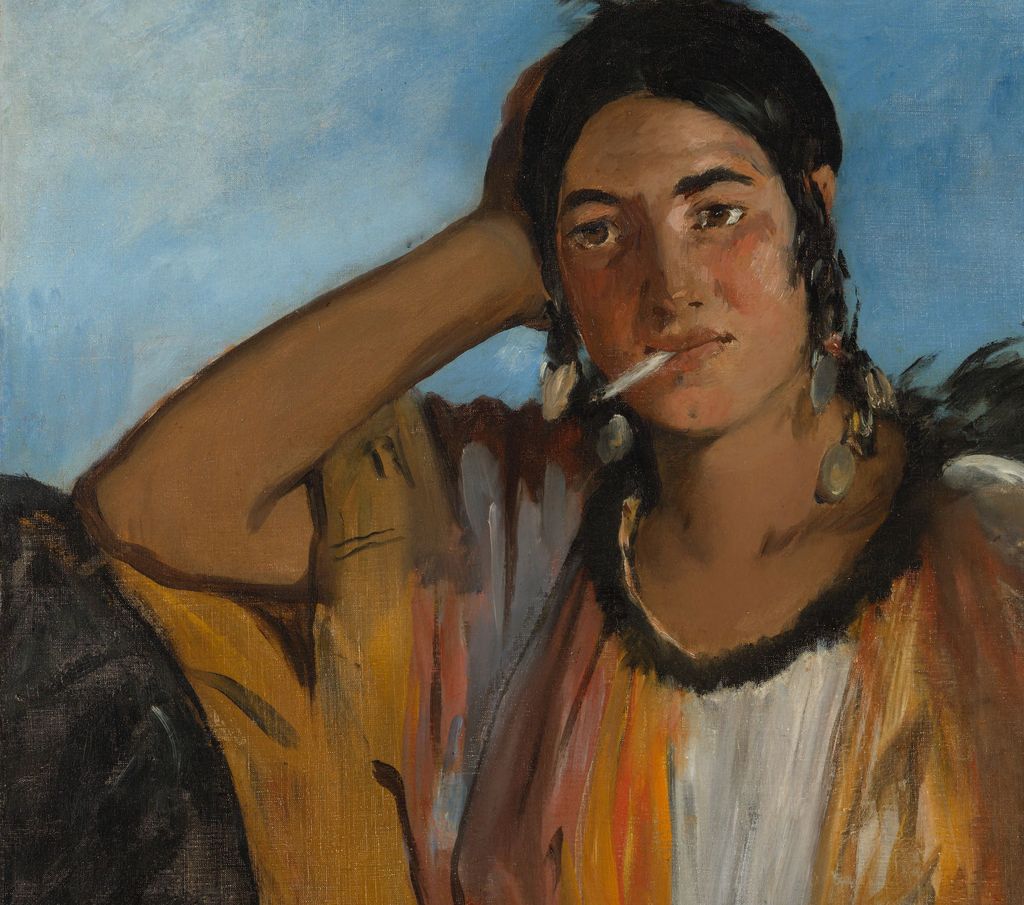
The raised right arm extends towards the image’s left edge before bending back to the head. Its broad, exposed forearm crosses the blue background. A darker line along its lower edge separates it from the clothing, while warmer and cooler brown marks give the arm a rounded appearance. The hand itself is largely concealed beside the dark hair.
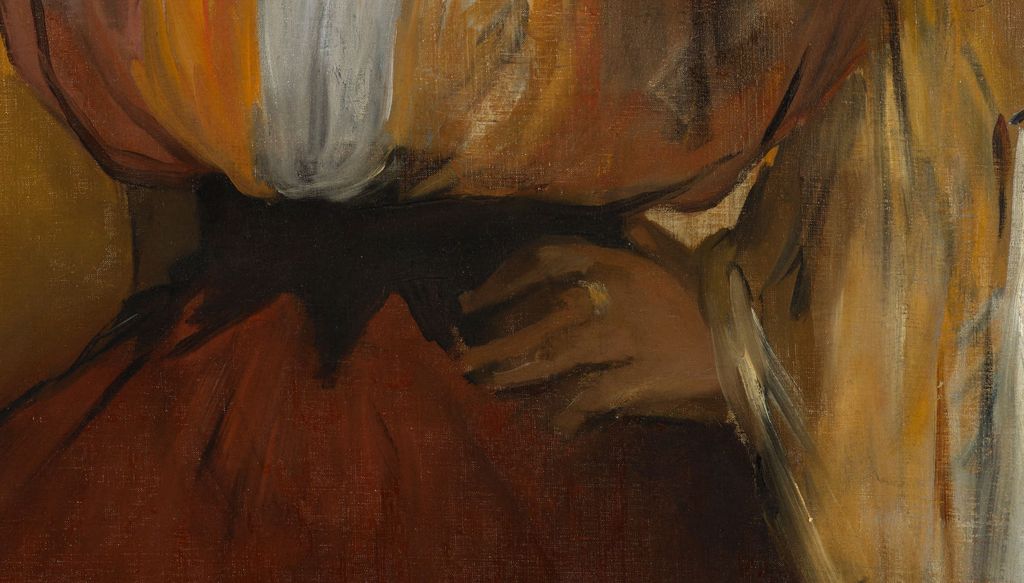
On the opposite side, the left arm bends down towards the waist. The hand rests across the hip, its fingers spreading over darker folds near the black sash. This lower gesture closes the figure’s outline near the body, whereas the raised elbow opens a much wider interval beside the head.
The raised forearm makes a strong diagonal above the shoulder. The lower hand draws attention back towards the waist, where the clothing gathers. The figure occupies the canvas through these changes of direction, rather than through a straight, upright posture.
The Garment and the Black Sash
Orange and yellow passages spread down the loose garment, interrupted by red-brown, grey and paler vertical strokes. Its broad sleeves extend towards both sides of the picture. On the right, long hanging folds carry the fabric nearly to the lower edge, making that side appear more enclosed than the area beneath the raised arm.
A white panel runs down the centre of the chest. Grey strokes divide its lighter surface, and a dark curved neckline separates it from the exposed skin above. The pale fabric widens and narrows as it descends, following the gathering of the garment rather than forming an even rectangular strip.
At the waist, a broad black sash interrupts the brighter colours. Loose dark points fall below it onto the red lower garment. The hip hand lies beside this junction, where fingers, dark folds and reddish cloth meet. Below the sash, the red spreads into larger areas, giving the lower part of the figure a different rhythm from the many narrow marks across the chest and sleeves.
Horses Close behind the Figure
A dark horse occupies the space along the left side and behind the woman’s shoulder. Much of its body joins into a broad dark mass, while shorter, uneven strokes suggest the mane behind her neck. These marks overlap the edges of the hair and clothing, making the different forms appear closely packed together.
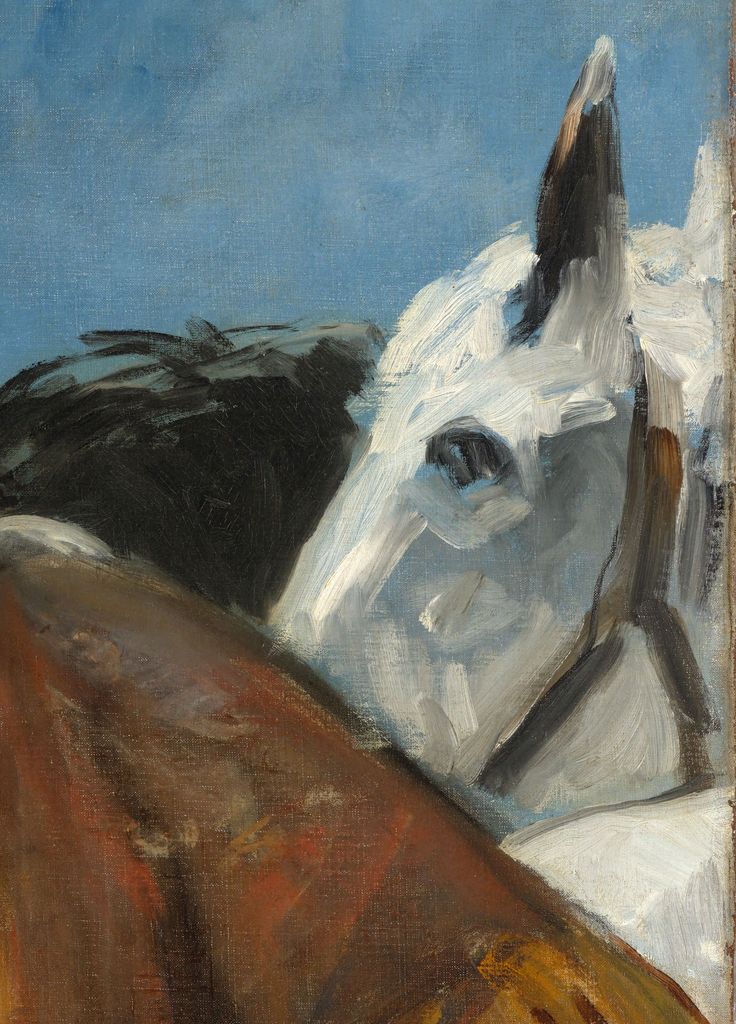
The pale horse at the right is described more distinctly. One upright ear rises into the sky, and the dark eye sits among angular white and blue-grey passages. Narrow darker bands cross the face and cheek. The horse’s head is partly concealed by the woman’s shoulder, with the rest passing beyond the right edge.
This unequal visibility makes the two animals contribute differently to the composition. The dark horse supplies a substantial shape beside the raised arm; the pale head introduces a smaller cluster of sharp contrasts near the opposite shoulder. Both bring the surrounding space close to the woman. There is little open ground between the figures to explain their positions through distance.
The Blue Opening above
Sky fills much of the upper third, opening a broad area above the head and raised arm. Its blues vary considerably. Paler strokes run through the centre, while darker blue and grey marks stretch diagonally near the top. A small white passage remains at the upper right.
The sky’s relatively open surface gives the eye a rest from the denser overlaps below. It also separates the head, arm and horse’s ear, allowing each outline to register against a cooler colour. Along the lower part of the painting, the forms crowd together again: red cloth, black horse and hanging sleeve reach the edges, with only a small pale angular patch surviving at the lower left.
Annotated Details from Woman with a Cigarette
The numbered points identify visible features discussed in this article. Return from each detail to the whole composition. Édouard Manet, Woman with a Cigarette, about 1878–80. Oil on canvas, 92 × 73.5 cm. Princeton University Art Museum, Bequest of Archibald S. Alexander, Class of 1928, y1979-55. Image courtesy of the Princeton University Art Museum. Image source. Official public domain image offer; free use without approvals under Princeton Image Use and Access. Resized without cropping from the supplied museum reproduction.
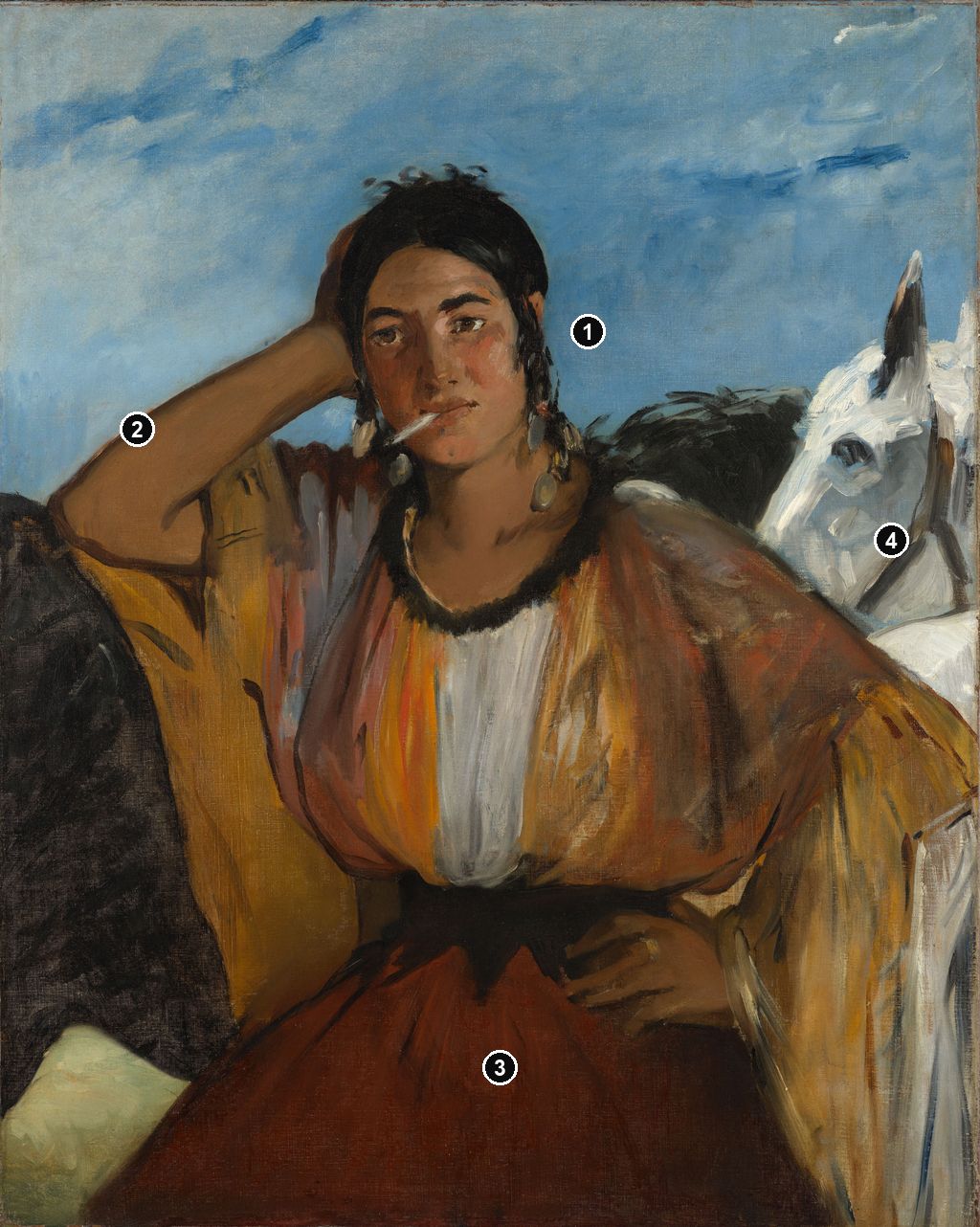
Details from WOMAN WITH A CIGARETTE
Move from the face and cigarette to the raised arm, then compare the gathered waist with the pale horse behind the shoulder.
The face and cigarette
The tilted head is framed by dark hair and oval pendant-like forms. A short pale cigarette projects diagonally from the lips.
The raised arm and dark horse
The raised forearm crosses the blue sky before the hand disappears beside the head. The dark horse and warm garment fill the space beneath the elbow.
The sash and hip hand
The hand spreads beside the broad black sash. Dark points and reddish folds interrupt the brighter vertical passages of the garment.
The pale horse’s head
An upright ear and dark eye stand out among angular white and blue-grey passages. Narrow darker bands cross the face beside the woman’s shoulder.
Names Given after Manet’s Death
The sitter’s identity remains unknown. The painting was found in Manet’s studio after his death, and later titles variously described her as Bohemian, Mexican or Indian. Scholars began using Gypsy with a Cigarette in the 1930s. Princeton changed the title in 2023, recognising the former term’s derogatory nature and the uncertainty surrounding the woman’s identity.[1]
The French catalogue raisonné published by Denis Rouart and Daniel Wildenstein in 1975 called the work Indienne fumant une cigarette. It placed it in 1861 and listed dimensions of 91 × 73 cm.[2] Those details belong to the painting’s cataloguing history. The older date and measurements differ from Princeton’s current record.[1]
The Possible Connection with Carmen
The Metropolitan Museum’s 2023 Manet/Degas exhibition label notes that no record of Manet’s original title or date has been discovered. It suggests that contemporary interest in Spanish culture may have shaped the painting and proposes a possible connection with Bizet’s Carmen, first performed in Paris in 1875.[3] This remains an interpretation of the picture’s setting and subject, rather than a secure identification of the woman depicted.
From Degas to Princeton
Edgar Degas bought the painting in 1896, and it appeared in the sale of his collection in 1918. It later entered Archibald S. Alexander’s collection and came to Princeton through his bequest.[1] Its combination of a loosely arranged pose, brightly divided fabric and tightly overlapping figures remains distinctive within Manet’s paintings of women.
Artworks directory
Explore selected paintings, drawings and prints by Édouard Manet. Search by title or another recorded name.
Frequently Asked Questions
Her identity is unknown.[1]
That historical title entered scholarly use in the 1930s. Princeton renamed the painting Woman with a Cigarette in 2023.[1]
Discussion
Look again at the images and ideas explored in Woman with a Cigarette by Édouard Manet. These editorial prompts invite your observations.
Reader Insights
Follow the raised arm from elbow to head, then look at the lower hand beside the sash. How do the two gestures divide the canvas?
Compare the narrow marks across the chest with the broader red passages below. What changes where the black sash interrupts them?
Compare the dark body at the left with the pale head at the right. How much of each animal do you need to recognise its place behind the woman?
Join the Conversation
Share a detail, comparison or question about Woman with a Cigarette by Édouard Manet below.
References
- Princeton University Art Museum, Woman with a Cigarette, y1979-55, current object record, title history and provenance. View source.
- Denis Rouart and Daniel Wildenstein, Édouard Manet: Catalogue raisonné, tome I, 1975, cat.46, pp.58–59, Indienne fumant une cigarette, entry and numbered illustration. Digitised catalogue, Wildenstein Plattner Institute. French. View source.
- The Metropolitan Museum of Art, Manet/Degas, 2023, official large-print exhibition text, PDF p.177, Woman with a Cigarette. View source.
- Splash image, Édouard Manet, Woman with a Cigarette, about 1878–80. Oil on canvas, 92 × 73.5 cm. Princeton University Art Museum, Bequest of Archibald S. Alexander, Class of 1928, y1979-55. Image courtesy of the Princeton University Art Museum. Image source. Official public domain image offer; free use without approvals under Princeton Image Use and Access. Resized without cropping from the supplied museum reproduction.


