



 by Tom Gurney
Tom Gurney BSc (Hons) is an art history expert with over 20 years experience
Published on June 19, 2020 / Updated on October 30, 2026
Email: tomgurney1@gmail.com / Phone: +44 7429 011000
The Blonde with Bare Breasts by Édouard Manet: Introduction
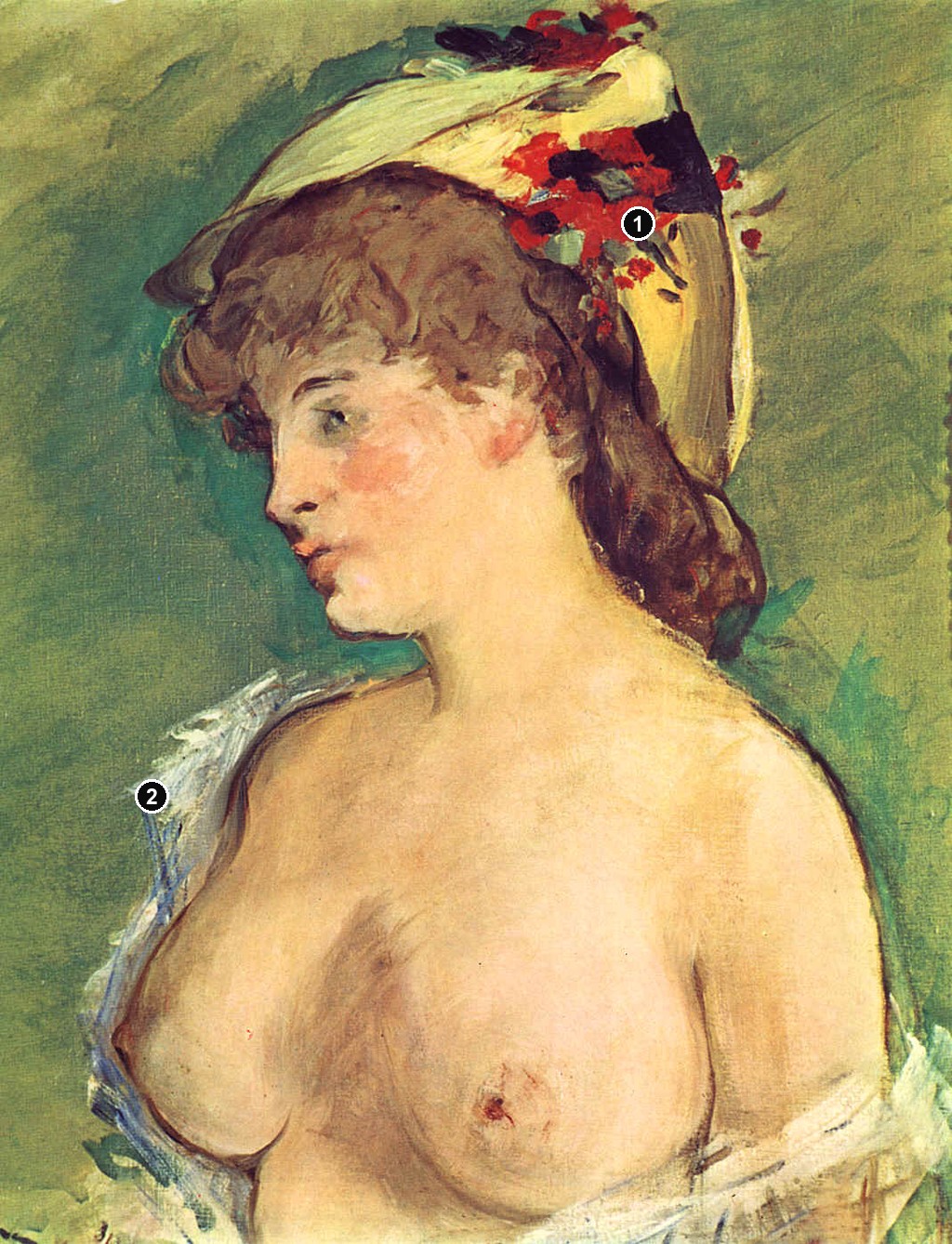
A pale hat decorated with red flowers sits above a face turned towards the left. Below it, a light upper body fills much of the picture, framed by loose clothing and a green background. In Édouard Manet’s The Blonde with Bare Breasts, a few sharply distinguished elements make a concentrated portrait.
The Musée d’Orsay records the painting as La Blonde aux seins nus, dated about 1878. Painted in oil on canvas, it measures 62.5 × 52 cm and belongs to the museum’s collection under inventory number RF 2637.[1]
At a Glance
- ArtistÉdouard Manet
- TitleLa Blonde aux seins nus / The Blonde with Bare Breasts
- DateAbout 1878
- MediumOil on canvas
- Dimensions62.5 × 52 cm
- CollectionMusée d’Orsay, Paris, RF 2637; Étienne Moreau-Nélaton bequest, 1927.[1]
This work across Édouard Manet’s career
Contents
- A Hat Close to the Upper Edge
- The Turn of the Head
- Light Fabric against the Figure
- A Descriptive Title and an Unidentified Portrait
- Comparing Before the Mirror
- From Mme Manet to the Musée d’Orsay
- Annotated details
A Hat Close to the Upper Edge
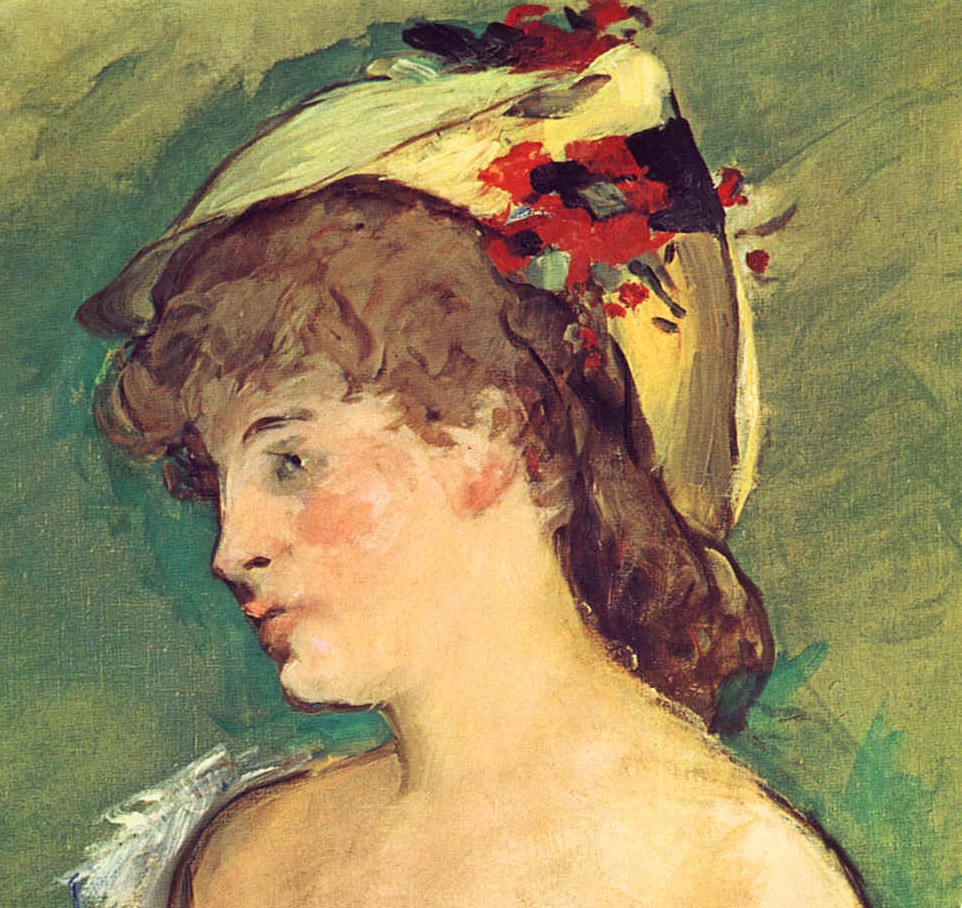
The hat gives the upper part of the composition a broad, irregular shape. Its pale brim tilts across the head, extending farther towards the left than the woman’s face. On the right, a hanging section descends beside the hair. These two directions help the hat enclose the head without forming a symmetrical frame around it.
Red flower-like touches cluster near the crown and the right side. Darker passages interrupt them, while pale yellow and greenish strokes describe the surrounding hat. The decoration is built from contrasting patches rather than a sequence of evenly outlined petals. Seen together, these marks create a conspicuous area of colour above the more softly modelled face.
The hat also brings several parts of the portrait into contact. Its brim touches the brown curls over the forehead; the trailing side lies beside the darker hair at the back of the neck. Pale passages in the hat recur in the light body and clothing below, while the concentrated red accents give the upper edge a different emphasis.
The Turn of the Head
The woman’s face turns towards the left, revealing the nearer cheek and ear while bringing the nose and mouth into a clear outline. A small dark eye directs attention beyond the side of the canvas. The lips form another dark interruption in the light face, and the curve of the jaw leads down towards the long pale neck.
Brown curls make an uneven border above the forehead. Behind the ear, larger dark shapes gather against the green background and continue down the neck. These passages give the head a different outline on each side: open towards the left, more densely enclosed by hair and hat towards the right.
Pink and ochre tones vary across the cheek, ear and throat. A lighter passage runs through the cheek and jaw, while darker colour helps separate the underside of the chin from the neck. The face contains numerous small changes within a relatively limited area, encouraging attention to features as well as to the broader direction of the pose.
The turn is especially noticeable against the broader upper body. The head carries the gaze sideways, whereas the shoulders and exposed torso establish a larger pale mass below.
Light Fabric against the Figure
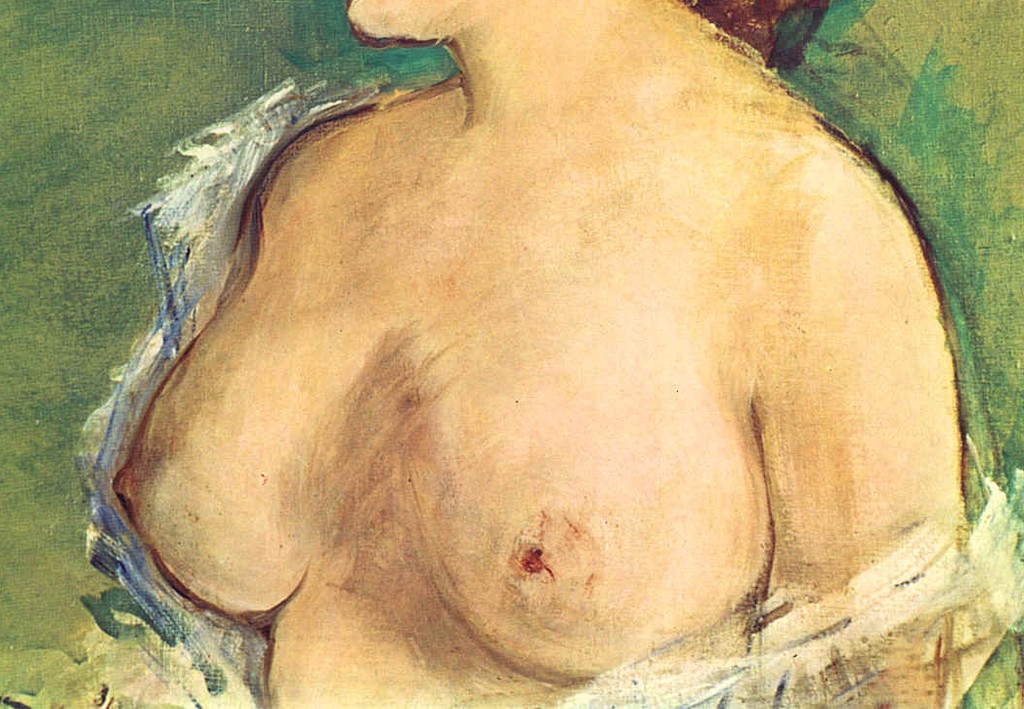
The displaced clothing remains important to the composition. At the left, white and blue-grey marks rise beside the shoulder and continue down the side of the chest. Near the lower edge, a wider band of pale fabric crosses the figure. At the right, the cloth meets the rounded arm before passing out of the picture.
Its broken light and dark strokes differ from the broader passages describing the skin. Some marks run diagonally; others catch the edges of folds or gather into short, uneven lines. They make the clothing register as a separate material without requiring every fold to be continuously outlined.
The fabric also connects the figure to the edges. The hat nearly reaches the top, the body fills the lower part, and the loose clothing passes beyond the sides and bottom. This close framing gives the subject a strong presence within a small canvas. There is little room for an object or piece of furniture to compete with the figure.
The green field provides a third kind of surface. Broad changes in tone and direction animate it, but they do not resolve into a detailed room. Darker green beside the face makes its light contour distinct, while warmer passages appear elsewhere around the hat and shoulders. Background, fabric and skin remain separate enough to be recognised, yet their adjacent colours repeatedly bring them together.
A Descriptive Title and an Unidentified Portrait
The Musée d’Orsay currently classifies the painting as an unidentified portrait.[1] The French national collection record describes a woman at half length, in three-quarter view, with bare chest and hat; it also records the lower-left monogram E.M.[2] These concise catalogue descriptions identify what is represented and how the work is recorded, without supplying a secure personal biography for the sitter.
The title names visible characteristics rather than a person or an event. Brown and ochre passages in the hair sit beside the pale hat and warm skin tones. These colour relationships help distinguish the head’s separate parts, while the sitter’s name and the circumstances of the sitting remain uncertain.
Comparing Before the Mirror
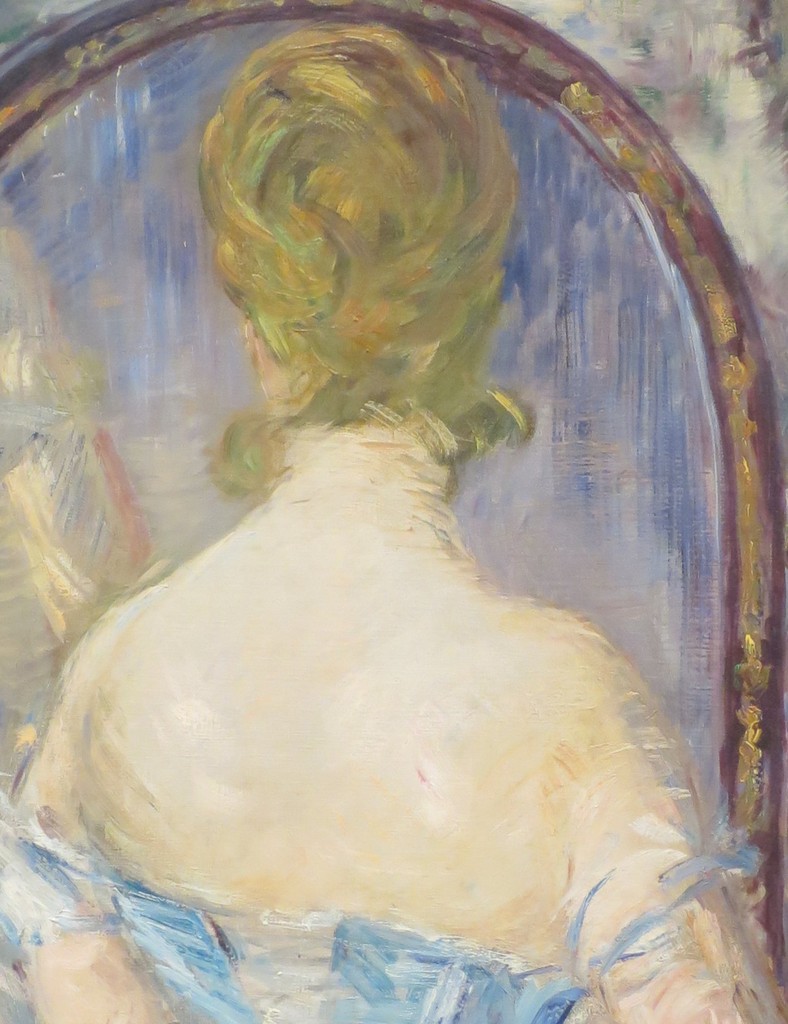
Manet approached a partly dressed figure very differently in Before the Mirror, now in the Solomon R. Guggenheim Museum. The museum dates that oil on canvas to 1876 and gives its dimensions as 93 × 71.6 cm.[3] It is a larger composition in which a woman turns her back towards the viewer before an oval mirror.
Pale shoulders and nape appear above a blue corset and light lower clothing. A dark curved mirror frame, bright touches and patterned blue-white surroundings give the room a substantial role. The reflection remains indistinct. Unlike the more isolated face in The Blonde with Bare Breasts, the figure here shares attention with a mirror and the surrounding furnishings.
Nancy Spector’s Guggenheim commentary emphasises the vigorous handling and its effect of immediacy.[3] Light strokes cross the clothing and body, while comparable marks enliven the drapery, wall and reflection. The dressing motif offers a way to bring several different surfaces into the same active field of paint.
In a published 2025 essay excerpt, Emily Beeny argues for autumn 1877, rather than the Guggenheim’s 1876 date, using a reported studio visit and the chronology of Manet’s stay at Montgeron. She also treats Before the Mirror as an independent experiment rather than a preparatory study for Nana.[4] The dating argument belongs to that comparison painting; The Blonde with Bare Breasts retains the Orsay’s approximate 1878 date.
Clothing and setting carry different weight in these pictures: a narrow fabric border around the torso here, a substantial part of an inhabited room in Before the Mirror.
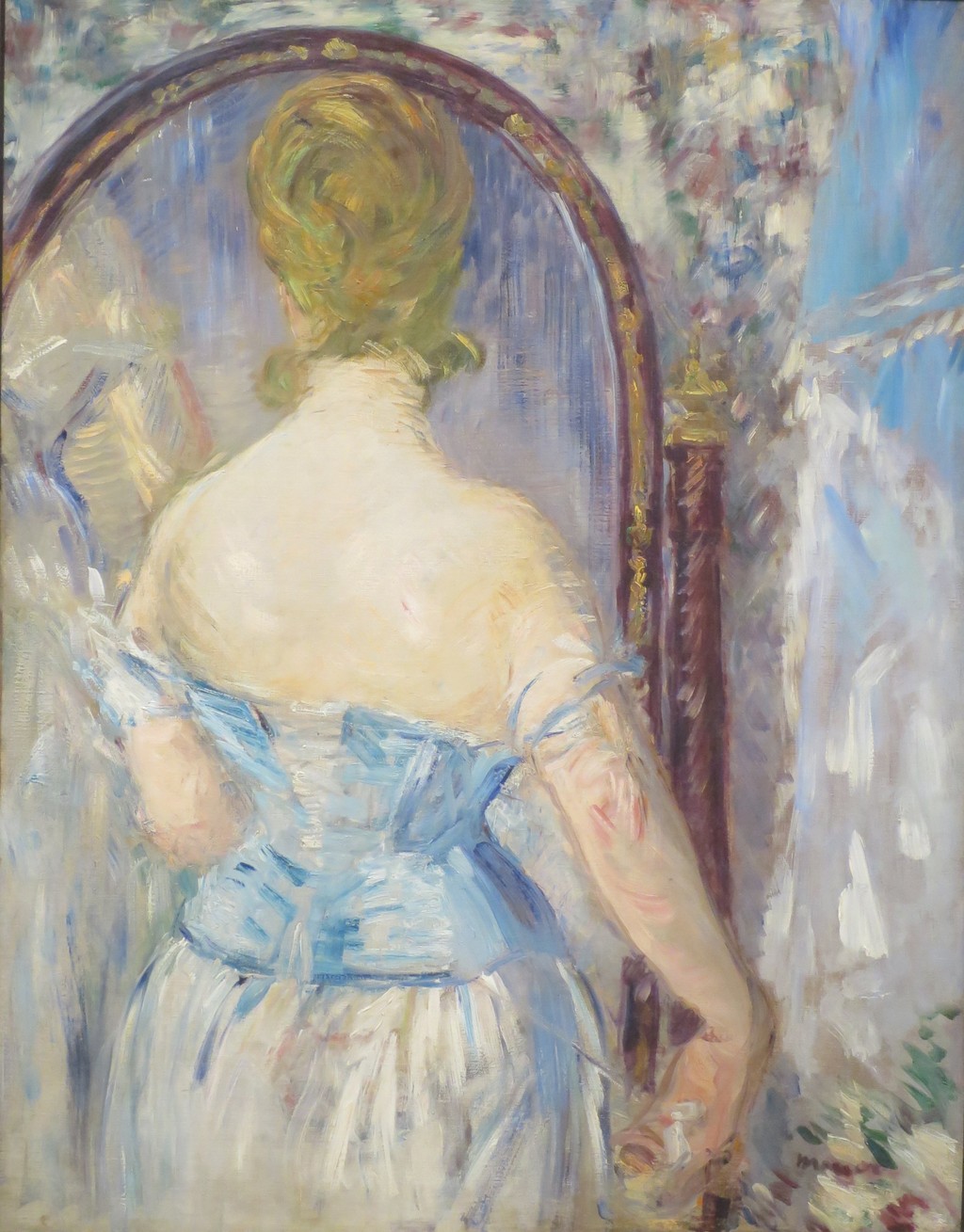
Édouard Manet, Before the Mirror (Devant la glace), 1876 (museum date). Oil on canvas, 93 × 71.6 cm. Solomon R. Guggenheim Museum, New York, 78.2514.27; Thannhauser Collection, Gift, Justin K. Thannhauser, 1978. Solomon R. Guggenheim Museum, New York, Thannhauser Collection; faithful reproduction via Wikimedia Commons / Wmpearl. Image source. Public domain.
From Mme Manet to the Musée d’Orsay
The painting’s collecting history supplies firmer names than its subject’s identification. According to the Orsay’s provenance, it remained in Mme Manet’s collection until 1894, when Ambroise Vollard acquired it from her. It subsequently belonged to Étienne Moreau-Nélaton, whose bequest brought it into the national collection in 1927.[1]
Its museum history passed through several Paris institutions. It was assigned to the Louvre in 1927, housed at the Musée des Arts décoratifs until 1934, and then at the Louvre until 1947. It spent the following decades at the Jeu de Paume before its assignment to the Musée d’Orsay in 1986.[1]
The Orsay also records its inclusion in the major 1983 Manet exhibitions in Paris and New York and in Manet, inventeur du Moderne in 2011.[1] The small portrait has therefore appeared within broader public accounts of Manet’s work, alongside the continuing catalogue distinction between its familiar descriptive title and an unidentified sitter.
Annotated Details from The Blonde with Bare Breasts
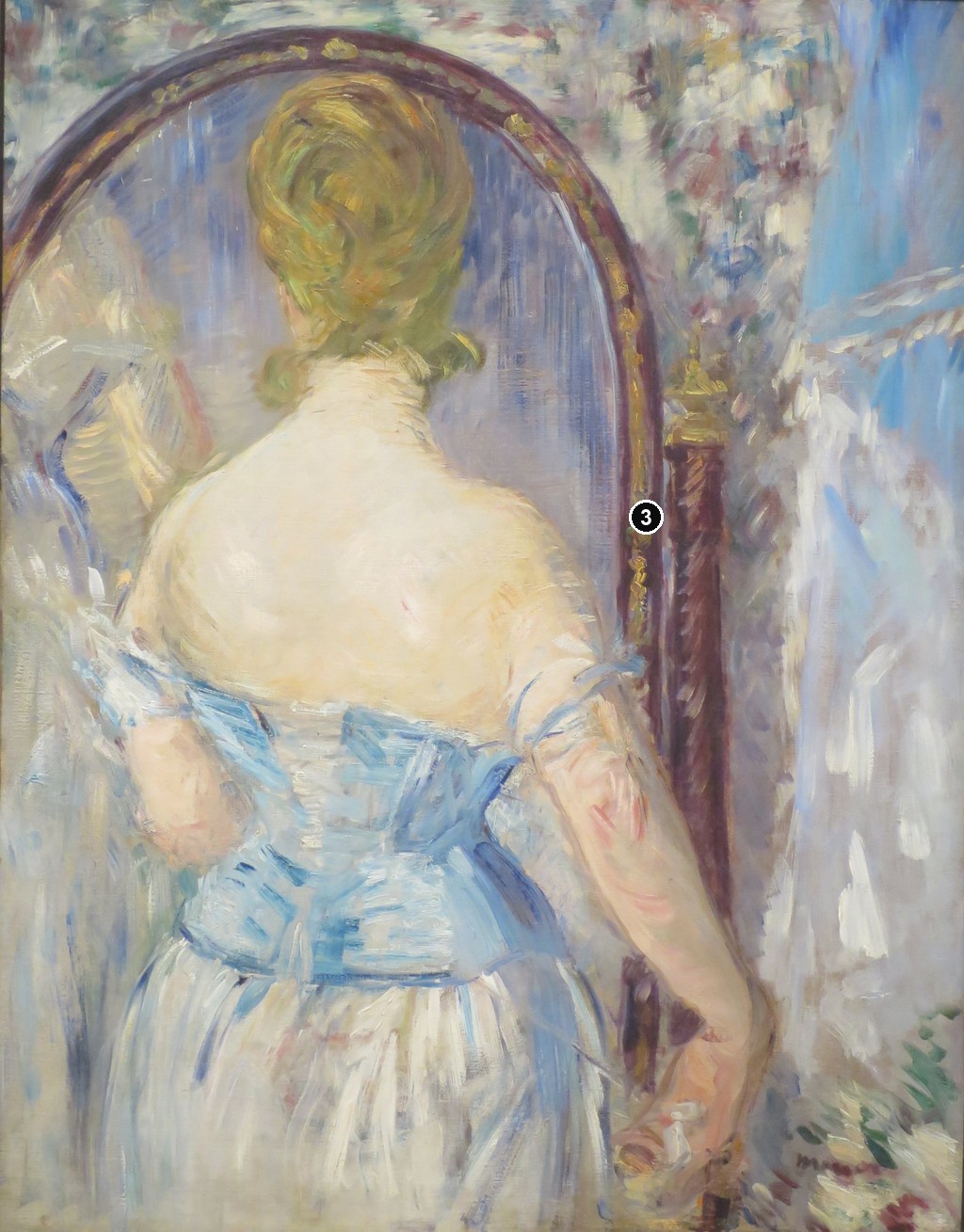
The numbered points identify visible features discussed in this article. Return from each detail to the whole composition. Each caption identifies the work shown.
The Blonde with Bare Breasts
Édouard Manet, La Blonde aux seins nus (The Blonde with Bare Breasts), about 1878. Oil on canvas, 62.5 × 52 cm. Musée d’Orsay, Paris, RF 2637; Étienne Moreau-Nélaton bequest, 1927. Musée d’Orsay, Paris; public-domain reproduction via Wikimedia Commons (source/photographer unrecorded). Image source. Public domain. Supplied reproduction; lower-left inscription and perimeter partly clipped.
Woman Before a Mirror
Édouard Manet, Before the Mirror (Devant la glace), 1876 (museum date). Oil on canvas, 93 × 71.6 cm. Solomon R. Guggenheim Museum, New York, 78.2514.27; Thannhauser Collection, Gift, Justin K. Thannhauser, 1978. Solomon R. Guggenheim Museum, New York, Thannhauser Collection; faithful reproduction via Wikimedia Commons / Wmpearl. Image source. Public domain. Numbers added to a separate resized overview. Detail crops from the supplied public-domain reproduction; no enlargement or retouching.
Details from THE BLONDE WITH BARE BREASTS
Follow the numbered details back to the complete images above. Each caption identifies the work shown.
The Blonde with Bare Breasts
Hat and turned head
The tilted brim, red decoration and hanging side surround the turned head unevenly. Brown curls and the light face form smaller shapes within this broad arrangement.
Fabric beside the figure
Broken white and blue-grey strokes run beside the shoulder and across the lower edge. Their narrow folds contrast with the broader light passages describing the figure.
Woman Before a Mirror
The Chignon and Pale Back
Coiled blond hair sits above the broad pale back. Short light strokes break into the surrounding blue-grey.
Artworks directory
Explore selected paintings, drawings and prints by Édouard Manet. Search by title or another recorded name.
Frequently Asked Questions
The Musée d’Orsay dates it to about 1878.[1]
The current Musée d’Orsay record classifies it as an unidentified portrait. A proposed name should not be treated as certain without supporting evidence.[1]
It belongs to the Musée d’Orsay in Paris, inventory RF 2637. It entered the French national collection through Étienne Moreau-Nélaton’s 1927 bequest.[1]
Discussion
Look again at the images and ideas explored in The Blonde with Bare Breasts by Édouard Manet. These editorial prompts invite your observations.
Reader Insights
Follow the hat’s tilted brim and hanging side. How do they create different borders around the turned head?
Compare the broad light body with the broken white and blue-grey clothing. How do the different marks distinguish these surfaces?
Compare the concentrated figure here with the room and reflection in Before the Mirror. Where does each picture distribute attention?
Join the Conversation
Share a detail, comparison or question about The Blonde with Bare Breasts by Édouard Manet below.
References
- Musée d’Orsay, La Blonde aux seins nus, RF 2637; current object facts, unidentified-portrait classification, provenance and exhibition history (in French). View source.
- Ministère de la Culture, POP/Joconde, La blonde aux seins nus, 000PE003902; subject description, monogram and collection data (in French). View source.
- Nancy Spector / Solomon R. Guggenheim Museum, Before the Mirror (Devant la glace), 78.2514.27; current collection essay and object facts (in English). View source.
- Emily A. Beeny, published excerpt from “Manet & Morisot,” Yale University Press, 7 November 2025; the comparison painting’s handling and argued 1877 date (in English). View source.
- Splash image, Édouard Manet, La Blonde aux seins nus (The Blonde with Bare Breasts), about 1878. Oil on canvas, 62.5 × 52 cm. Musée d’Orsay, Paris, RF 2637; Étienne Moreau-Nélaton bequest, 1927. Musée d’Orsay, Paris; public-domain reproduction via Wikimedia Commons (source/photographer unrecorded). Image source. Public domain. Supplied reproduction; lower-left inscription and perimeter partly clipped.


