



 by Tom Gurney
Tom Gurney BSc (Hons) is an art history expert with over 20 years experience
Published on June 19, 2020 / Updated on October 30, 2026
Email: tomgurney1@gmail.com / Phone: +44 7429 011000
Laundry by Édouard Manet: Introduction
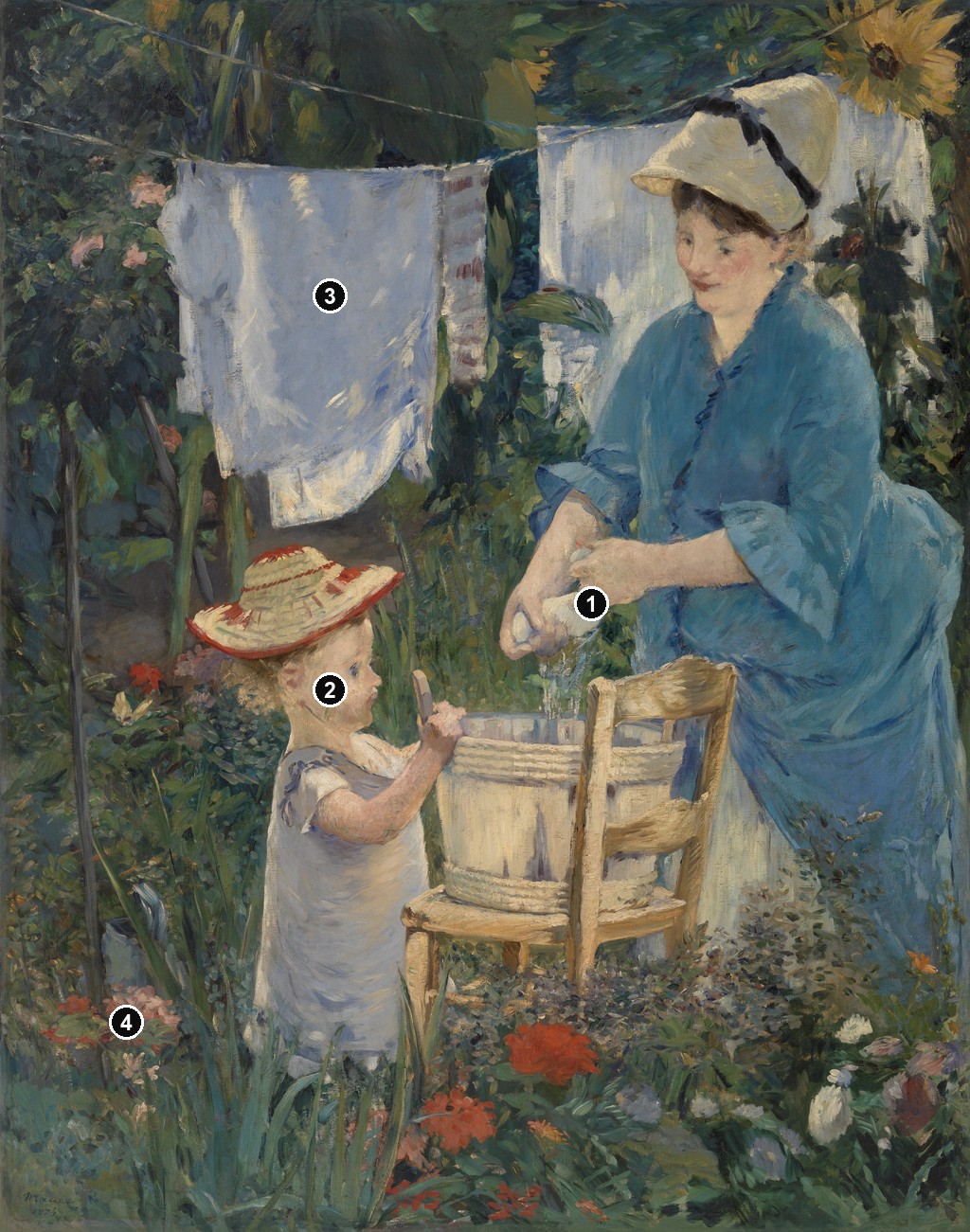
In Laundry, a woman wrings a pale cloth over a wooden tub while a child stands beside her. Hanging linen, flowers and dense greenery surround them. Édouard Manet painted the canvas in 1875; it now belongs to the Barnes Foundation in Philadelphia.[1] Its French title, Le Linge, directs attention to the washing that connects the figures with the bright fabric behind them.
At a Glance
- ArtistÉdouard Manet
- TitleLaundry (Le Linge)
- Date1875
- MediumOil on canvas
- Dimensions145.4 × 114.9 cm
- CollectionBarnes Foundation, Philadelphia
- Accession numberBF957.[1]
This work across Édouard Manet’s career
Contents
- Washing in a Garden
- Hands and Water
- Linen and Light
- Flowers Around the Figures
- Outdoor Effects and Worked Paint
- The Salon Rejection of 1876
- Two Images of Laundry
- Annotated details
Washing in a Garden
The woman occupies the right side of the tall canvas. Her blue dress expands below the waist, carrying a substantial area of colour from the shoulder towards the lower edge. She inclines her head and brings both hands forward, concentrating the action above the tub. The bent arms lead away from the large shape of the dress towards the smaller pale cloth.
Her light hat has a dark ribbon that turns across its crown and hangs behind. Its broad brim shades the forehead, while loose brown strands emerge around the face. The hat creates a pale shape high on the canvas, answering the laundry suspended nearby. Below it, the warm face and exposed forearms interrupt the cooler blue of the clothing.
The setting feels enclosed. Leaves and tall stems fill the background, and flowers extend across the foreground. There is no open expanse of sky or distant building to draw the eye away. Washing takes place in a narrow space between the screen of hanging cloth and the plants close to the viewer.
Hands and Water
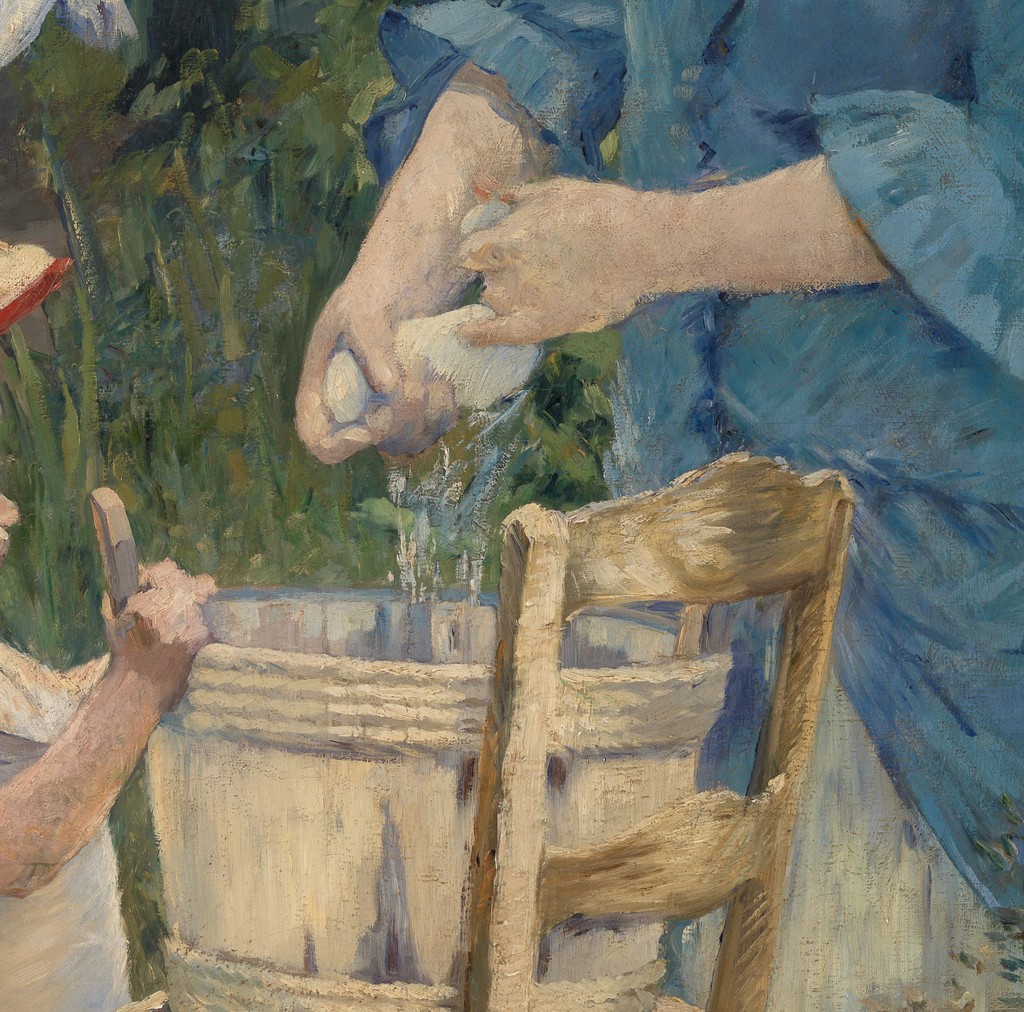
The cloth passes between hands that turn in different directions. One hand holds a rounded end near the left forearm; the other presses across the fabric higher up. Narrow light strokes descend from this point towards the tub. They give the falling water a fragile appearance against the darker vegetation behind it.
Manet brings the equipment close to the front of the picture. The tub rests on a chair, whose back rises between it and the viewer. A curved upper rail crosses the washing vessel, and a lower rail repeats that movement beneath it. The chair legs descend into the flowers. These overlapping wooden forms make the arrangement more intricate than a simple view of a basin on a stand.
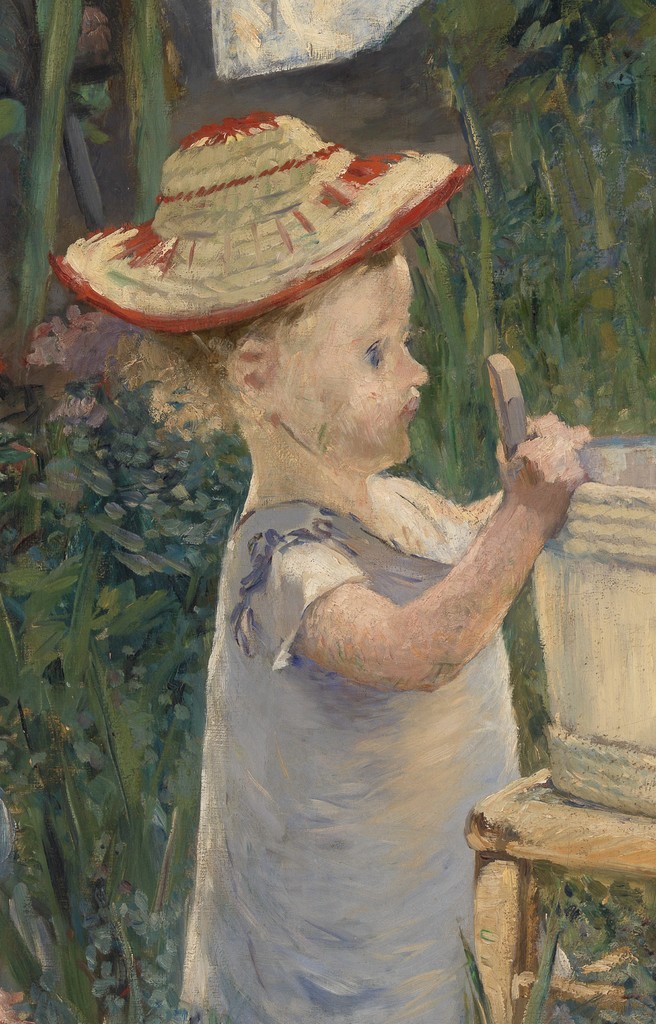
The child stands to the left, face turned towards the washing. A small raised hand holds a narrow wooden implement near the rim. The child's pale garment carries cooler marks around the shoulder and neck, while a red band traces the hat's broad edge. Its tilted brim projects towards the woman, helping connect the two figures across the water.
Much of their lower bodies disappears among the plants, concealing their footing and keeping the hands, faces and tub prominent. Neither figure turns towards the spectator.
Linen and Light
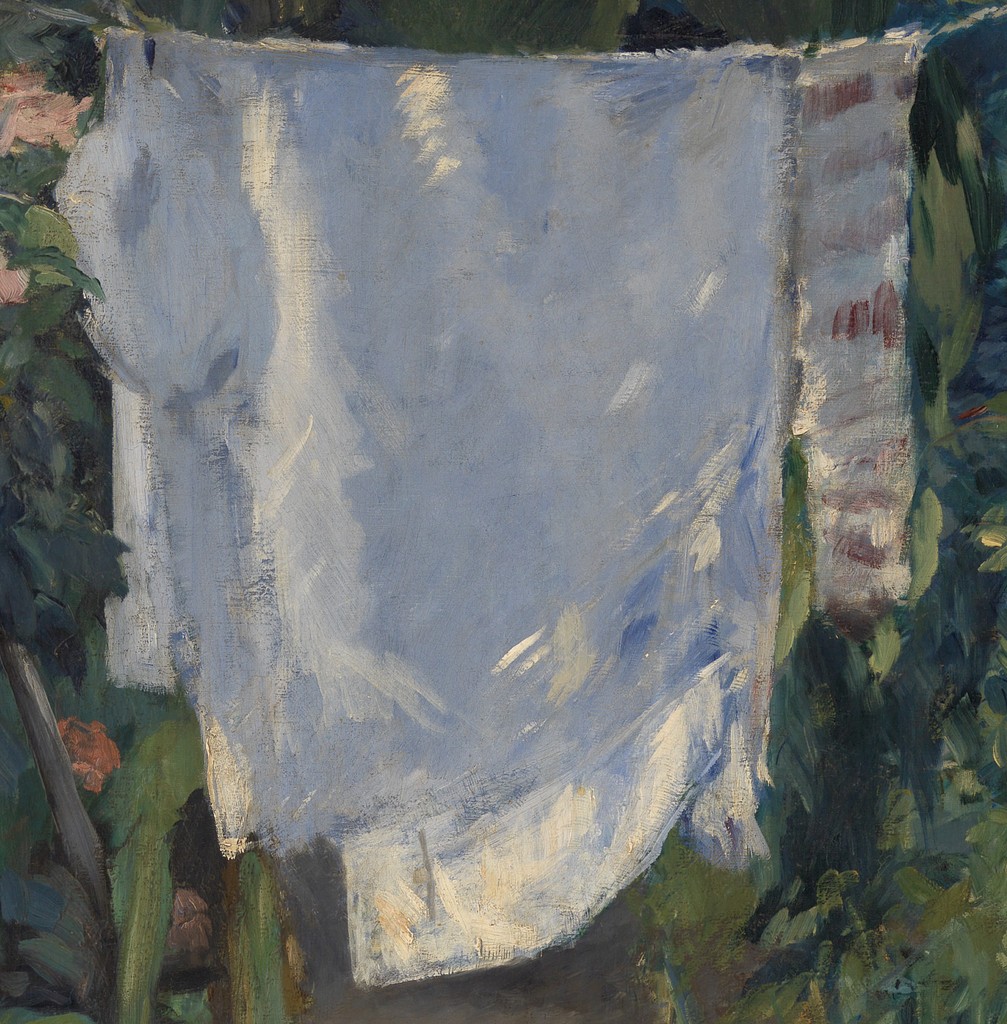
Behind the child, a broad piece of linen hangs from a sloping line. Its upper edge stretches fairly straight, but the lower portion gathers and bends. Pale yellow-white marks catch these folds; blue and gray passages spread through the larger surface. The fabric appears luminous without becoming an empty white rectangle.
A narrower striped piece hangs beside it. Its reddish marks introduce another scale of pattern between the broad linen and the many small leaves. Farther right, a second large pale cloth rises behind the woman's head and shoulders. Together, the hanging pieces create a broken screen across the upper half of the painting.
Thin clotheslines travel diagonally through the greenery above. Their taut directions differ from the softer edges of the cloth and the twisting growth around them.
Writing in 1906, the French critic Théodore Duret emphasized the combination of the woman's blue dress, green plants and white washing. He connected this juxtaposition of strong colours with the earlier Argenteuil.[2] His account draws attention to how much of the picture's effect comes from neighbouring areas of colour.
Flowers Around the Figures
Red blooms punctuate the lower part of the canvas. Their scattered positions carry the eye across the chair legs and the base of the dress. Pale flowers, smaller pink touches and darker foliage keep this foreground varied. The plants overlap objects instead of forming a neat border beneath them.
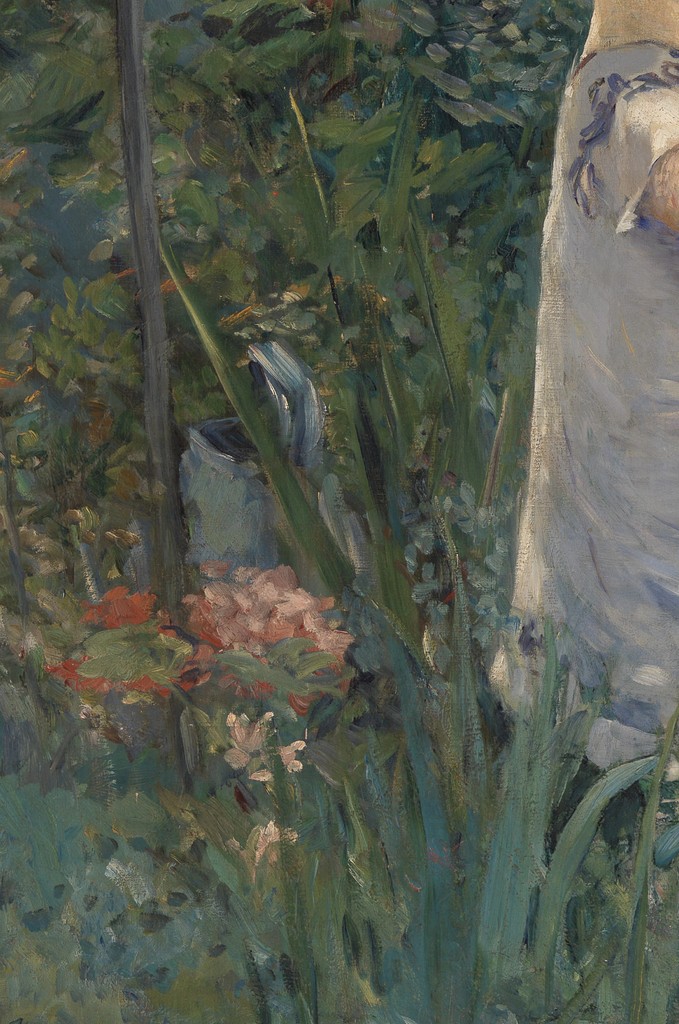
A watering can is partly hidden low on the left. Its curved handle emerges among the long leaves, and its spout makes a firm diagonal through the vegetation. This small piece of garden equipment adds another hollow vessel beside the much larger washing tub. It also brings a distinct manufactured shape into the loose tangle of stems.
At the upper right, a large yellow flower is partly cut by the edge. Its broad petals make a conspicuous warm patch above the woman's hat. The cropped flower and the vegetation pressing against the lower edge give the garden a sense of continuing beyond the canvas.
Outdoor Effects and Worked Paint
The bright linen and broken marks suggest changing outdoor light. Yet the painting's apparent freshness does not necessarily mean that it was completed quickly. In her study of Manet and the Gare Saint-Lazare, Juliet Wilson-Bareau describes Laundry as a densely worked canvas.[3]
Discussing a September 1875 letter to Mallarmé, Margaret Werth notes that the extent of Manet's outdoor work on this canvas remains unknown.[4] An effect of open air does not settle how the whole painting was made.
The Salon Rejection of 1876
The jury rejected Laundry from the Salon of 1876. Manet subsequently showed it independently in his studio, where the Barnes exhibition history records a display from 15 April to 1 May.[1][3] An everyday subject in bright surroundings had become part of his continuing struggle for acceptance at the official exhibition.
Duret later interpreted the refusal as a reaction against the colour and outdoor painting associated with Argenteuil. His account also describes divided responses to the studio display, alongside support from Manet's friends.[2] The rejection belongs to the broader history of Manet at the Salon.
Two Images of Laundry
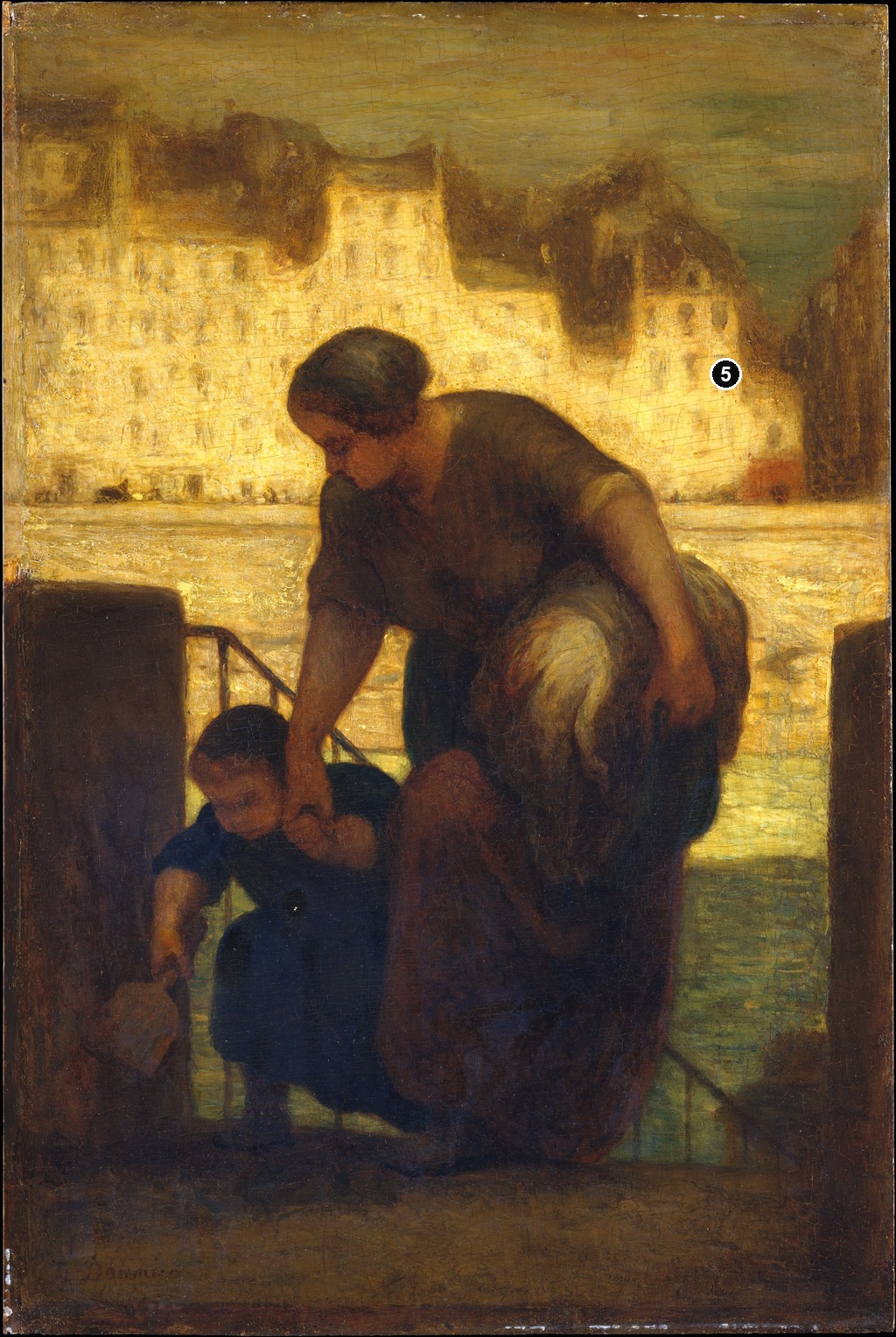
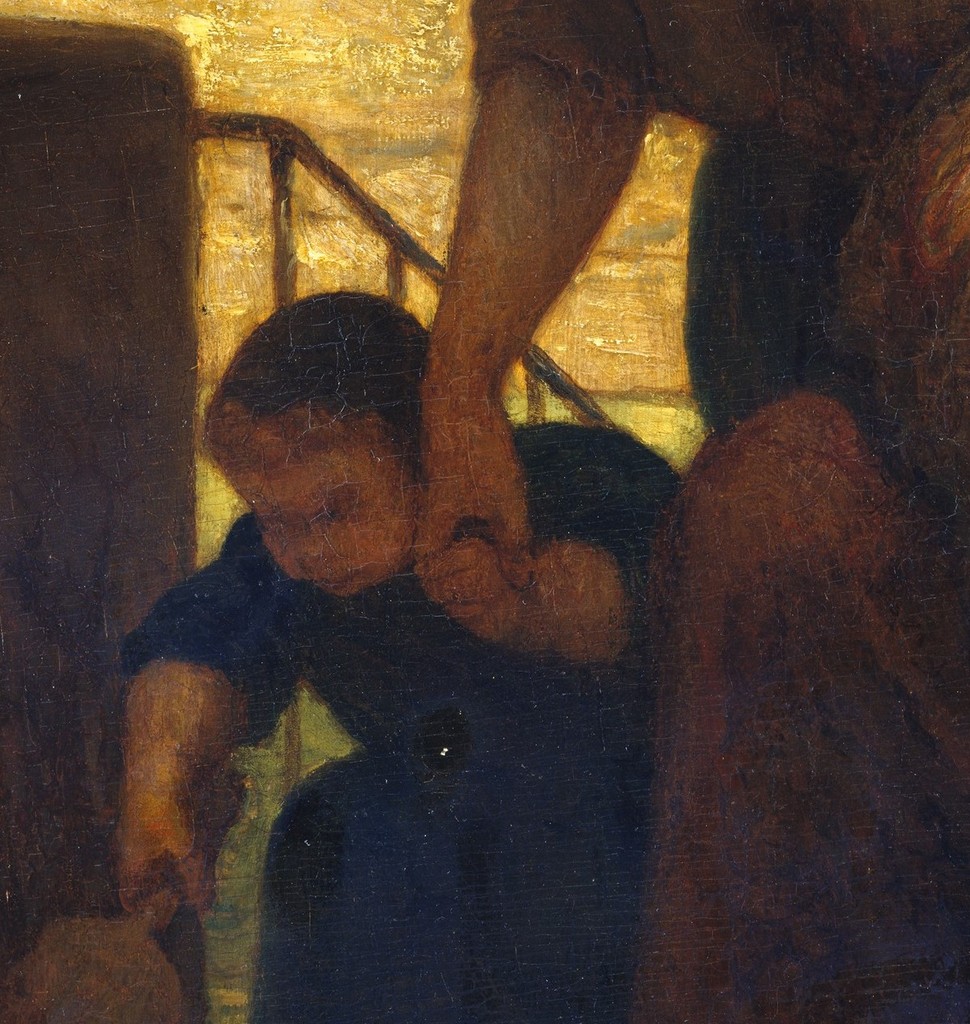
Honoré Daumier's The Laundress, painted about 1863 and now at the Metropolitan Museum of Art, also brings a woman and child together through washing work. The museum identifies the scene with laundresses returning from boats on the Seine: the woman carries a bulky load while helping the child up the embankment steps.[5]
Daumier's figures form a dark group against bright buildings and water. Their bodies lean into the climb, and the joined hands connect the smaller child with the heavily laden adult. Manet places the action within the garden, where the tub, chair and hanging fabric occupy much of the available space.
The comparison makes the different movements particularly clear. Daumier's pair ascend through the picture, while Manet's hands work over a fixed vessel. In Laundry, the cloth above the tub and the washing on the lines link the immediate action with the larger pattern of light across the canvas.
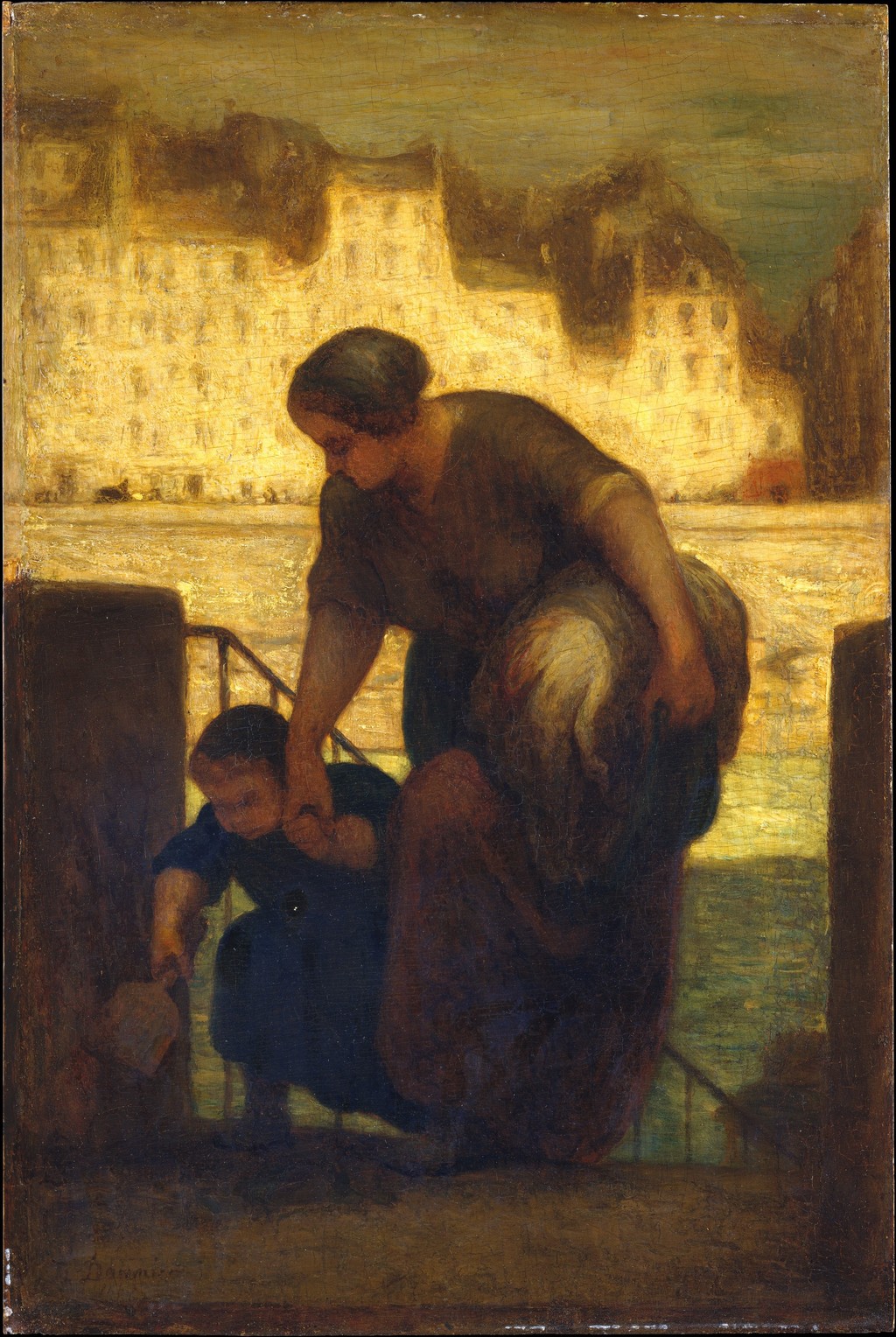
Honoré Daumier, The Laundress, about 1863. Oil on oak, 48.9 × 33 cm. The Metropolitan Museum of Art, 47.122. Bequest of Lillie P. Bliss, 1931. Image source. CC0 / Public domain. Whole supplied image resized without cropping or enlargement; no recolouring or retouching.
Annotated Details from Laundry
The numbered points identify visible features discussed in this article. Return from each detail to the whole composition. Each caption identifies the work shown.
Laundry
Édouard Manet, Laundry (Le Linge), 1875. Oil on canvas, 145.4 × 114.9 cm. Barnes Foundation, BF957. Courtesy of the Barnes Foundation, Merion and Philadelphia, Pennsylvania. Image source. Public domain. Numbers added to a separate overview. Four detail crops from the supplied faithful reproduction; no enlargement, recolouring or retouching.
The Laundress — Daumier
Honoré Daumier, The Laundress, about 1863. Oil on oak, 48.9 × 33 cm. The Metropolitan Museum of Art, 47.122. Bequest of Lillie P. Bliss, 1931. Image source. CC0 / Public domain. Numbers added to a separate resized whole supplied overview. Detail crops from the unchanged original; no enlargement, retouching or colour alteration.
Details from LAUNDRY
Follow the numbered details back to the complete images above. Each caption identifies the work shown.
Laundry
Hands, cloth and water
The hands turn the pale cloth above the tub. Narrow light strokes connect the cloth with the vessel, while the chair back overlaps its near side.
The child beside the tub
The red-banded hat projects towards the washing. A small hand holds a wooden implement near the rim; cool marks distinguish the pale garment from the surrounding plants.
Hanging linen and lines
Blue and gray areas spread across the broad pale fabric. A narrower striped piece and thin diagonal clotheslines interrupt the surrounding greenery.
The watering can
The curved handle and diagonal spout emerge among long leaves and flowers. Their firmer shapes contrast with the many small marks of the foreground plants.
The Laundress — Daumier
The Joined Hands
The adult’s lowered hand meets the child’s raised hand beside the pale bundle.
Artworks directory
Explore selected paintings, drawings and prints by Édouard Manet. Search by title or another recorded name.
Frequently Asked Questions
It belongs to the Barnes Foundation in Philadelphia, under accession number BF957. The canvas measures 145.4 × 114.9 cm.[1]
A woman washes cloth in a garden with a child beside the tub. Drying linen hangs behind them, surrounded by flowers and greenery.[1]
Discussion
Look again at the images and ideas explored in Laundry by Édouard Manet. These editorial prompts invite your observations.
Reader Insights
Follow the cloth between the woman's hands and down to the tub. How do the narrow falling strokes stand out against the garden?
Compare the large pale cloths with the smaller striped piece. How do their edges and folds change the space behind the figures?
Find the watering can, tub and chair. How do their handles, rails and rims give structure to the surrounding plants?
Join the Conversation
Share a detail, comparison or question about Laundry by Édouard Manet below.
References
- Barnes Foundation, Laundry (Le Linge), 1875, BF957, collection record, commentary and exhibition history. View source.
- Théodore Duret, Histoire d'Édouard Manet et de son œuvre, 1906, pp.173–178. French. View source.
- Juliet Wilson-Bareau, Manet, Monet, and the Gare Saint-Lazare, National Gallery of Art, 1998, pp.173–176, especially fig.157. View source.
- Margaret Werth, Mallarmé and Impressionism in 1876, Nonsite, no.27, 11 February 2019, discussion of Le Linge and note41. View source.
- Metropolitan Museum of Art, The Laundress, Honoré Daumier, about 1863, 47.122, collection record and commentary. View source.
- Splash image, Édouard Manet, Laundry (Le Linge), 1875. Oil on canvas, 145.4 × 114.9 cm. Barnes Foundation, BF957. Courtesy of the Barnes Foundation, Merion and Philadelphia, Pennsylvania. Image source. Public domain. Whole supplied image resized without cropping or enlargement; no recolouring or retouching.


