 by Tom Gurney
Tom Gurney BSc (Hons) is an art history expert with over 20 years experience
Published on June 19, 2020 / Updated on October 14, 2026
Email: tomgurney1@gmail.com / Phone: +44 7429 011000
A parting beside Venus's chariot
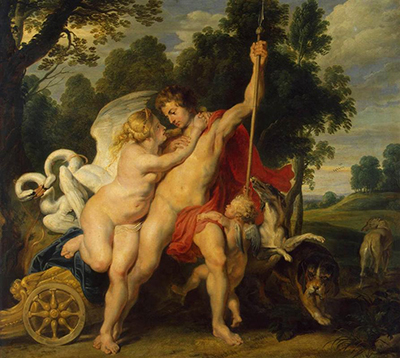
Venus presses close to Adonis beneath the trees. He holds a long spear, while Cupid reaches up between them and two hunting dogs wait nearby. At the left, two white swans stand beside the wheel of a golden chariot. The setting tells us that this is not simply an embrace in a quiet wood. Adonis is about to leave for a hunt, and the goddess tries to keep him where he is.
The State Hermitage Museum catalogues the painting[1] as Venus and Adonis by Peter Paul Rubens, dated 1610–11, oil on wood, 83 × 90.5 centimetres, inventory ГЭ-462. The museum's indexed object record supplies those facts and states that the work entered the collection in 1768 from Count Karl Cobenzl's collection in Brussels. The Louvre's record for a copy after the composition independently identifies the original as the rectangular Hermitage panel.
The route suffix “II” is a site label to distinguish this panel from the large Rubens Venus and Adonis at the Metropolitan Museum of Art. It is not the Hermitage's title or an official sequence number. The Saint Petersburg work is the small early wooden panel with Venus's swan-drawn chariot. The New York picture is a much later and larger canvas. Keeping the two objects apart lets each painting's material and composition speak for itself.
At a Glance
- ArtistPeter Paul Rubens [1]
- Date1610–11 [1]
- MediumOil on wood [1]
- Size83 × 90.5 cm [1]
- CollectionState Hermitage Museum, ГЭ-462 [1]
- SubjectVenus tries to stop Adonis leaving for a dangerous hunt [2]
Where this work sits in Rubens's career
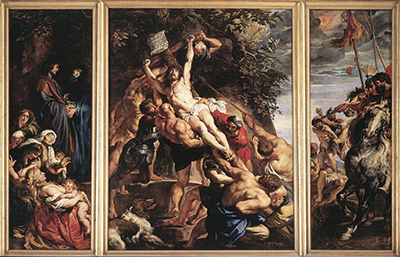
The Elevation of the Cross
1609–10Venus and Adonis
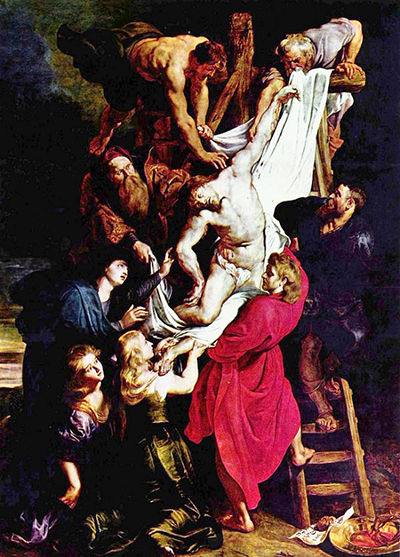
1610–11The Descent from the Cross
1611–14The Garden of Love
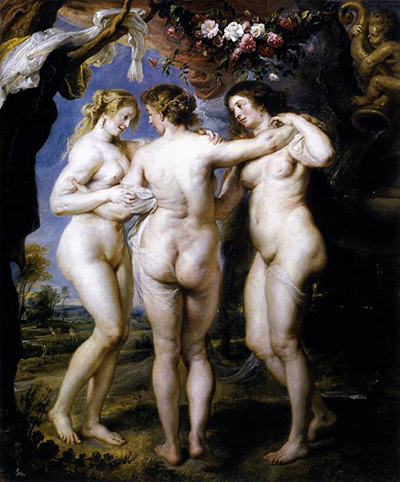
1630–35The Three Graces
1630–35Contents
- The instant of refusal
- What the swans and chariot contribute
- The myth beyond the painted moment
- Rubens's early treatment and a later New York canvas
- Copies after the Hermitage composition
- From Brussels to Saint Petersburg
- Looking once more at the small panel
The instant of refusal
The picture's central exchange is compact. Venus leans into Adonis, reaching around him as if to slow his departure. He stands upright with a spear raised in one hand. His body is close to hers, yet the hunting equipment and dogs make his intention clear. Rubens holds the contradiction in their poses: physical intimacy at the very moment of separation.
A Louvre catalogue entry for a later copy after this composition[2] identifies the narrative plainly. Venus, foreseeing her lover's death, descends from a golden chariot pulled by two swans and implores him not to hunt. Cupid tries to take the spear from Adonis, and two dogs wait impatiently. The Louvre is describing a different nineteenth-century circular painting, but explicitly says that it copies the Rubens original now in the Hermitage. Its object-specific description helps locate the actions visible in ГЭ-462.
Cupids often appear as playful attendants in mythological paintings; here this one is caught in the same urgent action as Venus. Pulling at a spear is a practical attempt to stop a hunter. The small figure stands beneath the much larger bodies, making their struggle legible at two scales. The gesture draws the eye to the weapon as the immediate sign of Adonis's choice.
The dogs add an opposite force. They remain near Adonis, ready for the hunt rather than responding to Venus's plea. The story's danger is still in the future, but the animals make the future feel imminent. They are not the fatal boar, and the panel does not show the wound that will kill Adonis. It shows a departure whose outcome the viewer may know before the painted figures can change it.
What the swans and chariot contribute
The swans at the left help identify Venus and her arrival. The Louvre calls them the pair that draw her chariot. In the painting, their white bodies stand out beside the darker wood and the chariot wheel. They turn a wooded meeting into a mythological encounter: a goddess has come in her own vehicle to persuade a mortal hunter. The wheel also provides a solid circular form among the flowing limbs and drapery.
The chariot sets a small drama outside the central embrace. Venus has descended from it, so the viewer can imagine an action before the instant shown. Adonis has prepared to hunt, so the scene also points forward. Between those times lies the present struggle. Rubens uses a few recognizable objects—chariot, swans, spear and dogs—to tell a story that extends beyond the panel's modest size.
The pair of swans should not be confused with the animals at right. One group belongs to Venus's conveyance; the other to Adonis's hunting world. That distinction gives the picture two competing directions. Venus's chariot has brought her to him, while the dogs are poised to lead him away. The small panel can therefore stage an emotional conflict through animals and objects as well as human figures.
White wings, pale flesh and a flash of red drapery draw the eye around the centre. Dark trees close in behind the lovers, while open landscape appears toward the right. The wooded enclosure makes their embrace feel private, but the visible route away keeps it from becoming still. The setting is active in the narrative: it shelters a plea that is unlikely to succeed.
The myth beyond the painted moment
The subject comes from Ovid's Metamorphoses. The Met's account of its separate Rubens painting[4] summarizes the story: Cupid's arrow causes Venus to love Adonis, she warns him against dangerous prey, and a wild boar fatally wounds him during a hunt. The Hermitage panel shows the warning and departure, not the later death. The Louvre's description of the copied composition confirms that Venus tries to retain him before he goes.
In a narrative painting, knowledge of the ending changes the way ordinary details appear. A spear is not just a sign that Adonis hunts; it is an object Venus and Cupid want removed from the action. The dogs are not merely picturesque animals; they are impatient companions for a dangerous journey. The swans suggest that Venus has made an extraordinary intervention. None of these details can guarantee a different result.
The image is intimate rather than monumental. Adonis and Venus nearly fill the panel's height, and the figures occupy most of its central area. The outcome depends on their shared point of contact. The distant ground is visible, but it does not pull attention away from the embrace. The story's path outward is suggested by the dogs and open view instead of being given a great panoramic space.
Ovid's tale has other possible pictorial moments. Artists painted Adonis's death and Venus mourning afterward. The Rijksmuseum catalogues a Willem Panneels print[6] after a Rubens design in which Venus mourns over Adonis's body. That print is a different object and episode; it should not be treated as a reproduction of this Hermitage panel. It helps clarify why “Venus and Adonis” titles need a description of the depicted instant.
Rubens's early treatment and a later New York canvas
The Hermitage's 1610–11 date places its panel early in Rubens's Antwerp period after his return from Italy. The current holding record credits Rubens. The Louvre's discussion[2] calls the rectangular Hermitage panel the original for the composition copied in its own later circular work. These institutional descriptions support treating ГЭ-462 as a specific early object, not as an interchangeable image of any Rubens Venus and Adonis.
The Met canvas 37.162[4] is different: probably mid-1630s, oil on canvas, and 197.5 × 242.9 centimetres including added strips. In that painting Adonis turns with a spear at the left while a seated Venus reaches toward him, Cupid stands between them, and hounds wait at the edge. The New York work magnifies the parting and gives the human forms a broader, more forceful sweep. Its later date and canvas support belong to that work alone.
A reader may notice a shared story, spear, dogs and plea in both. Those common features do not prove that the Hermitage panel was a direct sketch for the Met canvas, nor do they justify carrying the Met's added strips into the Hermitage caption. The paintings are distinct interpretations separated by decades and by scale. The site keeps a separate page for the Met canvas so that looking at one can sharpen, rather than blur, the other.
There is also a large Rubens Venus and Adonis in Düsseldorf. Kunstpalast identifies its work[5] as about 1610, oil on canvas, 276 × 183 centimetres. That tall painting is neither the Hermitage wooden panel nor the Met's later wide canvas. Its presence is another reason to use museum names, materials and dimensions whenever discussing a Rubens work with this title.
Copies after the Hermitage composition
The Louvre owns a small circular copy[2] made before 1869 by Joseph Albrier after Rubens. It is 29 centimetres in diameter and belongs to the Louvre collection, on long-term loan to Agen. The Louvre explicitly links its design to the rectangular Hermitage original. Its round format and nineteenth-century maker show how the subject could be preserved and changed in a later copy. It is not a newly discovered Rubens version.
The same Louvre entry names a workshop replica now at the Mauritshuis in The Hague. The Mauritshuis catalogues that panel[3] as “Peter Paul Rubens (atelier kopie)”, or a workshop copy, measuring 59 × 81 centimetres, inventory 254. It traces the work through French seizure and Louvre display from 1795 to 1815, then into the Mauritshuis in 1822. Those details belong to the replica, not to the original in Saint Petersburg.
The distinction is more than terminology. A copy or workshop replica can provide evidence that a composition circulated, but its attribution, size and collection path are not automatically those of the source painting. The Hermitage's own record credits Rubens for ГЭ-462. The Mauritshuis's workshop-copy label is attached to no. 254. The Louvre's later Joseph Albrier copy is a third object. Keeping their records separate allows a reader to understand the composition's reception without losing the identity of the painting on this page.
These linked objects also explain why casual image searches can mislead. A familiar embrace, swans and spear may appear in a rectangular Rubens panel, a smaller workshop version or a round nineteenth-century copy. The institutional inventory numbers—ГЭ-462, Mauritshuis 254 and Louvre MI 1310—are the safest way to keep them apart. They mark different physical things, even when the subject and many details match.
From Brussels to Saint Petersburg
The Hermitage reports that its panel entered in 1768 from the Brussels collection of Count Karl Cobenzl. This is a documented later acquisition point. The short museum record does not name the person who first commissioned Rubens or reconstruct every owner between the painter and Cobenzl. The page therefore stops where the evidence stops instead of inventing a continuous early chain.
The date and provenance should also not be transferred from the other copies. The Mauritshuis replica has its own documented eighteenth- and nineteenth-century movements. The Louvre's Albrier copy belongs to a later French collection. Those histories may show the ongoing appeal of the scene, but they do not fill gaps in ГЭ-462's earlier history.
The Hermitage inventory number makes the object identifiable even when a website translation or display changes. The currently indexed record is in Russian, using дерево, масло for wood and oil and 83 × 90.5 cm for size. This page translates those fields into English while retaining the museum number. The painting's compact composition brings together swans, chariot, embracing figures and dogs.
Looking once more at the small panel
Start with the swans and wheel at left to find Venus's arrival. Follow her body and arm into Adonis, then look up the spear and down to Cupid's attempt to intervene. Finish with the dogs and the opening into landscape at right. That route through the image moves from Venus's world to the hunter's intended departure. The figures remain close, but the objects around them tell us why the embrace cannot simply continue.
The painting's modest size makes every gesture count. It does not show the fatal boar or the goddess's later grief; those are parts of the story that the viewer brings to this moment. With the Hermitage's 1610–11 date, wooden support and ГЭ-462 identity in view, the scene can be read as Rubens's early, compact treatment of a myth he revisited in other forms. The chariot, swans and Cupid give this version its particular character.
Rubens artworks directory
Frequently Asked Questions
It is the small wooden panel ГЭ-462 at the State Hermitage Museum, Saint Petersburg, dated 1610–11 in the museum's indexed record. The route's “II” is a site label, not part of the museum title.
Venus tries to keep Adonis from leaving for a dangerous hunt. The Louvre's record for a later copy after the Hermitage composition identifies her swan-drawn chariot, Cupid reaching for the spear and the waiting dogs.
The Met canvas is a different, larger and later Rubens treatment. Its composition centres on a standing Adonis, seated Venus, Cupid and hounds, without this Hermitage panel's prominent swan-chariot group.
The Hermitage gives 83 × 90.5 centimetres and records the medium as oil on wood.
No. The Mauritshuis catalogues inventory 254 as a workshop copy of the related composition. The Hermitage panel is ГЭ-462, a separate object credited there to Rubens.
The museum records acquisition in 1768 from Count Karl Cobenzl's collection in Brussels. The cited short record does not establish its first patron.
Discussion
Follow the swans, chariot, embracing figures, spear and dogs across the painting.
Share an observation about the painting or a reliable source that adds to its history.
Reader Insights
How do Cupid and the dogs pull the story in different directions?
What changes when you know the hunt's fatal outcome?
How does this small wooden panel differ from Rubens's later Met canvas?
Join the Conversation
Add your reading below, keeping observations specific and evidence clear.
References
- State Hermitage Museum, Rubens, Venus and Adonis , ГЭ-462. View source
- Musée du Louvre, Joseph Albrier copy after Rubens's Hermitage composition, MI 1310. View source
- Mauritshuis, workshop copy after Rubens, Venus trying to prevent Adonis from hunting , 254. View source
- The Metropolitan Museum of Art, Rubens, Venus and Adonis , 37.162. View source
- Kunstpalast, Rubens's distinct Düsseldorf Venus and Adonis. View source
- Rijksmuseum, Willem Panneels, Venus mourning Adonis after Rubens. View source