 by Tom Gurney
Tom Gurney BSc (Hons) is an art history expert with over 20 years experience
Published on June 19, 2020 / Updated on October 14, 2026
Email: tomgurney1@gmail.com / Phone: +44 7429 011000
Three bodies, two routes to Fontainebleau
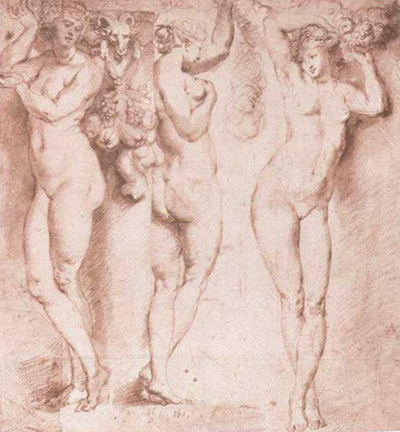
Three women fill this small sheet from foot to raised hand. The pair at left stand close together, their bodies turning in different directions as they lift heavy garlands. The woman at right stands apart, one arm above her head and the other carrying the decorative form at her shoulder. Red chalk gives the figures their warm outlines; darker passages suggest depth; light marks pick out their raised surfaces. At first glance the drawing seems to record one sculptural group. Its sources are more complicated.
The Museum Boijmans Van Beuningen catalogue[1] names the work Three Women Holding Garlands (after Francesco Primaticcio) and identifies Peter Paul Rubens as its draughtsman. It dates the sheet circa 1622–27, gives its materials as red chalk, brown wash and white heightening, and measures it at 269 × 253 millimetres. The museum's object number is V 6 recto (PK). The inherited route calls it “Three Caryatids,” a useful pointer to the decorative figures, but the current catalogue title is clearer about the women and their garlands.
“After Primaticcio” does not mean that Primaticcio drew this sheet. It names the earlier artist whose designs Rubens studied. Boijmans makes that distinction explicitly in its artist fields: Rubens is the draughtsman; Francesco Primaticcio is the artist after whom the work was made. That distinction matters because the drawing once had a very different explanation. The museum now uses the physical evidence of the sheet to challenge that older view.
At a Glance
- DraughtsmanPeter Paul Rubens [1]
- AfterFrancesco Primaticcio [1]
- DateCirca 1622–27 [1]
- MediumRed chalk, brown wash, white heightening [1]
- Dimensions269 × 253 mm [1]
- CollectionMuseum Boijmans Van Beuningen, V 6 recto (PK) [1]
Where this work sits in Rubens's career
The Elevation of the Cross
1609–10The Descent from the Cross
1611–14Three Women Holding Garlands
c. 1622–27The Garden of Love
1630–35The Three Graces
1630–35Contents
- What can be seen in the drawing?
- The two women at left: probable sculptural studies
- The right-hand woman: a printed source
- An older theory revised by looking at the sheet
- Why make a study after another artist?
- Collection identity and access
What can be seen in the drawing?
The figures almost reach the edges of the square format. Their raised arms and suspended garlands make a rhythm across the top, while their legs and feet bring the gaze back down. The left woman leans and turns, the middle figure twists, and the right woman stretches more openly. Their poses are related without being identical. Rubens records a sequence of bodies rather than repeating one fixed outline three times.
In the retained image, the contours are especially clear around shoulders, hips and knees. Areas of wash deepen the shadows beside limbs and below the hanging decoration. White heightening, listed in the museum's technique field, gives selected surfaces more light. These effects do not turn the drawing into a finished painting. They help a viewer understand how a drawn figure can recall the volume and illumination of relief sculpture.
The garlands are not small accessories. They determine the raised arms and connect the women's bodies with the decorative frame that their source designs once served. A viewer can follow the weight from hand to shoulder, then down through the turning torso to the legs. This is one reason “caryatids” became a plausible short name for the sheet: the bodies participate in architecture and ornament. Yet the museum's chosen title avoids implying that all three figures were copied together from one surviving architectural group.
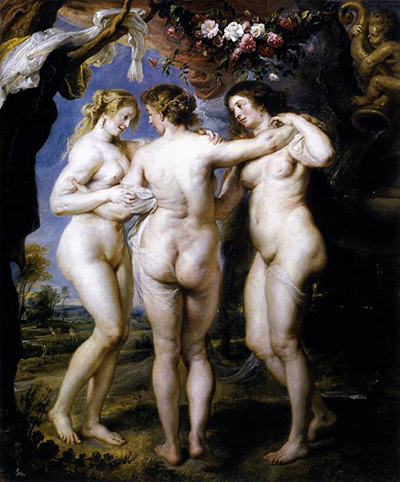
It is tempting to label them as the Three Graces because there are three women. Boijmans does not give this drawing that title or identify these figures as a specific mythological trio. The garlands and the decorative source are better evidence for what the sheet is studying. A three-figure grouping alone does not establish a named myth.
The two women at left: probable sculptural studies
Boijmans curator Albert Elen relates the two standing figures at left to stucco caryatids designed by Primaticcio for the Escalier du Roi at the Palace of Fontainebleau, around 1545. His catalogue wording is qualified: Rubens probably made these studies during a visit to the palace. That is a persuasive explanation for the figures' sculptural quality, but the museum does not present an itinerary document proving the exact encounter.
Stucco is a mouldable material used to make relief ornament on a wall or ceiling. At Fontainebleau, such ornament was part of an ambitious court setting in which painting, sculpture and architecture worked together. The Metropolitan Museum's account of Fontainebleau[2] explains that the palace decorations developed under Rosso Fiorentino and Primaticcio as a coordinated interior art. This context helps explain why Rubens might treat the women as more than isolated figure poses. They belonged to a decorative language of bodies, frames and garlands.
The Met's separate Primaticcio drawing, Two Nymphs Carrying a Third[3], concerns another Fontainebleau stucco scheme, the Appartement des Bains. It is not a source sheet for Rubens's three garland bearers. It does, however, document Primaticcio's work in a medium that could move between paper and palace decoration. Keeping it separate prevents a general historical parallel from becoming a false one-to-one model.
The two left figures can be read as Rubens's translation of sculpted forms back into drawing. A wall relief has its own scale, depth and lighting; a sheet of paper offers line, wash and selected highlights. Their limbs remain closely tied to decorative action, but Rubens can adjust how they meet the page. The result preserves the energy of architectural figures without reproducing an entire staircase wall.
The right-hand woman: a printed source
The woman at right has a different route into Rubens's sheet. According to Boijmans's catalogue[1], she is based on a print by Léon Davent after Primaticcio. The same underlying artistic world connects her to the other women, but the immediate model identified by the museum is a printed image rather than the palace stucco. That is why the drawing can look unified while holding more than one type of source.
The Met's history of the School of Fontainebleau[2] describes the production of prints after drawings by Primaticcio and others in the 1540s and names Davent among the important printmakers in that circle. Such prints spread Fontainebleau designs beyond the palace. Their existence offers a practical explanation for how an artist could study a French court design without needing every part of it to be present on the same wall or in the same original drawing.
The source difference also changes how we look at the right-hand figure. A print fixes a pose in line and makes it portable; the stucco figures have physical relief and a site. Rubens could bring them into one drawn field, adjusting their scale and spacing so they converse. The sheet need not be a literal record of one moment spent looking at three figures together. Boijmans's account instead points to selection and combination.
We should not assume the exact print impression Rubens held, when he obtained it, or whether it was in his collection. The museum identifies a Davent print type as the model for the third figure; it does not provide a documented purchase or a surviving copy owned by Rubens. The supported point is the visual relationship and the differing source medium.
An older theory revised by looking at the sheet
Boijmans says the drawing was once thought to be an existing Primaticcio drawing that Rubens had reworked. Such an explanation would make the sheet a collaboration across decades: an earlier drawing physically altered by a later artist. The museum says, however, that no traces of an underdrawing are visible. On that basis, it no longer sustains the old account of Rubens working over a pre-existing Primaticcio sheet.
The revision is important because Rubens did alter some drawings by earlier artists. Boijmans notes that he owned drawings, including sixteenth-century Italian works, and sometimes changed them drastically. A practice established elsewhere in his collection can suggest a hypothesis for this object, but it cannot prove that this particular sheet was made in the same way. The material inspection narrows the claim. Here, the museum attributes the drawing itself to Rubens after Primaticcio's designs.
“No traces of an underdrawing” does not establish every movement of Rubens's hand or explain every line. It is evidence against the specific older proposal that an identifiable Primaticcio drawing lies beneath his intervention. It leaves room for normal uncertainty about how he prepared the sheet, which earlier images he had available at the same time, and whether the work was made over one sitting or several.
The museum's circa 1622–27 date is also a range, not a year written on the paper. It places the drawing in Rubens's mature career, long after the Fontainebleau caryatids were made. The time gap is part of the story: a design created for a sixteenth-century French royal palace became material for a seventeenth-century Flemish artist's study. The route from palace decoration through print and drawing shows how visual ideas could survive in new forms.
Why make a study after another artist?
Copying and adapting earlier art was a way to learn from it. In this sheet Rubens could examine the twist of a body, the lift of an arm, and the relation of figures to ornament. The drawing's close focus removes much of the original architectural setting, inviting the viewer to compare the women's poses directly. It records artistic attention, not a commission for a known finished Rubens painting.
The specific purpose of this sheet remains open in the sources cited here. Boijmans does not identify a later canvas for which it served as a preparatory design, and no documented patron is named. It is safer to call it a study after Primaticcio's designs than to assign it to an invented painting project. The drawing is valuable in its own right because it shows how Rubens looked, selected and recombined earlier forms.
Primaticcio was an Italian artist working in France. The Met's account of his career[3] says that, with Rosso, he oversaw decoration at Fontainebleau and became central to the style now called the School of Fontainebleau. The phrase “after Primaticcio” in the Rotterdam title therefore points to a wider artistic exchange across Italy, France and the Low Countries. It does not require us to imagine Rubens meeting Primaticcio: the two artists' careers did not overlap.
The sheet lets us watch that exchange at a human scale. A palace's large decorative figures become bodies on paper, each one small enough to compare at a glance. Chalk and wash replace stucco, and the printed right-hand model joins the sculptural pair. The drawing turns inherited ornament into an active exercise in line, volume and movement.
Collection identity and access
The museum lists the drawing in its Drawings & Prints department under V 6 recto (PK). Its credit line is a loan from the Stichting Museum Boijmans Van Beuningen, associated with the former Koenigs collection, and the record gives 1940 as the acquisition or loan date. Franz Koenigs appears in its collector field. Those fields should be read carefully: a loan credit is not the same thing as saying the museum owns the sheet outright.
The online record currently marks the object as in storage. Display status can change, so visitors should consult the live Boijmans page[1] before planning to see the original. For identification, the stable details are the title, Rubens attribution, medium, dimensions and object number. They distinguish the sheet from Primaticcio's own works and from later images of Fontainebleau motifs.
The inherited name “Three Caryatids” remains in the URL, while the heading follows the museum's current title. That small editorial change serves a larger purpose: it tells the reader who made the surviving sheet and how its sources relate. Rubens drew the women; Primaticcio supplied earlier designs; Davent's print mediated one of them. Keeping those roles separate makes the work more interesting than a vague label of three figures.
Rubens artworks directory
Frequently Asked Questions
Museum Boijmans Van Beuningen identifies Peter Paul Rubens as draughtsman. “After Francesco Primaticcio” names the earlier designs he studied, not the maker of the Rotterdam sheet.
The museum relates the two women at left probably to Primaticcio's caryatid stuccoes at Fontainebleau. It identifies a Léon Davent print after Primaticcio as the model for the woman at right.
That was an older theory. Boijmans reports no traces of an underdrawing and no longer presents the sheet as a Primaticcio drawing reworked by Rubens.
The museum dates it circa 1622–27 and lists red chalk, brown wash and white heightening. It measures 269 × 253 millimetres.
The museum's online record currently marks it in storage. Check the current object page for any change in access or display.
Discussion
Compare the poses and decorative garlands across the three women.
Share an observation about the sheet or a reliable source that adds to its history.
Reader Insights
How does the right-hand figure differ from the pair at left?
Where do wash and white heightening make the bodies feel sculptural?
What does the revised attribution tell us about Rubens's way of studying earlier art?
Join the Conversation
Add your reading below, keeping observations specific and evidence clear.
References
- Museum Boijmans Van Beuningen, Three Women Holding Garlands (after Francesco Primaticcio) , V 6 recto (PK). View source
- The Metropolitan Museum of Art, Fontainebleau , history of palace decoration and printmaking. View source
- The Metropolitan Museum of Art, Primaticcio's separate Two Nymphs Carrying a Third. View source