 by Tom Gurney
Tom Gurney BSc (Hons) is an art history expert with over 20 years experience
Published on June 19, 2020 / Updated on October 14, 2026
Email: tomgurney1@gmail.com / Phone: +44 7429 011000
A pursuit halted by reeds
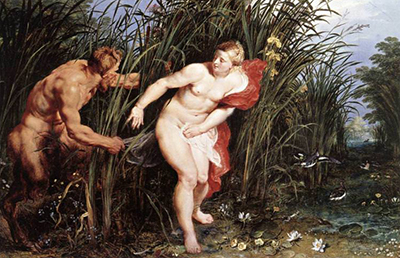
At the left, Pan reaches toward a young woman who recoils into a thick stand of reeds. Syrinx turns her face away and raises an arm between them. Her bright skin and red drapery stand out against dark, upright plants. Below and to the right, water, flowers and small birds extend the scene into a carefully observed landscape. The moment looks still in a photograph, but the positions of their bodies tell a story of urgent movement.
Hessen Kassel Heritage[1] catalogues Pan and Syrinx as a collaboration by Peter Paul Rubens and Jan Brueghel the Elder, made about 1617. The painting's inventory number is GK 1229, and its pictured surface measures 40.3 × 61 centimetres. The museum lists the technique as oil; a German government cultural-property record[2] identifies the support as oak. Those two sources together permit the full description “oil painting on oak” for this specific object.
The subject is not a meeting between willing lovers. In Ovid's Metamorphoses, Book 1[3], Syrinx rejects Pan's pursuit and runs until the river Ladon blocks her path. She asks the river nymphs to change her form; Pan grasps reeds where he expected to seize her. The Kassel catalogue places the painting at the end of that chase, just before the change. Syrinx's resistance and the dense reeds are therefore essential to understanding what the two artists pictured.
At a Glance
- ArtistsPeter Paul Rubens and Jan Brueghel the Elder [1][2]
- DateAbout 1617 [1][2]
- MediumOil on oak [1][2]
- Picture size40.3 × 61 cm [1][2]
- SubjectSyrinx flees Pan at the river Ladon [1][3]
- CollectionHessen Kassel Heritage, GK 1229 [1]
Where this work sits in Rubens's career
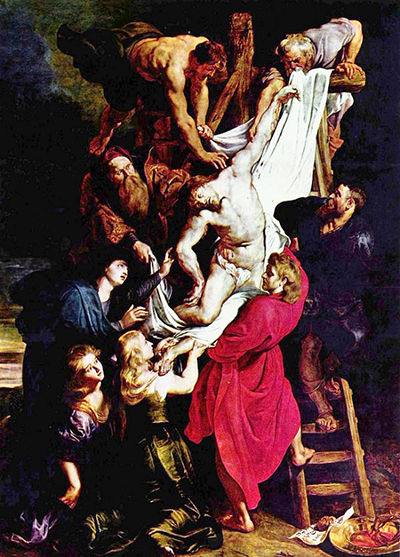
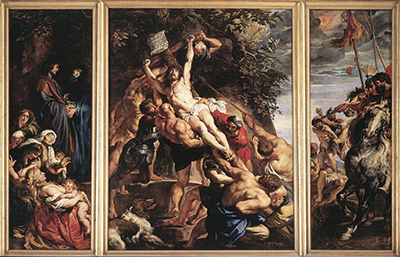
The Elevation of the Cross
1609–10The Descent from the Cross
1611–14Pan and Syrinx
c. 1617The Garden of Love
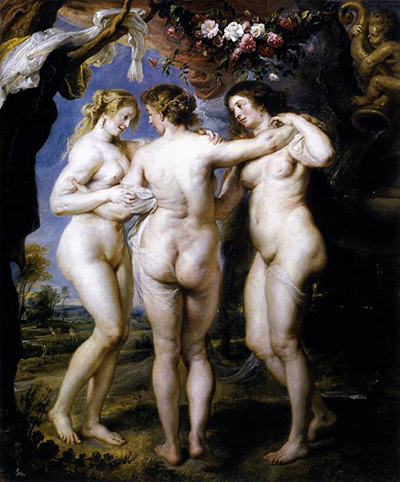
1630–35The Three Graces
1630–35Contents
- The instant before transformation
- Rubens's figures, Brueghel's landscape
- A small painting with large figures
- An antique pose reconsidered
- What Ovid tells us—and what the painting chooses
- The Kassel collection and a return
- Looking again at the riverbank
The instant before transformation
Ovid's story describes several events: Pan sees Syrinx, follows her, the river stops her escape, and she is transformed. A single painting must choose a point in that sequence. Rubens and Brueghel show the instant when Pan is close enough to reach but Syrinx is still human. The future transformation is already present in the plants around her, though it has not visibly happened to her body.
That choice creates suspense. Viewers who know the story can see why Pan's apparently certain grasp will fail. The reeds fill much of the image, especially behind Syrinx, so the plant that will replace her is already dominant in the setting. Her physical nearness to the reeds makes the transition imaginable without showing a half-human, half-plant figure.
Pan's body leans forward from the left. His goat legs and muscular torso identify him as the rustic god in the Kassel account. Syrinx turns sideways and away, lifting one arm against his approach while the other gathers her body and drapery. The opposing gestures make the chase readable even without a painted path stretching behind them. Their bodies preserve the motion of pursuit within a narrow space.
The river appears at the right, beyond the bank and vegetation. In the myth it is a barrier: water prevents Syrinx from fleeing farther by ordinary means. In the painting, the right-hand landscape is visually open, yet the narrative tells us this openness is deceptive. The place that seems to offer escape is where her flight comes to an end.
The word syrinx also names the reed pipe associated with Pan. Ovid explains that after the nymph's change, wind sounding through the reeds leads Pan to bind reeds of different lengths into a musical instrument. The picture stops before that episode. There is no need to imagine that Syrinx has chosen the pipe or that the later instrument turns the pursuit into a mutual romance. The painted moment and the poem both centre her attempt to get away.
Rubens's figures, Brueghel's landscape
The Kassel catalogue names both artists, describing Jan Brueghel the Elder as a collaborator. A review of the Kassel exhibition in the Historians of Netherlandish Art journal[4] makes the division more specific: Rubens painted the figures, while Brueghel painted the surrounding landscape and birds. This description fits the visible contrast between large bodies and finely detailed vegetation.
Rubens's Pan and Syrinx take command of the foreground. Their bodies are close to the viewer, with little intervening space. Pan's reaching arm and Syrinx's lifted arm form the crucial line of contact that has not quite happened. Her face turns away while his momentum carries him toward her. The pair tell the myth through anatomy, posture and proximity.
Brueghel's landscape is not a neutral backdrop pasted behind an independent figure scene. The reeds are the future of the story. Their stiff vertical lines make Syrinx appear pressed into a wall of plants, while the open water marks the limit of her escape. Small birds, flowers and foliage make the riverbank convincing as a living environment. The myth's transformation would be less forceful without that dense, specific setting.
The two modes of painting also work at different viewing distances. From across a room, the pale figure and darker Pan carry the composition. Close up, the scattered blossoms and birds bring the right side to life. The collaboration asks the viewer to move between these scales. Its meaning depends on both: a visible pursuit and a natural world that is about to take Syrinx into itself.
This is a credited collaboration, but the online museum text does not document every brushstroke's sequence. It is safe to state the broad division reported in the Kassel exhibition review. It would be less safe to claim a precise day-by-day order of work or that one artist merely filled blanks left by the other. The finished panel reads as one picture planned around two kinds of expertise.
A small painting with large figures
The painted image is only 40.3 cm high and 61 cm wide, a cabinet-picture scale. The Kassel curator notes that Pan and Syrinx dominate nearly the full surface despite that modest size. Their bodies stand at the front edge rather than receding far into Brueghel's landscape. The effect is unexpectedly monumental for a panel that can be viewed at close range.
The contrast between them is strong. Pan's darker body emerges from shadow at the left; Syrinx's pale body is sharply lit against the reeds. The red cloth behind her intensifies her outline. Their opposing tones make the gap between Pan's hand and Syrinx's body a visual centre. We understand the danger of contact before reading the story in full.
Syrinx's feet and legs convey an interrupted run. One foot touches the ground, while her torso twists away. Pan presses in, his goat legs and outstretched arm compressed against the left edge. The artists have not pictured a long chase across open country. They show its final pinch point, when bodies and reeds crowd together beside water.
The landscape opens beyond the immediate tangle. That right-hand area matters because it prevents the painting from becoming a simple two-figure study. It reminds viewers that the event occurs at the edge of a river within a larger living world. Birds move and plants grow around the figures, indifferent to the urgency of their encounter yet essential to what the myth will become.
An antique pose reconsidered
The Kassel curator compares Syrinx's pose with the Venus Pudica type in ancient sculpture, specifically invoking the Capitoline Venus as a possible model. The comparison concerns the way her body turns and her hands cover or protect it. The museum also notes Rubens's study of such an antique figure in a drawing. This is a curator's visual argument, not a document showing that one particular statue stood beside the artists while they painted.
In the painting, the protective pose has a narrative force. Syrinx shields herself because Pan is closing in. A form associated with idealised antique beauty becomes a gesture of resistance. The contrast matters: classical reference may help shape the figure, but the Ovidian story determines why she moves as she does at this moment.
The museum observes a relation to Rubens's Mars and Rhea Silvia of about 1616–17 and contrasts the Kassel panel with later, more animated treatments of the Pan and Syrinx theme. These are comparisons of composition and artistic development, not proof that the Kassel work was a preparatory study for a particular later picture. The panel already has its own complete narrative tension.
The Historians of Netherlandish Art review describes a 2004 Kassel exhibition that placed the panel among many versions of the subject. It included later works by Jan Brueghel the Younger and others associated with Rubens's workshop, as well as Rubens's much later Bayonne oil sketch. That context helps explain why exact object identification matters: the same myth was represented by several artists in different collaborative arrangements.
What Ovid tells us—and what the painting chooses
Ovid places Syrinx within a story told by Mercury to Argus. In that larger poem, the account of Pan and Syrinx explains the origin of reed pipes while Mercury tries to lull his listener to sleep. Rubens and Brueghel do not illustrate Mercury narrating. They enter the inner story directly, selecting the riverside chase rather than the frame of the tale.
The translated passage[3] makes Syrinx's refusal explicit. She does not reciprocate Pan's approach. She flees through the wilds and calls on the water nymphs when the river stops her. The painting's extended arm, turned face and clustered reeds make that refusal visually legible. A description of “courtship” alone would flatten the moment the artists chose.
The painting also withholds the change that gives the myth its title and aftermath. That withholding invites the viewer to supply the next event from the story. Pan's reach seems to promise possession; the reeds promise its failure. The picture makes anticipation its main device, placing the viewer between what is seen and what is known to happen next.
This does not mean every flower or bird carries a named symbolic code. The museum records the Ovidian episode and the figure-landscape collaboration. Its public text does not assign a fixed mythological meaning to each small creature. Those details can be appreciated for their close observation and their part in constructing the riverbank without being converted into unsupported emblems.
The Kassel collection and a return
The Kassel record's inventory number, GK 1229, is the stable key to this object. A review of the 2004 Kassel exhibition reports that Wilhelm VIII of Hessen-Kassel acquired the painting in 1747. During the Napoleonic era it left Kassel, and the collection eventually reacquired it in the early 2000s. The broad sequence is well attested; sources vary on the exact 2001–02 transaction date, so a simple “returned in the early 2000s” avoids false precision.
Its departure and return explain why the panel has a collecting history beyond its place in Rubens and Brueghel's careers. It was prized as a small cabinet picture in an eighteenth-century princely collection, then separated from Kassel for a long period. The modern collection displays it under the same distinctive subject and the number GK 1229.
The German government record[2] independently gives the date at about 1617, the same picture dimensions, the oak support and the two artists' names. This is useful where the Kassel museum's concise material field says only “oil.” Taken together, the records identify the work as an oil painting on oak. The Kassel source remains the authority for the detailed narrative and the current inventory number.
The image on this page matches the Kassel composition: Pan at left, Syrinx before dense reeds, with birds and flowers along the water.
Looking again at the riverbank
Begin at Pan's extended hand and follow its direction toward Syrinx. Notice that she turns away and raises an arm as a barrier. Then look behind her: the reeds are already more than background, because they are the form she will soon take. Move across the bank to the small birds and flowers that Brueghel contributed, and finally toward the water that blocks her flight.
The two artists make a small painting carry an entire turning point in Ovid's story. Rubens gives the figures physical urgency; Brueghel makes the riverbank both credible and ominously full of reeds. The result is a collaboration in which landscape supplies the myth's consequence and the figures reveal its immediate human stakes.
This is Peter Paul Rubens and Jan Brueghel the Elder's Pan and Syrinx, about 1617, in the Gemäldegalerie Alte Meister, Kassel, GK 1229. The picture measures 40.3 × 61 cm and is recorded as oil on oak across the collection and government records. It shows Syrinx resisting Pan at the Ladon just before her transformation. Keeping that moment, both artists' contributions and the precise Kassel object in view makes the scene more than a generic mythological chase.
Rubens artworks directory
Frequently Asked Questions
Peter Paul Rubens and Jan Brueghel the Elder. The Kassel collection credits both. A Kassel exhibition review assigns the large figures to Rubens and the landscape and birds to Brueghel.
Hessen Kassel Heritage dates the painting about 1617. The government cultural-property register gives the same approximate date.
The Kassel museum lists oil; the government record identifies oak as the support. Together they support “oil painting on oak.”
The painted image is 40.3 × 61 cm. The museum lists a larger overall object measurement that includes the frame.
In Ovid's story she rejects Pan and runs from him. At the Ladon, with escape blocked, she asks river nymphs to change her form.
No. The Kassel catalogue places the scene just before her transformation. The reeds surrounding her anticipate what is about to happen.
The Kassel record credits Jan Brueghel the Elder. Other Pan and Syrinx versions involved different artists, including the Younger; their attributions should not be transferred to GK 1229.
It is in the Gemäldegalerie Alte Meister of Hessen Kassel Heritage, inventory GK 1229. Check current display information before visiting.
Discussion
Follow Pan's hand to Syrinx, then look at the reeds behind her.
Share an observation about the painting or a reliable source that adds to its history.
Reader Insights
How do the reeds anticipate Syrinx's transformation?
What do Rubens's figures and Brueghel's landscape each contribute to the story?
How does knowing Syrinx resisted Pan change your reading of the scene?
Join the Conversation
Add your reading below, keeping observations specific and evidence clear.
References
- Hessen Kassel Heritage, Pan und Syrinx , GK 1229. View source
- German government cultural-property register, Pan und Syrinx , Hessen 07816. View source
- Ovid, Metamorphoses 1.689–712, translated text. View source
- Historians of Netherlandish Art, review of the Kassel Pan & Syrinx exhibition, 2004. View source