 by Tom Gurney
Tom Gurney BSc (Hons) is an art history expert with over 20 years experience
Published on June 19, 2020 / Updated on October 14, 2026
Email: tomgurney1@gmail.com / Phone: +44 7429 011000
A rescue at the rock
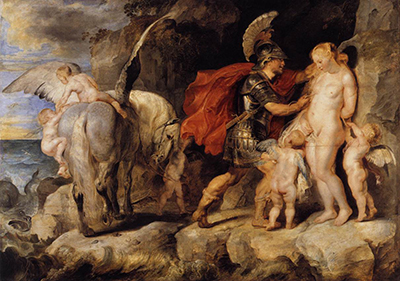
Perseus has reached Andromeda. His red cloak billows behind armour and helmet as he leans toward her, his hand at the bonds that held her to a rock. She stands close to the stone, turning toward the man who has defeated the sea monster. Two small winged figures help with the release. On the other side, more putti gather around Pegasus, the winged horse. The monster's body lies in the waves at the left. The painting joins the end of a fight to the first close encounter between rescuer and rescued.
The Gemäldegalerie in Berlin catalogues this work[1] as Perseus frees Andromeda by Peter Paul Rubens, dated 1620–22, painted on oak panel, measuring 99.7 × 139.6 centimetres, inventory 785. Its record also gives object identifier 871562. These details distinguish it from Rubens's closely related Saint Petersburg painting, whose dimensions are almost identical but whose current support is canvas transferred from panel.
The Berlin title puts the act of release first. Perseus is no longer only a distant hero arriving in time to fight. He is at Andromeda's side, with a hand near the restraints and his body turned toward hers. Pegasus and the dead monster still tell the wider story, but the point of contact between the two main figures controls the scene.
At a Glance
- ArtistPeter Paul Rubens [1]
- Date1620–22 [1]
- MediumOil on oak panel [1]
- Size99.7 × 139.6 cm [1]
- CollectionGemäldegalerie, Berlin, 785 [1]
- Recorded acquisitionTransferred from Prussian royal palaces, 1829–30 [1]
Where this work sits in Rubens's career
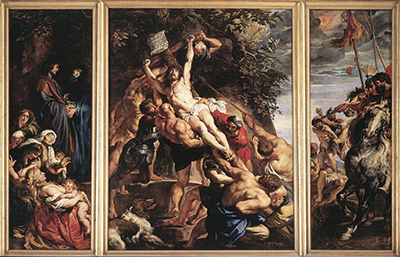
The Elevation of the Cross
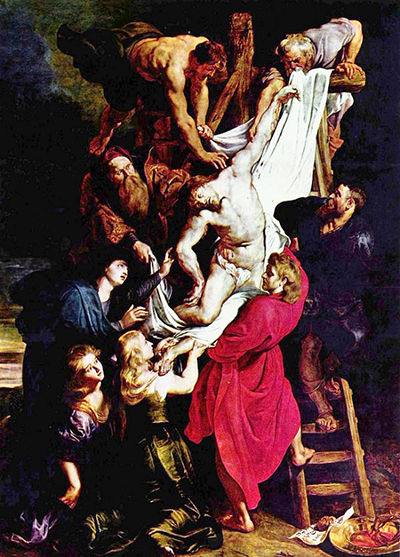
1609–10The Descent from the Cross
1611–14Perseus Freeing Andromeda
1620–22The Garden of Love
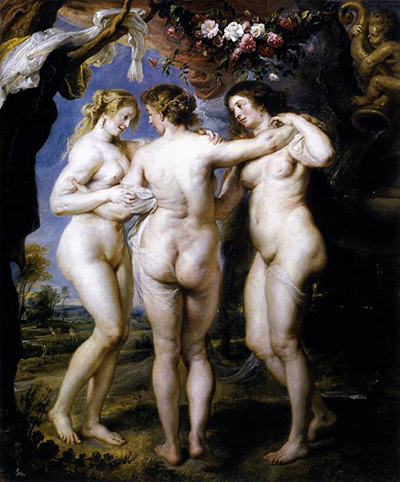
1630–35The Three Graces
1630–35Contents
- Why Andromeda was bound
- The action between Perseus and Andromeda
- The five putti and Pegasus
- A classical pose, carefully qualified
- The Berlin and Hermitage paintings
- Material and Berlin collection history
- Looking once more at the release
Why Andromeda was bound
Andromeda was the daughter of Cepheus and Cassiopeia. Her mother had claimed that she and Andromeda surpassed the sea nymphs, the Nereids, in beauty. A sea monster was sent as punishment, and Andromeda was exposed on a coastal rock. Perseus, returning after his defeat of Medusa, saw her and intervened. The Berlin museum's account[1] draws the story from Ovid's Metamorphoses and explains both the punishment and the rescue.
Rubens does not make the viewer wait through every stage. The monster is already dead, so the painting comes after the decisive violence. Andromeda is still by the rock, so freedom is not yet fully accomplished. Pegasus remains close, ready to take the hero onward. By placing the signs of battle, rescue and departure in one space, Rubens turns a long narrative into a moment of transition.
The sea monster is visible at the left edge of the shore. It is important without dominating the composition. Had the creature filled the centre, the scene would be primarily a combat. Here it establishes the danger that has just passed, allowing the centre and right to focus on Andromeda's changing condition. The threat remains close enough to make the release meaningful.
The rock also carries narrative weight. It is the place where Andromeda was held, and it rises behind her while the freeing action unfolds. She cannot simply walk out of the myth without first being unbound. Rubens makes that practical work visible through Perseus and the putti. The physical restraint helps the viewer understand the emotional significance of the gesture.
The action between Perseus and Andromeda
Look at how close the figures stand. Perseus bends into the space Andromeda occupies, his arm raised toward her fastening. She turns her face and body toward him, yet remains beside the rock. Their movements meet at the very point where the story changes from captivity to freedom. The Berlin curator describes the painting as combining an encounter and a liberation that Ovid recounts in a longer sequence.
Perseus's armour and cloak contrast with Andromeda's pale body. He is protected and active; she is exposed and constrained. Rubens uses that opposition to make the rescue visually immediate. At the same time, the figures are not held in isolated zones. His reaching arm and her turned posture draw them into a shared space. The encounter is both a physical action and the beginning of a relationship.
The red cloak is especially useful for finding the hero amid the rock and horse. It stretches behind him in a diagonal sweep, then the eye returns to his hand near Andromeda. The cloak announces movement; the hand gives that movement a purpose. A viewer may first notice the colour and only then understand that the important event is smaller and more precise: a bond being loosened.
The museum's essay sees the poses of the protagonists as mutually dependent. That is a helpful way to look without treating every painted movement as an exact transcription of Ovid. Perseus's forceful approach gains meaning because Andromeda turns toward him. Her response becomes legible because the hero has already crossed the space from Pegasus and the defeated monster.
The five putti and Pegasus
The Berlin object description[1] counts two putti helping to free Andromeda and three attending Pegasus. Those small figures are active participants in the scene. One group concentrates attention on the restraints; the other handles the horse, including its bridle and the movement of one attendant climbing onto it. Their tasks divide the narrative without breaking the picture into separate episodes.
Pegasus occupies much of the left half of the panel. A large pale wing rises against the darker shore, while the horse lowers its head toward the action. The wing marks this as a mythological arrival rather than an ordinary mounted rescue. The putti near the animal make its presence practical as well as spectacular: they manage a creature that will be needed when the scene moves on.
The horse's body also creates an interval between the dead monster in the surf and the two human figures by the rock. From the left, the eye can travel past the wing and attendants into Perseus's red cloak, and from there to Andromeda. This route follows the story from completed battle to present release. The Berlin curator likewise reads the rocky ledge as a progression toward the meeting of the protagonists.
Putti can be easy to dismiss as decoration because they are small and winged. Here their hands and positions matter. They make release and preparation visible. The two near Andromeda reinforce the urgency of undoing the bonds; the three around Pegasus keep the vehicle of the hero's arrival within the same action. Rubens asks them to carry portions of the story that would otherwise need more gestures from Perseus himself.
A classical pose, carefully qualified
The Berlin essay relates Andromeda's figure and the putto beside her to the ancient Venus Felix statue in the Vatican collections. This is a curatorial account of a formal source: a body and neighbouring small figure whose pose might have helped Rubens devise his own group. The Vatican Museums also identify Venus Felix[3] among the celebrated sculptures of the Octagonal Court.
How Rubens encountered the model is less certain. Berlin says he may have seen the statue during his time in Rome, or may have known it through a drawing after the sculpture by Hendrick Goltzius. Neither possibility is a documented act of copying this panel from a particular sheet. The distinction matters because a resemblance of pose can be persuasive without proving the route by which the painter learned it.
The comparison can still improve looking. Andromeda's upright body and the attendant below form a group that could be understood through the language of antique sculpture. But Rubens has given them a new job. This figure is chained to a rock in a narrative of danger; the little attendant helps free her. A classical body type becomes part of a seventeenth-century rescue scene rather than remaining an isolated study of the nude.
Classical reference also sits beside rapid storytelling. The viewer can read a learned pose while following the practical action at the wrists and bonds. Rubens does not need to choose between an admired ancient form and an affecting myth. The two work together, provided we keep the museum's suggested source pathway at the level of suggestion.
The Berlin and Hermitage paintings
Rubens made a second, near-format counterpart now in Saint Petersburg. The Hermitage's collection publication[2] gives its Perseus and Andromeda as early 1620s, 99.5 × 139 cm, oil on canvas transferred from panel, inventory 461. The Berlin oak panel is 99.7 × 139.6 cm. A difference of millimetres or a common myth cannot serve as proof that they are the same painting.
Berlin's own comparison[1] says the Hermitage version was painted just before its work. In the Saint Petersburg composition, Perseus stands centrally with Medusa's shield; the sea monster, Pegasus, Andromeda and putti are grouped around him, and Fame crowns him. That makes him the focus of a many-figure celebration. The Berlin panel shifts attention to the action between Perseus and Andromeda as he loosens her bonds.
The difference is visible even in small reproductions. In the Berlin image, Pegasus occupies the left, the red-cloaked hero crosses the middle, and Andromeda stands against the rock at the right. The arrangement lets a viewer read movement along the shore toward the rescue. In the Hermitage painting, the hero's armour and shield anchor a more crowded centre, with the rescued woman and winged horse to either side.
The Berlin curator suggests allegorical or political meaning for the Hermitage painting's glorification of Perseus, while saying that emphasis is absent from Berlin no. 785. That remains an interpretation of the older composition, not a documented purpose assigned to either panel by Rubens or a named patron. It is enough to say that the two pictures stress different aspects of a shared tale.
This comparison also protects the captions. Berlin no. 785 is on oak and arrived from the Prussian royal palaces in the nineteenth century. Hermitage no. 461 has a changed support and a recorded 1769 acquisition from Count Heinrich von Brühl's Dresden collection. Dates, dimensions, materials and histories should remain attached to their own physical objects.
Material and Berlin collection history
The museum records the painting's support as oak. That fact is not a small technical footnote when this work is compared with the Hermitage version. Two compositions may share a format and subject while having different present material histories. The Berlin panel's catalogue does not describe a transfer from wood; that qualification belongs to Saint Petersburg alone.
The current Berlin record says no. 785 was transferred from the Prussian royal palaces in 1829–30. This gives a documented stage in the painting's later history. It does not identify the person who first commissioned Rubens, nor does it prove a continuous chain from his studio to the royal palaces. An art-historical page can state a secure later move and leave the earlier gap open.
The object record also gives Antwerp as the place of production. This situates the painting in Rubens's working city during 1620–22, but it does not tell us which assistants, if any, touched this particular panel. The museum credits the execution to Peter Paul Rubens. More specific studio claims would need separate technical or archival evidence.
Looking once more at the release
Read the panel from the sea to the rock. The dead monster at left shows danger overcome. Pegasus and his attendants recall the hero's arrival and possible departure. The red cloak brings Perseus to the centre. His hand, Andromeda's turn and the putti at her side make the release the culminating action. The title's verb—freeing—is visible in their shared space.
This focus gives the Berlin painting a different emotional weight from the triumphant Hermitage composition. Perseus is still armed, and the winged horse still gives him mythic power. Yet the viewer is drawn to the restrained woman and the act that changes her situation. The panel lets the end of a battle become the beginning of an encounter.
The exact museum identity—Berlin Gemäldegalerie no. 785, 1620–22, oak panel, 99.7 × 139.6 cm—keeps this reading grounded in one painting. Once its near-twin in Saint Petersburg is recognized as separate, Rubens's choice becomes clearer: he could tell the same rescue as a hero's crowning or as a moment of intimate release.
Rubens artworks directory
Frequently Asked Questions
It is Gemäldegalerie, Berlin, no. 785, dated 1620–22, an oak panel measuring 99.7 × 139.6 cm. It is separate from the Hermitage's near-format painting, no. 461.
Perseus has killed the sea monster and is freeing Andromeda from her bonds. Two putti help near her, while three more attend Pegasus.
The defeated creature lies in the breakers at the left. Rubens makes the battle's outcome visible while centring the action on Andromeda's release.
The Berlin curator relates her figure and the nearby putto to Venus Felix. Whether Rubens saw the statue in Rome or knew it through a Goltzius drawing remains uncertain.
The Hermitage painting centres Perseus with Medusa's shield and has Fame crowning him. Berlin no. 785 gives greater emphasis to his hands-on release of Andromeda.
The Berlin record says it was transferred from the Prussian royal palaces in 1829–30. Its first commissioner is not established there.
Discussion
Trace the scene from the slain monster past Pegasus to Perseus and Andromeda.
Share an observation about the painting or a reliable source that adds to its history.
Reader Insights
How do the putti help tell the story of release?
What does Perseus's red cloak contribute to the movement of the scene?
How does Berlin's focus differ from the related Hermitage painting?
Join the Conversation
Add your reading below, keeping observations specific and evidence clear.
References
- Staatliche Museen zu Berlin, Gemäldegalerie, Perseus frees Andromeda , inventory 785. View source
- State Hermitage Museum, collection publication, Perseus and Andromeda , inventory 461, p. 81. View source
- Vatican Museums, Octagonal Court publication identifying Venus Felix. View source