 by Tom Gurney
Tom Gurney BSc (Hons) is an art history expert with over 20 years experience
Published on June 19, 2020 / Updated on October 14, 2026
Email: tomgurney1@gmail.com / Phone: +44 7429 011000
The moment before capture
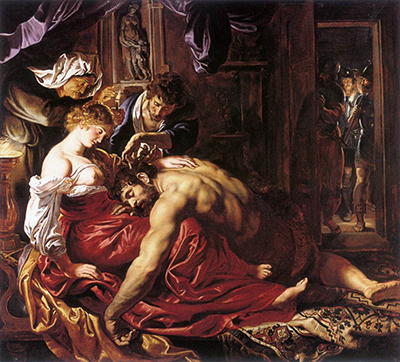
Samson sleeps with his head in Delilah's lap. His large body sprawls across the lower half of Peter Paul Rubens's painting, exposed and unguarded. A man bends in from behind her, scissors poised at Samson's hair. At the far right, armed men wait in a doorway. Rubens brings the betrayal into one room and one tense instant: the haircut is underway, but Samson has not woken or been seized.
The National Gallery in London[1] holds the picture as NG6461, an oil painting on oak panel. Its short object record dates it about 1609–10 and gives rounded dimensions of 185 × 205 centimetres. The Gallery's fuller 2025 catalogue entry[2] gives about 1609–11 and 184.8 × 204 centimetres. This page follows the more precise catalogue values while recognising that both records refer to the same panel. The reproduction here shows its candlelit room, sleeping Samson, cutting figure and soldiers beyond the door.
At a Glance
- ArtistPeter Paul Rubens, National Gallery attribution [2]
- DateAbout 1609–11 [2]
- MediumOil on oak panel [2]
- Dimensions184.8 × 204 cm [2]
- CollectionNational Gallery, London, NG6461 [1]
Where this work sits in Rubens's career
Samson and Delilah
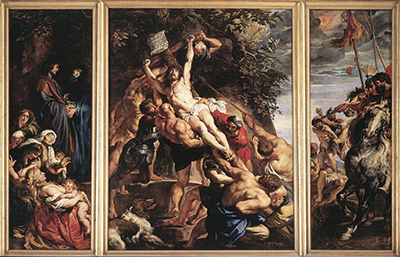
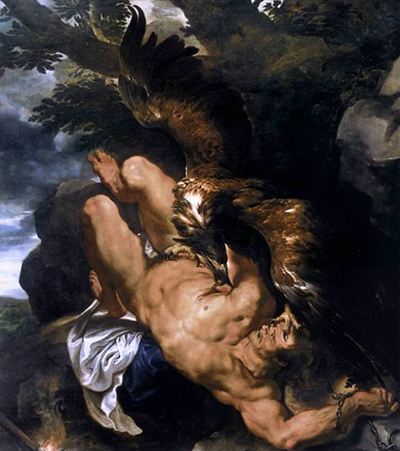
c. 1609–11The Elevation of the Cross
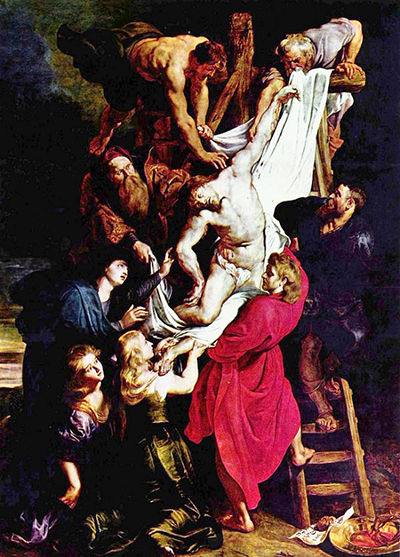
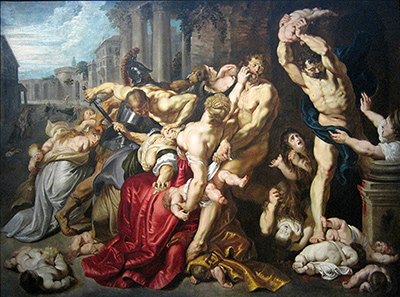
1609–10The Descent from the Cross
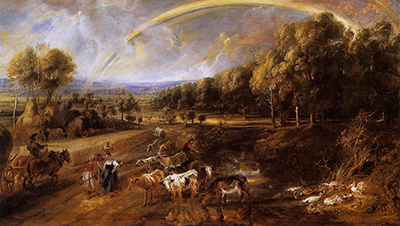
1611–14The Garden of Love
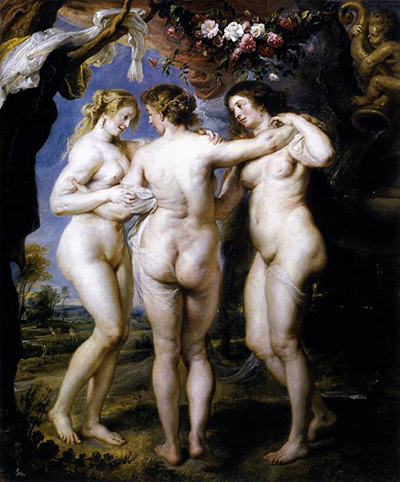
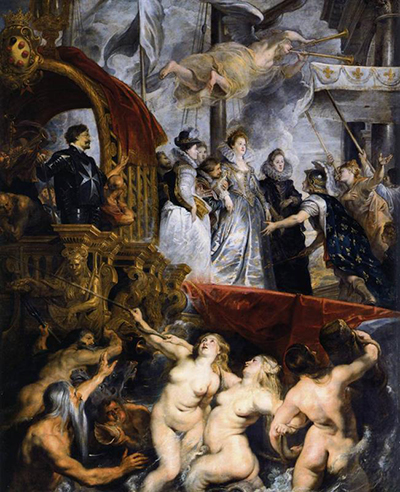
1630–35The Three Graces
1630–35Contents
- Who cuts Samson's hair?
- Light in the room
- A painting for Nicolaas Rockox's house
- The room Rubens invented
- Authorship and later history
- How Rubens worked toward the final scene
- From a private room into print
Who cuts Samson's hair?
In Judges 16[3], Delilah learns that Samson's uncut hair is bound to his dedication to God and to his extraordinary strength. She lets him fall asleep on her lap, then calls a man to shave his locks. Rubens keeps that detail: the cutter is the young man behind Delilah, while she supports Samson and watches the act. Saying that Delilah herself wields the scissors would misdescribe both the biblical account and the painting.
The Philistine leaders have promised Delilah payment for discovering the secret of Samson's strength. That story explains the soldiers waiting at the right edge. Rubens does not show the later capture or blinding. They are near enough to make the consequence clear, yet still separated from the bed by the threshold. The dark opening gives the eye a route from the intimate centre of the painting to the violence about to enter it.
Samson's body makes the reversal visible. It is strongly built, with broad shoulders and a lit back, but its weight lies across Delilah's lap and the bed. His left hand hangs loosely; he cannot defend the hair being cut above him. The cutter's narrow, careful movement contrasts with the hero's physical scale. Rubens chooses a task requiring precision rather than an open fight, so Samson's vulnerability is clear before his strength has visibly vanished.
Light in the room
A candle held by the older woman at left illuminates the scissors and the faces around them. A raised brazier and other candles add light elsewhere in the room. The Gallery's catalogue analysis[2] counts the brazier and three candles as Rubens's principal artificial sources. The bright skin and red drapery pull attention toward Delilah and Samson; the soldiers remain partly concealed until the viewer looks past the bed.
The placement of those sources makes light part of the plot. The older woman's candle is held where the cutter needs it, so illumination has a practical cause inside the story. Its concentrated glow lets the viewer follow the scissors without exposing every soldier beyond the doorway. Light therefore creates an unequal distribution of knowledge: the conspirators see what they are doing, Samson sleeps through it, and the viewer can detect the approaching captors before he can. The Gallery compares Rubens's nocturnal ambition with Adam Elsheimer's candlelit scenes, which he knew from Rome. That comparison is more specific than saying merely that the room is dark. Rubens stages several lights and their shadows within one confined interior, a different challenge from illuminating figures in a landscape.
The light is also material, not just atmospheric. Technical examination reported in the Gallery's catalogue identifies thick lead-tin yellow paint on the candle flame and dripping wax, with related highlights on the older woman's fingertips and the cutter's collarbone. Red lake derived from cochineal contributes to Delilah's crimson dress. These details explain how Rubens made the room glow and the fabric appear rich. They do not mean the small reproduction can reveal every pigment or brushmark; the technical findings come from examination of the painting itself.
The older woman and Delilah form a visual pair. Their profiles are close, one aged and one young. The Gallery suggests[1] a possible reminder that beauty changes with time, but does not treat this as a proven message from Rubens. Nor does it identify the older woman as a brothel keeper on documentary grounds. Her immediate role is plain: she holds light so the cutter can work without waking Samson. Other meanings can be considered without replacing that visible action.
The catalogue's discussion of facial types[2] adds another limit to portrait-like readings. It finds resemblances between Delilah and a figure in Rubens's lost Judith Beheading Holofernes, and between the candle-holder and an older figure in that design and in Elsheimer's Mocking of Ceres. These resemblances raise the possibility of shared models or drawings, but no surviving head study is directly linked to the four principal people in this panel. It would be unwarranted to name a real woman as Delilah or identify the older woman as a known servant on the strength of a familiar face. The comparison instead shows how Rubens may have developed character types across different biblical and mythological scenes.
A painting for Nicolaas Rockox's house
The earliest owner named in the Gallery's detailed research is Nicolaas Rockox, a leading Antwerp citizen and Rubens's patron. A 1640 inventory of Rockox's house lists an oil-on-panel Samson and Delilah by Rubens in its main reception room. The National Gallery catalogue[2] says there is no documentary proof that Rockox commissioned it: he may have acquired a picture already begun, or discussed it with Rubens while designs were being developed. The large panel was displayed above a mantelpiece in a painted view of Rockox's room, but that secure later setting is not a commission contract.
That domestic setting helps explain the picture's intimate scale of attention. It is nearly two metres wide, yet the central event is a pair of scissors at a sleeping man's head. The National Gallery's shorter essay relates Rubens's strong light and colour to a painting seen near a fireplace in Rockox's house. This is an informed interpretation of display and design, not a written instruction from Rubens saying he matched a particular hearth flame.
Rockox's known interest in antiquities also gives context to the room's classical touches. The Gallery identifies a statuette of Venus and Cupid in a niche behind the figures. It is a small image of love overlooking a scene of trust and betrayal. An antique-looking brazier and decorative bed add to the setting. They are part of the painting's imagined interior, rather than evidence that Samson and Delilah lived in a Roman room.
The room Rubens invented
The room is more carefully built than a generic biblical interior. The Gallery's catalogue discussion of the setting[2] identifies the statuette as based on the antique Venus Felix and notes glass flasks, a basin and a Roman-type ewer along the wall. It relates the low bed to an antique sarcophagus design known to Raphael and Giulio Romano, while the covering recalls a contemporary Turkish carpet. These elements bring distant times and places into one imagined chamber. Rubens is using things he had studied to give the scene material richness; the details do not relocate the story from ancient Israel to a documented Roman household.
The Venus statue can change the story one tells about Delilah. The National Gallery's catalogue explains that an early viewer might read Samson's loss of strength as a warning against desire, yet might also recognise a broader theme of love's power over even a celebrated hero. A garland on the statue invites that second reading. Neither interpretation excuses betrayal, and neither is a key that unlocks every object in the room. The point is that the antique image and the marriage imagery Rubens could draw on make the bedchamber more than an illustration of Judges 16. The painting sets trust, pleasure, calculation and impending violence in the same dim space.
That doubleness has a longer visual history. In the Gallery's interpretive section[2], Samson's story could be understood as a warning about yielding to sensual temptation or, through Christian typology, as an anticipation of Christ's betrayal. Yet the Gallery also traces a tradition in which even a formidable hero's submission to love was treated playfully or positively. Samson appeared in the train of Cupid in representations of Petrarch's Triumph of Cupid and on Florentine trays made to celebrate marriage and childbirth. Prints about the “power of women” also made Delilah a familiar figure outside strictly biblical teaching. These traditions do not reveal exactly what Rockox believed. They do explain why a Venus crowned with roses could sit above a story of deception without producing a single simple moral.
The timing sharpened that possible personal resonance. Peter Paul and his brother Philip Rubens both married in 1609, during the likely period of the picture's first conception. Philip later contributed verses to the print after the painting; the catalogue characterises their tone as more playful than condemnatory. The brothers' marriages do not make NG6461 a wedding commission, and no text says that Rockox ordered it to commemorate either ceremony. They give a documented contemporary setting in which viewers could recognise both the biblical peril and the language of love or marriage. The painting remains uncomfortable because Delilah's tender hand and calculated betrayal occupy the same gesture.
Rubens's own words from that year sharpen the point without solving the picture's purpose. The National Gallery cites an April 1609 letter to Johan Faber in which Rubens playfully describes Philip's marriage as entering Cupid's service and jokes about needing the permission of Philip's “Juno.” The terms belong to a private, learned exchange, not to a surviving instruction for Samson and Delilah. They do show that Rubens could speak about marriage through classical gods in the same period when he was developing a painting that places Venus above an Old Testament couple. That makes a love-related reading historically plausible while leaving the scene's betrayal and any original commission open to question.
One comparison in the catalogue clarifies his dramatic choice. Earlier images of Samson and Delilah often put them in an open landscape or palatial setting. The Gallery sees Rubens drawing on Adam Elsheimer's interest in artificial light and a confined interior, while using Tintoretto's treatment of the figures as a point of departure. This is a curatorial account of possible artistic sources, not a recipe copied line for line. The crowded bedchamber makes the waiting soldiers seem dangerously close and lets the separate lights pick out the people at different stages of the betrayal.
What did Rubens change from earlier images?
The National Gallery's catalogue comparison[2] is precise about the shift from dramatic violence to suspended action. It sees the close grouping of Samson, Delilah, the cutter and an older woman as related to Tintoretto's treatment of the subject, while Nicolò Boldrini's woodcut after Titian offered a stronger sense of the ensuing capture. Rubens drew energy from such images, but chose to stop before the soldiers rushed in. The barely moving scissors take the place of a fight as the composition's most consequential action. All the greater movement is held in reserve at the doorway.
Other proposed visual debts operate at the level of individual gestures. The catalogue compares Delilah's composed reclining pose with Michelangelo's figure of Night on the tomb of Giuliano de' Medici and his lost Leda design, both subjects Rubens studied. It notes a 1589 print by Raphael Sadeler after Joos van Winghe in which a cutter delicately holds scissors at Samson's hair. The Gallery suggests Rubens may have adapted that small, tense motif so the hands face the viewer. These relationships are proposals about how an artist transformed available images. They do not diminish the particular scene he built or prove that every figure was borrowed from a single source.
Samson's body is especially resistant to a one-source explanation. The Gallery says no direct model for the entire curled pose is known. It compares the massive back and arm with Rubens's studies of the Belvedere Torso and Farnese Hercules, and it notices an affinity with a porter in Rubens's Madrid Adoration of the Magi. Samson's head resting on his hand may recall a Michelangelo figure Rubens copied, though the date of that surviving copy is debated. The anatomy can thus be studied through antique sculpture and other works without turning the painting into a collage of certified quotations. Rubens had to fit a giant sleeping body into a room where the much smaller hands cutting his hair still command attention.
Authorship and later history
The National Gallery currently catalogues NG6461 as a work by Peter Paul Rubens. Its full entry[2] acknowledges that its authenticity has been questioned and that parts of its ownership history are missing; the authors defend the Rubens attribution. They cite the early Rockox inventory, the painting's documented later presence in the Liechtenstein collection, its relationship to the period's visual practice and technical examination. The disagreement belongs in the object's history, but a statement that the holding museum has rejected the picture as a copy would misrepresent its present catalogue.
The provenance has a notable gap after the panel left the Liechtenstein collection in 1881 and before it resurfaced in Paris in 1929. The Gallery acquired it in 1980. A gap in ownership does not by itself prove or disprove authorship; it does explain why historical reconstruction must distinguish what documents show from what is inferred. The 1640 Rockox inventory is a particularly strong early anchor, while the specific circumstances of the first commission remain less certain.
The route between Rockox and Liechtenstein is less direct than a simple transfer between two names. After Rockox died, his possessions were sold in 1641, but the buyers' list has not survived. The Gallery traces the painting into a branch of the Moretus family, associated with Antwerp's Plantin printing house. It cautions that a generically worded Moretus inventory entry calls one Samson “after Rubens,” making its identification with the London original uncertain. A more convincing later record places a Rubens showpiece in Elizabeth Hugens's great salon in 1678. A dealer's 1698 letter names her son-in-law Joannes Baptista Segers as owner. Those documents support a chain of possession while leaving the exact route through the 1641 sale unresolved.
The Gallery then documents the dealer brothers Guilliam and Marcus Forchondt handling the painting for a possible sale to Prince Johann Adam Andreas of Liechtenstein. An invoice dated 5 June 1699 lists Samson and Delilah by Rubens with a Van Dyck portrait, as well as cleaning, reframing and carriage to Vienna via Cologne. The prince insisted that the Rubens be an original and from the artist's mature period after Italy; price and attribution were discussed before the sale appears to have settled in 1700. These negotiations are valuable evidence about how the work was valued and doubted around 1700. They should not be turned into proof that the modern attribution must follow any one dealer's momentary opinion.
The painting's place in Rockox's house is better documented than the initial deal that brought it there. A painting by Frans Francken II of the great salon, made around 1630–35, shows Samson and Delilah above the fireplace. The National Gallery treats Francken's room view as a partly imaginative depiction, so it should not be read as an architectural survey. It does support the broad identification of a prominent domestic display, consistent with the inventory. The London panel's present frame is not the actual frame that hung over that hearth: the Gallery recounts later reframings, including a 1983 display above a replica chimney piece and a further frame made in 2005. Those modern efforts help visitors imagine a room, but the historic room and original frame cannot simply be recovered by looking at today's installation.
The question of authenticity has its own history. The Gallery's catalogue records correspondence in 1699 in which a dealer, after looking more closely at a Samson, wondered if it was a copy; subsequent correspondence shows the question remained unsettled in that transaction. This is historical evidence that doubts are not simply recent. It also shows why an isolated remark in a sales negotiation cannot be treated as a final verdict on the present panel. The catalogue weighs that record with the earlier Rockox inventory, later Liechtenstein evidence, the finished painting and technical examination in maintaining its attribution to Rubens.
How Rubens worked toward the final scene
The National Gallery's technical and historical catalogue[2] identifies three related oil sketches and a drawing. The earliest sketch, now in Madrid's Thyssen-Bornemisza museum, puts more emphasis on the tumult of Samson's capture. Another, in the Art Institute of Chicago, was painted over an abandoned design for an Adoration of the Magi. These are separate objects that show Rubens considering the subject; they are not fragments of the London panel. They also show that his final choice of a still sleeping Samson was a decision within a broader set of possibilities.
The Gallery proposes a more detailed sequence, while acknowledging that it is a reconstruction. Madrid's unfinished sketch, often called The Blinding of Samson, may be the earliest. Chicago's Capture of Samson retains the night setting but increases the violence and shows Delilah pushing Samson away. The change to the quiet betrayal appears in a pen-and-ink drawing now privately held, where the principal poses have been reset. A subsequent oil modello in Cincinnati develops the furnishings, the crowd at the doorway, Samson's abundant hair and the close placement of the heads. The Cincinnati study is more than a small colour copy of London: it is a stage at which the final arrangement took shape. The London panel in turn differs from the modello, showing that decisions continued at full size. No surviving life studies can be securely assigned to its main figures, as the catalogue expressly notes.
The finished panel itself was not made by mechanically enlarging a sketch. Imaging of the paint layers found small changes while Rubens worked: Delilah's neck and shoulders shifted, her hand and sleeve were adjusted, the older woman's head covering was altered, and a decorative animal head at the foot of the bed was suppressed. None of these changes transforms the story, but together they show a painter refining the arrangement after its first layout. The catalogue describes a relatively assured execution, with warm priming allowed to show through some passages and thicker paint where light strikes. That material evidence gives a firmer basis for discussing the painting's making than a general claim that Rubens painted quickly.
The oak support has its own physical history. The Gallery identifies seven Baltic oak boards and reports that tree-ring study allows a plausible use of the panel from 1605 onward. That is a limit on the wood's availability, not a date of 1605 for the image. The panel was later thinned and attached to modern blockboard. Such examination helps distinguish the material object in London from images after it and from other artists' retellings of the biblical scene.
The approximate 1609–11 dating also comes from the sequence of work around Rubens after his return from Italy. The National Gallery notes that the Chicago sketch of Samson's capture covers an abandoned design connected with the Adoration of the Magi commissioned for Antwerp's town hall in early 1609. Rockox was then serving as burgomaster, so the public commission could have brought him and Rubens into contact. This is a useful chronological clue, not a receipt for the private Samson panel. The Gallery also considers Philip's verses, which were published in 1615 after his death in 1611, when dating the picture and its print. Its conclusion is a reasoned range rather than an exact year recorded on the painting.
The technical record allows an unusually close look at how light was made. The Gallery identifies a white chalk ground and a thin yellow-brown priming applied in visible diagonal and vertical strokes. Rubens let that warm layer appear between marks of paint, including in Delilah's white sleeve. He built lighter flesh passages with lead white and reds, while transparent yellow earth and umber formed some shadows. The crimson robe contains cochineal-derived red lake; its deep folds and brighter accents required different mixtures and layers. The result is cloth that seems to turn in candlelight. These are material findings from the National Gallery's examination, not colour names guessed from the web image.
Conservation also qualifies what we see today. The support was thinned and fixed to blockboard before the Gallery acquired the picture, and it was cleaned in 1982. The catalogue judges the paint layers to be in excellent condition overall, while noting small losses and local wear. That history does not make every passage suspect. It tells the reader why the back of the panel no longer presents its original full thickness, and why material arguments about authorship draw on surviving paint, imaging and documents together.
One colour has changed enough to caution against assuming that the present surface is identical to the first display. The Gallery's macro X-ray fluorescence study finds a copper-containing pigment in the shadows of the older woman's robe, probably verdigris. Its text suggests the dark garment has browned to some degree, although it was never a brilliant green because black and umber were also present. That finding matters in a scene so dependent on shades of warm and cool light: a viewer sees a surviving material state, not a perfect time capsule of every original colour. The same catalogue finds the red of Delilah's dress built from cochineal-derived lake in different mixtures and layers. The two fabrics thus provide a small lesson in how aging and technique affect a painting's present appearance.
From a private room into print
The composition reached viewers beyond Rockox's house through an engraving by Jacob Matham. The Gallery's catalogue notes that the print carries a dedication naming Rockox as the picture's owner and verses by Philip Rubens, Peter Paul's brother. The print is not a transparent duplicate of the panel: it has fewer soldiers at the door, altered room details and a more elongated shape. Several states of the engraving survive. Its exact date has been debated, with proposals from the early 1610s onward, so it is safer to describe it as an early print after the painting than to present a single disputed year as certain.
The differences show how a private painting could be translated for another medium and audience. A print cannot reproduce the crimson lake glaze or the candle's raised yellow paint, but it can carry the arrangement of Samson, Delilah, the cutter and the waiting soldiers. The National Gallery also notes that the young Anthony van Dyck responded to Rubens's composition in his own Samson and Delilah. These are examples of reception, not evidence that Van Dyck or Matham helped paint NG6461.
The print carried the design into another civic setting. The National Gallery's catalogue[2] identifies Christiaen van Couwenbergh's Samson and Delilah, bought for the Dordrecht town hall in 1632, as strongly indebted to Matham's engraving. Van Couwenbergh kept the central pair and the sense of an interior, but brought a Philistine at the doorway farther into the room. This is a specific chain of transmission: Rubens's painting in Rockox's Antwerp house, Matham's portable printed version, then a new painting for a Dutch civic building. The Dordrecht canvas is not a workshop replica of the London panel. Its changed action shows an artist using the print as a starting point for his own scene, while its public destination differs from the prominent private room in which Rockox displayed Rubens's work.
The Gallery identifies further differences that make the print a genuine reinterpretation. Five soldiers appear at the painting's doorway, but only three in Matham's engraving. The printed bed has more elaborate animal-head fittings, and the doorway widens to accommodate an inscribed dedication within the scene. A later state even adds falling hair near Delilah. The catalogue suggests that Rubens may have contributed a drawing for the engraver and perhaps influenced revisions, while acknowledging that the exact working sequence remains partly inferential. The comparison separates evidence visible in two surviving objects from a speculative story that the engraving exactly reproduces a lost stage of the panel.
The print carries another kind of evidence: verses written by Philip Rubens, the painter's brother, later published in 1615. They make the engraving a joint literary and visual object, with Rockox named as the painting's owner in the dedication. The National Gallery does not establish a single uncontested year for Matham's first state; some proposed dates depend on whether he knew Philip's verses before or after their printed publication. The evidence for circulation is therefore solid, while the precise sequence of drawing, verse and engraved states remains open. That care matters because a print dedicated to Rockox proves that he owned and displayed the painting, but it does not by itself prove that he had commissioned it directly from Rubens.
For much of the twentieth century the panel itself was less accessible than its print and older records. The Gallery notes that it came to wider international attention at the 1977 Antwerp exhibition marking four centuries since Rubens's birth. Before that, specialists had examined it, but many readers knew it mainly through black-and-white reproductions. It entered the National Gallery after a sale in 1980. This reception history helps explain why arguments over its attribution intensified around a painting with strong early documentary anchors yet an incomplete modern ownership trail. The full catalogue's authors firmly retain Rubens as the painter; their position is a present scholarly judgement grounded in the object and records, not an erasure of every earlier question.
Rubens artworks directory
Frequently Asked Questions
No. A male accomplice cuts it while Samson sleeps in her lap, as in Judges 16. Delilah has arranged the betrayal and steadies the sleeping man.
The National Gallery's detailed catalogue dates NG6461 about 1609–11. Its shorter object page gives about 1609–10; both dates are approximate.
Rockox's 1640 house inventory records it in the main reception room. A position above the mantelpiece is likely, based on the Gallery's reading of its size, inventory order and a painted view of the room.
Some critics have questioned the painting's authenticity. The National Gallery's present catalogue attributes it to Rubens and addresses those objections. The ownership record has gaps, including 1881–1929, but the early Rockox inventory names a Rubens Samson and Delilah on panel.
It is in the National Gallery, London, inventory NG6461.
Discussion
Look closely at the moment Rubens chooses before Samson's capture.
Share an observation about the painting or a reliable source that adds to its history.
Reader Insights
How does the candlelight separate the figures and their roles?
Who cuts Samson's hair, and how does the painting show Delilah's part?
How should the National Gallery's attribution and the published objections be weighed?
Join the Conversation
Add your reading below, keeping observations specific and evidence clear.
References
- National Gallery, London, Samson and Delilah , current object page. View source
- Gregory Martin and colleagues, National Gallery catalogue entry for NG6461, 2025. View source
- Judges 16, biblical narrative. View source