 by Tom Gurney
Tom Gurney BSc (Hons) is an art history expert with over 20 years experience
Published on June 19, 2020 / Updated on October 14, 2026
Email: tomgurney1@gmail.com / Phone: +44 7429 011000
A family portrait addressed to heaven
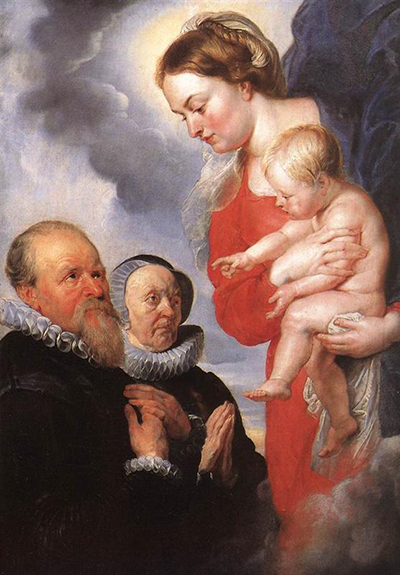
An older man turns his face upward. One hand rests against his chest, while the woman behind him clasps hers in prayer. Their black clothes and bright white collars bring their faces forward from the darker side of the painting. Beside them, Mary holds the naked Christ Child, who extends an arm toward the kneeling couple. Clouds gather around all four figures. The picture is a portrait of two people, but its action lies in the meeting they seek with Mary and her son.
The panel is Peter Paul Rubens's ex-voto in the Musée des Beaux-Arts de Tours, inventory 1803-1-29. The museum's current object record[1] identifies the donors as Alexandre Goubau and Anna Anthony, records oil on wood and gives the dimensions as 124 × 84 centimetres. The inherited route and old image filename use other spellings. Those spellings remain part of the site's address and stored asset, but the museum's current names identify the people in the reader-facing text.
This was made for a funerary monument in Antwerp Cathedral, not simply as a picture of a fashionable couple visiting a holy scene. According to Tours, Alexandre-Jean Goubau, a wealthy silk merchant and cathedral almoner, died in 1604. His wife Anna commissioned Rubens to make the work for their memorial. Alexandre's likeness was therefore painted after his death. Whether Rubens took Anna's likeness from life, from an earlier image, or at another stage is not settled by the museum's short account. The panel presents them together in perpetual devotion, whatever the separate histories of their faces.
At a Glance
- ArtistPeter Paul Rubens [1]
- Date1608–21 (Tours catalogue); other dates proposed [1][2][3]
- MediumOil on wood panel [1]
- Dimensions124 × 84 cm [1]
- CollectionMusée des Beaux-Arts de Tours, 1803-1-29 [1]
- Original purposeGoubau couple's funerary monument, Antwerp Cathedral [1][2]
Where this work sits in Rubens's career
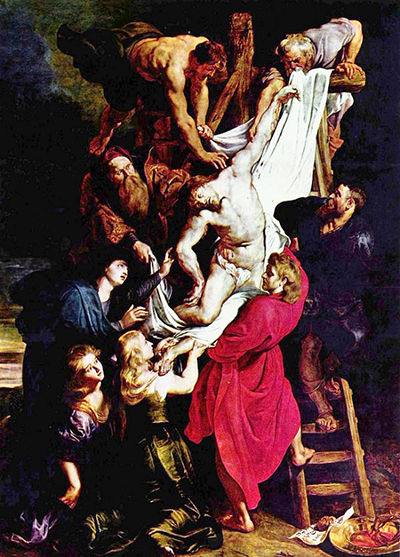
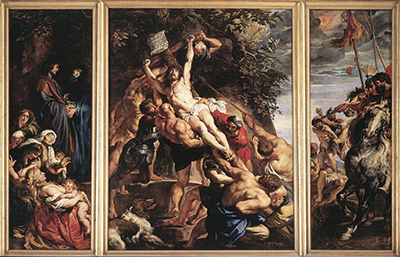
The Elevation of the Cross
1609–10The Descent from the Cross
1611–14The Garden of Love
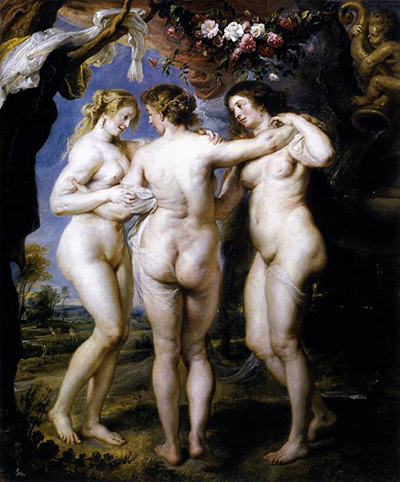
1630–35The Three Graces
1630–35Contents
- Who were Alexandre Goubau and Anna Anthony?
- Reading the four figures
- An ex-voto for a funerary monument
- When did Rubens paint it?
- Antwerp, Paris and Tours
- A later artist's related composition
Who were Alexandre Goubau and Anna Anthony?
The donors' names matter because the picture had a particular family purpose. Tours describes Alexandre as a rich Antwerp merchant in silks who also held an almoner's role connected with the cathedral. He was not a saint, an apostle or a fictional bystander. His portrait asked future viewers to remember a named local man while looking toward the Virgin and Child. Anna was more than the second figure in that portrait: the museum identifies her as the person who commissioned it after her husband's death.
The museum's longer educational guide[2] calls Alexandre's charitable office the principal almoner of the merchant city, while the current collection entry associates the role with the cathedral. The terms are close in subject but not identical in institutional detail. Without a cited appointment document, the safest account is that he was an Antwerp silk merchant associated with an almoner's office. That role helps explain his standing; it does not tell us precisely how he acquired every part of his wealth or how the memorial was paid for.
Anna's decision joined private remembrance to public prayer. The guide says elite patrons in Antwerp furnished epitaphs, chapel altars and nave pillars with paintings. Rubens was already in demand for major religious commissions in the city. Yet this panel's narrow format and four-figure scene are intimate beside a cathedral triptych. A family memorial did not need to compete in scale with a high altarpiece to be noticed. It could instead place recognizable people close enough to sacred figures that a visitor understood whom to remember and for whom to pray.
Modern spellings vary across the museum's own publications. Its current object page gives Anna Anthony; its guide calls her Anne Antoni and elsewhere Anna Antoni. The Louvre's Van Dyck catalogue[3] uses Anne Anthony when it identifies this Rubens painting as a comparison. These are variant modern forms for the same donor in those sources. They do not point to three different women or to three separate paintings.
Reading the four figures
Mary's red dress and blue drapery separate her from the sombre garments of the couple. Light on her face and the child's body draws the eye toward them first. Rubens places the sacred pair slightly higher, but he does not close them off behind architecture or an obvious painted frame. The donors occupy the same shallow field. The museum's guide notes that clouds appear both above and at the lower right, helping to connect the four figures within one pictured space.
That arrangement makes the gestures unusually important. Alexandre looks up and places his hands at his heart. Anna's hands come together while her gaze reaches toward the child. Mary looks down toward Alexandre; Christ turns toward the donors and raises a hand. The guide reads the child's gesture as a blessing. These crossed directions make a chain of attention across the panel. A viewer can follow it from the memorialized man to Mary, across to Christ, and back toward the praying woman.
The white ruffs do more than mark social dress. Against dark fabric, they illuminate the donors' necks and faces. The old man's grey beard and the woman's lined features are therefore not swallowed by the surrounding black. The contrast lets the painting preserve individual likenesses while giving the Virgin and Child the brighter colour and light appropriate to the devotional subject. The museum's guide describes the couple's dress as sober but luxurious within early seventeenth-century southern Netherlandish custom. Dress signals status here, but colour alone cannot reliably establish the donors' religious confession.
The child is lively rather than distant: his body turns outward and his extended arm crosses the small interval toward the couple. Mary supports him while inclining toward the donors. Because the composition makes almost no architectural boundary between people and vision, the closeness itself carries meaning. Tours describes the work as a Flemish devotional tradition in which divine figures and donor portraits are brought together. The panel does not pretend that its human sitters stood in the same historical room as Mary and Jesus. It visualizes a prayer for access to their care.
An ex-voto for a funerary monument
An ex-voto is a work offered in devotion, often in fulfilment of a vow or thanksgiving. Tours uses that term as the painting's present title. Here the securely documented function in the museum account is its destination at the Goubau couple's funerary monument. The online description does not identify the precise vow, request or event behind Anna's order, so the title should not be expanded into a specific miracle story.
The memorial setting changes how to read the couple's posture. They are not engaging the viewer with the confident stare of a formal civic portrait. They turn away from us in prayer. At a funerary monument, their image could keep that act of devotion visible after their deaths. Alexandre had died before Rubens made the panel, while Anna lived long enough to commission it. The painting gathers the two into a single act that no ordinary moment in the painter's studio could have supplied.
The guide places the original memorial in the cathedral's masons' chapel and says the panel was moved more than once within the building. Its fuller historical account records it against the Mason Masters' pillar near the ambulatory when French forces removed it in 1794. The present museum entry simply says the painting was intended for the couple's funerary monument in the cathedral. These descriptions can be read as different stages or degrees of precision: the memorial destination is firm in the museum narrative, while a permanent, unchanging original position is not established by the public record.
Rubens's decision to put the donors in the main pictorial field deserves attention. The Tours guide contrasts this with the common arrangement of donors on the side wings of a triptych. Here Alexandre and Anna meet Mary and Jesus without a wing or dividing border between them. The guide interprets this as distinctive within contemporary religious painting. A present-day viewer need not assume that every earlier donor image used wings, but the comparison reveals why this panel feels immediate. The people seeking intercession are in the same central image as the figures they address.
That proximity would have worked differently for a cathedral visitor than it does in a museum. In Antwerp, the panel belonged to a memorial associated with named dead people and a specific sacred building. Viewers moving through the cathedral might encounter it amid liturgy, chapels, other epitaphs and the physical reminders of burial. In Tours, the painting survives as an individual museum object. Its composition can still make the relationships legible, but the original architectural and commemorative surroundings are no longer around it. The surviving public records give us the function and later positions, not a complete reconstruction of every element of the monument.
When did Rubens paint it?
The date cannot be reduced to one uncontested year. The current Tours object record[1] gives a broad range, between 1608 and 1621, and its narrative says the panel was finished in 1621, the year of Anna's death. The museum's educational guide[2] instead labels it 1618–21 and says Anna commissioned it around 1618–19. A Louvre catalogue comparing it with a later Van Dyck donor painting[3] dates the Rubens panel around 1615. These sources agree on the object and its makers and donors, but their dates differ.
The museum's broad catalogue span may reflect an intentionally cautious object date, while its guide offers a narrower proposed chronology. The Louvre's circa 1615 is another scholarly date. It would be tempting to force these into a simple sequence: begun around 1615, commissioned in 1618 and completed in 1621. Nothing in the cited sources documents such a sequence, and a painting cannot be commissioned after its supposed start without further explanation. This page therefore keeps the proposed dates attached to their sources. The firm points in the museum narrative are Alexandre's earlier death, Anna's commission, the funerary purpose and the painting's completion claim in 1621.
The chronological question also affects the description of the portraits. Tours calls the image a double posthumous portrait because the completed work is tied to Anna's death year. Alexandre's posthumous status is straightforward: he died in 1604. Anna's is less straightforward when she is also identified as the commissioner in a guide that places the order around 1618–19. A finished painting and a living sitting need not occur on the same date. The public materials do not reveal whether Rubens revised her figure after death. Calling the pair together in a memorial image is sound; claiming to know exactly how and when Anna sat for it is not.
Antwerp, Paris and Tours
The panel's journey is part of its meaning. The Tours guide[2] says French forces seized it with ten other paintings on 5 August 1794, during the second French conquest of the region. It was then at the cathedral's Mason Masters' pillar by the ambulatory. The guide records its arrival in Paris on 19 September 1794 and entry into the Muséum central, the predecessor of the Louvre's present museum. It was sent to Tours in 1803. The current Tours object entry confirms the 1803 transfer from the Muséum central.
This is a documented removal, not an ordinary sale by the couple's descendants. The guide places it within the organized revolutionary seizure of artworks in conquered territories. That history explains why an Antwerp memorial painting belongs to a French municipal collection today. It also explains why a work once connected to a cathedral tomb has a French museum inventory number rather than a present position near the Goubau monument. The public account does not provide a complete list of all its moves within the cathedral or every administrative document from its passage through Paris, so the clear dated steps are preferable to an imagined continuous travel diary.
Tours's acquisition year is not the painting's making year. 1803-1-29 identifies the museum object, while 1803 records the shipment to Tours. The object itself is a seventeenth-century wood panel. Keeping those dates apart avoids a frequent confusion in online art listings, where a date of accession can accidentally appear beside a date of creation. The image retained on this page reproduces the Tours composition of the kneeling couple and the Virgin and Child; the site has not imported a new museum photograph.
A later artist's related composition
The Louvre's scholarly catalogue of Anthony van Dyck's Virgin with Donors[3] illustrates the Tours Rubens panel as a comparison. Its author observes that Van Dyck appears to take up the example of Rubens's donor composition. Van Dyck's large Louvre canvas is a different painting, dated about 1630–32 and catalogued as oil on canvas. It places an elderly man and woman before the Virgin and Christ Child, but it does not depict Alexandre and Anna simply because the positions and clothes seem familiar. The Louvre itself treats the identity and original purpose of Van Dyck's donors cautiously.
The comparison shows a compositional idea that could be adapted: living or remembered people praying before a sacred mother and child in a shared image. It does not supply a missing contract for the Tours panel, prove that Van Dyck saw it in a particular location, or establish that the Louvre canvas served the same funerary function. What makes the Tours panel distinctive remains its named donors and the documented connection to their Antwerp memorial. A comparison is most useful when those identities stay separate.
Rubens artworks directory
Frequently Asked Questions
The Tours museum identifies Alexandre Goubau, an Antwerp silk merchant and almoner who died in 1604, and his wife Anna Anthony, who commissioned the painting for their funerary monument. Published variants include Anne Antoni and Anna Antoni.
It was intended for the couple's funerary monument in Antwerp Cathedral. The museum guide associates that memorial with the masons' chapel and records the painting at the Mason Masters' pillar by the ambulatory when it was removed in 1794. It says the painting moved more than once within the cathedral.
Tours's current object entry gives 1608–21 and says it was finished in 1621. Its educational guide proposes 1618–21 and a commission around 1618–19; the Louvre's comparative catalogue says circa 1615. The published sources do not establish one universally accepted year.
No such joint sitting is documented here. Alexandre died in 1604, before Rubens's painting. Anna commissioned the memorial work; the public museum material does not settle how her likeness was made or whether it changed after her death.
French forces removed the panel from Antwerp Cathedral in 1794. After its arrival in Paris and entry into the Muséum central, it was sent to Tours in 1803. The Tours museum lists it as 1803-1-29.
No. It is a later, much larger Van Dyck canvas with different, uncertain donor identities. The Louvre catalogue compares its design with the Tours Rubens panel; it does not identify the works as one object.
Discussion
Look closely at how the four figures share one space and exchange attention.
Share an observation about the painting or a reliable source that adds to its history.
Reader Insights
How do the donors' gestures change the way you read this as a portrait?
What does the funerary setting add to the meeting with Mary and the child?
How should we describe its date when the museum and Louvre sources differ?
Join the Conversation
Add your reading below, keeping observations specific and evidence clear.
References
- Musées et Patrimoine de Tours, current object entry for Ex-voto: Virgin and Child with portraits of Alexandre Goubau and Anna Anthony , 1803-1-29. View source
- Musée des Beaux-Arts de Tours, educational guide to Rubens's Ex-voto. View source
- Musée du Louvre, scholarly Van Dyck catalogue, cat. 14, with Rubens's Tours panel as a comparison. View source