 by Tom Gurney
Tom Gurney BSc (Hons) is an art history expert with over 20 years experience
Published on June 19, 2020 / Updated on October 14, 2026
Email: tomgurney1@gmail.com / Phone: +44 7429 011000
A Genoese portrait on a grand scale
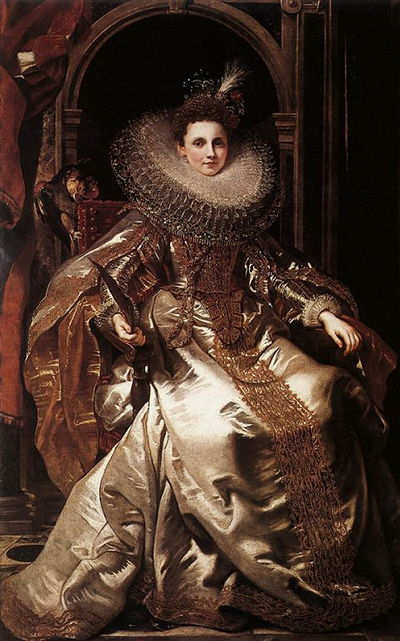
The woman sits in a high-backed red chair, facing us beneath a stone arch. A fan opens in one hand; her other hand rests on the chair. Her pale silk dress spreads almost to the lower corners, covered by broad passages of gold embroidery. A vast lace ruff frames her face, while a red hanging cloth and the architecture make a formal setting around her. A small parrot perches near the chair. Peter Paul Rubens turned a seated likeness into a full-length display of fabric, setting and rank, yet the person at its centre still meets the viewer’s gaze.
The National Trust[1] catalogues the painting as Marchesa Maria Serra Pallavicino (?). The question mark matters: the work is signed and dated 1606, but the sitter’s modern identification remains qualified by the collection that holds it. It is oil on canvas, 233.7 × 144.8 centimetres, at Kingston Lacy in Dorset, inventory 1257098. The reproduction here corresponds to this canvas. The museum’s question mark records the remaining uncertainty over the sitter’s name.
The tall format shapes how the painting works. Rubens gives the woman a commanding presence by allowing the dress to fill much of the frame. The face is comparatively small, but the brilliant lace and sleeve passages draw attention upwards to it. The fan and chair arm make both hands visible, so the pose feels deliberate and composed. The portrait depends on more than the sitter’s features: scale, clothing and architecture help present her place within Genoa’s wealthy world.
At a Glance
- ArtistPeter Paul Rubens [1]
- SitterProbably Maria Serra Pallavicino [1]
- Date1606, signed and dated [1]
- MediumOil on canvas [1]
- Dimensions233.7 × 144.8 cm [1]
- CollectionNational Trust, Kingston Lacy, 1257098 [1]
Where this work sits in Rubens's career
The Elevation of the Cross
1609–10The Descent from the Cross
1611–14The Garden of Love
1630–35The Three Graces
1630–35Contents
- Why is the sitter’s name qualified?
- The dress, chair and parrot
- Rubens, the Gonzaga court and a possible gift
- From Genoa to Kingston Lacy
Why is the sitter’s name qualified?
The National Trust explains that the two large Rubens portraits now at Kingston Lacy were formerly called portraits of women in the Grimaldi family. Those names appear to have been attached after the pictures entered that family’s ownership. In Ratti’s 1780 guide to Genoa, the pair was not named. Later research examined heraldic motifs in the curtain above the sitter and proposed Maria Serra, wife of Niccolò Pallavicino. This is a researched identification, not a name inscribed beside her face in 1606.
The museum has chosen to keep its question mark even while describing the heraldic argument. That is a useful distinction between confidence in an object and confidence in a sitter name. Rubens’s hand, the 1606 date, Genoese setting and large canvas are securely documented in the collection record. The name Maria Serra Pallavicino is a strong modern proposal with visible heraldic support, but the museum leaves room for revision. A reader can understand both levels of evidence without reducing the portrait to an anonymous woman or declaring the issue closed.
The companion canvas at Kingston Lacy is particularly easy to confuse with this one. The Trust now catalogues NT 1257100[2] as Probably Marchesa Maria Grimaldi and an Attendant, dated about 1607. That separate painting also presents an elaborately dressed Genoese woman, but includes a short attendant and a small dog. Its title and sitter remain qualified in their own way. The two canvases travelled together in later centuries; they are not interchangeable images, and their two women should not be merged into one biography.
More recent family research complicates the second name without changing this object's identity. The Faringdon Collection's account of its own Rubens portrait at Buscot Park[4] describes a group of related Genoese women painted around Rubens's 1605–06 visits. It identifies the woman with the attendant at Kingston Lacy as Anna Maria Lomellini, who has also been called Maria Grimaldi. This differs from the wording of the National Trust's current companion title, so the disagreement should be made visible rather than silently settled here. Both institutional accounts agree that the attendant picture is a different canvas from the signed 1606 portrait on this page.
The dress, chair and parrot
The National Trust describes silvery silk overlaid with gold embroidered lace, broad hanging sleeves lined with cloth of gold, and smaller ruff-like cuffs at the wrists. The detailed description helps a reader notice that the costume is constructed in layers rather than one continuous white surface. Rubens makes the fabric catch light in different ways: satin-like folds shine broadly, while the gold decoration breaks into smaller patterned highlights. The huge circular ruff holds a more delicate rhythm close to the face.
The sitter’s open fan carries a smaller pattern of lines in front of the dress. It gives one hand an action without disturbing the formality of the pose. Her other hand rests on the chair’s arm, anchoring her body in the rich red seat. These gestures are quiet compared with the spectacular clothes; that restraint keeps the portrait from becoming only a costume study. We see a person controlling her posture and address to the viewer within a carefully arranged display.
A parrot perches on the chair-back, where the Trust says it pecks at a stud. It contributes a small living movement near the otherwise still seated figure. The animal’s species and action are described in the collection record, but a fixed symbolic meaning is not. Parrots could invite many associations in early modern art; this source does not establish which, if any, Rubens intended here. The safest reading is visual and social: a striking bird adds rarity, colour and animation to an opulent portrait.
The stone arch and dark marble inlays create another kind of richness. They place the sitter within an idealised architectural setting rather than a clearly identified room. A strip of sky and clouds appears to one side. These background elements make the large dress and chair feel housed in a grand space, while the red drapery offers a deep colour behind the pale costume. The National Trust’s attribution of the sitter rests partly on heraldry within that curtain; the curtain can therefore be both part of the picture’s theatrical design and a material clue used by later researchers.
Look higher than the ruff and the costume becomes more intricate still. The Trust describes flowers, sprays of jewels and a white egret feather in the sitter's dressed hair. These small accents sit above a much larger arrangement of silk, lace and gold. Rubens shifts the viewer's attention from the broad train and hanging sleeves to the fine work at the neckline and hair, before it reaches the face. The effect depends on painting several surfaces with very different textures in one coherent pose. The Trust's broader collection feature on the portrait[6] notes precisely this treatment of surface and colour.
Rubens, the Gonzaga court and a possible gift
The National Trust places the painting in Genoa and identifies Maria Serra, if the attribution of her name is right, as the wife of Niccolò Pallavicino. Its account calls him a banker and host to Rubens’s employer, Duke Vincenzo I Gonzaga of Mantua. The museum connects the household to a lavish 1606 banquet and ball and suggests that the sitter may have worn the depicted dress on that occasion. “May” is essential: a sumptuous costume is visible on the canvas, while its exact use at a particular event is the Trust’s historical inference.
The painting bears a Latin inscription on the base of the niche at the left. The National Trust transcribes Rubens’s name, the 1606 date and a gift formula, D. D. (dono dedit, “gave as a gift”). The writing makes the portrait unusually informative about its early character. It supports the claim that the painting was presented as a gift. The Trust then proposes that Rubens may have made that gift on behalf of Gonzaga, a plausible interpretation of the relationship between patron, artist and host. The inscription does not by itself name the duke as the giver, so the proxy explanation should remain attributed as the museum’s proposal.
Rubens’s Genoese portraits often gave aristocratic and wealthy sitters an imposing bodily and architectural presence. This canvas shows why such a commission mattered to patrons: clothing, expensive furnishings and scale could make standing visible in a domestic setting. But the portrait is more than an inventory of valuable things. The fan, gaze and slightly turned body keep a human address at its centre. The sitter’s precise name may remain open, while her portrait makes clear how carefully Rubens shaped a public image for a woman in a powerful household.
The Buscot catalogue places this painting among portraits of women connected to the Serra and Pallavicino families. It names related sitters in pictures now at Buscot, Karlsruhe, Stuttgart and Kingston Lacy, and explains how similar poses, clothes and faces contributed to earlier misidentifications. On that account, Maria Serra Pallavicino was a sister-in-law of the woman now identified there as Violante Maria Spinola Serra, the Buscot sitter. The comparison gives a better reason for looking at Rubens's Genoese portraits together than simply calling them one repeated type. They record a network of marriage, banking and hospitality, while each picture retains its own inscription, history and level of certainty about the sitter.
The same source observes that no payment record has been found for the group and proposes that portraits may have been Gonzaga gifts to families who provided him with financial and other services. This supports the National Trust's possible proxy-gift reading, but it remains a historical explanation, not a surviving commission or payment receipt. The D. D. inscription is direct evidence on the 1606 canvas; the wider exchange of favours is reconstructed from the patrons' relationships. Keeping those two kinds of evidence distinct is especially important when the woman's name itself is still marked with a question mark.
From Genoa to Kingston Lacy
The provenance has several firm later points. The Trust says Ratti recorded the picture in 1780 on the first floor of the Palazzo Centurione in Genoa, then occupied by Giovanni Battista Grimaldi La Pietra. William John Bankes bought this painting and its companion from the Palazzo Grimaldi in 1840. The Bankes collection, with Kingston Lacy, passed to the National Trust in 1981. These dates trace important stages without proving every movement between Rubens’s studio and the eighteenth century.
The two portraits’ later shared ownership partly explains why both acquired Grimaldi names in the past. Collection history can preserve a painting while changing what people call its subject. The Trust’s current entries separate the two identities: this signed 1606 portrait is probably Maria Serra Pallavicino; the later companion is probably Maria Grimaldi with an attendant. A site visitor moving between the two should see different inventory numbers, dates and visual descriptions, not one repeated “Genoese lady” account.
The painting has continued to be studied and shown. The Trust records it in Dulwich Picture Gallery’s 2023–24 Rubens & Women exhibition; the gallery’s own exhibition archive[3] also identifies it by image and dimensions. The exhibition’s focus on women as patrons, family members and subjects offers a modern context for viewing this portrait. It does not settle the sitter’s name or turn the museum’s suggested banquet scene into a documented moment.
After that loan, the portrait returned to Kingston Lacy. A 2024 report by CODART[5] records that the two Rubens portraits were hung lower in the Saloon following conservation work there. The curator described the change as a way for visitors to meet the imposing paintings more directly and inspect Rubens's technique. This present-day display history cannot tell us where the portrait hung in 1606. It does, however, remind us that the height and closeness from which a viewer sees this life-size figure alter how its lace, parrot and small inscription can be read.
Rubens artworks directory
Frequently Asked Questions
The National Trust titles her Marchesa Maria Serra Pallavicino (?). Heraldic research supports that identification, while the question mark records the museum’s remaining uncertainty.
The portrait is signed and dated 1606. The Trust lists Genoa as its place of origin.
No. That is a distinct Kingston Lacy canvas, NT 1257100, now titled Probably Marchesa Maria Grimaldi and an Attendant. The present portrait is NT 1257098 and has a parrot by the chair.
Its inscription includes a gift formula. The Trust proposes that Rubens may have presented it on behalf of his employer, Duke Vincenzo Gonzaga; the proxy role is an inference, not named in the formula itself.
It belongs to the National Trust’s Bankes Collection at Kingston Lacy, Dorset, inventory 1257098.
Discussion
Look closely at the dress, fan and architectural setting.
Share an observation about the painting or a reliable source that adds to its history.
Reader Insights
What does the inscription establish about the gift?
Why does the sitter's name remain qualified?
How does this canvas differ from its Kingston Lacy companion?
Join the Conversation
Add your reading below, keeping observations specific and evidence clear.
References
- National Trust Collections, Rubens, Marchesa Maria Serra Pallavicino (?) , NT 1257098. View source
- National Trust Collections, Rubens, separate Probably Marchesa Maria Grimaldi and an Attendant , NT 1257100. View source
- Dulwich Picture Gallery, Rubens & Women exhibition archive. View source
- Faringdon Collection, Rubens's Portrait of Violante Maria Spinola Serra and the related Genoese portrait group. View source
- CODART, Kingston Lacy's 2024 rehang of the Rubens portraits. View source
- collection feature on the portrait. View source