 by Tom Gurney
Tom Gurney BSc (Hons) is an art history expert with over 20 years experience
Published on June 19, 2020 / Updated on October 14, 2026
Email: tomgurney1@gmail.com / Phone: +44 7429 011000
The moment after the execution
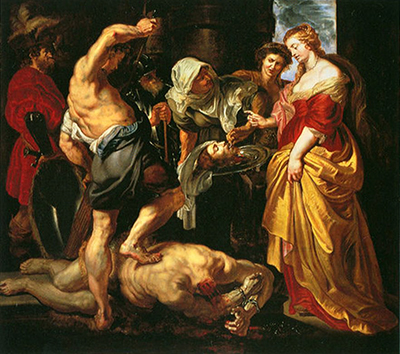
The executioner stands over John the Baptist's body with one leg raised and his muscular back turned toward us. The severed head rests on a platter at the centre. An old woman reaches toward it, while a small Black attendant struggles to support the dish. At the right, Salome in yellow and red turns toward them and raises a finger. The scene is crowded, close and unstable. Rubens does not hide the killing in a distant room; its result is still in motion before our eyes.
This is the painting that the inherited route calls “Beheading of St John the Baptist.” Its catalogue title in Sotheby's 2023 sale[1] is Salome Presented with the Head of Saint John the Baptist. The catalogue attributes it to Peter Paul Rubens, identifies oil on oak panel, and measures the panel at 94 × 101.8 centimetres. The title difference is useful: although John's decapitated body is shown, the primary action is the presentation of the head to Salome immediately afterward. The route stays familiar, while the heading and caption give the object its present catalogue name.
The panel belongs to Rubens's first years after his return from Italy. The National Gallery's 2005–06 exhibition catalogue, recorded in Sotheby's bibliography[1], dated it 1608–09; Sotheby's 2023 sale report[3] calls it a 1609 work. These are approximate scholarly datings rather than a signed year on the painting. “About 1609” is a concise description, with 1608–09 available when the dating history matters.
At a Glance
- ArtistPeter Paul Rubens [1]
- DateAbout 1608–09 [1]
- MediumOil on oak panel [1]
- Dimensions94 × 101.8 cm [1]
- Last public saleSotheby's New York, 26 January 2023, lot 5 [1][3]
- Current locationNot publicly confirmed after 2023 sale [1][3]
Where this work sits in Rubens's career
The Elevation of the Cross
1609–10The Descent from the Cross
1611–14The Garden of Love
1630–35The Three Graces
1630–35Contents
- Who is present in the scene?
- A Black attendant and the unstable platter
- Colour, bodies and an Italian education
- A picture that was long thought lost
- A different picture from the Edinburgh banquet
Who is present in the scene?
The Gospel accounts in Mark 6:17–29[7] and Matthew 14:3–12[8] describe John condemning Herod's marriage to Herodias. Herodias's daughter dances before Herod, receives a promise of a reward, and at her mother's urging requests John's head. The texts do not name the daughter in these passages. “Salome” is the name established in later tradition and in the painting's current title. Rubens chooses the interval after the executioner has carried out the order and before the head has settled securely in the young woman's possession.
The muscular executioner dominates the left centre. His arm rises toward the rods and axe of a fasces, the Roman emblem that Sotheby's research essay[2] reads as a sign of an officially sanctioned execution. George Gordon, the essay's author, describes Rubens as picturing him like a Roman lictor. Gordon also cautions that Herod Antipas, a tetrarch rather than a Roman magistrate, would probably not have had such a figure in historical service. The classical sign should therefore be read as Rubens's visual language of authority, not as exact evidence for Herod's household.
John's body lies at the bottom edge, almost entering the viewer's space. The executioner's weight and the bent limbs keep the death immediate. His severed head is no remote trophy safely lifted into the air. It is heavy, bloody and awkward to carry. The body and head pull the eye in different directions across a relatively small panel, making the viewer assemble the violence that has just occurred.
The old woman between executioner and Salome handles the tongue. In Gordon's reading, her grasp prevents the blood-slick head from slipping off the tilted platter. Salome raises a finger toward the head as if admonishing the man who could no longer speak. Those actions connect the visual detail with the reason John was killed: he had spoken against Herod and Herodias's marriage. Gordon proposes a classical parallel in the story of Fulvia's treatment of Cicero's tongue, as well as a later Christian account involving Herodias. Those are interpretive source comparisons; no document cited here proves that Rubens had one exact text open while designing this panel.
A Black attendant and the unstable platter
The Black youth supporting the platter has a distinct role in the composition. His arms stretch under the dish, and he looks up toward Salome. Gordon's essay emphasizes that the head seems to slide on the white cloth as the platter tilts. The boy's effort converts a still-life object into a moment of precarious action. It also helps explain why the old woman's grip and Salome's gesture are staged so close together.
The Haggerty Museum of Art[5] owns a circular fragment of a later canvas after Rubens, accession 65.11, that preserves part of this composition. Its exhibition label notes the young Black page and describes him as a court servant type used to convey the elite setting. This is a modern curatorial interpretation of the copied design, not a documented biography of the individual model. Neither the panel nor the fragment identifies the youth by name or establishes whether an actual person sat for Rubens. The figure should still be recognized as a participant in the scene rather than erased from the description of the painting.
The Haggerty canvas is not the Rubens oak original and is not the main image shown here. Its “After Peter Paul Rubens” credit matters: copies, fragments and prints can preserve the spread of a composition, but they have different makers, media and histories. In this case the fragment gives evidence that Rubens's design was repeated. It cannot establish the date of the original by itself or transfer its own ownership to the original panel.
Salome's dress provides the opposite visual pole to the executioner's exposed body. Yellow cloth and red drapery catch the light at the right, setting her apart from the dark greens and greys near the head. She looks young and composed despite the object brought before her. Her raised finger is small in comparison with the executioner's arm, yet it directs the meaning of the whole exchange. The painting gives her a role in the humiliation after the killing without showing the earlier dance that obtained Herod's promise.
Colour, bodies and an Italian education
Rubens had spent years in Italy before returning to Antwerp in 1608. The National Gallery's account of his early career[4] describes his study of classical sculpture, Renaissance painters and contemporaries including Caravaggio. That context helps explain why this small oak panel can feel both learned and immediate. It brings forceful, interlocking bodies into a shallow dark space, while keeping a strongly organized sequence of colours across the surface.
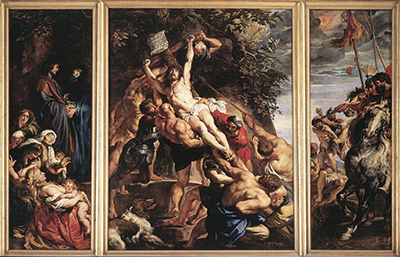
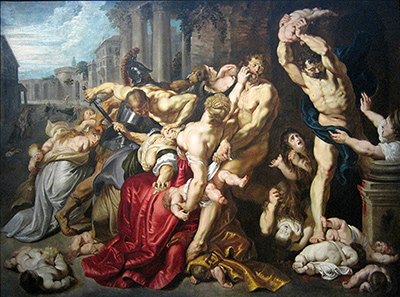
In his Sotheby's research essay[2], Gordon traces red at the far left, blue and grey on the executioner, darker green around the old woman, and yellow and red in Salome's dress. He compares this disposition with Rubens's early Antwerp Massacre of the Innocents, Samson and Delilah and Elevation of the Cross. The comparison is stylistic evidence for his proposed early date; it does not mean the paintings were commissioned together or executed in a neat, documented order.
Gordon also points to the princess in Rubens's Saint George and the Dragon in the Prado as a visual relation for Salome's face and drapery. His comparison with Adam Elsheimer's small painted and drawn treatments of John's death focuses on the executioner's raised leg resting on the fallen body. These are attributed scholarly observations. They make the panel's design more specific than a broad label such as “Italian influence,” but they do not prove a direct tracing or a surviving design sheet for this exact painting.
The panel's material anchors it in the north even if some of its ideas recall Italy. Gordon notes that it is on the kind of oak panel widely used in Antwerp. He speculates that Rubens could have begun to imagine the subject in Italy but concludes that its execution took place in the north. The first part is a possibility, the second a material and stylistic judgement. The painting should not be labelled as an Italian canvas because it contains Roman-looking features.
The essay further suggests it may be among the first works Rubens painted after his return to Antwerp. That is a relative placement proposed by one specialist, not a dated studio record. The painting's energy, muscular anatomy and forceful brushwork give the argument its basis. Other early works compete for the same place in a career chronology. We can describe the picture as early Antwerp Rubens, about 1609, without presenting its exact ordinal position as settled.
A picture that was long thought lost
The painting's later history explains why its identity was difficult to track. Sotheby's provenance list[1] places it in the Spanish royal collection at the Alcázar in Madrid, recorded between 1666 and 1700. A red wax seal on the back supports a later Le Camus family association. The catalogue also raises a possible 1768 Paris owner and sale, but marks that connection uncertain. A possible owner is not a firm link in a continuous chain.
By the twentieth century, scholars sometimes treated Rubens's original as lost and knew the composition through other versions. Sotheby's bibliography records that a 1977 Rubens exhibition and later discussions referred to a lost painting. The original panel reappeared in a Fontainebleau sale in 1987, catalogued then as “Studio of Rubens.” That old sale attribution is part of the object's recovery story. It should not override Sotheby's present Rubens attribution, though it shows why an object can pass through the market without being recognized as the historical original.
The provenance becomes more specific from the late twentieth century. Sotheby's records acquisition by Charles Bailly at the 1987 sale, an anonymous Sotheby's New York sale in 1998, then Otto Naumann Ltd. and Alfred Bader, followed by Steve Wynn in 1998 and MGM Grand in 2000. The Fisch Davidson collectors acquired it from MGM Grand that year. Each named stage is grounded in the auction catalogue, but the eighteenth- and nineteenth-century gaps remain.
The panel was on loan to the National Gallery in London by 2003 and appeared in its Rubens: A Master in the Making exhibition in 2005–06, as Sotheby's exhibition history records. A loan to a museum is not a permanent acquisition. The painting was still privately held when offered as lot 5 in Sotheby's 26 January 2023 New York auction. A Sotheby's sale report[3] says it sold for $26.9 million. The published lot and report do not identify the buyer or establish the painting's current location. “Last recorded in the 2023 sale” is therefore more accurate than claiming it is now in a named collection.
A different picture from the Edinburgh banquet
Rubens returned to the story decades later in the National Galleries of Scotland's The Feast of Herod, NG 2193[6], dated about 1635–38. That later painting is a large oil-on-canvas banquet scene, 208.3 × 271.5 centimetres, with Herod recoiling and Herodias using a fork beside the dish. It was probably made for Gaspar Roomer and was in Naples by 1640. None of those dimensions, patronage claims or later travels belongs to the early oak panel on this page.
The two images also choose different moments. Here John's body remains visible in the execution space, and Salome receives the unstable platter. In Edinburgh, the head has reached the banquet table and Herod confronts it. The early panel concentrates the act of delivery and the physical aftermath; the late canvas spreads the shock among diners. Reading them together reveals Rubens's repeated interest in the theme without collapsing them into one painting or assuming a documented plan to make a pair.
The inherited title “Beheading of St John” is understandable because the dead body and executioner are central. Yet the catalogue title draws attention to Salome's part in the action and to the precarious transfer of the head. The reader can keep both descriptions in mind: the painting visualizes a beheading just completed and the presentation immediately following it.
Rubens artworks directory
Frequently Asked Questions
Sotheby's 2023 catalogue calls it Salome Presented with the Head of Saint John the Baptist. The historical page route says “Beheading of St John,” which describes the death shown in its immediate aftermath.
The National Gallery's 2005–06 exhibition catalogue dated it 1608–09, according to Sotheby's bibliography. Sotheby's sale report calls it a 1609 work. About 1609 conveys the approximate consensus without inventing a precise day or year written on the panel.
The 2023 lot record identifies oil on oak panel, measuring 94 × 101.8 centimetres. It is far smaller than the later Edinburgh banquet canvas.
Yes. The traditional name Salome identifies Herodias's daughter, who requested John's head in the Gospel story. The cited passages in Mark and Matthew do not name her in the episode.
Sotheby's records the panel at the Alcázar in Madrid between 1666 and 1700. Its later provenance has gaps, including an eighteenth-century owner marked only as possible.
It sold at Sotheby's New York in January 2023. The publicly accessible lot and sale report do not name the buyer or confirm a present collection or display location.
Discussion
Look closely at the unstable platter and the figures gathered around it.
Share an observation about the panel or a reliable source that adds to its history.
Reader Insights
How does the visible body change your sense of the moment portrayed?
What do the colours and gestures tell you before you read the Gospel story?
Which facts distinguish this panel from the later Edinburgh banquet?
Join the Conversation
Add your reading below, keeping observations specific and evidence clear.
References
- Sotheby's, 2023 lot 5 catalogue for Rubens's Salome Presented with the Head of Saint John the Baptist. View source
- George Gordon, Sotheby's research essay, Rubens the Italian Painter. View source
- Sotheby's, 2023 sale report. View source
- National Gallery, London, Rubens's early career and A Master in the Making. View source
- Haggerty Museum of Art, later circular fragment after Rubens, 65.11. View source
- National Galleries of Scotland, distinct late The Feast of Herod , NG 2193. View source
- Gospel of Mark 6:17–29, New American Bible Revised Edition. View source
- Gospel of Matthew 14:3–12, New American Bible Revised Edition. View source