 by Tom Gurney
Tom Gurney BSc (Hons) is an art history expert with over 20 years experience
Published on June 19, 2020 / Updated on October 14, 2026
Email: tomgurney1@gmail.com / Phone: +44 7429 011000
A portrait made to look down from above
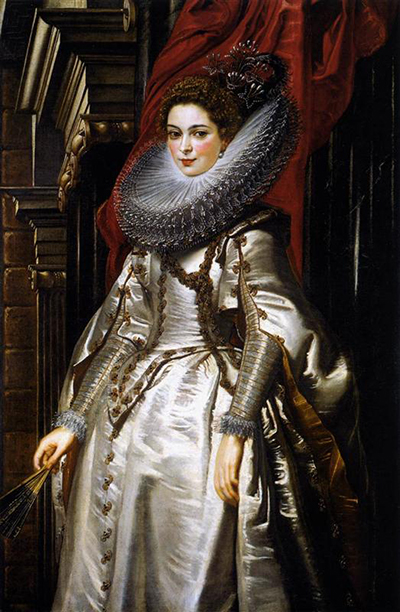
Brigida Spinola Doria meets the viewer's eye from within a grand architectural setting. White satin gleams beneath a huge pleated collar; red drapery rises behind her; a closed fan extends from one hand. The forms are imposing, but her slight smile and direct gaze give the portrait more life than an inventory of splendid possessions could. Peter Paul Rubens makes a young Genoese noblewoman seem both socially elevated and vividly present.
The National Gallery of Art (NGA) identifies the canvas[1] as Rubens's Marchesa Brigida Spinola Doria, painted in 1606 during his stay in Genoa. It is oil on canvas, accession 1961.9.60. The present overall size, 152.5 × 99 centimetres, describes a painting cut down after Rubens made it. That physical change affects how we see almost every feature of the composition. The present image is complete enough to be powerful, but it is not the whole design she and Rubens first knew.
The NGA says the perspective of the architecture and the direction of the marchesa's gaze imply an original display high on a wall. That is a curatorial interpretation of the painting's designed viewpoint, not a documented surviving record of its first hanging. It invites us to imagine viewing the portrait from below, with the architecture rising around Brigida. Even at reproduction size, the stone and curtain make her occupy a space much grander than a neutral studio background.
At a Glance
- ArtistPeter Paul Rubens [1]
- Date1606 [1]
- MediumOil on canvas [1]
- Current size152.5 × 99 cm, after trimming [1]
- CollectionNational Gallery of Art, Washington, 1961.9.60 [1]
- Original formatFull length; cut down between 1854 and 1886 [1][2]
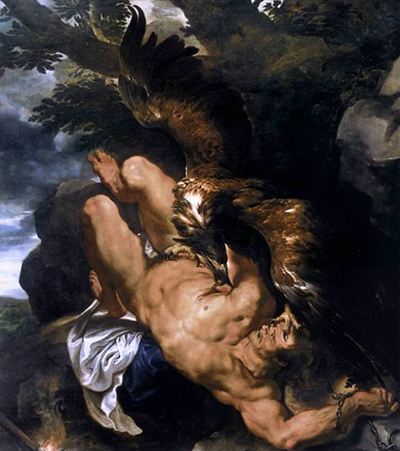
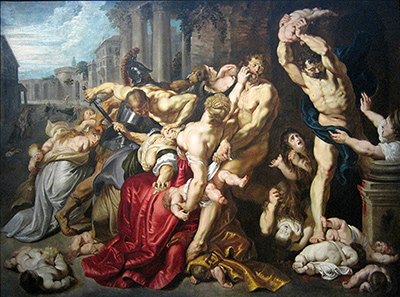
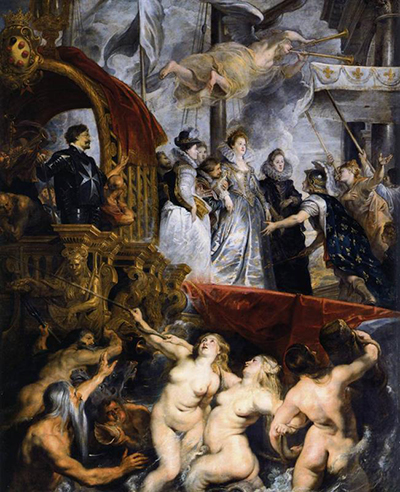
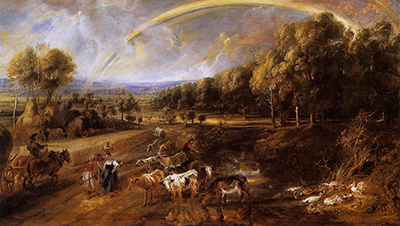
Where this work sits in Rubens's career
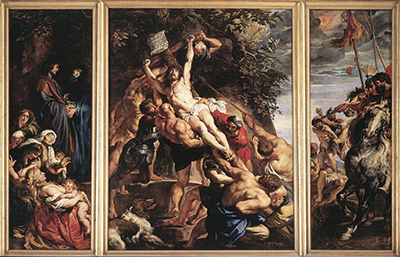
The Elevation of the Cross
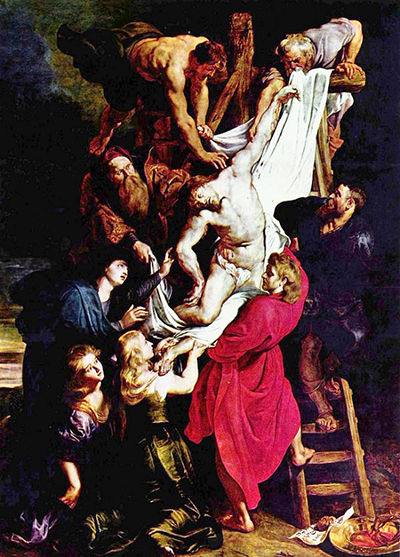
1609–10The Descent from the Cross
1611–14The Garden of Love
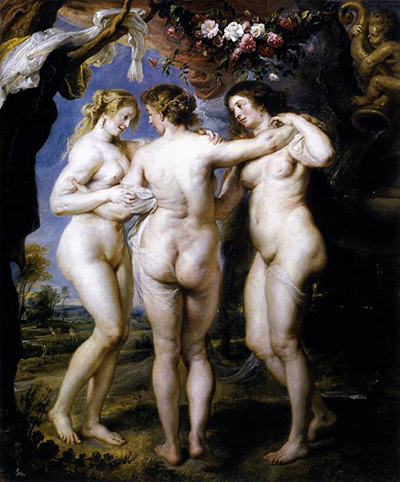
1630–35The Three Graces
1630–35Contents
- Brigida in Genoa in 1606
- The satin gown and the ruff
- Architecture, curtain and colour
- A full-length painting cut down
- The inscription: original wording, later copy
- Ownership and arrival in Washington
- What Van Dyck learned from the example
- Looking once more at Brigida
Brigida in Genoa in 1606
The NGA's account[1] describes Brigida as a 22-year-old newlywed from leading Genoese families. Its provenance records her marriage to Giacomo Massimiliano Doria on 9 July 1605. Rubens painted her the following year, when he was spending time in Italy and making portraits for Genoese society. This timing helps explain the portrait's emphasis on status, but it does not identify who formally commissioned the canvas.
Names and marriages can complicate a sitter's later history. After Doria's death, Brigida married Giovanni Vincenzo Imperiale in 1621, according to the NGA. The work's current title preserves the name by which the museum identifies the sitter in 1606. A later transfer of the painting through the Imperiale family does not make it a portrait painted in the 1620s or identify her second husband as its first patron.
The painting belongs to Rubens's Italian years. Genoa offered an audience with the means and desire for large portraits that announced family position. The NGA describes Rubens absorbing Italian artistic culture between 1600 and 1609. In this particular portrait, the scale of the architecture, the expensive clothing and the elevated viewpoint work together to build a public image of rank. Yet the face remains individually alert. Brigida's eyes and slight smile keep the display from turning her into a lifeless emblem.
The phrase “newlywed” does not mean the painting records a wedding day. There is no wedding ceremony in the image. It locates the portrait within a stage of her life given by the NGA's biographical account. The exact occasion of the commission remains unestablished in the sources used here. Distinguishing life context from depicted event is important when reading an aristocratic portrait.
The satin gown and the ruff
The marchesa's white gown is the largest bright area in the surviving canvas. Rubens paints folds that turn and catch light differently, making the heavy material seem both substantial and mobile. The NGA describes[1] the fabric as glowing satin, with lace, jewels and a richly worked hair ornament contributing to her commanding presence. The description directs attention to surfaces, but the clothing is also a way to frame the sitter's face and hands.
Her ruff is particularly striking. Its pleats widen from the neck toward the shoulders, a carefully structured halo that separates the pale face from dark hair, drapery and stone. Light touches its edges, and the pattern creates a dense interval between the natural expression above and the flowing dress below. The collar projects control and social formality; it also makes the face appear smaller and more delicate. Rubens balances costume and person instead of allowing either to disappear.
The jewellery and hair ornament continue that tension. They are signs of luxury, yet the portrait's strongest point of contact is the direction of Brigida's gaze. She does not turn away into a purely ceremonial pose. Looking from one eye to the other, the viewer moves from carefully made surfaces to an expression that seems responsive. The NGA singles out her large brown eyes and gentle smile, and the detail matters because it gives the grand setting a human centre.
One hand holds a fan, mostly closed. It extends diagonally from her side, a small object that helps animate the lower surviving portion. It is tempting to assign a precise symbolic meaning to every accessory, but the cited records do not give an object-specific interpretation of this fan. Its visible role is clear enough: it marks genteel dress and helps the hand sit naturally within the broad gown. The original full-length design gave that gesture more surrounding space than the trimmed picture does now.
Architecture, curtain and colour
The red curtain behind Brigida is more than a strong patch of colour. It separates her pale costume from the darker setting and makes the portrait feel staged in an imposing interior. The NGA emphasizes how Rubens combines the red drape with architectural diagonals and light to enliven a stately image. Stone and cloth form two different kinds of frame: one hard and fixed, the other soft and gathered. The marchesa stands between them.
The setting suggests a palazzo through marble, columns and masonry. The NGA calls attention to the lustre of these materials. Rubens does not treat them as incidental background texture. Their scale and perspective help elevate the figure. A viewer positioned below would see the architecture and sitter rising together, reinforcing the original portrait's authority. The effect survives despite the later loss of the lower section.
Light enters from the left and works across the gown. Some folds are nearly white; others take on warmer, darker tones. The result is not a flat declaration that Brigida wears expensive satin. It is a demonstration of how satin changes as it turns around a standing body. The red behind her makes the highlights seem stronger, while the dark edges prevent the white dress from dissolving into the background.
A drawing at the Morgan Library & Museum[2] preserves a revealing part of Rubens's planning. The Morgan catalogues his Study for the Portrait of Marchesa Brigida Spinola Doria in pen, brown ink and wash with black chalk. Its record transcribes the artist's colour notes: gold on architectural elements and red on the curtain. Those notes are concrete evidence that the contrast of rich architectural colour and drapery was considered during design. The drawing is a distinct work on paper, not a missing painted fragment of the canvas.
A full-length painting cut down
The NGA says the Morgan study shows a full-length Marchesa standing on a terrace, with distant landscape at the left. The drawing therefore offers a way to understand the original ambition without pretending to see the missing paint. The surviving canvas gives her from about the knees upward. The present crop is a later alteration, not Rubens's chosen finished format.
The date of the cut can be narrowed from records. The NGA provenance note[1] says an 1854 sale catalogue described the portrait as whole length and Brigida as standing on a palace terrace. In an 1886 sale, it was described as a three-quarter-length portrait. The NGA therefore concludes that trimming took place between 1854 and 1886. That conclusion rests on changing descriptions of the same work, not on an assumed fashion for cutting paintings at an unspecified date.
The NGA suggests that dealer Charles J. Nieuwenhuys may have been responsible because he acquired the work after the 1854 sale and offered it in 1886. The museum also notes he could have sold and reacquired the painting during those decades. The person who carried out the cutting is therefore not securely known. The dates of the two descriptions are firmer evidence than a named culprit.
The missing lower portion also means we must be cautious about original dimensions. The Morgan study and early sale descriptions establish full length, but neither provides the exact measurements of the lost canvas in the cited record. It would be wrong to present today's 152.5 × 99 centimetres as Rubens's intended full-length size. It would be equally wrong to reconstruct every lost architectural or landscape detail as though an image of the complete painting survived. The drawing helps, but drawing and final canvas are not interchangeable evidence.
One practical effect of the crop is compositional pressure. The gown now reaches the lower edge, and the figure feels closer to us. In a full-length view on a terrace, more ground and landscape would have given the portrait breathing room and a larger relation to its setting. This is an inference from the Morgan study and the NGA's reconstruction, not a claim that we can recover Rubens's exact final balance. The current canvas should be admired with its alteration visible in the explanation.
The inscription: original wording, later copy
A name, age, date and maker statement once appeared on the painting's front. The NGA records a transcription on the reverse[1], made by a later hand before the trimming. It identifies Brigida Spinola Doria, gives her age as 22 in 1606, and says the portrait was made by P. P. Rubens. The transcription helps anchor the sitter and date even though the original front inscription no longer survives in its former place.
The distinction between a transcription and an autograph matters. We should not call the visible reverse text Rubens's surviving signature on the front. It is a later record of wording that was there before the canvas was reduced. The NGA's artist attribution is secure in its own catalogue, and the reverse note is valuable evidence, but it has a particular material history. Its survival is tied to the same intervention that changed the portrait's format.
The age also has a clear role. It is evidence for how Brigida was identified when the inscription was present, and it matches the NGA's description of a young newlywed. It does not tell us whether Rubens painted her in one sitting or how many versions he made. The source supports identification and date, not a detailed account of studio practice.
Ownership and arrival in Washington
The NGA's provenance begins with Brigida's first husband, Giacomo Massimiliano Doria, and then records transfer through relatives and the Imperiale family, though several links are qualified as probable. This is a more complex history than a simple claim that the picture remained continuously with the Doria family until modern times. The museum's wording is careful about uncertainty, and the page preserves that care.
By the nineteenth century the painting was known outside the family, passing through collectors and dealers in Turin, Paris and London. The sale descriptions from this period are especially important because they show the change in its physical format. In the twentieth century it passed through the art market to the Samuel H. Kress Foundation, which gave it to the National Gallery of Art in 1961[1]. Its NGA accession number, 1961.9.60, is a stable way to locate the current object.
The museum's record includes a warning about an older sale catalogue's proposed early British ownership: it conflicts with other evidence placing the painting in Turin. Rather than turning every historical catalogue statement into a confirmed stop, the NGA weighs them. That approach is useful for this portrait in particular. Its history has gaps, and the documentation of its trimming is unusually strong because two sale descriptions can be compared.
What Van Dyck learned from the example
The NGA links Rubens's portrait[1] to Anthony van Dyck's later Marchesa Elena Grimaldi Cattaneo, also in Washington. The Van Dyck object record[3] describes his encounter with Rubens's Genoese portraits after his arrival in the city in 1621. It points to grand architecture, terrace, red drapery and an overall sense of height and luxury as aspects he developed in his own painting.
This relationship shows the influence of a portrait format, not Van Dyck's participation in the 1606 canvas. The later work presents another Genoese noblewoman and has its own sitter, date and history. Comparing them can help a reader see how Rubens made a human figure monumental within a palatial setting, and how another painter adapted that solution. The current cropped state of Brigida's portrait makes the Morgan drawing particularly useful when considering the original full-length effect.
The comparison also resists the idea that Rubens's Genoese portraits were simply exercises in rich costume. The sitter's position in space, the viewer's imagined low standpoint and the movement of fabric and architecture were all part of the invention. Those formal choices had consequences beyond this one portrait. Van Dyck's later portraiture gives a visible example of that wider reach.
Looking once more at Brigida
Begin with the eyes, then follow the broad ruff outward and down into the white satin. Notice where the red curtain cuts across the dark stone and where the fan draws a thin diagonal from her hand. The visible work is full of relations between face, fabric and architecture. Then remember the terrace and distant view recorded by the Morgan drawing, and the sale documents that place the cut between 1854 and 1886.
Rubens's achievement remains evident in the surviving canvas, but the physical loss is part of its story. The present portrait can seem to press Brigida toward the viewer because its lower space has vanished. The original was a full-length statement made for a high viewpoint. Holding both facts together lets us read the sitter's presence and the painting's history honestly: a commanding 1606 Genoese image, materially changed in the nineteenth century, now preserved in Washington.
Rubens artworks directory
Frequently Asked Questions
The National Gallery of Art attributes it to Peter Paul Rubens and dates it 1606, during his stay in Genoa.
The NGA identifies her as a 22-year-old newlywed from leading Genoese families in 1606. She had married Giacomo Massimiliano Doria in 1605.
No. It was originally full length. An 1854 sale description still called it whole length, whereas an 1886 sale described it as three-quarter length. The present 152.5 × 99 cm is the trimmed size.
The NGA records a later transcription on the reverse of wording once on the front. That transcription gives the sitter, her age, the year 1606 and Rubens's maker claim; it is not the original front inscription.
Yes. The Morgan Library & Museum holds Rubens's study[2], which helps establish the original full-length terrace design and includes colour notes for gold and red elements.
It is NGA 1961.9.60 at the National Gallery of Art, Washington. The museum's live record gives current display details.
Discussion
Follow the light from Brigida's face through the ruff and satin gown.
Share an observation about the painting or a reliable source that adds to its history.
Reader Insights
How do architecture and red drapery shape the portrait's elevated viewpoint?
What does the Morgan drawing tell us about the painting's lost lower section?
How do the 1854 and 1886 descriptions change the way you view the present crop?
Join the Conversation
Add your reading below, keeping observations specific and evidence clear.
References
- National Gallery of Art, Marchesa Brigida Spinola Doria , 1961.9.60. View source
- Morgan Library & Museum, Rubens, Study for the Portrait of Marchesa Brigida Spinola Doria , 1975.28. View source
- National Gallery of Art, Van Dyck, Marchesa Elena Grimaldi Cattaneo , 1942.9.92. View source