 by Tom Gurney
Tom Gurney BSc (Hons) is an art history expert with over 20 years experience
Published on June 19, 2020 / Updated on October 14, 2026
Email: tomgurney1@gmail.com / Phone: +44 7429 011000
One child, two moments of painting
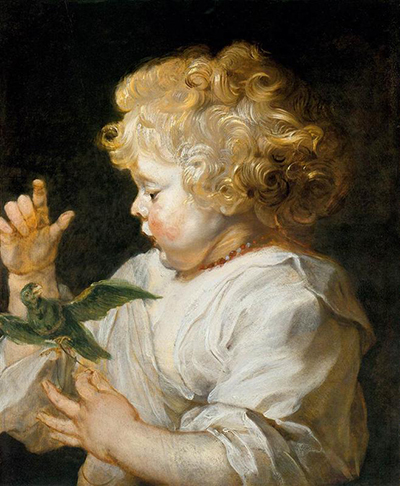
A child with fair curls bends his face toward a small bird. One hand rises, fingers open; the other supports the creature close to his body. A string seems to keep the bird near him. The image can feel like a single quick observation of childhood. The Berlin Gemäldegalerie's technical account[1] tells a more complicated story: the head and the action with the bird were not painted in one campaign.
Berlin titles the work The Child with the Bird, inventory 763. The oak panel now measures 50.9 × 41 centimetres. Its central core, made from two horizontal boards and carrying the child's head, dates to around 1614 and is probably Rubens's own work. A later angled extension on the left brought in the hands and finch. The museum dates this expansion after 1625, perhaps in or after 1629, and considers it probably the work of a painter in Rubens's studio. Those probability words are essential to the object's identity.
The inherited site address says “boy with bird,” which is a useful description of the finished picture. The holding museum's title says “child,” and its catalogue explains that the bird scene emerged through a later change. The small portrait-like head may initially have served another purpose in Rubens's workshop. What looks like a charming single scene therefore joins a vivid early study to a later effort to make that study into a complete, saleable painting.
At a Glance
- Core headProbably by Peter Paul Rubens, about 1614 [1]
- ExtensionProbably by workshop painter after 1625 [1]
- MaterialOil on oak [1]
- Current size50.9 × 41 cm [1]
- CollectionBerlin Gemäldegalerie, 763 [1]
- Possible sitterRubens's nephew Philipp, uncertain [1]
Where this work sits in Rubens's career
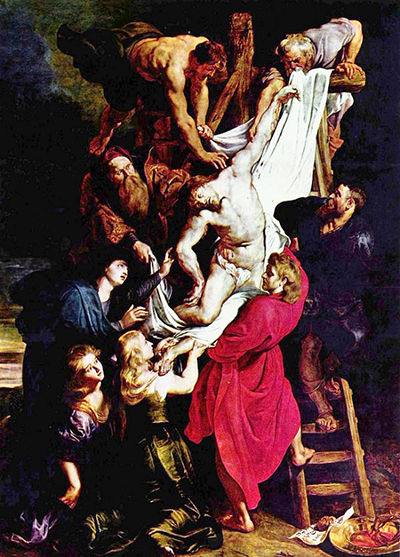
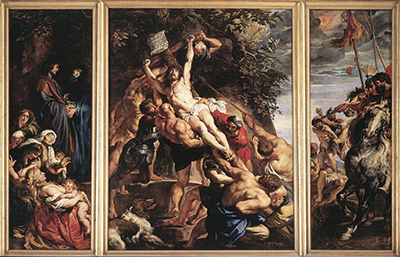
The Elevation of the Cross
1609–10The Descent from the Cross
1611–14The Child with the Bird
c. 1614; after 1625The Garden of Love
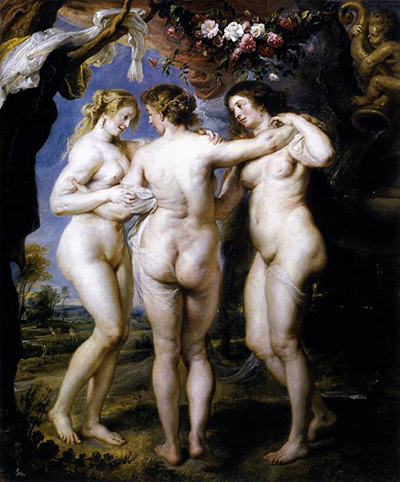
1630–35The Three Graces
1630–35Contents
- The head that came first
- An enlarged picture with different hands at work
- Was the child a member of the family?
- Reusing a face in another painting
- The bird, string and coral beads
- The child's pose and the picture's appeal
- How the Berlin panel reached the museum
- Looking again at the finished picture
The head that came first
The child's lowered face occupies the middle of the painting. A light forehead leads into a rounded cheek, a small nose and half-open lips. Dense curls catch brightness against the black background. The shoulders and white garment frame the face without turning it into a formal seated portrait. The impression is of a young model noticed in a fleeting movement rather than arranged to meet a viewer's gaze.
The Berlin catalogue says the original core panel was made from two horizontally joined boards. That construction detail matters because it gives a physical boundary to the first version. The head was not merely painted first in a normal sequence and then accompanied by details a day later. The museum describes a later enlargement of the support itself. The object literally grew to accommodate a different kind of image.
The museum considers the head likely to be Rubens's work. It also thinks he may have studied the child from life. These are scholarly conclusions, not a recorded sitting or an inscription from Rubens describing his model. The painted head is individual enough to invite a personal identification, but the catalogue argues that its original function was likely a workshop study. A study can capture a recognizable person without being intended as that person's public portrait.
Technical photographs, according to the museum, suggest that the head may initially have been designed as a small angel with wings. “May” remains important. The reproduction of the finished bird picture does not prove an angel was once plainly visible to every viewer. The technical evidence opens a possible earlier use for the head, while the later additions explain why the object now presents a child handling a bird.
An enlarged picture with different hands at work
The added section creates the action that gives the finished work its name. The child's hand reaches toward a finch that flutters at the left, tethered by a short string. The other hand and surrounding clothing make the interaction coherent. Without these parts, the surviving early core would have been a head study. With them, the picture becomes a narrative moment: a child concentrates on a living creature close to his body.
Berlin dates the addition no earlier than 1625 and suggests 1629 or later may be more likely. The catalogue notes a difference in brushwork and pigments between this extension and the central panel. On that basis it attributes the original core probably to Rubens and the later work probably to a studio painter. This is not a division a viewer can settle simply by preferring one part of a small image. It rests on the physical object, technical evidence and specialist comparison.
The construction does not mean the painting should be dismissed as “only” workshop work. The head carries much of its effect, and the added scene changed what viewers could do with it. A study kept for internal use could become an object ready for a buyer. The museum explicitly frames the transformation in those terms. The picture is valuable as evidence of workshop practice: an admired observation was preserved, adapted and given a new setting.
It also warns against a simple byline. “Rubens, 1614” describes the probable first phase, not the complete image now on display. “Rubens workshop, after 1625” alone would obscure the probable Rubens core. A precise caption can hold both: Rubens's probable head study around 1614, expanded by a probable workshop painter after 1625. The full painting belongs to a history of collaboration and reuse across time.
Was the child a member of the family?
The Berlin Gemäldegalerie proposes that the model may have been Philipp, Rubens's nephew, who was born in 1611. A child of about three would fit the estimated 1614 date of the head. The museum describes the relationship as likely rather than certain. No painted name or documented sitting proves that this boy is Philipp, and the later bird scene cannot by itself identify him.
The proposal is attractive because the head feels specific. The cheeks, lowered gaze and curls seem observed rather than assembled from a generic cherub. Yet resemblance and age do not establish an identity unless they can be matched to independent evidence. The catalogue's phrasing lets readers understand both why a family identification has been suggested and why it should not become a factual label without a qualifier.
Nor does “Philipp” necessarily mean this was a portrait made for relatives to hang at home. Berlin thinks Rubens used a young model, possibly his nephew, for a study that could serve several pictorial purposes. A workshop artist might preserve a child head precisely because it could become an angel, putto or other figure. The child's individuality and the sheet's practical use are not mutually exclusive.
This distinction helps explain why the head and later bird action can be separated. The original study would have been meaningful within the workshop even before it had a bird. Its face could be transferred, adapted or remembered in compositions made for very different patrons. The finished small painting gave that resource a new public identity as a child with a tethered finch.
Reusing a face in another painting
Berlin points to the same child head as a putto in the Munich Madonna in a Garland of Flowers. The Bavarian State Painting Collections identify that large oak panel[2] as a collaboration between Rubens and Jan Brueghel the Elder, dated about 1616–18. Their record says Rubens painted the Madonna and putti, while Brueghel added the surrounding flowers. The Munich painting is a different object, but it helps show how an observed head could be put to work in a sacred image.
That transfer changes the child's role. In Berlin, the finished picture presents a young human figure with a bird. In Munich, a similar head becomes one of the small angelic figures attending Mary. The Berlin catalogue's suggestion of a possible initial winged angel also belongs to this pattern of reuse. None of these connections proves that the later bird extension was planned from the start. In fact, the museum's reconstruction points the other way: the head study came first, and the bird scene was added years later.
The Munich work itself was collaborative. Its official record attributes different parts to two named painters. The Berlin object adds another kind of collaboration: reuse and expansion within a workshop over time. These examples make “by Rubens” less simple than a single hand working continuously across a surface. Rubens could invent and paint a figure, assistants could adapt a study, and another artist could contribute a setting or detail to a larger work.
A viewer need not memorize every workshop role to enjoy the image. But those roles explain why similar faces appear in distinct paintings and why the museum does not assign every brushstroke of the Berlin panel to Rubens. The passage from study to putto and from study to bird picture shows an image resource moving between religious and everyday-looking subjects.
The bird, string and coral beads
The bird is a finch, according to the Berlin catalogue. Its wings spread while a short string holds it close. The child reaches toward it with focused attention. The action can be read as play, control, affection or a mixture of all three. The painting does not include a written instruction telling us what emotion Rubens or the later studio painter meant to fix.
The museum offers an interpretive possibility: the tethered bird may allude to a child's upbringing and shaping. It also notes a coral necklace and the protective and life-affirming associations coral could carry in seventeenth-century emblematic language. These are proposed readings, not universally fixed codes. A finch can remain a bird in a child's hand while also inviting viewers to think about education, constraint or care.
Those interpretations depend on the finished image. If the bird and hands were added long after the core head, they should not be used to explain the original 1614 study as though all features were present then. This is the central historical consequence of the technical evidence. The meaning visible now may have been built in a later campaign by a different painter.
The red beads stand out against the child's white garment and warm face. Whether one takes them as an amulet, an emblem of vitality or a visual accent, their small scale keeps them secondary to the gaze and gesture. Berlin allows symbolic suggestions, but it does not claim an exact symbolic programme commissioned for a named patron. The careful reading is to start with what is shown and then present the museum's meanings as possibilities.
The child's pose and the picture's appeal
The boy is shown largely in profile, looking down and toward the bird rather than addressing us. Berlin calls that profile unusual within Antwerp Baroque painting and sees the head as a spontaneous study. The pose helps the finished picture feel unguarded. We appear to observe an activity the child is concentrating on, not to receive a formal presentation of his status.
The soft face and exaggeratedly youthful proportions strengthen that effect. The museum describes the child's features as unusually persuasive and childlike. This is a judgment about Rubens's handling of the core head. Looking at the image, we can see why: the rounded cheek and curls make the figure vulnerable and lively, while the dark ground isolates him from a distracting setting.
The later additions also change our position as viewers. A head alone asks us to look at likeness, expression and paint. The bird picture asks us to look at a relationship: hand, string, wing and attention. The finished composition invites a little story. The child might be trying to calm the bird or testing how it moves. The painting does not establish the moment before or after; its appeal rests partly in leaving that outcome open.
Because the added extension supplies the action, the painting demonstrates how subject can be constructed after an image has already begun to circulate in a workshop. The later painter did not simply fill empty background. The added features gave the old core a new title, new narrative and likely a new market. That is why the two-campaign history belongs near the front of any account, not in a technical footnote after an otherwise uncomplicated “Rubens portrait.”
How the Berlin panel reached the museum
The Berlin record lists a transfer in 1829/30 from the Royal Prussian Palaces. That is a documented collecting point for the present object. It does not identify the first purchaser after the workshop transformation or reconstruct every owner between the early seventeenth and nineteenth centuries. The current inventory number, 763, is the stable identifier for this exact panel in the Gemäldegalerie.
The museum gives oak as its support. It lists the image measurement 50.9 × 41 cm, which describes the now-enlarged work. The underlying core and angled addition together make that current format. A caption should not imply the panel had this finished bird composition at the first, about-1614 stage.
The museum's online record credits an image under a Public Domain Mark, but the approved site JPEG predates this review and its precise original file source is not documented in the project. Its visual match to Berlin 763 supports object identification; final release review must still keep the image's provenance and use terms distinct from the art-historical facts about the painted oak panel.
Looking again at the finished picture
Start with the child's face, because that is the probable early Rubens core. Follow his lowered gaze to the bird. Then look back at the left side where hands and wings make an event out of the head study. The finished image asks for a single emotional response, yet its material history asks us to separate two stages and probably two painters.
The exact object is Berlin Gemäldegalerie 763, The Child with the Bird, oil on oak, 50.9 × 41 cm. The museum dates the core head to about 1614 and a later reworking to after 1625, perhaps 1629 or later. It regards Rubens as the probable painter of the first phase and a workshop colleague as the probable painter of the enlargement. The child may be his nephew Philipp; the original study may have served as an angel. Both remain carefully qualified suggestions.
That combination makes the small painting more interesting than a straightforward child portrait. A lively observed head became a reusable studio resource and then a marketable scene. The boy's concentration still holds our attention, but the work's construction reminds us that a finished picture can preserve several moments of artistic decision. The bird is the subject we see today; the head is the earlier invention that made the later subject possible.
Rubens artworks directory
Frequently Asked Questions
Probably not. Berlin attributes the about-1614 core head probably to Rubens and the later bird-and-hands extension probably to a workshop painter. Its technical account notes different brushwork and pigments.
The Berlin catalogue says the angled extension was made after 1625, possibly in or after 1629. The bird was not necessarily part of the original head study.
The museum suggests Rubens's nephew Philipp, born in 1611, as a possible model. The identification is not certain, and the original work may have been a studio study rather than a family portrait.
Berlin says technical images suggest a possible earlier winged angel. This is a qualified reconstruction, not an established title for the first version.
The museum describes a finch on a short string. It proposes that the bird could carry an idea about upbringing, but does not present a single compulsory meaning.
It is held by the Gemäldegalerie, Staatliche Museen zu Berlin, inventory 763. The current expanded oak panel measures 50.9 × 41 cm.
Discussion
Look first at the head, then the hands and bird on the added section.
Share an observation about the panel or a reliable source that adds to its history.
Reader Insights
How does the later addition change the study into a scene?
What can the museum's technical evidence tell us about the different painters?
How does reuse of the child head in Munich alter your reading of the Berlin panel?
Join the Conversation
Add your reading below, keeping observations specific and evidence clear.
References
- Staatliche Museen zu Berlin, Gemäldegalerie, Das Kind mit dem Vogel , inventory 763. View source
- Bavarian State Painting Collections, Rubens and Jan Brueghel the Elder, Madonna in a Garland of Flowers , inventory 331. View source