 by Tom Gurney
Tom Gurney BSc (Hons) is an art history expert with over 20 years experience
Published on June 19, 2020 / Updated on October 14, 2026
Email: tomgurney1@gmail.com / Phone: +44 7429 011000
A chariot loses its course
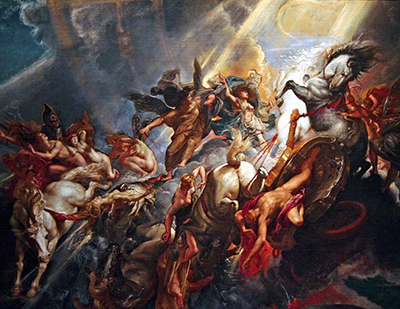
Rubens's The Fall of Phaeton catches disaster while it is still unfolding. Phaeton falls headfirst from the Sun's chariot. Horses rear, turn and break away; figures with butterfly-like wings recoil around him. A strong stream of light enters from the upper right, while small flames appear far below. The chariot's intended path through the heavens no longer seems to hold. The eye can follow individual bodies, but it cannot make the group settle into a stable procession.
This oil painting on canvas is in the National Gallery of Art in Washington[1], accession 1990.1.1, and measures 98.4 × 131.2 centimetres. The NGA dates its beginning to about 1604–05 and says it was probably reworked about 1606–08. A later technical study by NGA conservator E. Melanie Gifford argues for a further, final phase around 1610–12, after Rubens returned from Italy to Antwerp. The two dates should be read together: they record a work that changed, and the Gallery's current public label has not yet adopted every detail of the later proposed sequence. The composition visible today may not be identical with the one Rubens first painted.
A small reproduction helps locate the main figures and the shaft of light, while the conservation study provides magnified and technical images for details that are otherwise difficult to see. The painting's subject is a mythic loss of control; its surface is also evidence of Rubens repeatedly reconsidering how to represent that loss.
At a Glance
- ArtistPeter Paul Rubens [1]
- DateBegun c. 1604–05; later revisions debated [1][2]
- MediumOil on canvas [1]
- Dimensions98.4 × 131.2 cm [1]
- CollectionNational Gallery of Art, Washington, 1990.1.1 [1]
Where this work sits in Rubens's career
The Fall of Phaeton
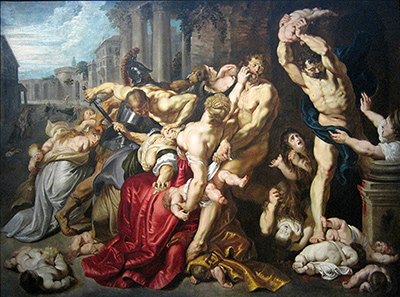
c. 1604–12The Elevation of the Cross
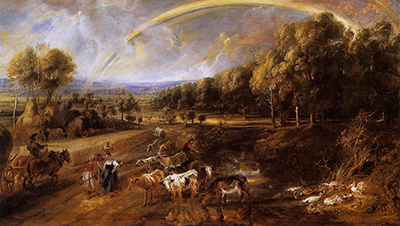
1609–10The Descent from the Cross
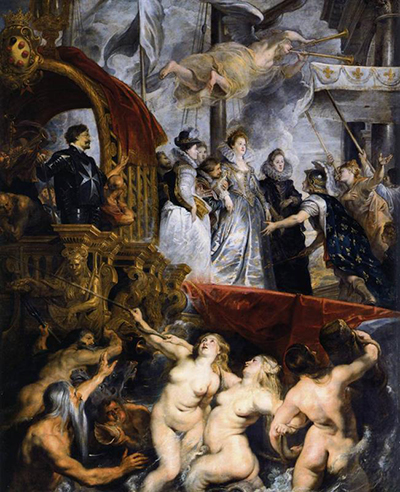
1611–14The Garden of Love
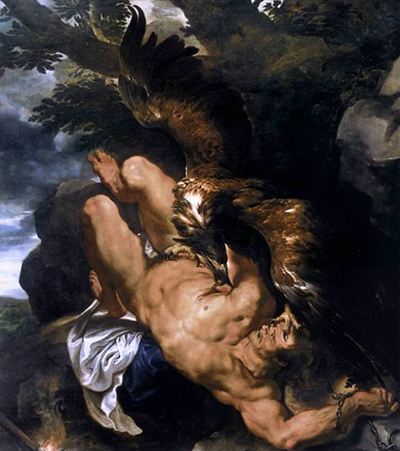
1630–35The Three Graces
1630–35Contents
- What happened to Phaeton?
- How is the collapse organised?
- An earlier painting under the present one
- A final revision after Rubens's return
- How did it reach Washington?
What happened to Phaeton?
In Book II of Ovid's Metamorphoses, Phaeton wants proof that he is the Sun god's son and asks to drive his father's chariot for a day. His father warns that even he finds the route difficult, but his promise cannot be withdrawn. Phaeton cannot control the horses. The chariot strays from its course, and the Earth alternately suffers cold and destructive heat. Jupiter finally throws a thunderbolt to stop the catastrophe, sending Phaeton down to his death. The University of Virginia's text of Ovid[4] gives the narrative that Rubens compresses into one moment.
Rubens does not paint the conversation with the Sun god or a later scene of mourning. He shows the turning point after the journey has failed. The NGA's account[1] identifies the winged women as the Horae, figures associated with the hours or seasons and the regular order of the universe. Their alarm enlarges the event beyond one young driver's death: the rhythms of sky and Earth have been disturbed. The arching bands of the heavens and the flames below make that cosmic scale visible.
Jupiter is outside the picture. The light that enters from the right conveys the force of his intervention, but there is no painted standing god to find among the horses. This matters for reading the action. Rubens turns an unseen decision into a physical change of direction. The chariot breaks apart, the figures scatter, and Phaeton's body descends through them. The viewer sees the consequence of a thunderbolt rather than its wielder.
The tale attracted moral readings in Rubens's time. The NGA cites Karel van Mander's 1604 interpretation: the chariot can warn against failing to keep a moderate course, and against the harm that an inexperienced ruler may cause a whole community. The Gallery says such ideas may lie behind Rubens's painting. They are useful historical context, not evidence of a personal political statement from Rubens or a known commission for this canvas. Its immediate subject remains the collapse that the body, horses, light and burning landscape make visible.
How is the collapse organised?
At first glance the figures appear to tumble without a pattern. Rubens nevertheless gives the eye routes through the disorder. The light cuts diagonally across the upper right. A curving celestial band sweeps around the left. The horses' heads and legs rise toward the bright edge, while Phaeton's falling body pulls attention down. The winged Horae are caught between those contrary directions. The result is an image of failed steering made by a carefully steered composition.
The painting's small scale relative to Rubens's later altarpieces makes its density surprising. Many heads, limbs, wings and lengths of harness occupy a canvas just over a metre wide. The chariot's red and gold, the grey and white horses, and the dark blue sky let the viewer separate parts of the wreckage. Light does more than reveal the participants: it seems to press them away from the course they should have followed.
The Gallery's visual description[1] counts eleven women in the visible picture. Some are clothed, others nude, and only some show the patterned wings that help identify the Horae. They are not arranged in a neat ring around Phaeton. One group presses against the curved band at the left, while others are caught beside or below the horses. The scattered positions make the collapse legible in stages: order breaks at the edge of the sky, the horses pull free, and figures who should mark regular time lose their bearings. The bright clothing also gives the eye small points of orientation amid the overlapping bodies. Counting the figures is useful, but it does not turn them into eleven named individuals with separate stories. Their collective reaction is what the NGA identifies. The count also refers to the present surface. Gifford's X-radiograph reveals a suppressed twelfth figure at lower right, so a technical account of what Rubens once painted and a description of what a visitor now sees need different numbers.
Some apparent oddities are traces of design decisions. The NGA notes[1] reins and harness straps Rubens painted over but which remain perceptible. These pentimenti, or changes made by the artist, show that the confusion did not emerge from one uninterrupted burst of painting. Gifford's study demonstrates that the present image contains several campaigns of work. A viewer can respond to its turbulence without seeing every concealed line, but the hidden evidence changes what the turbulence means as an artistic achievement.
An earlier painting under the present one
Gifford's 2019 technical study[2] reconstructs three stages rather than one. Rubens began the picture in Italy on a fine-weave canvas with a yellow-tan preparation. He sketched the figures in brown paint directly on that ground. Some of the ground and sketch lines remain part of the finished appearance, particularly in light details such as hair and wings. This was a way to make a complicated group move quickly on the surface without finishing every contour to the same degree.
The first stage, begun around 1604–05, was darker and more literal in its violence than the picture now appears. Technical imaging reveals a dark, pre-dawn sky, a narrower stroke of lightning and flames among the falling figures. Gifford identifies fire around a Hora and evidence that Phaeton's cloak itself once appeared to burn. A cloud of smoke and reflected red light intensified the impact. The figure group was already largely present, but it occupied a frightening setting in which Jupiter's weapon and the conflagration were harder to miss.
That reconstruction rests on several types of evidence, not on imagining an unseen lost painting from the myth. Infrared images expose dark paint below later layers, X-radiographs distinguish revisions, and close study of pigments separates red cloak from red fire. The article's reconstructions are scholarly visualisations of the evidence, not photographs of a complete earlier state. They help explain how a picture could become brighter and more abstract without Rubens replacing its whole cast of figures.
In the second stage, which Gifford places while Rubens was still in Italy, he reduced the flames and softened the explicit lightning into a broad burst of yellowish radiance. Grey and white clouds covered portions of the fire. He altered the lower right, suppressing one falling Hora and introducing the distant burning Earth. The emphasis moved from bodies caught in a literal inferno toward a diagonal force of light passing through them. Gifford argues that the painting was still unresolved at this point and was set aside. She offers the sequence as a reasoned interpretation of the layered paint, rather than a dated studio diary.
A final revision after Rubens's return
Gifford's most consequential proposal is that Rubens completed a third stage in Antwerp, around 1610–12. He narrowed and focused the wash of light, brushed blue sky around some figures and covered more of the earlier reins. He also painted a brilliant white horse over parts of the existing design. Gifford counts five horses in the resulting composition, although Ovid's chariot has four; the NGA's shorter public visual description counts four visible horses. Her technical finding concerns a painted addition that is hard to separate at a glance in the crowded group. The added animal crowns the central group and gives the horses' rearing movement a sharper visual peak. Rubens also brightened the neighbouring grey horse so the two would read together.
The case for a later campaign is material as well as stylistic. In a tiny existing loss at the white horse's shoulder, a paint sample shows the layers in order: early smoke, then golden light, then blue sky and the white horse. The earlier layers appear to have cured before the last were applied. Gifford also finds differences in the supplies of some pigments across stages. Rubens used indigo in part of the first sky and ultramarine in the later blue passages. No single pigment proves where a painter was working, but the combination of a time gap, material differences and comparisons with Antwerp works supports her proposed return to the canvas after 1608.
This is why the NGA's brief label and the detailed study should not be collapsed into one date. The object page gives the long-standing public range of a painting begun about 1604–05 and probably reworked about 1606–08. Gifford's later research argues that the final white horse and related changes belong closer to 1610–12. The first stages and final appearance can therefore be separated in discussion without pretending that the precise month of any repainting is known.
Gifford compares the final horses with Rubens's Conversion of Saint Paul[5] and Death of Hippolytus. The related pair of rearing animals appears as Rubens works through several crowded subjects around 1610–12. Her point is not that the Phaeton painting is a copy of those works, or that they are copies of it. She argues that Rubens revisited related compositional problems across paintings, moving between projects and testing new arrangements. That process makes the Washington canvas a record of artistic thinking over time.
How did it reach Washington?
The NGA's provenance notes[1] identify a Phaeton on canvas by Rubens in the 1657 inventory of Susanna Willemsens in Antwerp and mark the connection to the Washington painting as probable. A possible 1775 sale is less secure. Later ownership is clearer: the work was in the Caledon family before 1857 and passed through successive earls. At a London sale in 1939 it appeared under the name of Abraham van Diepenbeeck, a historical attribution that differs from the NGA's present catalogue credit to Rubens. The Gallery purchased the painting in 1990 through its Patrons' Permanent Fund.
These changes of attribution and ownership matter because the painting's meaning did not stay fixed once it left Rubens's studio. A nineteenth-century observer also described it as a copy after Rubens, according to the NGA bibliography. The current attribution draws on the Gallery's direct object study, including the revisions Gifford traces through the paint. The earlier sale labels remain part of its collecting history, while the painting is now catalogued as Rubens.
Rubens artworks directory
Frequently Asked Questions
It is in the National Gallery of Art, Washington, accession 1990.1.1.
No. His thunderbolt acts from outside the frame; Rubens represents its force through light and the collapse of Phaeton's chariot.
The NGA labels it begun about 1604–05 and probably reworked about 1606–08. A 2019 conservation study proposes a further final revision in Antwerp around 1610–12.
The NGA identifies them as the Horae, figures of time or the seasons. Their disorder shows that Phaeton's failed journey has disrupted a larger cosmic order.
Discussion
Look closely at the falling figures, horses and force of light.
Share an observation about the painting or a reliable source that adds to its history.
Reader Insights
How does the light change the direction of the chariot group?
Where can you see the traces of Rubens's revisions?
How does Gifford's proposed final stage change your reading of the canvas?
Join the Conversation
Add your reading below, keeping observations specific and evidence clear.
References
- National Gallery of Art, The Fall of Phaeton , object record, visual account, provenance and bibliography. View source
- E. Melanie Gifford, “Rubens's Invention and Evolution: Material Evidence in The Fall of Phaeton ,” Journal of Historians of Netherlandish Art 11.2 (2019). View source
- Gifford, “Exploration and Resources,” technical images and study guide. View source
- Ovid, Metamorphoses , Book II, University of Virginia Electronic Text Center. View source
- Conversion of Saint Paul. View source