 by Tom Gurney
Tom Gurney BSc (Hons) is an art history expert with over 20 years experience
Published on June 19, 2020 / Updated on October 14, 2026
Email: tomgurney1@gmail.com / Phone: +44 7429 011000
A decision in the garden
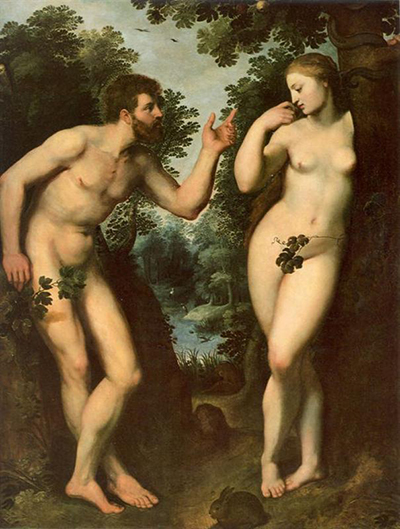
Adam leans toward Eve with one hand raised. Eve stands against a tree, bringing her right hand near her face while her other arm reaches up to a branch. Between them a path of water and dark foliage leads the eye deep into the garden. A serpent coils above Eve; a rabbit sits at her feet. The two figures are nearly life-size in the original painting, but Rubens has made a small interval between their hands the centre of the drama. Adam seems to caution Eve at the moment she is about to eat the forbidden fruit.
The work reproduced here is the Adam and Eve identified by the Rubenshuis[1] as a painting by Peter Paul Rubens, dated 1598–1600, oil on panel, in the City of Antwerp Collection. It is one of the few surviving paintings from the years before Rubens left for Italy. This page's established address ends in “ii,” but the holding institution does not title the object Adam and Eve II. Nor should that suffix be taken to mean that this panel is a numbered sequel to another painting.
The date matters because this is not yet the Rubens of his vast Antwerp altarpieces or later court commissions. The Flemish Art Collection[3] places the picture in the short period after Rubens became an independent master in 1598 and before his departure for Italy in 1600. Much of his work from that interval is unknown. A painting that survives from it can show both what he had learned from his Antwerp teacher Otto van Veen and what he was beginning to change.
At a Glance
- ArtistPeter Paul Rubens [1]
- Date1598–1600 [1]
- MediumOil on panel [1]
- CollectionCity of Antwerp Collection, Rubenshuis [1]
Where this work sits in Rubens's career
Adam and Eve
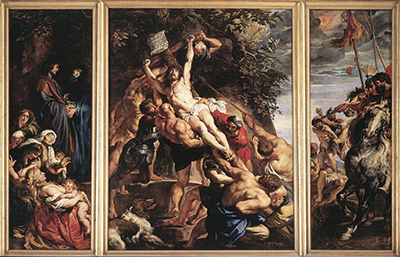
1598–1600The Elevation of the Cross
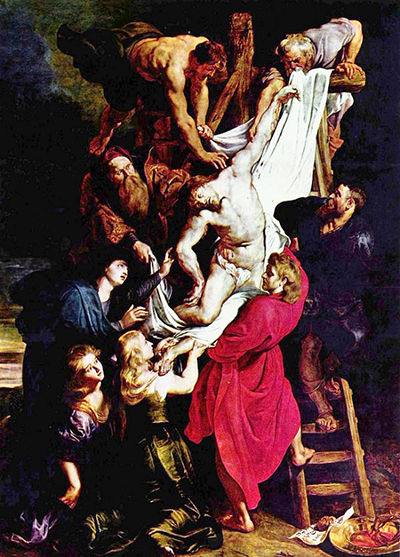
1609–10The Descent from the Cross
1611–14The Garden of Love
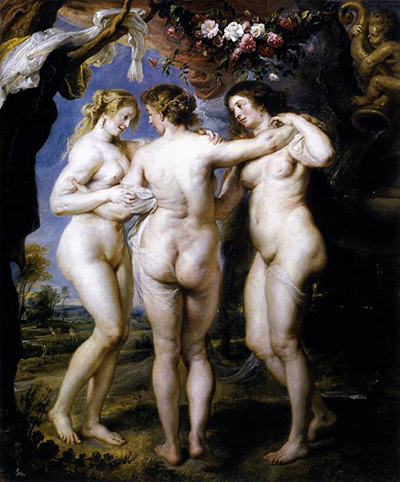
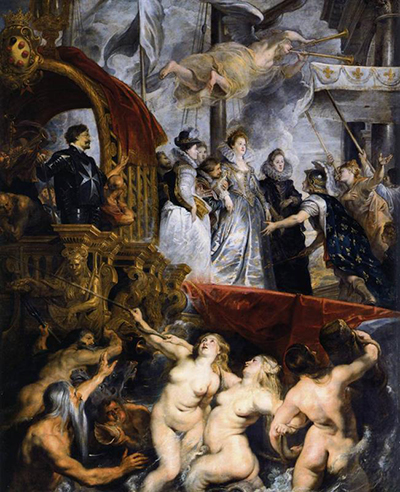
1630–35The Three Graces
1630–35Contents
- Which moment from Genesis does Rubens show?
- How do the two figures shape the picture?
- What is borrowed from Raphael and Raimondi?
- What do the animals contribute?
- An early work beside later Rubens paintings
- What did conservation reveal about the panel?
Which moment from Genesis does Rubens show?
The story in Genesis 3[5] describes a serpent speaking to the woman about the tree, her taking and eating its fruit, and her giving fruit to the man, who also eats. Only afterward do they recognise their nakedness and make coverings. Rubens concentrates on the charged instant before the eating. Eve has the fruit near her face, while Adam's open hand appears to interrupt her movement. The Rubenshuis reads his gesture as a warning: he tries to stop the decision that will bring about the Fall.
This reading depends on the relationship between the figures rather than a large supernatural event. No angel is driving them out yet, and there is no view of God judging them. The apparent calm of the pond and trees makes their poised hands more consequential. Adam's body bends across the gap; Eve's head tilts toward her hand rather than toward him. Rubens invites the viewer to wonder whether his warning will reach her in time, even though the biblical outcome is already known.
The museum calls the object an image of the Fall and describes Eve's fruit as an apple. The biblical text itself says fruit, without naming a species. “Apple” belongs to the later visual and interpretive tradition used by the museum, not to a botanical detail supplied by Genesis. The modest distinction is useful here because the fruit is partly hidden by Eve's hand in the small reproduction on this page. The dramatic relationship between her hand, her mouth and Adam's gesture is clearer than an exact identification from the pixels alone.
Nor should Adam's warning be mistaken for a line of dialogue that Genesis transcribes. Rubens invents a visible exchange to make a known story unfold before us. The biblical account says the man was with the woman when she gave him fruit, but does not describe this particular hand gesture. The painter's addition compresses temptation, hesitation and the risk of disobedience into a single encounter.
How do the two figures shape the picture?
Adam is on the left, stepping and leaning into the open centre. His extended arm carries the eye across the pond to Eve. She is on the right, more upright and closely aligned with the tree. Her raised left arm meets the branch above her, while her lowered gaze and right hand bring the eye back to the fruit. These opposing directions create an exchange: one figure reaches outward to persuade, the other seems absorbed in the choice before her.
The figures' poses have a measured, almost sculptural clarity. They are not swallowed by the leafy setting; each body can be read against darker trees. Yet the composition is not simply a pair of isolated nudes. The strip of garden between them sets a distance that Adam's hand tries to overcome. The serpent is placed on Eve's side, and the foreground rabbit sits below her. Narrative emphasis gathers around her without making Adam visually unimportant: his anxious movement gives the scene its sense of time.
The Flemish Art Collection's description[3] calls the figures full-length and life-size and notices the painting's cool green-blue landscape. It also characterises the young Rubens's handling as still fairly static and precise. The Rubenshuis essay[1] stresses instead the added tension and movement of Adam's warning. These are compatible observations about different levels of the work: the overall painted language remains controlled and close to van Veen, while the interaction of the two figures supplies a more urgent story.
Rubens did not arrive at the visible Eve in one effortless pass. The Rubenshuis reports that he reworked her face and left arm several times. The changes are important even when they cannot all be distinguished in a small online image. They show that her expression and the line between arm, hand and branch were problems the young painter returned to. The finished pose should be read as a choice after revision, not as evidence that his first idea came fully formed.
What is borrowed from Raphael and Raimondi?
The Rubenshuis says Rubens took the composition from an engraving by Marcantonio Raimondi after Raphael, then altered it. The Metropolitan Museum of Art[4] catalogues an impression of Raimondi's Adam and Eve flanked by two trees, dated about 1512–14. The Met identifies the object as an engraving, not a painting by Raphael. That distinction matters: the surviving print gave viewers a portable version of a Raphael design, which another painter could study and reshape.
In both works a man and woman stand among trees in a garden. Rubens retains the basic encounter but heightens the decision between them. The Rubenshuis singles out Adam's admonishing gesture as a marked departure from the model. Instead of merely matching a printed arrangement, the young painter uses the proximity of hand and fruit to make a warning seem possible. This is an example of adaptation, rather than an assertion that Rubens owned the Met's particular impression or copied every line of the engraving.
The difference of medium also changes what the model could become. Raimondi's print uses engraved lines to build bodies and setting on a small sheet; the Met gives that impression as 24.2 × 17.6 centimetres. Rubens worked in oil colour on a much larger panel. The Flemish Art Collection points to a Flemish landscape visible between the figures, alongside the Italian figure model. The print helped supply a structural starting point, while the panel lets colour, woodland depth and the two figures' changing expressions carry the story.
Rubens's use of an earlier artist was not an admission that he had no ideas of his own. The Rubenshuis describes his wish to equal and surpass admired models. That idea should not be turned into a claim that he rejected Raphael. He kept enough of the engraving's design for the connection to be recognised, then tested how far a gesture, expression and painted setting could alter its effect.
What do the animals contribute?
The garden contains more life than the two figures and the serpent. The Flemish Art Collection identifies a rabbit in the foreground, a monkey in the reeds, storks, herons and ducks near the pond, and a brightly coloured Amazonian parrot behind Adam. The species are easier to examine in the collection's detail photographs than in a small page image. Together they make the garden appear inhabited and abundant before the Fall changes the relationship between humans and their surroundings.
The Rubenshuis[1] assigns more pointed meanings to two of these animals. It reads the fertile rabbit as a sign of love and unchastity and the monkey as a sign of lewdness and vanity. The Flemish Art Collection gives similar readings. Those meanings help explain why Rubens could place seemingly peaceful creatures near a story of temptation. They are curatorial interpretations of this picture's symbolism, however, not a rule that every rabbit or monkey in European art always means the same thing.
The parrot is a distinctive observation because it places an exotic bird within the painted paradise. The sources identify it as an Amazonian parrot but do not claim that Rubens made a zoological field study of this particular bird for the panel. The waterbirds and pond contribute a different visual effect: small forms in and around the distant water expand the space between Adam and Eve. Their scale lets the figures remain dominant while keeping the landscape active.
The serpent is different from the other animals because Genesis makes it an agent in the story. Rubens places it above Eve, close to the tree. A viewer can therefore move from the serpent to her fruit-bearing hand and then across to Adam's warning. The rabbit and monkey enrich the meaning of the setting; the serpent helps organise the immediate cause of the human exchange.
An early work beside later Rubens paintings
The Antwerp panel belongs to a different moment from Rubens's later garden scenes. The Mauritshuis in The Hague[6] holds a Garden of Eden with the Fall of Man of about 1615, made jointly by Jan Brueghel the Elder and Rubens. Its museum describes Rubens painting Adam, Eve, the tree, serpent and horse, with Brueghel rendering the other plants and animals in detail. This is a separate, later panel and a documented collaboration. The Rubenshuis painting is not to be given Brueghel's credit simply because both works have an Eden landscape.
The Museo del Prado[7] also catalogues a separate Adam and Eve made by Rubens after Titian during his Spanish visit of 1628–29. That much later work has another immediate model and history. It should not be dated 1598–1600 or identified as the City of Antwerp panel. Rubens returned to the first couple more than once; the repeated subject makes exact object identification essential.
The contrast with the Mauritshuis work also says something limited but useful about Rubens's career. The early Antwerp picture makes the two life-size human figures the main event, with animals scattered around their garden. The later Hague collaboration makes the abundance of nature an overt display of two specialists' skills. One need not claim a single straight line of artistic progress to notice the different scale, partnership and emphasis of those two paintings.
What did conservation reveal about the panel?
The Rubenshuis conservation account[2] describes a recent treatment of the Antwerp painting. Conservators cleaned surface dirt and discoloured accretions so that colours and small details could be seen more clearly. They also repaired a crack in the wooden panel that continued through the paint layer. Those actions concern the survival and present appearance of this specific object; they do not change the museum’s attribution or supply an exact date for its first painting.
The museum reports a new fitting inside the existing frame. Shaped supports follow the curve of the panel, while flexible springs allow small movements of the wood. A painted panel is a physical structure that responds to its surroundings, even when a reproduction makes it look like a perfectly flat, unchanging image. The conservation detail is especially pertinent here: Rubens’s cool garden and carefully revised figures depend on a paint layer carried by that wood. Repairs can help keep the image legible, but the museum does not claim that treatment has recovered a lost original version of Eve’s face or arm.
Rubens artworks directory
Frequently Asked Questions
The Rubenshuis dates it 1598–1600, before his departure for Italy. An exact completion year and original patron are not established in the sources used here.
It belongs to the City of Antwerp Collection and is catalogued by the Rubenshuis. Its present display status can change and should be checked with the museum before a visit.
The Rubenshuis describes it as oil on panel. Its public essay does not give an inventory number or exact dimensions, so those fields are left open here.
Genesis calls it the fruit of the tree without naming the species. The Rubenshuis calls the fruit in this pictorial interpretation an apple.
No. The collaborative Eden painting of about 1615 is in the Mauritshuis. This page concerns Rubens's earlier Antwerp panel.
Discussion
Look closely at Adam's hand, Eve's fruit and the animals in the garden.
Share an observation about the painting or a reliable source that adds to its history.
Reader Insights
How does Adam's gesture make a familiar story feel undecided?
What did Rubens change from the Raimondi engraving after Raphael?
Which animal details can you see in the small reproduction?
Join the Conversation
Add your reading below, keeping observations specific and evidence clear.
References
- Rubenshuis, Peter Paul Rubens, Adam and Eve , 1598–1600. View source
- Rubenshuis, conservation account for the Adam and Eve panel. View source
- Flemish Art Collection, Adam en Eva , Rubenshuis panel and early-career interpretation. View source
- The Metropolitan Museum of Art, Marcantonio Raimondi after Raphael, Adam and Eve flanked by two trees. View source
- Genesis 3, New Revised Standard Version Updated Edition. View source
- Mauritshuis, Jan Brueghel the Elder and Peter Paul Rubens, The Garden of Eden with the Fall of Man. View source
- Museo Nacional del Prado, Rubens's later Adam and Eve after Titian. View source