 by Tom Gurney
Tom Gurney BSc (Hons) is an art history expert with over 20 years experience
Published on June 19, 2020 / Updated on October 14, 2026
Email: tomgurney1@gmail.com / Phone: +44 7429 011000
Two women caught between riders and horses
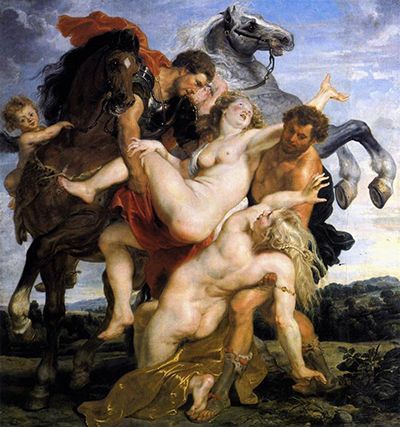
Two women occupy the crowded centre of The Rape of the Daughters of Leucippus. One is lifted across the space between the riders; the other is pulled upward from the ground. Their bodies, the men's arms and the horses' legs cross in so many directions that the scene seems to turn as one looks at it. Rubens makes the struggle instantly visible, yet he gives no calm viewpoint from which to separate all four principal figures. The violence of the abduction is built into the picture's arrangement.
The painting is held by the Bayerische Staatsgemäldesammlungen at the Alte Pinakothek, Munich. The collection record[3] dates it around 1618, identifies its support as canvas, gives its painted dimensions as 224 × 210.5 centimetres, and lists inventory number 321. It credits Peter Paul Rubens with Jan Wildens. That joint credit matters: the work is presented by its holding collection as a collaboration, although the brief public record does not specify which passage Wildens painted.
The large, nearly square canvas helps the movement feel contained and pressured. The dark horse to the left, the pale horse above, and the women's lit bodies form a knot near the centre. One woman's raised arm points toward open sky; another's arm reaches across her body as she is drawn away. The small figures near the horses make the main group seem larger still. Even the horizon and distant landscape have little room to settle the eye.
At a Glance
- ArtistsPeter Paul Rubens with Jan Wildens [1]
- DateAround 1618 [1]
- MediumOil on canvas [1]
- Dimensions224 × 210.5 cm [1]
- CollectionAlte Pinakothek, Munich, inventory 321 [1]
Where this work sits in Rubens's career
The Elevation of the Cross
1609–10The Descent from the Cross
1611–14The Garden of Love
1630–35The Three Graces
1630–35Contents
- What is happening in the myth?
- How does Rubens make the figures turn in space?
- What does Jan Wildens's credit tell us?
- How did the painting reach Munich?
What is happening in the myth?
The women are the daughters of Leucippus. The two men are Castor and Pollux, the twins often called the Dioscuri. The Munich museum's account[3] describes their act as the abduction of the king's daughters. The painting shows that seizure itself: the women are being taken by force, not meeting the riders freely. The older English title uses “rape” in its historical sense of abduction; the word can also carry a modern sexual meaning. The image gives us the immediate, nonconsensual capture, while the museum's short account does not establish a separate sexual event depicted here.
Rubens chooses a moment before anyone has escaped. The lifted woman's body spans the composition diagonally, and the other woman is still low enough to touch the ground. Both riders remain close to their horses, so the threatened departure is part of the same instant as the struggle. This is why the horses are more than a background setting. Their bodies supply the force that could carry the captives away, while their rearing legs add to the difficulty of following each movement.
The museum's narrative continues beyond the scene. It says the abduction ends tragically after a pursuit and links the twins' different fates to their parentage: Castor is mortal, while Pollux is the son of Jupiter and immortal. Pollux's wish not to be separated from his brother leads, in that account, to their placement among the stars. None of those later events is shown in the painting. They explain the wider story around the abduction without turning the visible scene into an image of the twins' deaths or transformation.
The ancient texts give the women names, Phoebe and Hilaeira, but the Munich museum's short object record does not identify which painted body is which. Rosanna Lauriola's study of the myth's reception[6] points to Theocritus, Idyll 22, and Ovid, Fasti 5 as major literary accounts. In both, the seizure receives comparatively little description; the poets move quickly to the conflict with Idas and Lynceus, the brothers to whom the daughters had been promised. Rubens instead makes the instant of seizure the entire large picture. The text's brief cause becomes the painting's central event.
The two poems make that change of focus more precise. In Theocritus's Idyll 22[1], the seizure has already happened when the narrator turns to the pursuing brothers. Lynceus then argues that Leucippus had promised the women to him and Idas, and accuses the Dioscuri of winning the marriage through gifts. The poem gives the rival men a dispute over oaths, kinship and honour; the daughters have no equivalent speech in that scene. Rubens removes the argument and the pursuers from view. His painting cannot tell us which contract would have prevailed, but it forces us to look at the act on which the men's later quarrel depends.
Ovid's Fasti, book 5[2], gives the seizure only a brief opening before following Castor's death, Pollux's appeal to share his immortality and the twins' celestial fate. Ovid introduces them as differently skilled, one a horseman and one a boxer. That detail helps explain why a painter might distinguish their bodies and roles, as McGrath argues, but the poem is a story about the twins' eventual place among the stars. On Munich's canvas they have not yet escaped with the women. No star, death or rescue directs the viewer away from the immediate resistance. This is a comparison between a painted choice and two ancient narratives, not proof that Rubens selected a particular line of either poem as his instruction.
How certain is the painting's subject?
The Munich collection uses the Leucippus title today, but the identification has a history. In her study of Rubens's subjects from history[7], Elizabeth McGrath records that an early eighteenth-century viewer called the picture a Rape of the Sabines. Other Düsseldorf Gallery descriptions gave it only the general name of an abduction. Wilhelm Heinse identified the daughters of Leucippus in 1777, citing Theocritus. The title is therefore an argued reading of a picture whose first known descriptions were less specific, not a surviving label written by Rubens.
McGrath explains why viewers hesitated. Classical images of the twins often make them nearly identical, with matching horses, caps or stars. Rubens instead gives the men different roles and contrasting horses; the episode is removed from the wedding feast and pursuit that might have made its setting unmistakable. She nevertheless defends the Leucippides identification. Ovid's Fasti distinguishes one twin as a horseman and the other as a boxer, offering a literary reason for making the brothers unlike each other. McGrath also traces the composition back to Rubens's experiments with abduction groups for the Sabine subject. In that account, a design can grow from one subject and become another without the later identification being a mistake.
This uncertainty is useful to the viewer. The two women and two abductors are clear even before their names are supplied; the specific names require reading the picture with ancient texts and the history of Rubens's designs. It would overstate the evidence to claim that every person in the scene was identified beyond dispute from the moment of its creation. Equally, the fact that older cataloguers proposed other subjects does not undo the Munich museum's present title or McGrath's reasoned case for it.
That difference matters for how we read the scene. The mounted twins have a famous mythic destiny, but the painting confronts us with what their action does to two people. The women brace, twist and reach while their captors lift them. The small Cupids at the horses' reins, which Lauriola discusses, introduce love imagery without cancelling the force shown in the figures' bodies. The same ancient story can therefore support a heroic reading of the twins and a reading focused on the captives' experience. Neither requires pretending the visible abduction is a willing encounter.
Lauriola points to a sharper tension within the ancient literature itself. In Ovid's Fasti, the kidnapping opens the quarrel between two pairs of men, and the daughters' feelings are barely described. In the Ars Amatoria, Ovid invokes Phoebe and her sister in a passage that treats force as if it could become welcome. That rhetoric is part of the source tradition later artists inherited; it is not evidence that the women in Rubens's painting consent. Reading the texts alongside the visible arms and bodies helps separate the myth's celebration of heroic power from the immediate act represented on the canvas.
How does Rubens make the figures turn in space?
The eye moves among surfaces that face in different directions. A rider bends down from one horse; another figure twists against him. The women appear from above, below and across the picture plane rather than forming a simple front-facing group. The horses' heads, backs and hooves redirect the gaze again. Looking at one pair of figures does not resolve the other. The composition invites repeated looking because each turn reveals a new connection between an arm, a body and a horse.
The museum interprets these multiple suggested viewpoints as part of a claim for painting's powers in comparison with sculpture. It also points to the sensual rendering of textures. On the canvas, skin, horsehair, cloth and sky can meet in one changing play of colour and light. A sculpture might invite a viewer to walk around it; Rubens's arrangement makes several directions feel available within a single painted view. That is the collection's interpretation of the visual effect, not a documented statement of Rubens's intention for this particular canvas.
The difference in textures also sharpens the human action. Pale flesh stands against the horses' dark and grey bodies. Red cloth near the centre and golden fabric lower down interrupt the cooler background. The women are the most brightly exposed figures, so the viewer registers their vulnerability before following the riders' movements. The rich paint does not make the capture consensual. It makes the scene visually compelling while leaving the coercion plain.
Is there an earlier design for the scene?
The Flemish Art Collection reports[8] that Paul Huvenne and Nico Van Hout identified a small panel in the National Museum in Oslo as a possible early Rubens oil sketch for this subject. It measures 27 × 29 centimetres and, in their account, was made before 1615. The two men in the small composition wear stars on their heads, which the scholars take as a clue that they are Castor and Pollux. They propose that Rubens developed this initial idea into the larger Munich painting. This is an attributed research proposal about a separate Oslo object, not an established claim in Munich's short collection record that its canvas was copied directly from that panel.
The proposal is not unanimous. In her earlier Corpus Rubenianum discussion[7], McGrath noted that the Oslo panel and related versions clearly point to the Dioscuri through such signs as stars or their distinctive caps, but she doubted that any of those versions reproduced a Rubens composition. She also found that their arrangement did not relate directly to the Munich canvas. The Flemish Art Collection's later report presents a different attribution by Huvenne and Van Hout. The two accounts should remain visible as scholarly positions, rather than being collapsed into a settled sequence of sketch and final painting.
The comparison is nevertheless useful for understanding how a myth could be tested before a final picture. A small sketch can establish the principal action and identities while leaving a large canvas to solve the difficult relationships among riders, women and horses at full scale. The proposed earlier date also warns against treating the Munich museum's around 1618 as the date of every related image. Even if the Oslo attribution or its role were revised, the Munich picture would remain the object described here, with its own support, measurements and joint Rubens–Wildens credit.
This tension has become part of the painting's modern scholarly history. Lauriola argues that praise for the composition's grace and colour can cause viewers to overlook the violence it depicts. Her essay uses a modern artwork responding to Rubens to recover the daughters' perspective. The museum's formal reading and that ethical reading address different aspects of the same canvas: how it is put together, and what its arrangement asks us to feel about an abduction. A strong account of the work needs both. Its mastery of movement is most consequential because the movement belongs to a forced removal.
In Lauriola's account, Michael Merck's 2004 collage Classic Tragedy deliberately reworks Rubens's arrangement and removes the small Cupid that helps control a horse in the older painting. The modern work gives the daughters a different visual status. It is one documented example of later artists answering Rubens's image rather than merely reproducing its virtuoso composition. The collage cannot tell us what Rubens meant in 1618, but it helps reveal how the same composition can be received differently when attention moves from the abductors' heroic story to the people being taken.
What does Jan Wildens's credit tell us?
The Bavarian collection's attribution[3] says Rubens with Jan Wildens. Wildens was a painter associated with landscape, but this public object record offers no passage-by-passage division of labour. It would be tempting to assign the distant terrain to him and every central figure to Rubens. The evidence used here does not support that exact separation, so the joint attribution is the useful public fact.
The visible landscape still has a role in the composition. A low horizon and small background forms give scale to the horses and people while keeping the drama close to the front of the canvas. The relatively open sky gives the raised limbs room to read clearly. The setting does not identify a precise geographic site. Its purpose in the picture is to let the four large bodies and two horses dominate a scene that could otherwise become difficult to parse.
Collaboration was part of Rubens's practice, and another subject in this collection of pages, The Head of Medusa, has a separate museum credit involving workshop help and animal painter Frans Snyders. The two records should be read on their own terms. In Munich's Daughters of Leucippus, Wildens is named in the artwork's attribution, but the holding museum's public summary does not explain exactly how the hands were divided.
How did the painting reach Munich?
The museum records that the canvas was acquired in 1806 from the Düsseldorf Gallery. That is a point in its later collection history, not evidence of who first commissioned it around 1618. The current museum identification rests on the object in Munich: the large canvas, its catalogue number and its present joint credit. These concrete details also distinguish it from later works after Rubens, including an eighteenth-century engraving of the same subject held by the Metropolitan Museum of Art[5]. A print that repeats the composition is evidence of its afterlife, not another version of the Munich canvas.
The painting remains memorable because its form and subject are inseparable. Two women are seized; two mounted men pull them into a tightening cluster; the horses make the abduction ready to move. Rubens and Wildens's credited collaboration produces a scene that seems to turn before the viewer, while the museum's mythic account makes clear that this compressed instant belongs to a longer and darker story.
The print after the painting belongs to yet another stage of reception. A later engraving can preserve the main arrangement while shrinking a canvas of more than two metres into a portable image. It helps explain how an ambitious Munich picture could become familiar to viewers who never stood before it. The reverse is also true: the availability of copies and prints makes exact object identification especially important. The joint Rubens–Wildens credit, material and measurements here belong to the Munich original, not automatically to every sheet after its design.
Rubens artworks directory
Frequently Asked Questions
It is in the Alte Pinakothek, Munich, in the Bayerische Staatsgemäldesammlungen, inventory 321.
The holding museum credits Peter Paul Rubens with Jan Wildens. Its short public record does not assign individual areas of the canvas to each painter.
The museum dates it around 1618. The canvas measures 224 × 210.5 centimetres in the painted area.
Castor and Pollux are abducting the daughters of Leucippus. The painting concentrates on the seizure, while later events in the twins' story are outside the frame.
No. The museum's account describes a later pursuit and tragic outcome, but Rubens's painting shows the abduction before those events.
Discussion
Look closely at how the riders, women and horses cross within the square canvas.
Share an observation about the painting or a reliable source that adds to its history.
Reader Insights
How do the horses make the threatened departure part of the struggle?
Which changes of viewpoint make the central group seem to turn?
What can the museum's Wildens credit tell us without assigning him a precise passage?
Join the Conversation
Add your reading below, keeping observations specific and evidence clear.
References
- Theocritus, Idyll 22, ancient account of the Dioscuri and the pursuit after the abduction, Perseus text with public-domain translation. View source
- Ovid, Fasti 5.693–720, ancient account of the abduction, conflict and twins' celestial fate. View source
- Bayerische Staatsgemäldesammlungen, The Rape of the Daughters of Leucippus , inventory 321. View source
- Bayerische Staatsgemäldesammlungen, German object record and interpretation. View source
- Metropolitan Museum of Art, later engraving after Rubens. View source
- Rosanna Lauriola, “Re-Proposing ‘Heroic’ Abduction in Art,” New Voices in Classical Reception Studies 6 (2011). View source
- Elizabeth McGrath, Rubens: Subjects from History , Corpus Rubenianum Ludwig Burchard XIII/1 (1997), chapter 5, “Ovid and the Art of Love”. View source
- Flemish Art Collection, report on Huvenne and Van Hout's attribution of an Oslo oil sketch related to the Munich composition. View source