 by Tom Gurney
Tom Gurney BSc (Hons) is an art history expert with over 20 years experience
Published on June 19, 2020 / Updated on October 14, 2026
Email: tomgurney1@gmail.com / Phone: +44 7429 011000
Two animals at the centre of a hunt
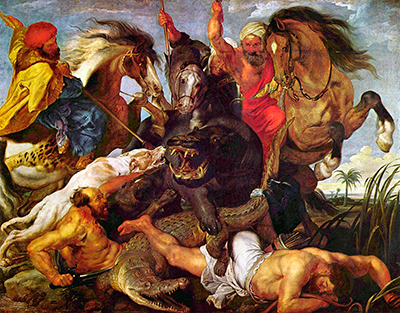
A hippopotamus opens its mouth at the centre of Peter Paul Rubens's Hippopotamus and Crocodile Hunt. Men and horses close around it from several directions. Beneath the hippopotamus, a crocodile lies across the foreground, its long body visible among fallen and struggling hunters. A horse rears at the right, lifting its forelegs above the crowded action. The painting gives the eye no safe, empty place to rest: a spear, a limb or an animal's body leads immediately into another movement.
The Bavarian State Painting Collections[2] date the Munich canvas about 1616. It measures 248.3 × 321.3 centimetres and is inventoried as 4797 at the Alte Pinakothek. The reproduction here shows that exact composition, with the hippopotamus central, crocodile below and riders pressing in from both sides. The two animal names in the title matter: this is not simply a generic lion or boar hunt.
At a Glance
- ArtistPeter Paul Rubens [1]
- DateAbout 1616 [1]
- MediumOil on canvas [1]
- Dimensions248.3 × 321.3 cm [1]
- CollectionAlte Pinakothek, Munich, inventory 4797 [1]
Where this work sits in Rubens's career
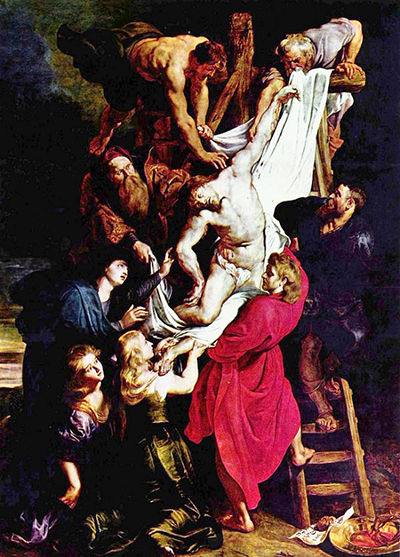
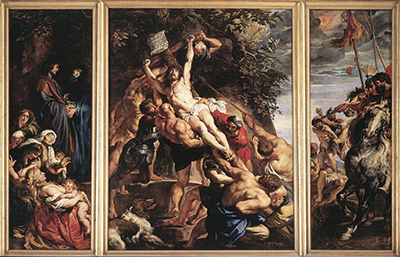
The Elevation of the Cross
1609–10The Descent from the Cross
1611–14The Garden of Love
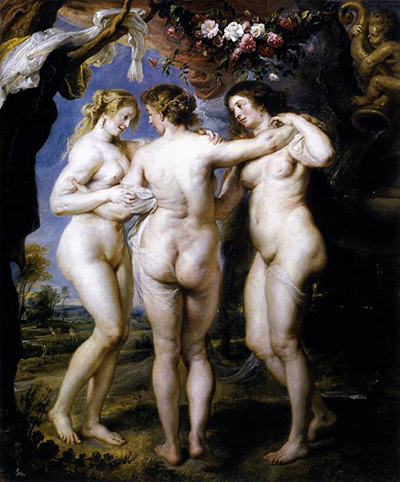
1630–35The Three Graces
1630–35Contents
- Following the action
- Why a hippopotamus?
- One of four paintings for Schleißheim
- The hunt beyond the palace
- Maximilian, collecting and the four hunts
- Rubens's work and the question of assistants
- What makes the painting a Rubens hunt?
Following the action
At first glance, the foremost hippopotamus dominates through its size and dark skin. Its mouth opens toward the viewer, exposing teeth and a pink interior. The contrast between the dark animal and the pale body falling across the foreground helps separate forms that otherwise overlap. The crocodile is lower and more horizontal; its scaly back and long snout run across the base of the scene. The hunters must respond to danger on more than one level at once.
Rubens sets the horses against that low centre. The horse at the right rears, turning a diagonal up through the canvas; another horse pushes into the crush from the left. Riders lean over their mounts with weapons raised. A bright red garment near the upper centre and a yellow one at the left help the viewer pick out human figures from the brown bodies of the animals. Yet no single hunter becomes an isolated hero. Their actions converge on the hippopotamus, while the crocodile and fallen figures make the ground itself unstable.
The painting is almost as wide as a large wall, and its width lets the confrontation spread out. On a small screen it can seem like one tangled mass. At full scale, the repeated lines of lances, horses' legs and human arms would guide the viewer through different local struggles. Rubens makes the moment feel simultaneous rather than sequential: attack, recoil and fall are all visible within the same crowded field.
Why a hippopotamus?
The Munich museum proposes that Rubens's relatively convincing hippopotamus was presumably informed by a stuffed specimen displayed in Rome in 1601. That is a hypothesis about a possible model. It does not establish that Rubens saw the specimen, studied a living hippopotamus or drew one specifically for this painting. The same museum account[2] relates the work more broadly to his study of classical art, where dramatic hunting scenes had long been valued.
The animal's unfamiliarity gives the hunt a special character. A horse, a spear and a hunter are recognizable from many European hunting pictures; the massive hippopotamus and the low crocodile shift the scene to an imagined encounter with creatures associated with distant waters. Rubens makes their bodies central enough that the viewer has to compare them with the human and equine figures. The result is neither a zoological chart nor a record of a particular expedition. It is a staged confrontation that gives force and texture to animals seldom seen in European painting at this scale.
The possible Roman specimen is useful precisely because it raises a question the painting cannot answer by itself: how does a painter construct a credible animal he cannot readily encounter alive? A preserved body might supply proportions and surface details, while classical reliefs or sculptures could suggest a dramatic arrangement. Neither kind of source would dictate the finished encounter. Rubens has made the hippopotamus sufficiently solid to anchor the composition, but its open jaws and contact with the men belong to an invented instant of action. The museum's two suggestions—classical art and a specimen—therefore describe different parts of the painter's task rather than competing explanations.
Historian Susan Maxwell, writing for the Max Planck Institute for the History of Science[4], places the hunts in a wider study of animals in Rubens's art. She argues that this commission gave animals a more central role in history painting, and relates Rubens's interest in their bodies to early modern natural history. That is an interpretive research argument, not proof of which animal Rubens observed while making this particular canvas. It does, however, explain why identifying the hippopotamus and crocodile matters to the work's ambition. They are actors in a large narrative painting, rather than incidental creatures placed along its edges.
One of four paintings for Schleißheim
This canvas originally belonged to a four-part cycle of hunting scenes ordered from Rubens by Elector Maximilian I for the Old Palace at Schleißheim, according to the Bavarian collection. Its first function was therefore as part of an ensemble, not as an isolated museum picture. The commission explains why a subject of unusual animals could be treated on such a monumental scale. It also suggests that viewers in Maximilian's palace encountered the work in relation to other hunts.
The Sandrart research edition[6], drawing on Arnout Balis's catalogue, identifies the other subjects as a boar hunt, a tiger, lion and leopard hunt, and a lion hunt. These titles describe the four-part programme, but should not be used by themselves to identify any particular surviving canvas: Rubens and his studio made more than one version of some hunt subjects. The Munich museum says[2] the group was seized by Napoleonic troops and that this canvas was the only one to return to Munich. That history is part of why a once-related group is no longer experienced together there.
The cycle also has an early written afterlife. In his 1675 Teutsche Academie, the painter and writer Joachim von Sandrart mentioned both a lion hunt and a violent hunt involving enormous crocodiles among Rubens's works. The annotated modern edition[6] connects the latter reference with this Munich picture and records the painting in the Schleißheim collection in Sandrart's period, with a possible room identification from a 1637 inventory. Sandrart's few words do not describe every figure, and the room placement remains qualified. They nevertheless show that the crocodile made the painting memorable to an early reader and that the work's palace history was already established before its later removal.
The Corpus Rubenianum catalogue of hunting scenes[1] gives more texture to that palace history. It reports that a 1637 Schleißheim inventory lists all four hunts, divided between rooms described as a changing room and a dining room. The catalogue does not establish that all four were viewed as one unbroken wall display, or fix this particular canvas's place on a specific wall. It does show that the series had become part of the palace's lived interior rather than remaining an undelivered idea. The catalogue also notes a 1706 request by the Duke of Marlborough that the group be given to him as a reward; the request was refused. That episode is evidence of the works' desirability before their later seizure, not a change of owner.
The same research traces a sequence behind the Munich museum's concise statement that only this hunt came back. The four paintings moved within Schleißheim during the eighteenth century and were sent to Paris in 1800. The Hippopotamus and Crocodile Hunt returned to Munich in 1815. The other subjects became separated in French collections: the tiger hunt at Rennes and the boar hunt at Marseille, while the lion hunt sent to Bordeaux was lost in a 1870 fire. These identifications belong to the catalogue's reconstruction of the original cycle; they should not be confused with every other Rubens hunt of the same animal. When we see the Munich picture alone, the missing ensemble is the result of documented collecting and wartime movements, not evidence that Rubens designed a single exotic scene without companions.
Dating also deserves this distinction between a current object label and a reconstructed production period. Munich labels its canvas about 1616. The Corpus Rubenianum author argues that the four pictures were probably made across 1616–18, with much work around 1617, using a 1618 Rubens letter about a lion hunt and the dates of related palace and painting projects. That is a scholarly range for the group, not a new inscription found on this canvas. The museum's approximate date remains the concise identification here; the longer range explains why a cycle need not have been conceived and completed in a single year.
The later move to a public museum changes how the image is seen. In a palace, four hunts could have formed a sustained display of princely collecting and the painter's command of motion. In the Alte Pinakothek, this one canvas must carry that story partly through its catalogue. Its inventory number, current location and documented cycle relationship keep its identity clear even without the other works alongside it.
The hunt beyond the palace
The Munich canvas generated other objects with their own makers and histories. A drawing in the British Museum[7], numbered 1949,0413.1, repeats the hunt after Rubens's painting. Made in brown and grey wash with black chalk and dated broadly to about 1618–24, it is marked with a grid for transfer and incisions across its lower half. Those working marks matter more than calling it simply a “Rubens drawing.” The British Museum catalogues it as after Rubens, tentatively attributes it to Pieter Soutman, and discusses whether it served an engraver or helped transfer the design toward another version. Its cited scholarship includes a different attribution to Anthony van Dyck. Neither attribution turns the sheet into a secure preparatory drawing made by Rubens before the Munich canvas. It documents the composition being studied and translated after the painting existed.
A later, securely catalogued print gives the circulation a date and a name. The Rijksmuseum holds Pieter Soutman's Hunt of the Hippopotamus and Crocodile[8], an etching and engraving after Rubens's painting, dated 1644–50 and numbered RP-P-OB-70.141. Soutman is named as both printmaker and publisher. Its plate is about 47.4 × 64 centimetres, far smaller than the Munich canvas but large enough to carry an intricate version of the hunt. The print is a separate work produced decades after the painting, not evidence that the palace canvas was made in the 1640s.
These two records also show why stages of copying should be kept distinct. The British Museum suggests a possible relation between its squared drawing and Soutman's engraved design but leaves the precise function open; the Rijksmuseum identifies an actual surviving impression and its production period. The painted animals, riders and fallen men could move beyond Maximilian's rooms through prints even while the canvas itself stayed part of a court collection. A viewer of the print would encounter Rubens's design through another artist's cutting and tonal decisions, rather than through the original paint and colour.
Maximilian, collecting and the four hunts
The Munich curator Mirjam Neumeister[5] describes Maximilian as a committed collector who approached Rubens directly for the four Schleißheim paintings. That makes this work part of a specific court commission, with an intended palace setting and a patron who was already building a significant collection. Neumeister also notes Rubens's later Bavarian commissions in a political and confessional context. Those later works help situate the relationship between painter and court; they do not make the hippopotamus itself an identifiable political symbol.
Maxwell proposes a more particular connection between the hunt cycle and collecting. In her account, one scene showed a boar while the others presented more exotic animals, including lions, tigers, crocodile and hippopotamus. Such a spread of species could speak to a courtly interest in assembling and studying the natural world. The argument does not require a viewer to read the painting as a scientific illustration. It suggests why a patron might want an ensemble that ranged far beyond an ordinary local hunt. Here the two unfamiliar animals are brought into the same monumental pictorial language as horses and armed men.
The interpretation needs a boundary. Maxwell connects the Wittelsbach history of collecting to ideas about princely knowledge and control, but the museum object record does not supply a commission contract explaining Maximilian's exact instructions for this canvas. The painting can securely be called part of the four-work palace cycle. Claims about a complete programme of species, political messaging or a precise hang should be attributed to scholarship or left open. This distinction is especially important now that the works no longer hang together in Schleißheim.
Rubens's work and the question of assistants
Large works made while Rubens ran a busy Antwerp studio often raise questions about division of labour. The animal painter Frans Snyders collaborated with Rubens elsewhere, which makes it tempting to assign him these creatures automatically. Maxwell argues the opposite for Maximilian's hunt commission: on the evidence of preparatory sketches, Rubens's letters and the finished paintings, she sees Rubens taking an unusually direct role in mastering the animal forms. Her project summary says the Bavarian paintings were executed largely by Rubens or under his close supervision. That is a scholarly position about the group, not a documented brush-by-brush attribution for the Munich surface.
The Sandrart edition's object entry[6] records both Rubens and his workshop in its attribution fields and notes that much of the execution was by the studio. This is a different emphasis from Maxwell's account of close authorial involvement, not a licence to give an individual animal to Snyders. The two readings can coexist if Rubens directed the composition and supervised substantial workshop execution. Neither source provides a passage-by-passage technical map of the Munich paint surface.
For a visitor, the useful result is a more careful question. Rather than treating every textured animal passage as a separate specialist's contribution, look at how the hippopotamus, crocodile, horses and people are locked into one design. The dark central body gives the composition weight; the rearing horse pulls it upward; the crocodile anchors the lower edge. Their visual coordination is clear from the work, regardless of any unresolved allocation of individual strokes. A detailed technical study would be needed to claim more about exactly whose hand painted each passage.
What makes the painting a Rubens hunt?
The subject depends on collisions. Muscular animals and people press into one another; polished fabric, skin, hair and scales demand different kinds of painted surface. The viewer can look from the hippopotamus's open mouth to the crocodile's low form, then up through the horses and back into the crowd. That route is built from positions and colour, not from a neat division into foreground and background narratives.
The museum's classical-art comparison offers a way to think about Rubens's design without naming an unproven single antique source. The bodies are packed together like a large sculptural group, but painting lets him add colour, atmosphere and competing textures. The scene is frightening, yet it is also a display of how a painter can make many figures act together at the height of danger. That visual problem is specific to this canvas: both the broad hippopotamus and the crocodile on the ground have to remain readable amid the human and equine struggle.
Rubens artworks directory
Frequently Asked Questions
It is in the Alte Pinakothek, Munich, part of the Bavarian State Painting Collections, inventory 4797.
The museum dates it about 1616. Its date should remain approximate.
It was one of four hunting paintings commissioned by Elector Maximilian I for the Old Palace at Schleißheim. It is the only member of that seized group the museum says returned to Munich.
The museum suggests a stuffed specimen shown in Rome in 1601 as a possible model. It does not establish a live-animal study or prove that Rubens saw that specimen.
Yes. It lies across the lower foreground beneath and beside the central hippopotamus, partly obscured by the overlapping struggle.
Discussion
Look closely at the compressed movements of animals, horses and hunters.
Share an observation about the painting or a reliable source that adds to its history.
Reader Insights
How does Rubens keep the hippopotamus and crocodile distinct amid the struggle?
Where do the horses' movements lead your eye?
What can be said about the Schleißheim commission without guessing at every companion work?
Join the Conversation
Add your reading below, keeping observations specific and evidence clear.
References
- Corpus Rubenianum Ludwig Burchard , catalogue of Rubens's hunting scenes, the Schleißheim inventory and the cycle's later dispersal. View source
- Bavarian State Painting Collections, The Hippopotamus and Crocodile Hunt , collection record and historical note. View source
- Bavarian State Painting Collections, German collection record. View source
- Susan Maxwell, “Natural History and History Painting in Rubens’ Animals,” Max Planck Institute for the History of Science. View source
- Mirjam Neumeister, “Flemish Baroque Painting in the Alte Pinakothek,” CODART. View source
- Sandrart research edition, Hippopotamus and Crocodile Hunt object and 1675 text. View source
- British Museum, drawing after the Munich hunt, 1949,0413.1, with squared-transfer marks and qualified maker attribution. View source
- Rijksmuseum, Pieter Soutman's 1644–50 print after the painting, RP-P-OB-70.141. View source