 by Tom Gurney
Tom Gurney BSc (Hons) is an art history expert with over 20 years experience
Published on June 19, 2020 / Updated on October 14, 2026
Email: tomgurney1@gmail.com / Phone: +44 7429 011000
An emperor, a globe and a borrowed design
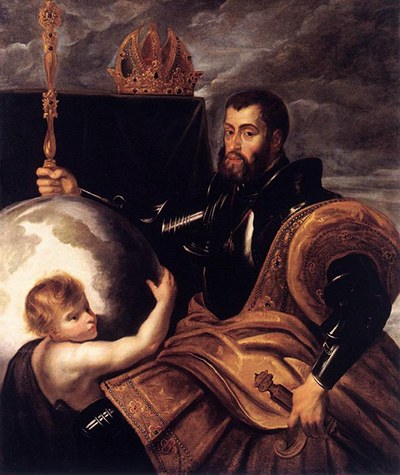
Charles V looks out from dark armour, gripping a sceptre above a globe. A young figure at lower left seems to present the world to him. Crown, sword and an ornate mantle complete an image of extraordinary authority. Yet Peter Paul Rubens was not painting the emperor from life. The Salzburg picture is Rubens's copy after an earlier allegory by Parmigianino, made several decades after Charles's death.
The Residenzgalerie Salzburg's catalogue[1] identifies the painter as Peter Paul Rubens and calls the painting a copy after Francesco Mazzola, known as Parmigianino. It dates Rubens's version about 1604, records oil on canvas, and gives the image size as 166.5 × 141 centimetres, inventory 303. The established English title, Allegory of Emperor Charles V as Ruler of the World, captures its subject better than an unqualified “portrait of Charles V.”
This distinction between maker and model is central. Parmigianino devised an allegorical image of the emperor around 1530. Rubens saw a painting of it in the collection of the Duke of Mantua and made his own version during his Italian years. The Salzburg canvas therefore belongs to Rubens's practice of learning from, preserving and reworking other artists' inventions. Calling it a copy describes a documented artistic relationship; it does not erase the decisions Rubens made on his own canvas.
At a Glance
- ArtistPeter Paul Rubens, after Parmigianino [1]
- DateAbout 1604 [1]
- MediumOil on canvas [1]
- Size166.5 × 141 cm [1]
- CollectionResidenzgalerie Salzburg, inventory 303 [1]
- SubjectAllegorical image of Emperor Charles V [1]
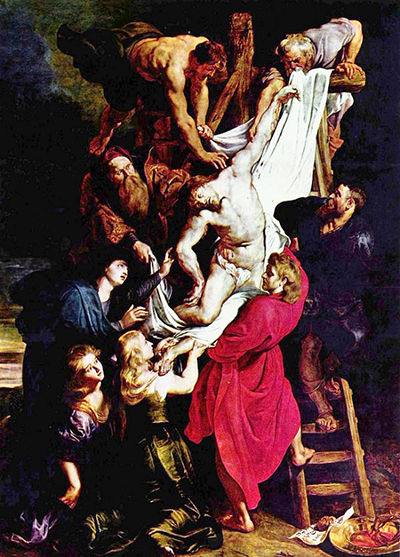
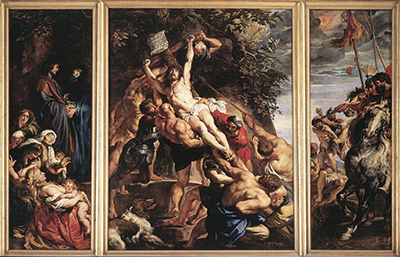
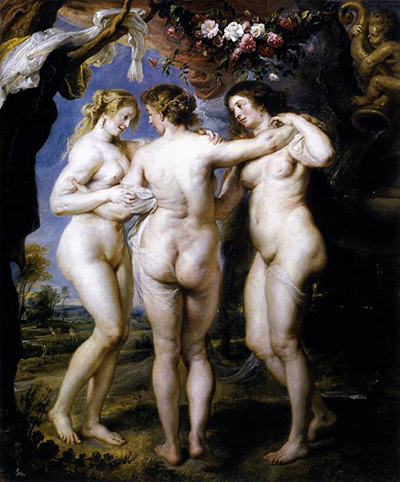
Where this work sits in Rubens's career
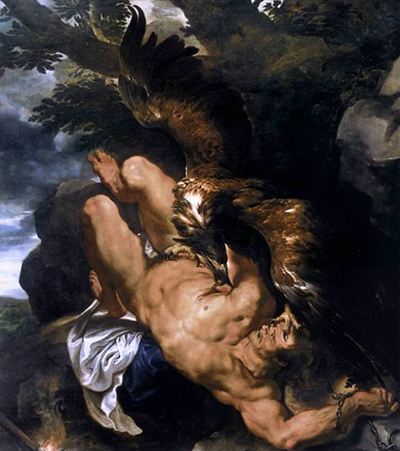
The Elevation of the Cross
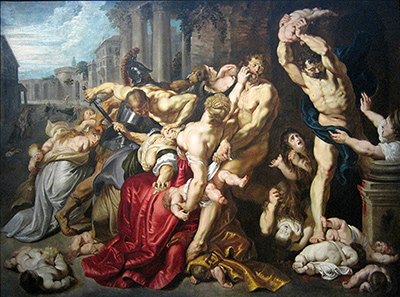
1609–10The Descent from the Cross
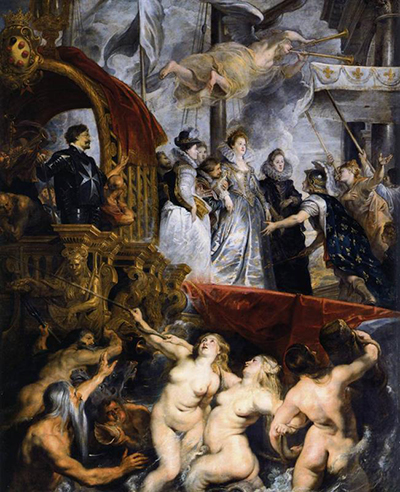
1611–14The Garden of Love
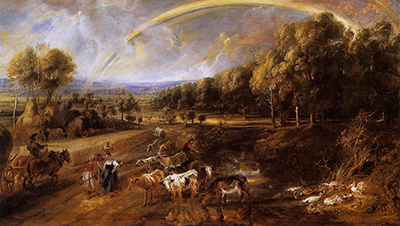
1630–35The Three Graces
1630–35Contents
- Charles V as an idea of rulership
- Armour, sword and Golden Fleece
- The Mantuan model and Rubens's Italian years
- What Rubens changed in the copy
- The child, globe and an image of empire
- Size, support and collection history
- Reading the painting once more
Charles V as an idea of rulership
Charles V, who lived from 1500 to 1558, ruled lands spread across Europe and beyond. Rubens, born in 1577, could not have observed him. The painting makes a claim about imperial authority through objects and allegorical company rather than recording a sitter at a particular audience or battle. Its serious face gives the claim a human centre, but the surrounding signs tell us what kind of image this is.
The crown behind Charles and the sceptre in his hand announce sovereignty. The globe expands the claim beyond one court or territory. A small figure holds or presents it at lower left; the Salzburg collection calls that figure a genius[1], a personification that proclaims the extent of the emperor's dominion. It is tempting to call the figure a generic child or putto, but the museum's term preserves its allegorical role.
The words “ruler of the world” are part of an image of power, not a literal statement that Charles governed every place shown or imagined. Allegory compresses ambitions, symbols and political ideals into a scene that never occurred in ordinary life. A reader can admire the painting's force while recognizing that its globe turns complex and contested domains into a single object offered to one ruler.
The dark, active sky strengthens that rhetoric. Behind Charles, it replaces an ordinary indoor setting with an atmosphere large enough for imperial claims. The sceptre rises against the clouds; the globe occupies the foreground. Rubens arranges the viewer's route from the emperor's face through the insignia to an imagined world, drawing attention to the gap between one body and the vast territory it is supposed to command.
Armour, sword and Golden Fleece
Charles wears polished black armour. The Salzburg catalogue points to bright white highlights on its surface and to the sword in his left hand as signs of a warlike ruler. The weapons do not depict a named battle. They supply the visual language of military readiness to an allegorical portrait.
The mantle over the armour is enriched with pearls and gemstones. It gives the figure splendour as well as protection, joining the courtly and the martial. Its warm surfaces also break up the dark metal. The contrast helps Charles stand out from the stormy background and keeps the image from becoming merely a collection of black shapes and metallic reflections.
At his neck hangs the Order of the Golden Fleece on a red ribbon. The Residenzgalerie notes[1] that Charles was the order's grand master. This is a more specific sign of dynastic and chivalric status than the generic crown. Even if a small reproduction makes the pendant hard to resolve, its position and colour form part of the costume's message.
The sceptre and crown speak of rule; armour and sword speak of force; the Golden Fleece names an honour associated with the Habsburg court. Rubens gathered these signs around Charles's direct gaze. None of them proves that the painting was commissioned by the emperor or made during his reign. Their purpose is representational: to make an imperial identity immediately legible.
The Mantuan model and Rubens's Italian years
Rubens entered the service of the Gonzaga court in Mantua during his years in Italy. According to the Salzburg catalogue's description, he travelled to Spain in 1603–04 on a diplomatic mission and returned to Mantua, where a Parmigianino allegory in the duke's collection gave him a model for this painting. The collection's about-1604 dating follows that sequence. It is a curatorial estimate, not a signed day and month on the canvas.
The Spanish journey matters because Charles V represented a powerful Habsburg example to later rulers. Rubens's work for a Mantuan duke and his exposure to Spain placed him among courts where such an image had political and artistic meaning. The Salzburg account also notes his engagement with Titian's portraits of emperors. That is a useful context for his interest in imperial likenesses, although this canvas's direct model was Parmigianino's allegory.
Parmigianino painted Charles's image in the sixteenth century, when the emperor was alive. Rubens's early seventeenth-century version belongs to a later moment of looking back. It can be understood as a painter studying a celebrated Italian design while adapting it to his own handling of armour, cloth, body and atmosphere. The work is therefore both an exercise in artistic inheritance and a renewed image of Habsburg power.
The original model and Rubens's version should not be merged into one object. The Residenzgalerie holds Rubens's oil canvas, inventory 303. The Parmigianino work is the source composition. Recent scholarship discusses an Allegorical Portrait of Charles V attributed to Parmigianino, with possible workshop involvement[2] and now in a private collection. That attribution nuance concerns the earlier picture, not a reason to relabel the Salzburg canvas as Parmigianino's own painting.
What Rubens changed in the copy
A copy can be close to its model and still redirect attention. In a 2026 article in the Journal of Historians of Netherlandish Art[2], Aaron M. Hyman compares the two Charles V pictures. He observes that Rubens replaced a figure of Fame and a green drape in the Parmigianino design with a dramatic sky. That change makes the emperor appear less like a ruler staged before a ceremonial textile and more like a figure set against an expansive atmosphere.
Hyman also examines the globe. In the earlier picture, he sees recognizable geography, centred on the eastern Mediterranean, together with references to the Pillars of Hercules. In Rubens's copy, he argues, those specifics disappear and the sphere becomes a more general assembly of blue and green. This is a documented scholarly comparison, not proof that Rubens intended to suppress one exact political message. It directs our attention to a visible difference that a simple “copy after” label might hide.
The globe in the Salzburg image can seem surprisingly indistinct for a painting about worldwide rule. In a small reproduction, pale and dark patches suggest land and water, yet they do not invite a confident search for named coasts. Hyman treats that lack of specificity as part of a broader argument about Rubens's handling of globes. Readers need not adopt every inference about the artist's motives to see the contrast: Parmigianino's design tied dominion to a more particular mapped world, while Rubens's version lets the globe function as a broad emblem.
The loss of Fame and the changed globe work together. Rubens does not abandon the claim to vast power; Charles still holds his sceptre above the world. The claim is carried more by scale, gesture and atmosphere, and less by precise geography or an additional crowning personification. This is one way a later artist can make an inherited allegory feel newly his own without changing its central subject.
The child, globe and an image of empire
The genius is easy to overlook because Charles's head and ornate costume dominate. Yet the figure at lower left physically supports the image's central claim. The globe does not simply sit on a table. It is held up to the ruler, so the relationship between person and world becomes an action. Charles's sceptre appears to meet or command the orb above the genius's arms.
The globe also sets up a difference of scale between the adult emperor and the small attendant. A world reduced to a manageable sphere can be presented to one man. This is the painting's rhetorical trick. It makes a dispersed political reality look unified and graspable. That is why the object matters even when its geography is vague: it gives the title's “world” a visible form.
The Residenzgalerie's account[1] calls the attendant a genius proclaiming far-reaching dominion. It does not identify the figure as a particular mythological child, and the article need not invent one. The face, arms and globe are enough to explain the role: a personification presents the empire as an object for the ruler's authority.
Modern viewers may read this symbolism more critically than early patrons did. A sphere with little geographic detail offers no account of the peoples and places it represents. That absence is not a defect to be silently filled by the viewer. It is part of how allegory works here: the world becomes a sign, while Charles remains the individual with recognisable features and agency.
Size, support and collection history
The Salzburg record gives 166.5 × 141 cm as the painting's image dimensions. It separately lists a 194 × 169 × 10 cm frame. Those measurements should not be mixed. The canvas is large enough for a substantial human figure and foreground globe, but it is not one of Rubens's vast altarpieces or tapestry cartoons. Its portrait-like scale helps the allegorical emperor confront a viewer directly.
The medium is oil on canvas. That matters when comparing it with drawings or engravings after Charles V: this is a painted, coloured version of a painted model. Rubens could handle glossy armour, skin, gems, clouds and cloth in the same medium as Parmigianino while changing their effects. The image can be studied as a work of paint as well as a source of information about iconography.
The Residenzgalerie's provenance field[1] records the Spencer-Churchill collection at Northwick Park in Gloucestershire, then Palladio Fine Arts in London. The Salzburg institution purchased the picture on 7 December 1966, through the mediation of Kurt Rossacher. The listed sequence identifies important later owners and the acquisition, but it does not provide a continuous account from Rubens's studio to the English collection. The missing intervening steps should remain unfilled.
The current catalogue says the painting is not presently on display. That is a changeable status; anyone planning a visit should check the collection's current information. The secure holding is Residenzgalerie Salzburg, part of the DomQuartier, inventory 303. The artwork and its museum number do not depend on its position in the galleries at any particular date.
Reading the painting once more
Start at Charles's face, then take in the black armour and heavy mantle. Follow the sceptre down to the globe and the genius supporting it. Find the crown behind him, the sword and the Golden Fleece at his neck. Finally look past the figure into the sky. The painting joins each object to the same claim: the emperor is presented as a ruler whose authority extends far beyond the human scale of his body.
The picture's precise identity changes how that claim is interpreted. Rubens painted it about 1604 after Parmigianino, working from a model in Mantua and adapting its details. Charles V had died in 1558, so this is a later artist's reconstruction of imperial grandeur, not testimony from a sitting. The changes to the sky and globe reveal that the Salzburg canvas is not merely a neutral duplicate.
The painting now held as Residenzgalerie inventory 303 gives a reader two histories at once: the sixteenth-century invention of Charles as a world ruler and Rubens's early seventeenth-century response to an Italian master's design. Keeping those histories distinct makes the allegory richer. It lets the emperor's symbols be read clearly while still seeing the choices of the painter who brought them forward again.
Rubens artworks directory
Frequently Asked Questions
No. Charles V died in 1558, before Rubens was born. Rubens painted this about 1604 as a copy after an earlier allegory by Parmigianino.
It belongs to the Residenzgalerie Salzburg at DomQuartier, inventory 303. The collection record currently says it is not on display, so check before visiting.
The globe presents Charles's far-reaching dominion in a single visible object. A small allegorical figure, called a genius by the museum, holds it up to him.
It is the Order of the Golden Fleece on a red ribbon. The Salzburg collection notes that Charles was its grand master.
No. Aaron M. Hyman's comparison notes that Rubens replaced Fame and a green drape with a dramatic sky and made the globe less geographically specific.
The museum gives the painted image as 166.5 cm high and 141 cm wide. Its separately listed frame measures 194 × 169 × 10 cm.
Discussion
Follow Charles's sceptre to the globe held by the genius.
Share an observation about the painting or a reliable source that adds to its history.
Reader Insights
How do the armour, sword and Golden Fleece shape Charles's image?
What did Rubens change from Parmigianino's earlier allegory?
Does the indistinct geography of the globe change how you read the claim of world rule?
Join the Conversation
Add your reading below, keeping observations specific and evidence clear.
References
- Residenzgalerie Salzburg, Rubens, Allegorie auf Kaiser Karl V. als Weltenherrscher , inventory 303. View source
- Aaron M. Hyman, “Global (In)Attentiveness in the Age of Rubens,” Journal of Historians of Netherlandish Art 18, no. 1 (2026). View source
- DomQuartier Salzburg, Residenzgalerie Flemish Baroque collection overview. View source
- DomQuartier Salzburg / Residenzgalerie, Flemish Baroque collection presentation. View source