 by Tom Gurney
Tom Gurney BSc (Hons) is an art history expert with over 20 years experience
Published on June 19, 2020 / Updated on October 14, 2026
Email: tomgurney1@gmail.com / Phone: +44 7429 011000
A court favourite rides toward us
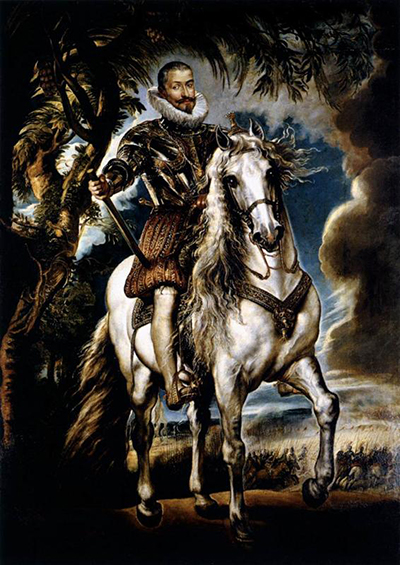
The Duke of Lerma sits high on a white horse that seems to advance out of the painting. He wears dark half-armour, holds a command staff, and faces the viewer. A tree rises beside him, while a small cavalry action unfolds in the distance. The horse's raised foreleg and the duke's extended arm make a portrait of political authority feel like an event in motion. Rubens has given a courtier the visual presence of a commander.
The Museo Nacional del Prado catalogues this work[1] as Equestrian Portrait of the Duke of Lerma by Peter Paul Rubens, 1603, oil on canvas, 290.5 × 207.5 centimetres, inventory P003137. The painting is signed and dated on its face: P. P. Rubens fecit 1603. It was made during Rubens's first Spanish visit, in Valladolid. A separate Rubens drawing for an equestrian portrait of Lerma survives in the Louvre; its paper support and dimensions belong to another object.
This large canvas is a portrait, but it does more than record the duke's features. Armour, staff, horse, badge and background cavalry join the sitter to an image of military command. The Prado describes Lerma as Philip III's favourite and first Duke of Lerma. The painting turns a court relationship into something visible: a man whose access to royal power is represented through the symbols of leadership.
At a Glance
- ArtistPeter Paul Rubens [1]
- Date1603, signed and dated [1]
- MediumOil on canvas [1]
- Size290.5 × 207.5 cm [1]
- CollectionMuseo Nacional del Prado, P003137 [1]
- SitterFrancisco de Sandoval y Rojas, Duke of Lerma [1]
Where this work sits in Rubens's career
The Elevation of the Cross
1609–10The Descent from the Cross
1611–14The Garden of Love
1630–35The Three Graces
1630–35Contents
- The man behind the image
- Armour, staff and Saint James badge
- The horse and the landscape
- Rubens and Titian's Charles V
- The related Louvre drawing
- From Lerma's collection to the Prado
- Looking once more at the advancing rider
The man behind the image
The sitter was Francisco de Sandoval y Rojas, Marquis of Denia and first Duke of Lerma. The Prado's object account[1] calls him Philip III's favourite. In the court system of the Spanish monarchy, that relationship gave him exceptional influence. Rubens's portrait does not state a list of government actions; it constructs the public appearance of a person close to the king.
The Prado's Spanish catalogue entry[2] tells an anecdote attributed to Rubens: when a petitioner was referred by the king to Lerma, the petitioner replied that if he could obtain an audience with Lerma he would not have needed to visit the king. The story conveys the duke's perceived power. As an anecdote, it should be read as a pointed contemporary characterization, not a transcript of how every royal decision was made.
Rubens had arrived in Spain from the Mantuan court in 1603 with paintings intended as gifts to Philip III and Lerma, according to the Prado's entry on the duke's collection[3]. That context places the portrait within a network of courtly exchange. It does not make the painting one of the gift pictures or tell us the precise terms under which Lerma sat for it. The signed canvas itself and the Prado's Valladolid account establish the central facts.
The duke's gaze matters in a portrait designed for looking from below. He seems aware of a viewer in front of the horse. Rubens gives his face enough detail to retain the identity of a particular man while the pose enlarges him into a type: an armed leader on horseback. The individual and the role are present together.
Armour, staff and Saint James badge
The sitter wears half-armour rather than a complete suit enclosing his body. The dark metal catches small highlights, and the white horse brings it into sharper contrast. The Prado identifies the staff[1] as an emblem of command. Lerma extends it toward the viewer's left, opening the figure's pose and giving his authority a direction beyond the canvas.
At his neck is the scallop badge of the Order of Santiago, also called Saint James. It is small beside horse and armour, but the Prado singles it out as the portrait's principal decorative sign. The badge helps anchor the sitter in an identifiable order and social world. A viewer can recognize a court noble rather than a nameless figure of martial fantasy.
The horse's tack and the duke's costume are rich without making the image primarily a display of jewels. The contrast between dark armour and pale animal is enough to draw attention. Rubens lets the horse's chest, head and stepping leg command much of the foreground. The duke's body then rises from that mass to meet the viewer's gaze. The portrait's scale turns both man and mount into a monumental pair.
None of these emblems documents Lerma leading the particular cavalry action shown behind him. The tiny riders reinforce a military identity, but the museum does not identify a named battle represented there. The scene works as a visual claim about command. Treating it as a documentary record of one campaign would ask more of the painting than its catalogue supports.
The horse and the landscape
The animal faces nearly forward, its head close to the picture's centre. One foreleg lifts while the other bears weight. The movement produces a sense that the horse may step toward the viewer, even though the paint and canvas hold it still. This dynamic frontality is central to the picture's effect. Lerma seems to arrive rather than merely pose.
A palm-like tree and dark foliage frame the duke on one side. On the other, clouded sky opens behind the horse. This imbalance is useful: the tree gives a vertical measure of height, while the brighter space lets the horse's head and the rider's outline stand clear. The small cavalry below and beyond expands the portrait into an imagined military setting without distracting from the main pair.
Rubens's painting is almost three metres high. The physical size supports the illusion of an approaching mount. A small reproduction can show the composition, but it cannot fully convey the relation between a standing visitor and this near life-size horse and rider. The museum measurement is part of understanding how the image was meant to confront a viewer.
The horse is not simply a prop. Its forward movement makes the duke's power appear active. It also gives Rubens a way to break the stillness of formal court portraiture. The sitter remains composed, but the animal supplies energy beneath him. That combination of controlled person and moving mount is a visual argument about authority.
Rubens and Titian's Charles V
The Prado relates Lerma's portrait to Titian's Emperor Charles V at Mühlberg, also in Madrid. Titian's 1548 equestrian portrait[4] presents the emperor in armour on horseback after the Battle of Mühlberg. The comparison matters because an equestrian ruler portrait offered Rubens a prestigious visual tradition for a man who was not himself king.
The two paintings do not stage the horse identically. The Prado says Rubens turns Lerma's mount to face and advance toward the viewer, making the result more forcefully forward-looking. Titian's Charles V moves across the landscape in profile. Rubens has taken the authority of a mounted image and changed its direction, so the sitter's command seems to project into the viewer's space.
Titian's work refers to a specific imperial victory. The Prado's discussion of Lerma's picture does not connect the distant cavalry to a named victory by the duke. That difference is important. The later painter could draw on an established iconography of sovereign power while adapting it to a royal favourite whose political position had to be represented rather than inherited as a crown.
The Prado also sees Rubens's solution as influential for later equestrian portraits, naming Anthony van Dyck and Gaspar de Crayer. Such influence is a museum's broad art-historical assessment; it need not mean those painters repeated this canvas detail by detail. The lasting contribution lies in the commanding frontal horse and the political energy it gives a portrait.
The related Louvre drawing
The Musée du Louvre holds a Rubens Portrait du duc de Lerma drawing[5], inventory INV 20185 recto. Its current catalogue identifies the rider as Lerma and describes pen and brown ink, brown wash and black chalk on a sheet about 29 × 21.5 centimetres. It is a small work on paper associated with the equestrian portrait, not another copy of the finished canvas.
In the drawing, the armed rider and horse explore the form of the composition. Its monochrome materials let a painter test placement and movement without committing to the full colour and size of an oil portrait. Comparing it with the Prado work can show how an equestrian image was developed, but the two records do not justify calling every visible difference a documented step in a precise chronological sequence.
The Louvre's historical Musée Napoléon inventory once identified the rider as Archduke Albert. The museum's present title and person index identify Lerma. That is a reminder that old collection labels can change as objects are studied. The current identification should guide the page, while the historical label may interest a reader tracing attribution and cataloguing history.
The Louvre entry itself does not give a year of execution for the sheet. A date around 1603 follows from its relationship to the signed Prado portrait; it is an inference, not a date inscribed on the drawing. The Prado canvas, by contrast, carries Rubens's 1603 signature and date. Keeping this distinction preserves the value of both objects as evidence.
The site has a separate page for the Louvre study. The painting and drawing can be linked without exchanging their museum numbers, supports or dimensions. A visitor following the pair can see the change from a small graphic idea to a large public portrait while still respecting the limits of the records.
From Lerma's collection to the Prado
The Prado's provenance begins with the Duke of Lerma's collection. It records the painting in the Royal Collection in 1635 and says Philip IV later gave it to the Admiral of Castile. Subsequent ownership passed through noble families, including the marquises of Denia and dukes of Medinaceli, before the painting eventually reached the museum. The later inventory history is detailed, but it does not remove every gap between one owner and the next.
The museum acquired the canvas in 1969. Its Spanish entry records a purchase by the museum's governing board in January of that year from Capuchin custodians in Madrid. This modern acquisition date is much later than the painting's creation and its seventeenth-century royal period. It explains why an image so closely tied to Spanish court history entered the Prado's own holdings only in the twentieth century.
After Lerma's fall, the portrait's meaning would no longer have been fixed by its original political moment. It became an object to collect, transfer and display. The painting still presents him as a powerful mounted figure even when the viewer knows that court favour could end. This gap between the sitter's image of permanence and the instability of political position is part of what makes the portrait historically revealing.
The provenance should not be flattened into a simple statement that the picture always belonged to the Spanish crown. It moved from Lerma's possession into the royal collection, out again through a royal gift, and through later hands before the Prado purchase. Those changes give the work its own biography distinct from the duke's.
Looking once more at the advancing rider
Begin with the white horse's lifted leg, then follow its head to the rider above. Notice the command staff reaching outward, the small Saint James badge, and the cavalry in the distance. The elements work together to turn a sitter into a figure of action. The duke's political proximity to Philip III is made visible through a vocabulary usually associated with commanders and rulers.
Rubens was young when he painted this in 1603, yet the canvas is assured in scale and purpose. The signed date, Valladolid setting and original subject are securely recorded by the Prado. Beyond that evidence, the portrait invites interpretation without requiring a claim that its background records an actual battle. It is an image of power crafted for a specific man at a specific court.
The exact identifier P003137 keeps the finished Prado canvas distinct from the Louvre's small drawing. With the object clear, the image can be read for what it accomplishes: Lerma approaches on horseback, the landscape opens around him, and Rubens makes a political favourite appear to ride into history.
Rubens artworks directory
Frequently Asked Questions
He is Francisco de Sandoval y Rojas, first Duke of Lerma and a powerful favourite of Philip III of Spain.
Rubens signed and dated it 1603. The Prado says he painted it in Valladolid during his first visit to Spain.
The Prado identifies it as the scallop badge of the Order of Santiago, or Saint James.
The museum describes cavalry action reinforcing the portrait's military character. It does not identify a specific battle shown there.
No. The Louvre's INV 20185 recto is a small pen, wash and chalk drawing. This page concerns the signed oil-on-canvas Prado portrait P003137.
The museum acquired it in 1969, after a history in Lerma's collection, the Spanish Royal Collection and later hands.
Discussion
Follow the horse's raised leg up to Lerma's gaze and command staff.
Share an observation about the portrait or a reliable source that adds to its history.
Reader Insights
How do armour, badge and cavalry construct an image of authority?
What changes when the horse advances toward the viewer?
How does this finished canvas differ from the related Louvre drawing?
Join the Conversation
Add your reading below, keeping observations specific and evidence clear.
References
- Museo Nacional del Prado, Equestrian Portrait of the Duke of Lerma , P003137, English object record. View source
- Museo Nacional del Prado, Retrato ecuestre del duque de Lerma , P003137, Spanish object and provenance record. View source
- Museo Nacional del Prado, Duke of Lerma collection encyclopedia entry. View source
- Museo Nacional del Prado, Titian, Emperor Charles V at Mühlberg. View source
- Musée du Louvre, Rubens, Portrait du duc de Lerma , INV 20185 recto. View source