 by Tom Gurney
Tom Gurney BSc (Hons) is an art history expert with over 20 years experience
Published on June 19, 2020 / Updated on October 14, 2026
Email: tomgurney1@gmail.com / Phone: +44 7429 011000
A queen steps ashore
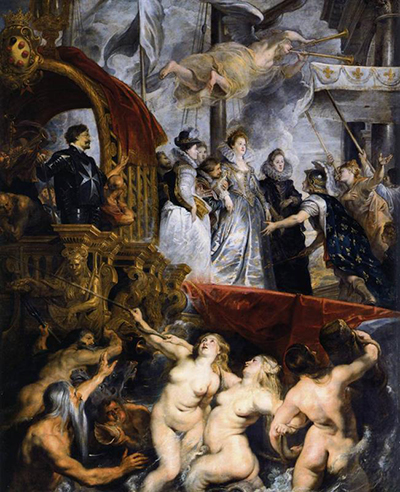
Marie de Médicis stands at the centre of a busy landing. A richly decorated vessel rises behind her, a welcoming group waits at the right, and large sea beings fill the water below. Rubens has divided the canvas between an event on a quay and a mythological celebration at the waterline. Both parts describe the queen's arrival, but they do so in different visual languages.
The Louvre[1] titles the painting Le Débarquement de la reine à Marseille, le 3 novembre 1600, The Disembarkation of the Queen at Marseille, 3 November 1600. Its inventory numbers are INV 1774 / MR 965. It is oil on canvas, 394 × 295 centimetres. The date in the title marks the event represented. Rubens painted the canvas with the Marie de Médicis cycle in 1622–25, more than twenty years later.
This distinction matters because the picture is a retrospective commission by the queen. It is neither an eyewitness sketch made on the quay in 1600 nor a simple record of people who actually stood there. Its historical anchor is Marie's entry into France; its sea gods and civic personifications tell us how she wanted that entry remembered.
At a Glance
- ArtistPeter Paul Rubens [1]
- EventMarie de Médicis lands at Marseille, 3 November 1600 [1]
- Painted1622–25 for the Marie de Médicis cycle [1]
- MediumOil on canvas [1]
- Dimensions394 × 295 cm [1]
- CollectionMusée du Louvre, Paris, INV 1774 / MR 965 [1]
Where this work sits in Rubens's career
The Elevation of the Cross
1609–10The Descent from the Cross
1611–14The Garden of Love
1630–35The Three Graces
1630–35Contents
- What happened on 3 November 1600?
- How does the ship frame the landing?
- Who receives Marie?
- Why are sea beings in the foreground?
- How are history and allegory joined?
- Where did the painting belong?
- How should the picture be read today?
What happened on 3 November 1600?
The date belongs to Marie's arrival at Marseille. She was coming from her Italian homeland to France as the wife of Henri IV. The journey is the subject of one part of Rubens's twenty-four-canvas account of her life. The Louvre says she steps off a galley bearing the Medici arms, and that personifications of France and the City of Marseille receive her. The historical movement from sea to land becomes, in the painting, a welcome by the kingdom and its port.
The older site route uses “Landing at Marseilles” and puts “3rd November 1600” in its address. The city is usually written Marseille in English today, but the inherited route remains useful as an established path. Readers should understand that the title's exact day dates a represented event. The correct object record and the later painting date belong in the page text and caption.
Rubens's imagery makes a public claim about that arrival. Marie is placed in the open, visible to those on the quay and to the viewer. The welcoming figures give the action the appearance of a formal reception. At the same time, the supernatural swimmers say that even the sea has carried and honoured her. These details do more than decorate a journey; they frame a foreign-born bride's entry into France as an auspicious beginning.
The Louvre's gallery guide[2] calls the arrival painting one of the best known in the series. The guide also identifies people in the scene, including Marie's sister Eleonora de' Medici. That specific identification sits alongside the object record's broader list of personifications and sea beings. A viewer need not label every human attendant to follow the main act: Marie comes down from her ship into a carefully staged welcome.
How does the ship frame the landing?
The galley occupies the upper left of the picture. Gold ornament, a red canopy and the Medici coat of arms turn it into an emblem of the queen's family as well as a means of travel. Rubens does not hide the vessel after Marie reaches shore. Its high, curved structure encloses the people on board and provides a dark backdrop against which the brighter central figures stand out.
Marie stands between vessel and land. That position carries the story in one glance. Behind her are the ship and the journey; in front of her is the receiving country. The bodies close around her, yet her pale dress and upright position give her a distinct centre. Rubens's arrangement makes the short physical step between ship and quay feel like a passage between two public identities.
The red cloth at the landing forms a strong diagonal below her. It leads the eye from the hull towards the welcome at right and also marks a boundary above the water beings. Seen in a small reproduction, this band is especially useful for reading the painting: it keeps the upper human ceremony and lower marine celebration connected without collapsing them into one space.
The ship's Medici arms matter to the commission's political purpose. They identify the family from which Marie came. France's personification, dressed with fleurs-de-lis, marks the realm into which she enters. The painting lets these signs meet around the queen. The gesture suggests a transfer and a welcome, while its allegorical figures remind us that this is a carefully composed version of the event rather than a documentary view.
Who receives Marie?
The Louvre identifies the welcoming figures as France and the City of Marseille. The figure of France is recognisable by the fleur-de-lis pattern associated with French monarchy. These are personifications: human bodies used to stand for political places. Their appearance changes the landing from a private arrival into a reception by kingdom and city.
At the right, a figure extends an arm towards the queen. This gesture helps bridge the short distance from ship to land. The Louvre's description also identifies Fame, who carries news of the event to the king. Fame is another invented presence that makes the scene larger than the moment on the quay. The announcement sends the landing onward into the cycle's account of Marie's marriage and French life.
The identities have different levels of certainty. The Louvre names France, Marseille and Fame in its description. The exact placement of every courtier around Marie is not equally central to its explanation. It is more useful to notice how their gestures work together: one group accompanies the queen, another welcomes her, and Fame carries the news away. Rubens builds a chain of attention across the upper picture.
This is why “welcome” is more than a polite detail. Marie had come from Florence and needed to be presented as a French queen. The image makes that transition visible through symbolic hosts. It suggests that her presence is accepted by the city and by France itself. The series was commissioned much later, when the queen had political reasons to stress her place within the kingdom. The image's cordial reception belongs to that later telling of her life.
Why are sea beings in the foreground?
Beneath the landing, the water is crowded with figures. The Louvre identifies Nereids, tritons and Neptune with his trident. It also mentions a figure who is probably Proteus, preserving uncertainty about that name. These are classical sea beings, not people who actually helped the galley dock. Rubens gives the voyage a supernatural escort and a second, exuberant welcome below the formal ceremony.
The sea group fills the lower half with intertwined bodies and turning gestures. A viewer's eye may first reach Marie at the centre, then drop to the pale figures in the water. Their movement makes the lower foreground feel almost as active as the queen's disembarkation. Rather than treating the sea as an empty surface, Rubens turns it into a stage inhabited by mythological witnesses.
The Louvre calls the Nereids in the foreground an especially admired motif. Their bodies are close to the viewer and rendered at a scale comparable with the main human figures above. Their pale flesh contrasts with the darker water and with the ship's deep reds and golds. The strong contrast gives this part of the picture immediate force, even when the full four-metre canvas is reduced to a website image.
Neptune's trident helps identify the sea's mythological ruler. The Louvre's public guide says he escorts the vessel to safe harbour. That statement expresses the painting's allegorical meaning: the sea itself appears to favour the queen's passage. It should not be mistaken for evidence about weather, navigation or an actual escort on 3 November 1600. The mythic figures are Rubens's way of praising an historical journey.
The possible Proteus is best named with the museum's “probably.” Iconographic labels can depend on old descriptions and surviving memoranda, not solely on features obvious to every modern viewer. The Louvre refers here to a memorandum preserved in the Baluze papers. A cautious label lets readers appreciate the figure's role within the marine crowd without presenting an uncertain identification as a settled fact.
How are history and allegory joined?
The canvas has two kinds of evidence within one frame. Marie, the ship and the landing refer to an event dated 3 November 1600. France, Marseille and Fame personify places or ideas. Neptune, Nereids and tritons belong to myth. Rubens does not ask viewers to choose one mode. He joins them so the historical arrival seems to receive approval from both a political community and the natural world imagined as divine.
The Louvre describes the cycle as a fusion of historical reality and allegorical symbol. This particular painting makes the method easy to see because the sea figures are so large. The apparently factual action is not hidden, but it is surrounded and interpreted. A queen steps ashore; the country welcomes her; the sea celebrates her. That progression is the painting's argument.
Its political force comes partly from hindsight. By 1622, when Marie commissioned the cycle, her relationship with her son Louis XIII had suffered serious conflict. The Louvre guide explains that the series offered her a way to present her own account of a turbulent life. The 1600 landing is therefore not neutral background to later events. It is an opening chapter in a biography designed to support her dignity and legitimacy.
That context does not make the picture less worth looking at. It makes its invention more interesting. Rubens could stage a joyful moment without pretending the later conflict never occurred. Viewers can enjoy the luminous bodies and crowded composition while recognising that the image is also an act of royal self-presentation.
Where did the painting belong?
Rubens made the Marie de Médicis cycle between 1622 and 1625 for the western gallery of the Luxembourg Palace in Paris. The Louvre says its twenty-four canvases included scenes of the queen's life and portraits. They were installed between windows, forming a sequence that visitors could follow along the room. The Marseille landing was one episode in that larger narrative, not originally an isolated museum picture.
The painting's size, 394 × 295 centimetres, suited an architectural setting. A life-sized viewer standing before it would encounter a vessel towering above and sea figures spreading across the foreground. The small image on this page can orient the eye, but it cannot convey the bodily scale of the canvas or the effect of walking from one episode to the next.
The Louvre's object record traces the cycle's later movements. The canvases entered the Louvre in 1790, returned to the Luxembourg for display between 1802 and 1815, and moved definitively to the Louvre in 1816. They were later rehung in several museum settings; the complete series has occupied the Richelieu wing since 1993. These moves changed the physical context in which viewers read the landing, though the object itself remains part of the same cycle.
A sketch for the Marseille composition is recorded by the Louvre in Munich. It is evidence that Rubens prepared the large painting through smaller designs. The sketch is a separate object and should not be confused with the Louvre canvas pictured here. The present page illustrates and describes INV 1774 / MR 965; it does not reproduce that preparatory work.
The Louvre catalogue describes the series as Rubens's work. Its general prose calls the canvases autograph. This page follows the museum's object credit. It does not assign particular sea figures or courtiers to named assistants without an object-specific conservation or catalogue basis. The painting's meaning can be explained without turning an unsettled workshop question into a claim about who painted each passage.
How should the picture be read today?
Begin at the queen near the centre. Trace her movement from the ship towards France and Marseille, then follow Fame's announcement towards the right. Finally look down at the water, where Neptune and the other sea beings give the voyage a second celebration. This sequence shows how Rubens organised an event into a chain of welcomes.
Keep the two dates separate: 3 November 1600 for the represented landing, 1622–25 for the painting. Keep the two languages of the image together: a queen steps onto a quay, while mythological and allegorical figures make that journey signify royal acceptance. These distinctions let the canvas be vivid without being mistaken for a literal report.
The inherited “Marseilles” route and “Landing” title remain an entry point, but the Louvre's Disembarkation of the Queen at Marseille identifies the collection object precisely. Its inventory numbers, medium and dimensions make the identification auditable. The picture's lasting interest lies in how a particular day at a particular port becomes a vast, carefully staged statement about a queen's place in France.
Rubens artworks directory
Frequently Asked Questions
No. The title gives the date of Marie's arrival at Marseille on 3 November 1600. Rubens painted the canvas in 1622–25 for the Marie de Médicis cycle.
It belongs to the Musée du Louvre, Paris, inventory INV 1774 / MR 965. It was originally made for Marie's Luxembourg Palace gallery.
The Louvre identifies personifications of France and the City of Marseille. Fame announces her arrival to the king.
The Louvre describes Nereids, tritons and Neptune, and says another figure is probably Proteus. They form a mythological celebration, not a literal record of the landing.
No. The Louvre mentions a preparatory sketch in Munich. This page concerns the finished Louvre canvas, INV 1774 / MR 965.
Discussion
Follow Marie from the Medici ship towards the welcoming figures.
Share a close observation or a reliable source about Louvre INV 1774.
Reader Insights
How do France and Marseille turn an arrival into a political welcome?
What do the sea beings contribute to the painting's account?
Why must the event and painting dates stay separate?
Join the Conversation
Add your reading below, keeping the Louvre's uncertain Proteus identification qualified.
References
- Musée du Louvre, Le Débarquement de la reine à Marseille, le 3 novembre 1600 , INV 1774 / MR 965. View source
- Musée du Louvre, “To the glory of a queen of France: The Galerie Médicis”. View source