 by Tom Gurney
Tom Gurney BSc (Hons) is an art history expert with over 20 years experience
Published on June 19, 2020 / Updated on October 14, 2026
Email: tomgurney1@gmail.com / Phone: +44 7429 011000
The eyes move from a dead guardian to a living bird
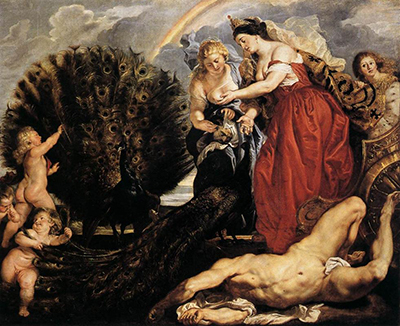
In Juno and Argus, Rubens makes a strange transformation the centre of a large mythological painting. The giant Argus lies headless across the foreground. Above him, Juno takes the eyes that once made him an all-seeing guard and sets them into the feathers of her peacock. Its dark tail spreads across the left side of the picture, already flecked with bright round markings. An attendant supports Argus's severed head, while small winged children occupy the edge of the scene. Rubens presents an aftermath: the killing is over, but the work of turning its victim into a lasting sign has begun.
The painting belongs to the Wallraf-Richartz-Museum in Cologne[1]. The museum dates it about 1610, identifies it as oil on canvas, and measures it at 249 × 296 centimetres. Its inventory number is WRM 1040. The size matters to the experience: Argus's stretched body is almost monumental, yet the viewer must also attend to the tiny eyes, narrow feather markings and interrupted gesture of Juno's hand.
The museum's description[1] calls the episode both bloody and almost solemn. That tension is visible in the way Rubens holds the body low and gives the gods and their attendants room to work above it. A violent death becomes an elaborate act of commemoration. The peacock's eyes will remain visible long after the guardian's own have ceased to see.
At a Glance
- ArtistPeter Paul Rubens [1]
- DateAbout 1610; documented by May 1611 [1][3]
- MediumOil on canvas [1]
- Dimensions249 × 296 cm [1]
- CollectionWallraf-Richartz-Museum, Cologne, WRM 1040 [1]
Where this work sits in Rubens's career
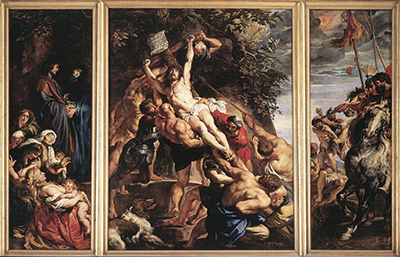
The Elevation of the Cross
1609–10Juno and Argus
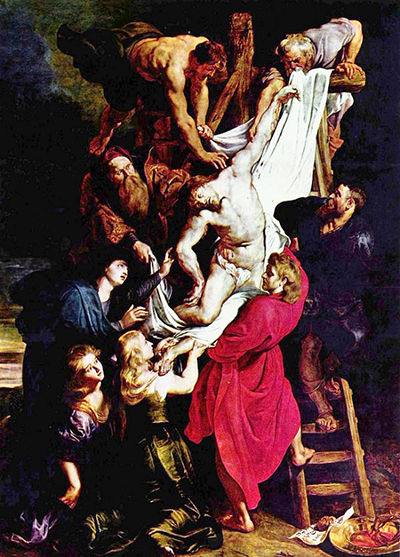
c. 1610The Descent from the Cross
1611–14The Garden of Love
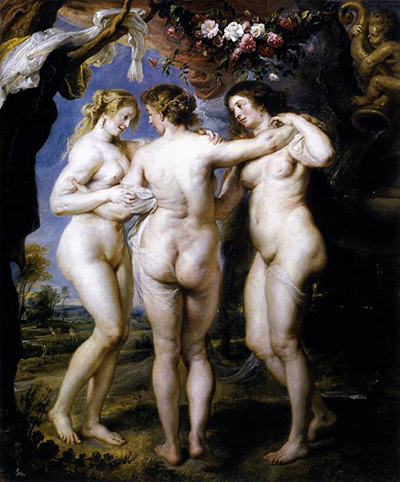
1630–35The Three Graces
1630–35Contents
- Why was Argus guarding Io?
- A scene arranged around sight
- What does the date tell us?
- How the picture travelled in print
Why was Argus guarding Io?
The story comes from Book I of Ovid's Metamorphoses. Jupiter desired Io, and she was changed into a heifer. Juno, Jupiter's wife, demanded the animal and placed it under the watch of Argus, whose hundred eyes could keep guard even while some slept. Jupiter sent Mercury to free Io. Mercury lulled Argus, then killed him. Juno rescued the eyes and fixed them in the tail of her bird. The University of Virginia's text of Ovid[2] and the Wallraf account[1] provide the narrative behind Rubens's selected moment.
Io, Jupiter and Mercury are absent from Rubens's scene. The viewer therefore sees the consequences of their actions without watching the deception and murder that caused them. Rubens has selected the point at which Juno responds to a loyal servant's death, rather than the confrontation between Mercury and Argus. The severed head and outstretched body tell us what happened. Juno's hands and the spread tail tell us what is still happening. That distinction prevents a common misreading of the painting as Mercury in the act of killing Argus.
The story also explains why the eyes matter beyond their unusual appearance. Argus's power was continuous vigilance. Once he is dead, that power cannot protect Io or serve Juno. The peacock carries its visible trace instead. The transfer is part memorial, part metamorphosis: something that belonged to a watchful body becomes a pattern on living feathers. Ovid tells the change in words; Rubens makes it a physical, almost painstaking process that a viewer can follow across the canvas.
A scene arranged around sight
The peacock at the left is nearly as arresting as the human figures. Its tail forms a broad dark fan, with scattered eye shapes waiting to be read as ornament. The headless Argus occupies the lower foreground. Between them, Juno and her attendant bring the human eyes into contact with the bird. The viewer's gaze travels along the same route as the story: from the inert body to the tiny, repeated marks that will survive it.
Rubens sets this close action inside a much larger theatre of colour. Juno's red garment dominates the centre-right, the bird's feathers offer blue and dark green, and the bright sky opens around a rainbow. The Wallraf's interpretation[1] connects the blue, yellow and red passages with the colours available to a painter and the rainbow with the spectrum of light. It calls the peacock eyes a symbol of sight. That is a museum reading of the composition, rather than a surviving declaration from Rubens that he intended a formal theory of colour.
The rainbow is especially effective because it is both part of the pictured sky and an invitation to think about looking. Its arch is visible at a distance; the painted eyes require the viewer to move closer. Rubens gives the painting two scales of vision. The large arc and standing figures organize a first glance, while the feather pattern and the handling of Argus's head slow it down. The myth of a watcher who failed to keep watch lets the painter show what a picture can hold for an attentive eye.
There is a historical debate behind this way of reading the canvas. Art historian Eveliina Juntunen connects its light, colour and watching eyes with Karel van Mander's writing on painting, published in 1604. A review of her study[7] notes that she challenges an older proposed connection with Franciscus Aguilonius's book on optics. The Wallraf's public interpretation likewise foregrounds sight and colour. These readings explain why Rubens's striking palette may be more than ornament, but they remain scholarly arguments. Neither the 1611 letter nor a known commission document says that Rubens meant the painting as an illustration of a particular treatise. The visible result can be described without treating a debated source as certain.
There is also a harder edge to the visual pleasure. The lush tail and brilliant clothing are made possible, in the story, by a death. Argus's body does not vanish when his eyes become decoration; it remains conspicuously stretched across the lower part of the scene. Rubens makes it difficult to treat the peacock simply as a pretty emblem. The viewer can admire its surface while being reminded where the marks came from.
What does the date tell us?
The Wallraf dates the canvas circa 1610, and a letter gives a firmer outer limit. On 11 May 1611, Rubens wrote to Jacques de Bie that an opportunity had arisen to sell his painting of Juno and Argus at a reasonable profit. He said he wanted to alert de Bie before concluding the sale. The letter is preserved in the Herzog August Bibliothek's edition of Rubens's correspondence[3]. Its postscript confirms that Rubens had a recognisable painting of this subject to offer by May 1611. It does not name a buyer or prove that the opportunity resulted in a completed sale.
This is a useful distinction because dates attached to paintings can look more exact than the documents warrant. “Around 1610” is the holding museum's artistic dating; May 1611 is a documentary boundary. The letter also tells us how Rubens dealt with a prospective transaction. He wrote to de Bie before closing it, suggesting a prior expectation or claim that he wished to respect. It would go beyond the words of the letter to name de Bie as the painting's commissioner or eventual owner.
The postscript is especially revealing when read alongside the rest of the same letter[3]. Rubens first explains why he cannot accept a young man whom de Bie has recommended for training: his workshop already attracts far more applicants than he can accommodate. He then turns to the Juno and Argus opportunity, saying that he hopes another work from his brush might eventually please de Bie and that he wants to inform him before concluding the proposed sale. The letter thus places this canvas in the ordinary pressures of an active studio and a network of personal obligations. It does not show a settled transfer. Even the phrase about another future painting signals that the picture's prospective buyer and de Bie's expectations should not be collapsed into one undocumented commission.
Nor should the possible sale be treated as evidence that Rubens disliked the subject. A painter could seek profit from a large, completed work and still value its design. The letter is a practical communication about a specific opportunity. It supplies a date, an intention to be courteous and an unrealised possibility in the surviving text; it does not supply the terms of the eventual transaction. The difference between what an artist explicitly wrote and what a later viewer infers from a painting is unusually clear in this case.
The large format makes the canvas a significant undertaking, but size alone cannot establish a commission. Rubens may have designed it for a patron, for a prospective sale or for display in a setting now unknown. The first secure facts are the museum's object identity and the artist's 1611 mention. The Wallraf record[1] then records its entry into the Cologne collection as a gift from local art lovers in 1894. The span between those points should not be filled with an invented continuous ownership story.
How the picture travelled in print
A related engraving shows that Rubens's invention did not remain confined to the original canvas. The Rijksmuseum holds a proof[4] of Juno Decorating her Peacocks with the Eyes of Argus by Magdalena van de Passe, catalogued as made in Utrecht between 1617 and 1634 after Rubens's design. It identifies the attendant holding Argus's head, his body at Juno's feet and three putti with peacock feathers. The print is a separate work on paper, not another state of the Cologne painting.
The proof is unusually informative because the Rijksmuseum compares it with a finished impression. Sketchy marks in the right background suggest that van de Passe considered adding figures there; in the final version she left a cloudy sky. This is an artist making choices while translating a painted composition into engraved lines. A later illustrated edition of Ovid used the print, according to the museum record. Those facts support an afterlife for the Juno and Argus design, while leaving open exactly when van de Passe saw the painting or which version of the print first circulated.
That illustrated Ovid belongs to a different kind of viewing from the Cologne canvas. A reader could encounter Juno, Argus and the peacock while following the poem in a book, with the engraved image guiding the story at a much smaller scale. The Rijksmuseum's publication record[5] lists the subject among images for an edition of the Metamorphoses. It demonstrates the design's use as an illustration, not that every book reader knew Rubens's original palette or that the painter supervised the later publication. The print's separate maker, format and context are part of its history.
The change of medium also clarifies what Rubens's colour contributes. An engraving can retain the action of Juno, Argus and the peacock, but cannot repeat the red garment, blue feathers and rainbow in the same way. It carries the narrative and figure arrangement into new hands; the Wallraf's interpretation of the original as an exercise in colour still depends on standing before the painting or a colour reproduction. Looking at both objects keeps the printmaker's work visible instead of treating the engraving as a transparent photograph of Rubens.
Another painter offered a separate answer to the same Ovidian episode. Hendrick Goltzius's Juno Receiving the Eyes of Argus from Mercury[8], signed and dated 1615, is now in Museum Boijmans Van Beuningen in Rotterdam. Its title identifies Mercury as the giver of the eyes; the museum describes him presenting them to Juno for the peacock. In the Cologne Rubens, Mercury is absent and Argus's body dominates the foreground. The comparison shows how much narrative emphasis can change while the subject remains recognisable. Juntunen suggests that Goltzius knew Rubens's composition, as summarised in the scholarly record[9]; the two paintings' shared subject and order of dates do not by themselves prove a direct borrowing. They are two distinct works in two distinct collections.
Rubens artworks directory
Frequently Asked Questions
It is in the Wallraf-Richartz-Museum & Fondation Corboud in Cologne, inventory WRM 1040.
Mercury killed him after being sent by Jupiter to free Io. Rubens shows the aftermath, when Juno takes Argus's eyes for her peacock.
In Ovid's story, Juno places the eyes of her dead guardian Argus in the bird's tail. Rubens paints that transfer as the central action.
The holding museum dates it about 1610. Rubens mentioned an opportunity to sell his Juno and Argus in a letter dated 11 May 1611, so the painting existed by then.
Discussion
Look closely at Juno's gesture, Argus's body and the peacock's tail.
Share an observation about the painting or a reliable source that adds to its history.
Reader Insights
How does Rubens turn the myth of many eyes into a scene about seeing?
What does the 1611 letter establish, and what does it leave unknown?
How does the related engraving change the emphasis of the painted scene?
Join the Conversation
Add your reading below, keeping observations specific and evidence clear.
References
- Wallraf-Richartz-Museum & Fondation Corboud, Juno and Argus , object and interpretation. View source
- Ovid, Metamorphoses , Book I, University of Virginia Electronic Text Center. View source
- Rubens to Jacques de Bie, 11 May 1611, in the Herzog August Bibliothek's digitised correspondence. View source
- Rijksmuseum, Magdalena van de Passe, Juno Decorating her Peacocks with the Eyes of Argus , proof RP-P-OB-16.069. View source
- Rijksmuseum, illustrated Metamorphoses publication record containing the Juno and Argus subject. View source
- Museen der Stadt Köln, Explain art to me: Juno and Argus. View source
- Historians of Netherlandish Art, review of Eveliina Juntunen's Juno and Argus study. View source
- Museum Boijmans Van Beuningen, Hendrick Goltzius, Juno Receiving the Eyes of Argus from Mercury (1615). View source
- OpenBibArt, bibliographic record and abstract for Juntunen's study. View source