 by Tom Gurney
Tom Gurney BSc (Hons) is an art history expert with over 20 years experience
Published on June 19, 2020 / Updated on October 14, 2026
Email: tomgurney1@gmail.com / Phone: +44 7429 011000
A procession held together by three bodies
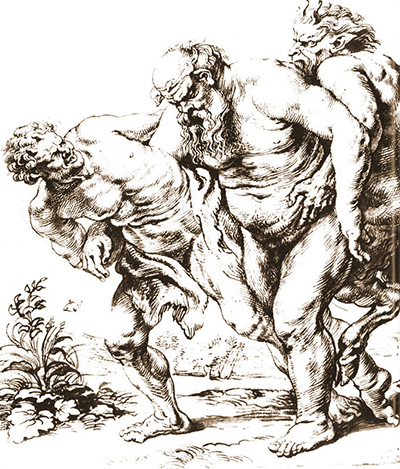
A large, bearded Silenus sways between two companions. One figure pulls away to the left while another helps carry the weight at the right. Their arms and torsos knot together, turning an uncertain walk into a single moving shape. This is the work pictured on the inherited “Silenus or Bacchus and Satyrs” route. It is a drawing, not an oil painting, and the Louvre[1] calls it La Marche de Silène, The March of Silenus.
The sheet is INV 20288 recto in the Louvre's Department of Graphic Arts. It measures 36.8 × 33.5 centimetres and uses pen and brown ink, wash and white heightening. The museum's current artist field reads “copy after Peter Paul Rubens.” Its commentary also says that Rubens made pen reworkings and some coloured heightening. That combination is crucial: the Louvre distinguishes the status of the underlying drawing from later interventions attributed to Rubens.
The museum does not give the sheet a specific creation date in the current object entry. A seventeenth-century source called it a Rubens drawing, and modern scholars have argued both for and against full autograph authorship. The page therefore uses the Louvre's present catalogue designation while explaining the debate. A confident “Rubens painted Silenus and Satyrs in 1616” would confuse object type, date and attribution at once.
At a Glance
- Catalogue roleCopy after Peter Paul Rubens; pen reworkings attributed to him [1]
- SubjectThe March of Silenus [1]
- DateUndated in the current Louvre record [1]
- MediumPen and brown ink, wash and white heightening on paper [1]
- Dimensions36.8 × 33.5 cm [1]
- CollectionMusée du Louvre, Department of Graphic Arts, INV 20288 recto [1]
Contents
- Who is Silenus?
- What kind of drawing is this?
- How does it relate to Jegher's woodcut?
- Did Rubens draw the whole sheet?
- Where did the drawing come from?
- What should this sheet not be confused with?
- How should the drawing be read today?
Who is Silenus?
Silenus belongs to the circle of Bacchus, the classical god associated with wine and revelry. In art he is often shown aged, heavy and supported by other figures after drinking. Here the central bearded man fills much of the sheet. His body appears strong but unstable: one foot advances while his upper mass leans on companions. The story is communicated by the difficulty of moving him.
The inherited route names “Bacchus and satyrs,” but the Louvre's specific subject is Silenus. That identification matters because Silenus is the person being carried through the scene, not merely an accessory to Bacchus. Other figures may be described as satyr and faun in related print catalogues. The National Gallery of Art's Jegher woodcut[2], for example, is titled Silenus Accompanied by a Satyr and a Faun. The Louvre's drawing title places the procession itself at the centre.
Nothing in the sheet requires a vast crowd or a landscape setting. A few plants, stones and marks of ground locate the group outdoors, but the bodies dominate. The left companion's bent posture pulls the eye downward; Silenus's beard and head bring it back up; the right figure's upright torso holds the composition at the edge. Even in a small website image, the sheet's main idea is clear: motion depends on support.
This subject offered an artist a chance to study balance and imbalance together. Silenus is not falling alone, because the others keep him upright. Their gestures are practical as well as expressive. Arms cross bodies, shoulders press together and feet try to find a place on the ground. The drawing is therefore both a mythological procession and a compact exercise in how several figures can behave as one moving unit.
What kind of drawing is this?
The Louvre lists pen and brown ink, wash, and white heightening. Pen lines set edges and details; wash creates broader passages of shadow; white accents lift selected forms from the paper. The sheet is neither a finished oil canvas nor simply a quick pencil outline. It has enough tonal structure to direct another maker towards light and dark in a print.
At 36.8 × 33.5 centimetres, it is close to square, with three near life-sized-in-miniature bodies packed tightly into the space. The brown lines can change from contour to texture. Hair, beard, flesh and ground are differentiated by strokes and washes rather than by full painted colour. The composition gives Silenus bulk through its broad centre while leaving small open areas around the legs and plants.
The Louvre says the drawing was made for a woodcut by Christoffel Jegher, with the design reversed in the print. That relationship is more specific than a loose resemblance between two Bacchic works. It identifies this sheet as part of a process of translating an image from drawing to carved block and then to printed paper. The visible sheet is one stage in a chain, not the final woodcut itself.
A drawing for a print has a different job from a spontaneous nature study. Its forms must survive transfer, carving and printing. Broad masses, legible contours and deliberate light-dark relationships help the central group remain readable after reversal. The Louvre's note about Rubens's pen reworkings suggests attention to this stage of preparation, although it does not mean every original line was his.
How does it relate to Jegher's woodcut?
Christoffel Jegher made woodcuts after Rubens's designs. The National Gallery of Art[2] holds a related impression, Silenus Accompanied by a Satyr and a Faun, dated 1635 in its record, woodcut on laid paper, 44.5 × 33.9 centimetres. It credits Jegher as the printmaker after Rubens. The print's own object number is 2001.103.1. These details belong to that impression, not to the Louvre drawing.
The NGA lists inscriptions cut into the block that credit Rubens with designing and publishing the work and Jegher with cutting it. A printed credit is valuable evidence for how the work was presented in its own time. It does not, by itself, settle whether every stroke of the surviving Louvre sheet was drawn by Rubens. Design authorship, woodblock cutting and the hand responsible for a particular preparatory copy are different questions.
The Metropolitan Museum of Art[3] catalogues another Jegher impression, titled The March of Silenus, as a woodcut after Rubens. Its record uses a different date, about 1652, for that particular print. Such variation is a reason to state dates with their institutional objects attached. Neither the NGA nor the Met print date can simply be copied onto the undated Louvre sheet.
The Louvre describes the Jegher woodcut as reversed relative to its drawing. Reversal is common when a design is transferred to a block: the printed image appears opposite the carving surface. Looking at sheet and print side by side can reveal the transformation, but a page showing only the sheet should avoid claiming that a specific line appears on a specific side of every surviving impression. The secure relationship is the one the Louvre states: this drawing is related to Jegher's reversed woodcut.
The Met's explanation of woodcut[4] describes the relief process: cutters remove areas that are to remain white, leaving raised surfaces to receive ink. That basic technique helps explain why line and contrast matter in a preparatory drawing. Jegher had to turn a lively tangle of bodies into a printable pattern. The Louvre sheet gives a view of the design before that final multiplication in ink.
Did Rubens draw the whole sheet?
The Louvre's current artist-role field says “copy after Rubens” and lists Rubens as an older attribution. In its commentary, the museum summarises a disagreement. Julius Held maintained Rubens's authorship in 1959, comparing the sheet with other designs connected to Jegher. The Louvre text says some details, including Silenus's heavy feet, appear weaker than in those comparanda; it reports that K. T. Parker had already rejected the attribution and that the 1978 Louvre exhibition catalogue did not retain it.
The same Louvre entry also records that Nico Van Hout supported attribution to Rubens in a 2004 exhibition catalogue. This is why it would be misleading to present a single, uncontested scholarly verdict. The catalogue's structured role provides the current practical label, while the prose preserves an active history of argument. Readers can understand both without being forced to decide from a low-resolution image alone.
The Louvre's commentary further says that Rubens made pen corrections and some colour highlights, as he often did. That statement adds a layered possibility: a drawing begun by another hand could still bear Rubens's intervention. It supports the careful caption “copy after Rubens, with reworkings attributed to him” better than either “fully autograph Rubens drawing” or “anonymous copy with no Rubens contact.” The page follows that distinction.
Attribution is not a contest in which an older inventory automatically wins. Everhard Jabach's seventeenth-century inventory called the sheet Rubens's. That is important evidence about how the drawing was valued and identified then. But the Louvre's modern examination weighs style and quality against that history. A historic name, a modern catalogue role and later scholarly proposals can coexist without being flattened into one claim.
The likely purpose of the sheet also does not settle its full authorship. Jegher's print is after a Rubens design, and Rubens may have corrected this preparatory drawing, while the first hand could still be debated. The most accurate public description gives each of those statements its own place.
Where did the drawing come from?
The Louvre traces the sheet to the collection of Everhard Jabach. It was purchased for the French king's cabinet in 1671. The museum identifies the Jabach mount, numbering and later collection marks as physical evidence of that passage. This history is unusually detailed for a drawing, and it helps explain how a working design survived long after the print was made.
Jabach's inventory described a Silenus with three full figures drawn in pen on washed paper and attributed it to Rubens. The Louvre connects that seventeenth-century description to the present sheet through the old mount and marks. It also records a later Musée Napoléon inventory that described Silenus supported by two satyrs and called the drawing pen-work with retouching. These documents show continuity of subject and collection even though the scholarly attribution has changed.
The sheet now belongs to the Louvre's Department of Graphic Arts, rather than to its painting collection. That distinction matters for readers arriving from an inherited site page that may once have treated every Rubens image as a painting. The Louvre record places it in the cabinet of drawings and gives the recto inventory number INV 20288. Its present public record describes consultation arrangements, not a permanent wall display that should be promised by a timeless article.
The provenance does not reveal the complete circumstances of production. The 1671 purchase proves a later collection history, not the exact date at which the design was drawn or who first held the pen. Keeping these kinds of evidence separate makes the object easier to understand.
What should this sheet not be confused with?
Rubens and his circle made many images of Silenus and Bacchic company. The Louvre drawing is the compact three-figure design associated with Jegher's woodcut. It is not a large oil painting of a drunken Silenus, nor the Jegher impression itself. The inherited “Bacchus and Satyrs” wording is broad enough to pull a reader towards other compositions, so the museum title and inventory number are essential here.
A separate National Gallery, London, Drunken Silenus Supported by Satyrs[5] is an oil painting with its own attribution and history. Its title sounds close, but a title alone cannot make it the same object. The Louvre sheet is on paper and was prepared in relation to a print; those facts set it apart from a gallery canvas.
The NGA's 2001.103.1 and the Met's 51.501.7695 are related woodcut impressions, not alternate inventory numbers for the Louvre drawing. The Louvre number INV 20288 recto remains the anchor for this page. The 1635 and circa 1652 dates on print records describe those institutions' impressions. The present Louvre entry supplies no firm date for the drawing, and this manuscript does not invent one.
How should the drawing be read today?
Start with the central Silenus, then follow the pressure of the two companions keeping him upright. Notice how legs, arms and weight create motion within a nearly square sheet. Look next at the pen lines, wash and white accents that turn bodies into a legible pattern. Those qualities made the design suitable for another craftsperson to translate into woodcut.
Then consider the object's layered authorship. The current Louvre catalogue calls the underlying drawing a copy after Rubens; its prose says Rubens made corrections and heightening, while recording scholars who continue to argue for full autograph status. The Jegher woodcut demonstrates the design's life in print. No single label can replace the distinction between original design, preparatory sheet, artist's reworking and printed impression.
The Louvre's title, The March of Silenus, makes the scene and its collection identity clear. The old route can remain a way to find it, but the page should leave readers with the right object in mind: an undated Louvre drawing, INV 20288 recto, connected to Rubens and to Jegher's woodcut through a carefully documented, still debated history.
Rubens artworks directory
Frequently Asked Questions
No. The object pictured is a drawing on paper in the Louvre's Department of Graphic Arts. Its current catalogue role is copy after Rubens, with pen reworkings and some heightening attributed to him.
The large bearded figure is Silenus, supported by companions as he moves in a procession associated with Bacchic mythology.
The Louvre identifies it as a design for a reversed woodcut by Christoffel Jegher. Surviving impressions are catalogued by the NGA and the Met as separate objects.
The current Louvre entry gives no specific creation date for the sheet. Dates attached to individual Jegher prints should not be assigned automatically to the drawing.
The Louvre records earlier Rubens attribution and later scholars who support it, but its current role calls the base sheet a copy after Rubens. Its commentary notes weaker details while also attributing some pen and colour reworkings to Rubens.
Discussion
Follow the three figures as they carry Silenus through the scene.
Share a close observation or a reliable source about Louvre INV 20288.
Reader Insights
How do pen line, wash and heightening prepare the design for print?
What separates the underlying drawing from Rubens's reported reworkings?
How does Jegher's reversed woodcut change the design?
Join the Conversation
Add your reading below, keeping the drawing and woodcut as distinct objects.
References
- Musée du Louvre, La Marche de Silène , INV 20288 recto. View source
- National Gallery of Art, Silenus Accompanied by a Satyr and a Faun , 2001.103.1. View source
- Metropolitan Museum of Art, The March of Silenus , 51.501.7695. View source
- Metropolitan Museum of Art, “Woodcut”. View source
- National Gallery, London, Drunken Silenus Supported by Satyrs. View source