 by Tom Gurney
Tom Gurney BSc (Hons) is an art history expert with over 20 years experience
Published on June 19, 2020 / Updated on October 14, 2026
Email: tomgurney1@gmail.com / Phone: +44 7429 011000
A smile on a sheet of paper
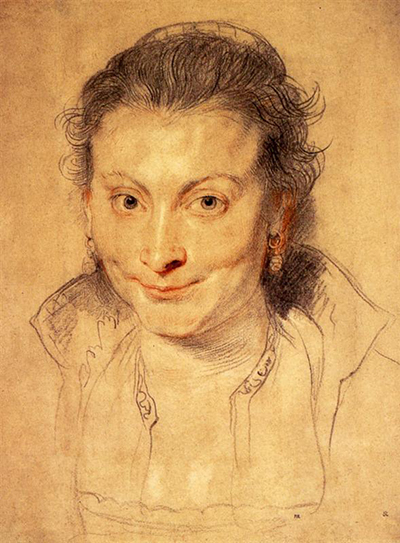
Isabella Brant faces us with an expression that seems about to change. Her lips lift slightly, one cheek tightens, and her eyes are alert. Rubens has drawn her hair away from her forehead and gathered it behind her head; small drop earrings remain visible. The outline of her clothing is much looser than the face. The British Museum’s drawing[1] brings a family member close without turning her into a formal, full-length sitter.
The museum identifies the woman as Isabella Brant, Rubens’s first wife. Its object number is 1893,0731.21. The recto measures 38.1 × 29.4 centimetres, on light grey-brown paper. It combines black and red chalk, some brown wash, and white heightening. The museum’s structured production field dates the front to about 1620–21, while its description says about 1621–22. “Around 1621” conveys the shared centre of those estimates without presenting a day or single year that the object record cannot support.
The reproduction here shows the front of the sheet. Its warm tones and uneven lines help identify the object, although a compressed photograph cannot tell us everything about chalk particles, wash, paper fibres or changes visible under close examination. The museum record, rather than the old file name, governs the sitter’s spelling, materials and dating. The sheet also has a drawing on its reverse. That second image belongs to a different moment in Rubens’s family life and should not be mistaken for part of the portrait we see here.
At a Glance
- ArtistPeter Paul Rubens [1]
- SitterIsabella Brant [1]
- DateAbout 1621 (recto) [1]
- MediumBlack and red chalk, brown wash, white heightening [1]
- Dimensions38.1 × 29.4 cm [1]
- CollectionBritish Museum, 1893,0731.21 [1]
- Image scopeRecto only; later family study on verso [1]
Where this work sits in Rubens's career
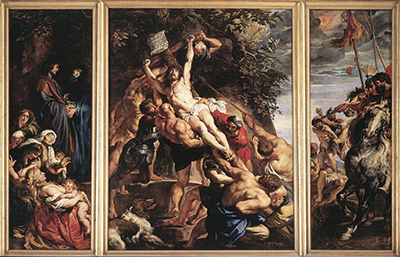
The Elevation of the Cross
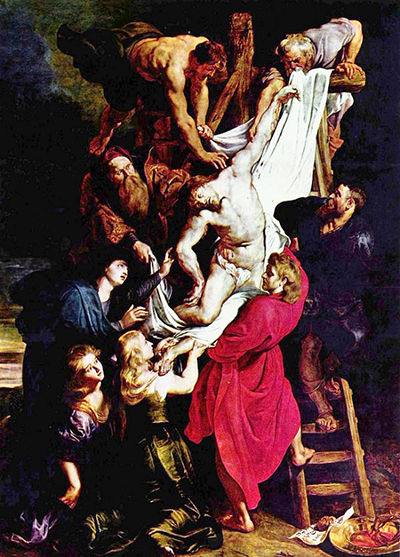
1609–10The Descent from the Cross
1611–14Portrait of Isabella Brant
c. 1621The Garden of Love
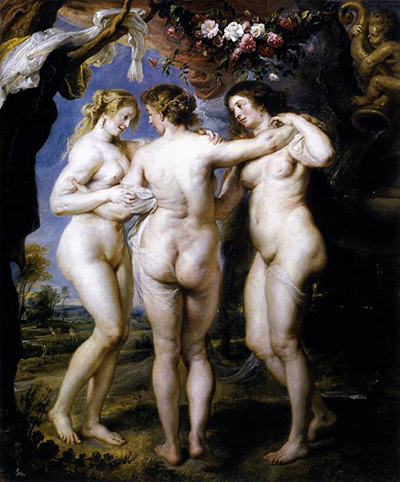
1630–35The Three Graces
1630–35Contents
- How did Rubens build the face?
- Isabella and the family portraits
- What is on the reverse?
- From a private sheet to the British Museum
How did Rubens build the face?
The drawing gives the face more finish than the shoulders and dress. Across the forehead and around the eyes, dark marks describe form without a hard painted outline. Light catches the nose and upper cheek; touches of red chalk bring warmth to the skin. The white highlights matter because the paper itself is not white. Rubens could use the coloured ground as an intermediate tone, then add lighter and darker marks where he needed them. The British Museum describes this mixture as a favoured method of his portrait drawing.
Notice how Isabella’s gaze meets ours while the head turns only a little. The near symmetry lets a small difference at the mouth become expressive. The earring, hair and ruff give enough information to place the head in a living body, but they do not compete with the face. Below the neckline, lines separate into open strokes and the costume is less firmly resolved. This shift in finish is visible evidence of the artist’s emphasis. It does not prove how long Isabella sat or whether Rubens intended the sheet to remain in the household.
The museum’s curator’s comments[1] call it one of Rubens’s most striking portrait studies and suggest it might be understood as an independent work. That is a useful caution about the word study. A drawing need not be a mere incomplete step toward an oil painting. Its directness and selective detail can be its own artistic result. The same museum also states that no painting directly corresponds to this sheet. Parallels with other likenesses are therefore relationships to explain, not evidence of a single confirmed commission for which this drawing was made.
Isabella and the family portraits
Rubens and Isabella married in 1609, and she appears elsewhere in his art. The Munich painting of the couple together[2], often called the Honeysuckle Bower, belongs near the beginning of their marriage. The British Museum drawing is later and concentrates on Isabella alone. It offers neither the couple’s paired hands nor the setting and dress that help the Munich painting speak publicly about marriage. Here the viewer’s attention stays with her face and Rubens’s working marks.
The British Museum[1] notes parallels between this drawing and Rubens paintings in Cleveland and the Uffizi. It also finds especially close similarities with Anthony van Dyck’s portrait of Isabella in Washington, painted before Van Dyck left for Italy in 1621. Those links help explain why the sheet has attracted attention: Isabella’s likeness moved among drawings and paintings made in Rubens’s circle. They do not make the British Museum recto identical to any of those works. Each has its own support, scale, history and interpretation.
An older British Museum exhibition catalogue, quoted in the current online entry, argues more strongly that this drawing served as a model for the Cleveland painting and that Van Dyck made use of it. The current curator’s comment is more measured, saying there is no directly corresponding painting and describing parallels instead. The current museum interpretation leaves those relationships open. A likeness may be visually related to another without a surviving document showing exactly when and how one artist used the sheet. Likewise, the Berlin panel[3] on the separate /isabella-brandt-first-wife/ page is a different object with an uncertain sitter identification and later enlargement. Its properties do not describe this drawing.
The comparison becomes clearer when the other collections' own records are read. The Cleveland Museum of Art[4] dates its Portrait of Isabella Brant to about 1620–25 and identifies it as a small oil painting on wood, 53 × 46 centimetres unframed, accession 1947.207. It notes that Rubens painted Isabella's face first and added hands later. Those additions mark a change within the Cleveland panel's making; they are not changes to the chalk drawing in London. The sitter's expression invites comparison, but one object is a worked oil portrait and the other a sheet with a drawn face on one side and a later family sketch on the other.
The National Gallery of Art in Washington[5] records its larger Isabella Brant as a 1621 Van Dyck oil canvas, 153 × 120 centimetres, accession 1937.1.47. Its entry proposes that Van Dyck probably based the portrait on a likeness Rubens drew around 1620 and that it may have been a gift to Rubens before Van Dyck left Antwerp for Italy. These are carefully worded historical proposals, useful alongside the British Museum's visual comparison. The Washington canvas gives Isabella a chair, curtain, rich dress and architectural setting, making a public portrait out of a face that remains close and mobile in the London drawing. Similarity does not turn the Van Dyck canvas into a painting by Rubens.
That last distinction once required a correction. Washington's museum notes that its canvas entered Catherine II's collection in 1772 as a Rubens. It was later recognised as Van Dyck's work, although debate continued, and the gallery made the reattribution final in 1976. This history shows why artist names in older books and inventories need checking against current holding records. It also explains how easily three portraits of the same woman can become confused: the British Museum has a Rubens drawing, Cleveland a Rubens panel, and Washington a Van Dyck canvas whose earlier attribution was different. Their dates overlap, but each object's material and documented history remain separate.
Isabella died in 1626. The image on the front of this sheet predates that loss by several years, according to the museum’s dating. It is tempting to read the smile as a premonition of tragedy or the later drawing on the back as a deliberate memorial response. Neither reading is established by the object record. This is a likeness made while Isabella lived. The paper’s later use shows that Rubens retained and worked with the sheet after her death, but it does not tell us what he felt at each stroke.
What is on the reverse?
When conservators lifted the sheet from a mount in 1964, they revealed a second drawing on the reverse. The British Museum identifies it as a loosely sketched self-portrait with Helena Fourment and a child, dated about 1635. The reverse uses black and red chalk but is much freer than Isabella’s carefully modelled face. The museum relates it to a family portrait now in the Metropolitan Museum of Art, New York. It is best understood as a later use of the same physical sheet, not as a picture made at the same sitting as the front.
The two sides bridge two periods of Rubens’s family life. Isabella was his first wife; Helena became his second wife years after Isabella’s death. On the front, a single face commands a measured, affectionate attention. On the back, figures are placed together more rapidly. These contrasts can be seen and described without claiming that Rubens planned a symbolic pair of pictures. The reuse of a sheet may be practical; it can also show that the drawing stayed accessible in the studio. The museum suggests Rubens kept family drawings for personal enjoyment and cites his wish that they remain with his children. The physical object gives unusually concrete access to those changing household circumstances.
The reverse is easy to omit because most reproductions, including the front-side image here, show only Isabella. Mentioning it changes how we understand the front. We are looking at one face of an object that remained in Rubens’s possession for years. It was not simply a portrait extracted from family life and placed in a museum immediately after being drawn. At the same time, the reverse’s date and subject should remain clearly labelled. A reader should not be led to believe Helena or the later child appears in the visible Isabella image.
The Metropolitan Museum of Art's related family painting[6] is another distinct object. It catalogues Rubens, Helena Fourment, and Their Son Frans at about 1635, as oil on wood, accession 1981.238. The family appear in an idealised garden linked to Rubens's Antwerp home. The British Museum's loose reverse sketch can be understood beside that painted grouping, but the finished panel has its own scale, support and setting. The two works help place the later marks on the back of Isabella's drawing in a new family period without making them a deliberate reply to the front. That difference between a plausible working relationship and an invented private message is part of reading a reused sheet responsibly.
From a private sheet to the British Museum
The British Museum’s provenance[1] records several later collectors, including Prosper Henry Lankrink, Sir James Thornhill, Jonathan Richardson, the Earl Spencer, and Robert Stayner Holford. It includes a Richardson annotation, formerly on a strip of paper attached to the verso, stating that Thornhill gave him the sheet in October 1724. Such collector notes document parts of the drawing’s later circulation; they should not be confused with a seventeenth-century statement by Rubens about its original purpose.
The museum purchased the drawing in 1893 after the Holford collection was sold. A sheet that could once be handled and turned over in a studio or collector’s room is now a museum object with a registration number and conservation history. Its acquisition and later remounting explain why scholars can discuss both sides today. They do not remove the uncertainty over the initial reason for drawing Isabella’s head. The evidence is unusually rich for a family drawing, yet its earliest function remains open.
This page is about the British Museum chalk drawing, not every portrait of Isabella Brant. Rubens represented her in different formats across their marriage, and related paintings can provide context. The strongest way to read this sheet is to stay close to its specific marks, date range and double-sided history. The smile is visible. The exact exchange between sitter and artist is not recorded.
Rubens artworks directory
Frequently Asked Questions
She was Peter Paul Rubens’s first wife, identified by the British Museum as the sitter on the front of this sheet.
The museum dates the recto to around 1621. Its online fields vary between about 1620–21 and about 1621–22, so a precise year would overstate the evidence.
The British Museum says no painting directly corresponds to it, while noting parallels with portraits in Cleveland, Florence and Washington. Its possible independent status remains part of the drawing’s interest.
The reverse shows Rubens with his later wife Helena Fourment and a child, in a looser drawing dated about 1635. It is not shown in the front-side image here.
The drawing is in the British Museum, registration 1893,0731.21.
Discussion
Look closely at Rubens's treatment of Isabella Brant's face.
Share an observation about the drawing or a reliable source that adds to its history.
Reader Insights
How do chalk and white heightening shape her expression?
What changes when the reverse is considered?
Why is the sheet not tied securely to one painting?
Join the Conversation
Add your reading below, keeping observations specific and evidence clear.
References
- British Museum, Rubens, Portrait of Isabella Brant , 1893,0731.21. View source
- Bayerische Staatsgemäldesammlungen, Rubens and Isabella Brant in the Honeysuckle Bower. View source
- Berlin Gemäldegalerie, Rubens, Portrait of a Woman , 762A. View source
- Cleveland Museum of Art, Rubens, Portrait of Isabella Brant , 1947.207. View source
- National Gallery of Art, Van Dyck, Isabella Brant , 1937.1.47. View source
- Metropolitan Museum of Art, Rubens, Rubens, Helena Fourment, and Their Son Frans , 1981.238. View source