 by Tom Gurney
Tom Gurney BSc (Hons) is an art history expert with over 20 years experience
Published on June 19, 2020 / Updated on October 14, 2026
Email: tomgurney1@gmail.com / Phone: +44 7429 011000
Finding Daniel among the lions
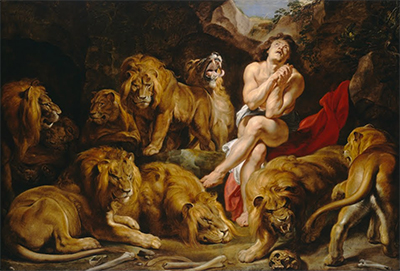
Peter Paul Rubens places Daniel slightly to the right of the centre of a vast, dark cave. He sits on a rock with his hands clasped, his head tilted toward the small opening above. Light catches his face and bare chest. The lions occupy most of the space around him: some rest, others move or stare, and one bares its teeth. Rubens makes the danger immediate without painting an attack. Daniel is close enough to the animals for their size and weight to register, yet the figures remain suspended in a tense interval.
The National Gallery of Art[2] in Washington dates the oil-on-canvas picture about 1614–16. It measures 224.2 × 330.5 centimetres and has accession number 1965.13.1. Its width lets the cave spread out on both sides of Daniel, so that the viewer must look through the group of animals to find the human figure. The painting's scale also makes the lions feel nearly present in the viewer's space. This is a specific work in the National Gallery's collection, not a generic illustration of a familiar Bible scene.
At a Glance
- ArtistPeter Paul Rubens [1]
- DateAbout 1614–16 [1]
- MediumOil on canvas [1]
- Dimensions224.2 × 330.5 cm [1]
- CollectionNational Gallery of Art, Washington, 1965.13.1 [1]
Where this work sits in Rubens's career
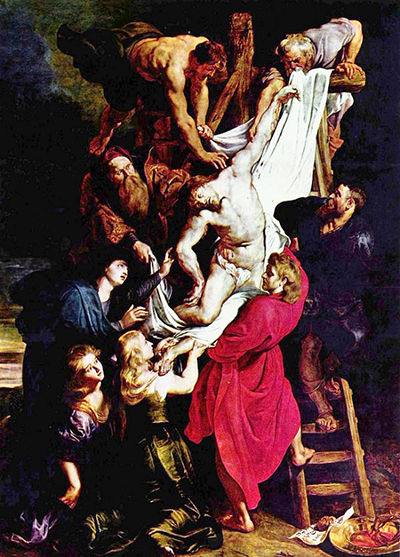
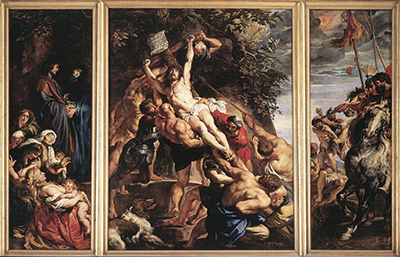
The Elevation of the Cross
1609–10The Descent from the Cross
1611–14Daniel in the Lions' Den
c. 1614–16The Garden of Love
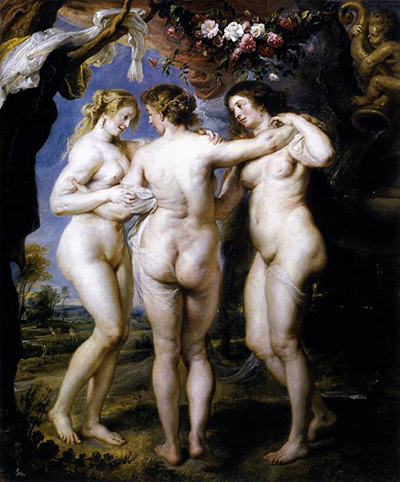
1630–35The Three Graces
1630–35Contents
- What is the story?
- Nine different lions
- Observation and invention
- Rubens's own account and the painting's travels
- From Whitehall to Washington
What is the story?
The subject comes from the Book of Daniel, chapter 6. Daniel is condemned to spend the night in a den of lions because he continues to pray to his God despite a royal prohibition. He survives; in the biblical account, an angel shuts the animals' mouths. Rubens pictures the den itself, with Daniel praying amid the lions and light entering through an opening. The viewer can see his trust and his danger at the same time. The National Gallery's object interpretation[2] reads the light as a likely sign of faith and communication with God. “Likely” matters: it is the museum's reading of Rubens's arrangement, not a written explanation left by the artist.
The painting does not need a precise minute assigned to it. One National Gallery account describes the suspense before Daniel's rescue, while another educational essay[5] associates the scene with the following morning. The visible evidence supports a careful description: Daniel is alive, praying and surrounded by lions in a cave open to the sky. It does not show the king at the entrance or the angel as a separate painted figure. Keeping the moment open allows the picture's central tension—danger beside survival—to remain clear.
The narrative in Daniel 6[1] gives that uncertainty a dramatic structure. Daniel's political rivals cannot find corruption in his work, so they persuade Darius to forbid prayer to anyone but the king for thirty days. Daniel continues to pray and is condemned under the decree. Darius tries to save him, then has the den closed and sealed; the king spends a sleepless night and returns at daybreak to ask whether Daniel has survived. Daniel answers that God sent an angel to shut the lions' mouths. Rubens omits the rivals, king, sealed stone and visible angel. The painting places the viewer inside the moment of danger that the written story approaches from outside. Because the lions are still close, Daniel's survival does not look effortless even if the biblical ending is known.
The biblical chapter also cautions against treating the den as simply a test of physical courage. Daniel has been punished for continuing a habitual act of prayer despite a political prohibition. His clasped hands and raised gaze therefore carry the reason he was put among the lions, as well as his plea for rescue. The shaft of light directs attention to that act. The painting does not spell out the legal intrigue, but the text makes clear why a solitary praying figure could stand at the centre of a scene full of animals.
Nine different lions
The Gallery's current visual description[2] counts nine lions: seven male and two female. That count helps when looking across the crowded canvas. The animals do not form a repeated pattern. A lion near Daniel throws back its head and opens its mouth; other cats lie with heavy paws on the ground, turn toward one another, or watch from the darker edges. The variety holds the viewer's attention on the animals even while Daniel's lit body draws the eye upward.
Some older National Gallery educational material says ten lions, but the museum's current object description and verbal tour both say nine. This account follows the current object record and avoids building an interpretation around an uncertain extra animal. The difference is also a reminder that a crowded painting can be surprisingly hard to inventory by casual glance. The sex count is the holding museum's catalogue description, not an independent diagnosis from a small reproduction.
The lion nearest Daniel's left side becomes a visual hinge between the quiet figure and the animals in the foreground. Toward the bottom of the painting, bones and a skull give the den a history of danger. The cats' bodies fill the horizontal space, while the rocky vault encloses them. Daniel's upright upper body and raised face form a counter-movement to their low, prowling positions. This contrast lets Rubens make prayer visible without turning it into a detached emblem: Daniel is still physically in the den.
Observation and invention
Rubens studied living lions, and the National Gallery connects this painting with opportunities to observe animals at the royal menagerie in Brussels. Its audio discussion[2] invites a zoo curator to comment on the cats' bodies and behaviour. Observation was one source of the picture's animals, though it does not mean that all nine were seen together in the poses Rubens painted.
The realism of the lions has a theatrical purpose. Their differing expressions and positions make it possible to believe that one could spring while another sleeps. Their fur and weight contrast with Daniel's smooth, illuminated body. The Gallery's close-looking notes[2] set his idealised anatomy alongside Rubens's study of ancient sculpture. Observed animals and a classically shaped human figure thus serve the same drama. Both are convincing enough to carry the story, though neither is presented as a neutral record of a real cave.
The National Gallery's audio account[2] includes observations by Craig Saffoe, a curator of great cats at the Smithsonian's National Zoo. He singles out the lower-right pair baring teeth at one another, a lion yawning farther back, a watchful animal below it and another fully asleep. He cautions that teeth-baring between lions need not be an attack; it might be a normal interaction over scraps. That distinction sharpens rather than weakens the picture's suspense. The animals remain capable of violence, but Rubens has given them varied behaviour instead of one repeated expression of rage.
The NGA chalk Lion[4] gives a more intimate view of Rubens's attention to an animal. Black chalk builds a standing male lion's mass, and touches of white pick out the eye, nose, mouth and mane. An eighteenth-century inscription on the back claims the sheet served for the Daniel subject. That is valuable evidence of a historical association, but it is a later inscription and cannot by itself prove where or how Rubens used the sheet. The painting's animals occupy different poses and roles; a single drawing is not a map for all nine.
The Prado's catalogue for Two Lions and a Lioness[7] identifies three animals that recur in the Washington painting. The Prado attributes its later oil canvas, about 1620, to Frans Snyders; it is not a preparatory drawing by Rubens. Its account says one lioness was adapted from Rubens's drawings after Renaissance bronze figures. This is a useful check on the phrase “from life” in Rubens's 1618 letter: direct observation could contribute to some animals while a studied work of art supplied a pose for another. The repeated forms also show how animal models could circulate between Rubens and painters close to him without making the Prado canvas the source of the Washington picture.
The Morgan Library & Museum[10] holds a separate Study of a Sleeping Lion, dated about 1614–15 in its current drawing record. The black and white chalk sheet is about 25 × 42 centimetres. Morgan connects it with the Washington Daniel and with Rubens's Saint Jerome in Dresden, so the same animal study should not be described as uniquely made for the den. Its sleeping pose also reminds us that suspense in the painting depends on a range of animal states, from rest to threat. The drawing's separate identity matters: it is evidence of a working repertory of lion forms, not another view of the finished canvas.
Daniel himself has a much more direct preparatory sheet. Morgan's Seated Male Youth[9], dated about 1613, is a large black-chalk drawing heightened with white, roughly 50 × 30 centimetres. Its hands, legs and tilted head closely anticipate the praying man in Washington. Morgan interprets the small differences as a sign that Rubens made the drawing late in his preparation, probably using a live model. Its catalogue also proposes that he drew on Girolamo Muziano's Penitent Saint Jerome and the antique Dying Alexander for the pose and expression. Those are scholarly comparisons, not a claim that Daniel is a portrait of the model or that one antique supplied every detail. Beside the separate lion studies, this sheet makes the painting's construction visible: Rubens worked out the human figure and individual animals before binding them into a single cave scene.
Light is the other means by which Rubens organises the crowd. The narrow opening above Daniel gives the eye a place to travel; his raised face and clasped hands follow it. Scarlet fabric beneath and beside him introduces a strong colour accent within the brown cave. Because the painting is so wide, this concentration of light and red keeps Daniel from disappearing among the animals. The light can be read devotionally, as the Gallery suggests, but it also solves a visual problem: how to make one praying man the centre of a picture dominated by lions.
Rubens's own account and the painting's travels
In a list sent to Sir Dudley Carleton in April 1618, Rubens described a Daniel among lions as painted from life and entirely by his hand. The list formed part of negotiations in which he offered paintings in exchange for antiquities. The National Gallery's provenance[2] says Carleton acquired the painting from Rubens that year. The artist's words are useful evidence for how he presented its authorship, while the current museum record supplies the surviving object's date, material and identity. “From life” should be read as Rubens's statement about his practice, not as proof that Daniel or the entire cave was observed as a scene.
Carleton later presented the painting to Charles I. The Gallery's record places it in the royal collection between about 1625 and 1632 and then traces it through the Hamilton family, sales and later owners before its acquisition for Washington in 1965. That path explains why a Flemish biblical painting could pass through English royal and Scottish aristocratic collections before entering an American public museum. It should not be compressed into a claim that Rubens painted the work for Charles I: the Gallery documents its first transfer to Carleton, and a later gift to the king.
From Whitehall to Washington
The National Gallery's provenance record[2] places the canvas in the Bear Gallery at Whitehall during Charles I's ownership. That is a more specific location than simply “in the royal collection.” The same record traces it to Hamilton Palace in Scotland by 1643, through later Hamilton sales and repurchases, and then into the Cowdray family before the 1960s. The painting's survival through those moves is part of its object history, although its changing rooms should not be confused with its first destination in Rubens's studio.
One late episode shows how an attribution can change during circulation. The NGA records that a 1963 Bonhams catalogue listed the painting as by Jordaens and De Vos before it was withdrawn and sold privately. Washington acquired it in December 1965 as Rubens. This is a documented change in cataloguing, not evidence that today's Gallery regards the painting as a collaborative work by those two artists. The early Carleton transaction and Rubens's own description are particularly important when judging the identity of the work now in Washington.
The sequence also changes what the title can imply. Daniel in the Lions' Den might suggest a picture made for a church, yet the earliest transfer recorded here is a negotiated exchange with an English diplomat, followed by royal and aristocratic ownership. Its subject remained devotional, but its documented early audience was not the congregation of a named church. That combination helps explain the painting's unusual blend of biblical danger, learned figure design and almost life-size animal study without inventing a missing commission.
Rachel Aviva Pollack's University of Maryland dissertation[8] asks what the painting meant once it was in those collections. Working from a seventeenth-century inventory by Abraham van der Doort, she reconstructs its place in Whitehall's Bear Gallery and proposes that Charles I displayed it in a royal setting where lions could carry heraldic and political associations. She also considers its proximity to Rubens's Peace and War, made during the artist's diplomatic visit to London. Those are interpretations of a documented later display, not evidence that Rubens designed Daniel as a royal commission years earlier. The distinction matters because the painting changed owners and audiences without changing its biblical subject.
Pollack also explores possible antique sources for Daniel's pose and for individual lions. Her proposed parallels show how the painting can be read through classical sculpture as well as observation of animals. The National Gallery's own account[2] likewise sets Daniel's idealised body beside ancient sculpture. These comparisons are best used to explain Rubens's available visual language, not to assert that one antique object supplies a complete key to every form in the canvas.
The public record of the canvas also predates its arrival in Washington. The National Gallery's exhibition history[2] records it at the Royal Academy's London Old Masters exhibition in 1873 and at the New Gallery's Flemish and British painting exhibition in 1899–1900. Those appearances do not fill the painting's early ownership gaps, but they show that it was displayed beyond private rooms while still in British collections. Its later appearance in the 2019–20 Early Rubens exhibition, which travelled from San Francisco to Toronto, placed the finished painting in dialogue with the artist's early development for a new public audience. These dated displays are distinct from the painting's movements between owners: an exhibition loan documents a temporary viewing context, not a sale.
Rubens artworks directory
Frequently Asked Questions
The National Gallery of Art's current object description counts nine, seven male and two female. An older museum teaching publication gives a different number; this page follows the current object record.
The Gallery dates it about 1614–16. Rubens included a Daniel among lions in his April 1618 offer to Sir Dudley Carleton, giving a later documentary point in the painting's history.
He is alive and praying among the animals. The painting does not show the angel, the king or the moment he leaves the den. Museum interpretations differ on the precise point of the story depicted.
It is in the National Gallery of Art, Washington, accession 1965.13.1.
Discussion
Look closely at how Rubens places one praying figure among many different lions.
Share an observation about the painting or a reliable source that adds to its history.
Reader Insights
How does light help you find Daniel in the broad, crowded cave?
Which lion looks most alert to you, and what makes its pose different?
What can the painting show about the biblical story without fixing an exact moment?
Join the Conversation
Add your reading below, keeping observations specific and evidence clear.
References
- United States Conference of Catholic Bishops, Daniel 6, the story of the decree, den and rescue. View source
- National Gallery of Art, Daniel in the Lions' Den , object record, visual description and provenance. View source
- National Gallery of Art, verbal description of the painting. View source
- National Gallery of Art, Lion , drawing, 1969.7.1. View source
- National Gallery of Art, Quiet Heroes & Heroines , educational account. View source
- Max Rooses, ed., Correspondance de Rubens , vol. 2, letter CLXVI, Herzog August Bibliothek digitisation. View source
- Museo del Prado, Two Lions and a Lioness , later canvas attributed to Frans Snyders with repeated Rubens animal forms. View source
- Rachel Aviva Pollack, Peter Paul Rubens' Daniel in the Lions' Den: Its Sources and Its Political Significance , University of Maryland, 2015. View source
- Morgan Library & Museum, Rubens, Seated Male Youth , study for Daniel. View source
- Morgan Library & Museum, Rubens, Study of a Sleeping Lion. View source