 by Tom Gurney
Tom Gurney BSc (Hons) is an art history expert with over 20 years experience
Published on June 19, 2020 / Updated on October 14, 2026
Email: tomgurney1@gmail.com / Phone: +44 7429 011000
A severed head that still seems alive
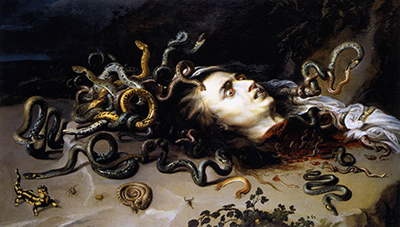
The head of Medusa lies on a low surface in this painting at the Kunsthistorisches Museum, Vienna. Her face is pale against a dark background, and her eyes remain open. Snakes coil through her hair and spill outward over the ground. Smaller creatures gather near them. Although the head has been cut from the body, movement continues all around it. The contrast between the still face and the active animals makes the viewer hesitate between looking at a dead figure and watching a scene that has not stopped changing.
The Vienna painting is oil on canvas, 68.5 × 118 centimetres, inventory GG 3834. A Kunsthistorisches Museum exhibition[1] credits it to Peter Paul Rubens and workshop and says the snakes were contributed by the animal painter Frans Snyders. That is a more careful attribution than simply printing Rubens's name as if every part were his alone. The museum's current collection album[8] gives around 1613; its 2022–23 exhibition gave 1612/13, while an English programme page[2] and 2017 materials retain 1617/18. The safest concise dating is within the 1610s, with the difference made visible rather than hidden.
The image is wide and low. Medusa's head occupies the middle; the serpents extend the action to both sides. A dark upper band makes the white face stand out, while the foreground holds twisting bodies, glossy scales and small living creatures. The composition's pressure comes from the fact that the danger is not confined to her gaze. It has multiplied into the animals, which seem able to cross the edge of the picture.
At a Glance
- ArtistsPeter Paul Rubens and workshop; snakes attributed to Frans Snyders [1]
- Date1610s; KHM records include about 1613 and 1617/18 [1][2]
- MediumOil on canvas [1]
- Dimensions68.5 × 118 cm [1]
- CollectionKunsthistorisches Museum, Vienna, GG 3834 [1]
Where this work sits in Rubens's career
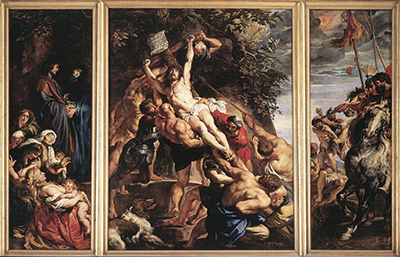
The Elevation of the Cross
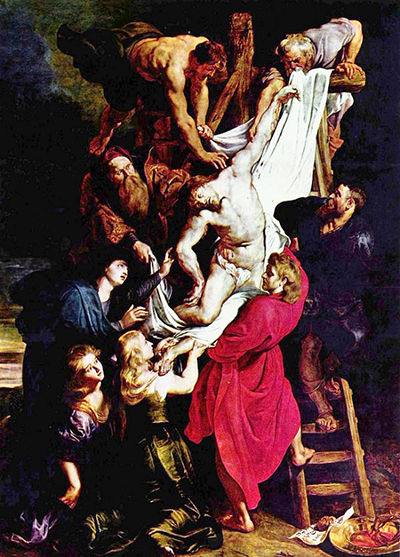
1609–10The Descent from the Cross
1611–14The Head of Medusa
1610sThe Garden of Love
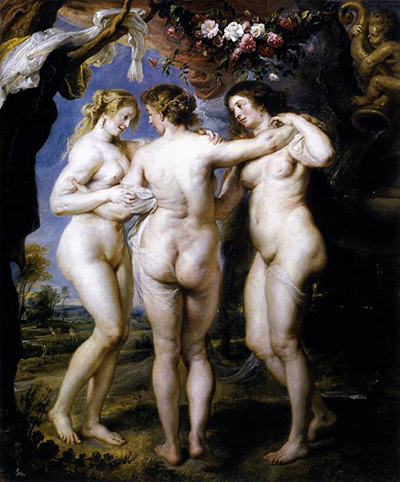
1630–35The Three Graces
1630–35Contents
- Who was Medusa, and what moment is shown?
- Why are Rubens and Frans Snyders both involved?
- Why do museum dates differ?
- A painting meant to unsettle
Who was Medusa, and what moment is shown?
In the Greek myth, Medusa was a Gorgon whose gaze could turn others to stone. Perseus killed her by cutting off her head. The KHM's account[2] places the painting after that act and connects the spreading snakes to the blood from the severed head. Perseus himself is not visible here. Rubens and his collaborators choose the aftermath, bringing the viewer close to the object that made the hero's task dangerous.
The myth has a history before the beheading. In Gruber and Tomášek's KHM study[4], the authors point to Ovid's account in which Neptune assaults Medusa in Minerva's temple and Minerva changes Medusa's admired hair into snakes. Ovid also describes Perseus avoiding her direct gaze by using his shield as a mirror. The Vienna painting shows neither the assault nor that heroic stratagem. The transformed hair and severed head are what remain, and the absent Perseus leaves the viewer without the myth's protective intermediary. Those narrative omissions matter when calling this simply a picture of a monster defeated by a hero.
That choice changes the usual shape of a heroic story. There is no triumphant figure holding a trophy, no battle scene and no safe distance between the viewer and Medusa. Her open eyes draw attention even though the myth says her gaze was deadly. The painting turns the head toward us and places the serpents in our space. It asks us to look at what the hero could hardly face directly.
The visible creatures are not just a pattern of decorative curves. Some snakes loop back on themselves; others stretch outward. Their different surfaces catch small flashes of light. A reptile at the lower edge and other tiny animals make the ground feel populated. The scene appears to continue after Medusa's death. KHM's later interpretation also suggests that viewers in Rubens's period could read the image politically or allegorically as reason overcoming enemies of virtue. That is an account of possible reception, not a known original commission or a single meaning written by Rubens onto the canvas.
The head had a protective history as an image. Ancient and later makers placed Medusa on shields or armour so that a face capable of petrifying an enemy could also repel danger. Woollett calls this an apotropaic use: an intimidating image meant to ward off evil. She notes that early modern writers also read the Gorgon's head through reason, virtue and sensuality, though their moral explanations differed. The Vienna painting holds those associations in reserve. It lies horizontally in an outdoor setting, rather than facing forward as a shield emblem. The viewer meets a severed body and its proliferating creatures before finding a neat symbol of victory. Woollett's Getty catalogue discussion[10], pp. 182–83, presents the contrast without claiming a known original programme.
The animals also give the myth a less familiar focus. In a study of Rubens's images of spontaneous generation[9], art historian Marisa Mandabach connects the serpents to the ancient account in Lucan: drops from Medusa's head fall to the earth as Perseus travels over Libya and produce its snakes. The painting brings that later consequence into the immediate aftermath of the beheading. Medusa is therefore both a dead monster and a source of new life. This is Mandabach's interpretation of the image and its classical sources, rather than a statement Rubens left explaining his intentions.
Look closely and the surrounding life becomes stranger. Mandabach identifies two spiders, a scorpion, a salamander and a small, two-headed snake among the creatures. The last is an amphisbaena, a creature discussed in early modern natural histories, where reports of unusual animals could sit beside fabulous ones. The painter has made an apparent specimen display out of a violent event. The creatures are individually observable, yet they arise from a body that belongs to myth. That tension helps explain why the picture rewards sustained looking even as its subject discourages it.
Mandabach's close reading of the Vienna picture[9] shows that the setting contributes to this effect. Ivy, ferns and vines grow across the rocky foreground; a dark forest and cloudy sky recede beyond the sharply lit head. A pale cloth wraps around Medusa and mingles with her hair. These details place the apparent display of animals in a particular outdoor world, though the sudden illumination makes that world feel staged for inspection. The cloth does not hide the wound; it directs attention back to the boundary between the motionless face and the living forms around it.
The cloth and ground do not pin the painting to a single sentence of the myth. In Gerlinde Gruber and Petr Tomášek's KHM catalogue, available in Gruber's author upload[3], Gruber notes that the white material can suggest a burial cloth, though ancient accounts also describe a bag in which Perseus carried the head. A rocky drop at the right has been read as a reference to Atlas, whom Perseus turned to stone with Medusa's head. Neither proposal establishes the intended location. Ovid tells of Perseus briefly laying the head on water plants after rescuing Andromeda, but those plants harden into coral; Rubens does not show that episode. The picture is precise about the aftermath and deliberately less precise about a named place or hour.
The strange two-headed snake is especially revealing. Mandabach explains that Pliny and later natural historians wrote about the amphisbaena, while a supposed specimen from Mexico was reported in the early seventeenth century. She also notes a closely matching painted example in Frans Francken the Younger's 1617 collector's-cabinet picture. That comparison suggests a shared visual culture of curiosities, not a proven direct copy from one painting to the other. A viewer of Rubens and Snyders's work could encounter the animal as a marvel at once catalogued and implausible. Its presence beside ordinary creatures makes the boundary between natural observation and myth difficult to draw.
Gruber draws attention to two snakes at the upper right that attack one another and to a snake at the far right apparently giving birth. The entwined pair resembles sixteenth-century emblems titled Femina improba or Venus improba, which used an old story about vipers' mating and death to moralise about destructive behaviour. The birthing snake recalls another early modern belief about how vipers reproduced. These are proposed visual and literary connections, not an animal-identification key supplied by Rubens. They matter because the foreground offers more than one kind of generation: blood seems to form new serpents, while an adult snake seems to produce young. Gruber's catalogue essay[3] also connects the blood-born snakes to both Ovid and Lucan, strengthening the case that the picture compresses several ancient accounts into one disturbing sight.
Why are Rubens and Frans Snyders both involved?
Snyders specialised in animals. In the KHM's Idols & Rivals exhibition[1], the museum uses The Head of Medusa to explain collaboration between painters. It names the snakes as his contribution and labels the complete Vienna work Rubens and workshop. This does not supply a map assigning each serpent, frog or insect to an individual hand. The broad division is secure in the museum's current presentation; finer assignments require more specific technical evidence.
Rubens's figure and the animals demand different kinds of attention. The head is modelled through flesh, shadow and the fixed expression of the eyes. The serpents require closely observed surfaces and quick changes of direction. Bringing the two together makes the painting more than a portrait of a mythic victim and more than an animal study. Snyders's specialist work helps turn Medusa's defining attribute—her living hair—into a force that fills the surrounding space.
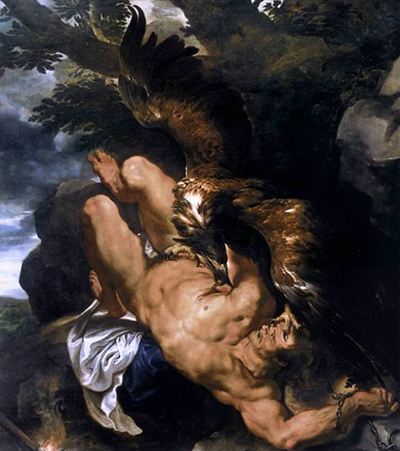
The collaboration should also not be confused with Rubens's Prometheus Bound, where a documented 1618 account assigns the eagle to Snyders. Both paintings use another artist's animal painting for a central part of the scene, but the evidence and visible roles differ. In Medusa, the museum's qualified workshop credit is part of the current object identity. Identifying it simply as a single-artist Rubens painting would lose that distinction.
There is historical evidence for the partnership as well as a modern attribution. As Mandabach notes, the 1635 sale inventory of George Villiers, Duke of Buckingham, from which the Vienna version was sold, names Rubens and a second painter rendered as “Subter,” understood as a likely corruption of Snyders. A 1642 Amsterdam inventory of collector Nicolas Sohier names Rubens and Snyders for a Medusa; the existence of two versions means that second record should not be treated as proof that Sohier owned this Vienna canvas. Together, these records show that early collectors could recognize a shared authorship without settling which modern version every reference denotes.
The history of that attribution is more varied than a simple pair of names. In the Getty Museum's Rubens and Brueghel catalogue[10], pp. 180–84, Anne T. Woollett records past proposals naming Jan Brueghel the Elder, Paul de Vos or Rubens alone for some of the surrounding creatures. She favours Snyders's participation, citing the snakes' firm, opaque surfaces and bright highlights, while allowing that Rubens could have painted reptile forms close to the scalp and made final touches elsewhere. This is a scholarly assessment of hands, not a technical map with a signature on each animal. The holding museum's present “Rubens and workshop” designation and its Snyders explanation remain the clearest public credit for the Vienna picture; the older alternatives explain why some descriptions differ.
Woollett adds a useful caution about the apparent naturalism. She reports earlier identifications of common European water snakes, a pair of vipers at the right and the recognisable European fire salamander. Alongside them sits the two-headed amphisbaena, known from descriptions rather than an ordinary specimen. These names are scholarly identifications of painted forms, not a surviving list supplied by either artist. Their mixture helps explain the painting's peculiar credibility: observation of familiar animals supports the impossible birth of snakes from Medusa's blood. Woollett, pp. 183–84[10].
Collaboration may have helped shape the subject itself. Mandabach argues that making the snakes and other animals central gave Snyders's specialist craft an unusually active role in a mythological painting. The creatures do not merely identify Medusa, as snake hair often does; they appear to be generated by the blood flowing from her head. The painting can therefore be read as an encounter between two kinds of work: Rubens's large human head and Snyders's closely differentiated animal forms. This is an argument about the picture's structure, rather than evidence for a surviving contract specifying how the painters divided the labour.
Why do museum dates differ?
The KHM's current collection album[8] dates the Vienna canvas around 1613, close to the 1612/13 in its 2022–23 Idols & Rivals presentation[1]. The museum's English programme[2] still uses 1617/18, as did its 2017 materials. These are institutional dates for the same Vienna canvas, not two separate Medusa paintings. A precise year would suggest more agreement than the sources show.
The distinction is especially important because there is also a separate version in Brno. A KHM study by Gerlinde Gruber and Petr Tomášek, available in Gruber's author upload[3] compares the two surviving pictures and records the Brno work on oak panel, while Vienna's is on canvas. The reproduction here shows the Vienna canvas, not the Brno panel.
The two paintings have also been examined together using imaging methods. In the published abstract of her 2022 conference paper[6], KHM curator Gerlinde Gruber says macro X-ray fluorescence scans clearly show that Brno was the prototype. She cautions that those scans alone cannot settle the question of authorship, which also needs stylistic analysis. The evidence thus helps establish a working sequence without assigning every snake or patch of ground to an individual painter.
The University of Antwerp's project description[7] identifies the collaboration among its imaging laboratory, KHM and the Moravian Gallery in Brno. It explains why their two supports and documented early collections make comparison valuable. That project description was written before the results were published and presents Brno-first as a scholarly proposal; Gruber's later abstract states the result more firmly. Taken together, the sources support the sequence while leaving a detailed division of hands open.
Their supports and dimensions differ, and even close designs need not have been completed in the same way. The KHM's public dates still differ: the collection album gives around 1613, while an English programme page uses 1617/18. Brno-first is a statement about sequence, not an exact year for either picture. For the Vienna canvas, “1610s” remains the useful short date until the museum's public records converge.
An earlier X-radiograph discussed in the Getty catalogue found another revision on the Vienna canvas: Medusa's pointed tongue originally extended beyond her lips. The final painted mouth is less extreme. The finding is useful because a viewer might assume the terrifying expression appeared fully formed in Rubens's first layout. Here imaging reveals a decision to reduce one feature while leaving the severed head, open eyes and living snakes powerfully present. It also belongs to the Vienna work specifically; it should not be carried over to the Brno panel without separate technical evidence.
The paintings may be close in design, but their supports, dimensions and collection histories distinguish them. The AGO's Early Rubens exhibition[5] included the Brno picture, another reason that an exhibition mention of a Medusa cannot automatically be applied to the Vienna object. A careful account names the city and support before using a date, attribution or technical conclusion from either version.
The Brno panel has a particularly well documented later life that reinforces the distinction. Petr Tomášek's account for the two-picture KHM exhibition[4] says it entered the Franzensmuseum in December 1818 as a gift from Count Joseph von Nimptsch; how he acquired it is still unproved. An ownership seal survives on the panel's reverse. The nineteenth-century curator Ernst Rincolini assigned the head to Rubens's pupil Abraham van Diepenbeeck and the animals to Snyders. He also reported that the museum ordinarily kept the picture behind a curtain, explicitly because it was judged too disturbing for women visitors. That reason reflects a nineteenth-century museum judgment, not a property of the image or a seventeenth-century display rule. A Brno curtain is documented independently of the curtain Huygens saw in Amsterdam; neither belonged to the Vienna canvas.
That distinction also matters when discussing an early viewer. Mandabach cites a description by Constantijn Huygens of seeing a Medusa at the Amsterdam home of collector Nicolas Sohier. According to the account, the image was kept behind a curtain and revealed to selected visitors, making its sudden appearance part of the experience. The version Huygens saw is thought likely to be the one now in Brno. It would be misleading to present this as a documented display arrangement for the Vienna canvas. It does, however, show the kind of response the shared design could invite: looking was staged as an encounter with an image reputed to overwhelm the viewer.
The Getty catalogue traces the Vienna painting from Buckingham's collection by 1635 through an Antwerp dispersal in 1648–50 and its later Habsburg history. The KHM's detailed reconstruction[4] names successive pledges of the picture in Antwerp during 1649–50 and negotiations in August 1650 for Archduke Leopold Wilhelm to purchase works from Buckingham's collection for his brother Ferdinand III. It documents the Medusa in Prague inventories from 1685 to 1875 and its transfer to the imperial collection in Vienna in 1880. These are transactions and records for the Vienna canvas, not proof that the Amsterdam picture described by Huygens was the same object. They also show why a smooth, uninterrupted ownership story would overstate the evidence: the painting circulated as collateral before it entered the imperial holdings.
The 1648 sale also brought the Vienna painting back into view for other artists. Woollett records a signed copy by Victor Wolfvoet and notes later reuses of its animals by Jan van Kessel. The relationship should be described carefully: access to the painting at or after the sale makes copying possible, but the precise occasion of every borrowed snake is not documented. These later images show how the Medusa composition could be separated into reusable parts. A painter could take up the whole shocking head, or lift an animal motif into a new setting, without reproducing Rubens and his collaborators' original encounter between corpse and moving life. Woollett, p. 184[10].
A painting meant to unsettle
KHM's Idols & Rivals exhibition places Rubens in dialogue with earlier depictions of Medusa by Leonardo and Caravaggio. That comparative frame helps explain why a single severed head could be a challenging subject for painters: how can a still image suggest a gaze, a death and continuing motion at once? The Vienna canvas answers with a fixed, brightly lit face surrounded by twisting, mobile forms. It makes the viewer's act of looking part of the drama.
Gruber's catalogue gives that rivalry a more specific history. Vasari described a frightening creature painted by Leonardo after close study of animals, as well as an unfinished image of Medusa; the survival and appearance of the latter are uncertain. Gruber also considers an engraving after Rubens's teacher Otto van Veen, in which Medusa's snakes and hair are closely mingled, as a possible point of comparison. Rubens does not merely place a ring of snakes around an otherwise ordinary head: near the temples, hair and reptile seem to grow together, while other snakes have already separated and spread across the ground. The comparison with Leonardo and Van Veen is about how a painter could make a monster seem to grow from observed forms. It does not prove that Rubens saw a lost Leonardo painting or copied one particular print into the Vienna canvas. Gruber and Tomášek, Ansichtssache 23[3], pp. 14–16.
The comparison with Caravaggio in Mandabach's study[9] is more precise than a general claim of influence. Caravaggio's Medusa is painted on a convex shield-shaped support; she seems to confront a viewer in the instant of dying. The Vienna Medusa lies on a ledge, with room for a menagerie of reptiles and insects and for the vegetation behind them. Both images can alarm the viewer, but Rubens and Snyders make the aftermath and its proliferating life as important as the face. The difference follows from what each composition actually shows, without requiring proof that Rubens copied Caravaggio's particular picture.
The painting is disturbing without needing a battle in view. Blood and severance establish what has happened, while the animals insist that consequences remain. If it once encouraged Stoic or political reflection, as the KHM suggests, that reading grew from the vivid visual experience rather than replacing it. The work's current museum presentation invites us to see both the force of Rubens's invention and the contributions of other hands who made it visible.
Mandabach's account offers another way into that experience. She describes the drops of blood and the emerging creatures as a picture of matter becoming living form. Her argument connects Rubens's handling of liquid paint to contemporary curiosity about how nature might generate life. The red fluid becomes the hinge between painted substance and a story of creation. This need not displace the horror or the moral reading; it explains why the painting attends so closely to the moment at which a wound seems to produce something new.
The analogy remains an art historian's reading, not a chemical analysis of the red paint. Mandabach observes small light and dark touches around individual drops, so that the blood seems to pulse between liquid and distinct forms. She asks whether painting, made from ground pigments and liquids, could itself be imagined as capable of giving apparent life to inert materials. That question fits a picture where snakes seem born from blood but appear almost solid enough to be collected. It does not license a claim about the exact pigment Rubens used: the article leaves the Vienna blood's material composition open. Nor does it imply that early viewers all understood the canvas through one theory of nature. The myth, visual shock and craftsmanship remain visible without that specialised interpretation.
Rubens artworks directory
Frequently Asked Questions
The painting is in the Kunsthistorisches Museum, Vienna, Gemäldegalerie GG 3834.
The KHM credits the Vienna painting to Rubens and workshop and attributes the snakes to animal painter Frans Snyders. It does not assign every individual creature to a named hand in the public sources used here.
KHM's current collection album says around 1613. Other KHM materials give 1612/13 and 1617/18. It belongs to the 1610s; no single year is settled by those public records.
No. Brno holds a related version on oak panel. The work discussed here is Vienna's canvas, 68.5 × 118 centimetres.
No. It concentrates on Medusa's severed head and the creatures around it after Perseus's act.
Discussion
Look closely at the contrast between Medusa's still face and the moving serpents.
Share an observation about the painting or a reliable source that adds to its history.
Reader Insights
How do the animals extend the scene beyond the severed head?
Why does the museum's workshop credit matter to this object's identity?
What keeps the Vienna canvas distinct from the related Brno panel?
Join the Conversation
Add your reading below, keeping observations specific and evidence clear.
References
- Kunsthistorisches Museum, Idols & Rivals : collaboration and Vienna Head of Medusa. View source
- Kunsthistorisches Museum, public programme on The Head of Medusa. View source
- Gerlinde Gruber and Petr Tomášek, KHM Ansichtssache 23, Vienna and Brno Medusa versions, author upload. View source
- Gerlinde Gruber and Petr Tomášek, KHM Ansichtssache 23, museum-hosted catalogue PDF. View source
- Art Gallery of Ontario, Early Rubens exhibition, including the Brno version. View source
- Gerlinde Gruber, KHM, published abstract on macro X-ray fluorescence findings for the two Medusa versions, HNA 2022 programme, pp. 80–81. View source
- University of Antwerp AXES laboratory, comparative research project on the Vienna and Brno Medusa pictures. View source
- KHM, Highlights of Flemish Baroque Painting , current collection album including the Vienna Medusa. View source
- Marisa Mandabach, “Matter as an Artist: Rubens’s Myths of Spontaneous Generation,” Journal of Historians of Netherlandish Art 13.2 (2021). View source
- Anne T. Woollett, The Head of Medusa in the Getty Museum's Rubens and Brueghel: A Working Friendship (2006), pp. 180–84. View source