 by Tom Gurney
Tom Gurney BSc (Hons) is an art history expert with over 20 years experience
Published on June 19, 2020 / Updated on October 14, 2026
Email: tomgurney1@gmail.com / Phone: +44 7429 011000
Words with a date and an addressee
Rubens left letters as well as paintings. They can bring us unusually close to his working decisions, but they are not a book of timeless sayings. The passages on this page come from two letters to Sir Dudley Carleton in 1618, during a negotiation to exchange pictures for antiquities. Each short excerpt is identified by its date, recipient, letter number and original-language edition. The English wording beside it is a fresh, deliberately narrow rendering of the quoted fragment. The surrounding account explains what Rubens was doing in the larger letter.
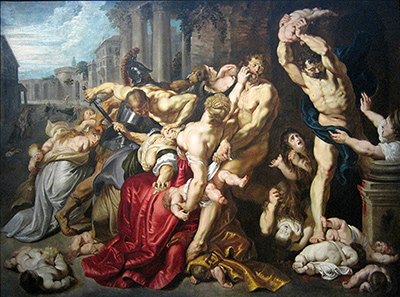
The image above is The Massacre of the Innocents in the Thomson Collection at the Art Gallery of Ontario, Toronto, catalogued about 1610, oil on panel, object 2014/1581. It is an existing illustration for this route, not the subject of the Carleton letters. It is also distinct from a later painting of the same subject in Munich. The Toronto artwork page treats its own evidence. Keeping image and quotation separate prevents a painting on a biography-style page from becoming false documentary proof.
At a Glance
- DocumentLetters to Sir Dudley Carleton [1]
- Dates28 April and 12 May 1618 [1]
- SourceRooses, Correspondance de Rubens, vol. 2 [1]
- Image aboveToronto Massacre, AGO 2014/1581 [4]
Where these words survive
The source used here is Max Rooses's Correspondance de Rubens, volume 2, digitised and transcribed by the Herzog August Bibliothek. Rooses prints the original letter text with historical spelling and also supplies editorial matter. The exact originals were reopened for this page. The two relevant items are letter CLXVI, 28 April 1618, and letter CLXVIII, 12 May 1618, both addressed to Sir Dudley Carleton, the English diplomat then at The Hague. The letter numbers belong to Rooses's edition; they provide a way to find the passage without pretending that Rubens numbered his own correspondence this way.
The first letter accompanies a list of paintings Rubens said were in his house. He offered them in discussion of Carleton's antiquities. The list names subjects, sizes, prices and varying degrees of Rubens's participation. The later letter responds to Carleton's preferences and works through the balance among pictures, tapestries and cash. They are business letters, shaped by a particular transaction. Their vivid phrases can be quoted, but their commercial purpose should travel with them.
The spelling in the excerpts is that of the printed transcription, including forms that differ from modern Italian. Rubens also moves between Italian and Latin in one of the passages. A translation can make the sense available to an English reader, but it cannot silently turn period phrasing into an unattached modern maxim. For that reason the original fragments below are deliberately short and the explanatory prose carries most of the meaning.
28 April 1618: a named collaborator
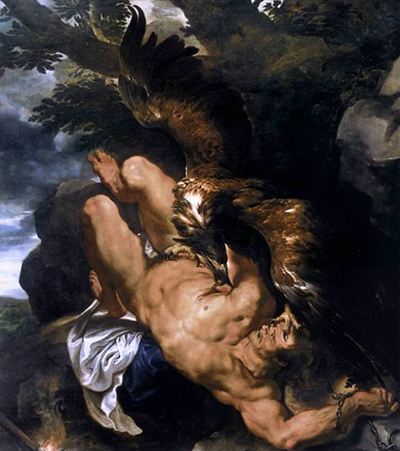
In the list attached to letter CLXVI, Rubens described a painting of Prometheus bound on Mount Caucasus and specified a division of work. One fragment reads:
Original Italian: “l'acquila fatta dal Snyders”
English rendering: “the eagle made by Snyders.”
The phrase refers to Prometheus Bound, the painting now in the Philadelphia Museum of Art. Rubens presents the composition as his own work while identifying Frans Snyders as maker of the eagle. It is unusually direct evidence for a named collaboration in a specific picture. It does not prove Snyders painted every bird or animal associated with Rubens, nor that the same split of work applied to a different version. The Prometheus page sets this statement against the painting and its museum record.
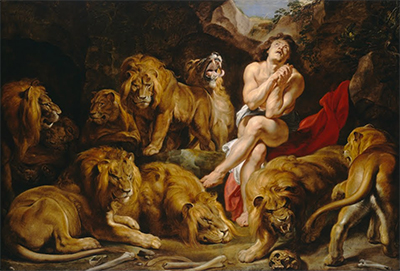
The same list calls Daniel among the lions entirely his own hand. This is useful when comparing two works that both feature animals: Rubens did not describe them in identical terms. Yet the letter is still a statement made in an exchange negotiation. It should be read alongside the National Gallery of Art's record for Daniel and other object evidence. A painter's description of a work for a prospective buyer is important primary testimony, not a substitute for every later physical or documentary question.
The list also names a Leda. That does not identify the small Mazoh Leda and the Swan discussed elsewhere on this site. The letter's work is described in a different context and at a different scale. Bringing the famous 1618 list into a quote page makes it especially important not to attach its provenance or price to a namesake painting simply because titles overlap.
28 April 1618: public and private commitments
Rubens then explains why he cannot simply devote his time to an open-ended new undertaking. He says he is already committed to:
Original Italian: “opere publice i private”
English rendering: “public and private works.”
This short phrase appears within a longer sentence in letter CLXVI about the demands on his time for years ahead. He nevertheless assures Carleton that pictures in the proposed exchange which are not fully finished can be completed, while finished works could be sent more promptly. The point is practical: he is managing a negotiated delivery while already responsible for other commissions. It tells us something about the pressures of a successful studio, but it is not a slogan that he valued busyness for its own sake.
The distinction between public and private work also helps place Rubens's activities in Antwerp. Church commissions, court pictures and private collecting did not arrive in separate eras. His studio handled several kinds of demand at once. The letter lets us hear him explaining capacity to a prospective counterpart. It does not provide a complete workshop schedule, a count of orders or proof that he personally painted every picture then in progress.
12 May 1618: what counts as a copy?
By letter CLXVIII, Carleton had indicated a preference for works described as original. Rubens replied that the other pictures on his list were not merely:
Original Italian: “copie semplici”
English rendering: “simple copies.”
In the following words he says he had retouched those works with his own hand and argues that this made them difficult to distinguish from the originals, while they were priced lower. That is Rubens advocating for specific paintings he wished to trade. It is valuable because it shows that he distinguished a fully autograph work, a pupil-made work retouched by him and an unqualified simple copy. It does not authorise a modern catalogue to label an unidentified surviving picture as personally retouched by Rubens without independent evidence.
Carleton's preference matters here. The wording is part of a response to a buyer's concerns about authorship and value. Rubens could describe how a picture had been made, but he was also trying to close a transaction. The workshop and collaborators guide places the letter alongside present museum attribution labels. Those labels may preserve or challenge an earlier description, and their object-specific evidence cannot be replaced by a general quotation about “copies.”
Rooses's transcription retains period spelling and line breaks. The phrase is embedded in a longer sentence, not set apart by Rubens as a polished aphorism. Extracting just two words is useful for showing his distinction while avoiding the false impression that a modern English maxim was found on a separate sheet headed “Rubens on copying.” The source, recipient and transaction supply its meaning.
12 May 1618: the painter and his house
Later in the same letter Rubens refers to money spent on building his Antwerp house and the need to manage expenses. In a sentence that continues into Latin, he says:
Original Italian fragment: “non son Principe”
English rendering: “I am not a prince.”
The Latin clause that follows invokes living by the labour of one's hands. The sentence appears while Rubens weighs paintings, tapestries and ready money in the exchange. It is a memorable contrast between courtly access and the financial life of a working artist. It should not be presented as proof that he was poor, or as a free-standing claim that he rejected the company of princes. He was explaining why the terms of a large transaction mattered to him while he paid for construction at the Wapper house.
The Rubenshuis account of his home helps place the spending in a larger story of the house, studio and collection. The letter itself is firmer evidence for his own description of his finances at that moment than for an exact modern estimate of construction costs. Its mixed Italian and Latin also shows the educated, multilingual register in which he wrote to an elite correspondent. A translation should convey the sense without replacing the original with a pithy sentence never written in English by Rubens.
How to use a historical quotation
A reliable quote has at least four anchors: who wrote it, to whom, when, and where the text is preserved. The Carleton letters offer all four. The edition may still require care with spelling, editorial brackets, damaged words and the distinction between the original and a nineteenth-century editor's explanatory note. This page gives only short verbatim fragments from the original-language transcription. Its English renderings are limited to those fragments; the surrounding prose is an explanation of the longer passage.
An isolated sentence can mislead even when its words are genuine. The Snyders phrase is about one eagle in one offered painting. The remark about commitments is a statement during a trade. The “simple copies” distinction is a defence of particular inventory items. The “prince” sentence follows discussion of cash and building expense. If any is copied onto a list of “inspirational Rubens quotes” without date or context, a reader loses exactly the evidence that makes it interesting.
Checking a line against a surviving picture
The Carleton list can be tested against paintings that museums now identify individually. The National Gallery of Ireland catalogues Saint Peter Finding the Tribute Money[1], an oil canvas dated 1617–18, as one of the works scholars connect with the 1618 exchange. Its record cites Rubens's description of that picture as original and by his own hand. The Dublin canvas, inventory NGI.38, has its own documented route from Carleton's collection through later owners to the Gallery's 1873 purchase. The museum's wording is appropriately qualified: identifying a present object with an item in a seventeenth-century list is a scholarly conclusion, even when the historical description and the object's later provenance fit together.
This case shows why a short quote should lead a reader to an object, not end the inquiry. “By my hand” described how Rubens offered one picture to Carleton. Dublin's current attribution, date, support, dimensions and ownership chain describe the surviving painting. The two kinds of record strengthen each other but answer different questions. The letter alone does not tell us how the canvas looks today, and the current label alone would not convey how Rubens represented its authorship to his prospective buyer. The same discipline applies to Prometheus Bound, where the 1618 description specifically names Snyders's eagle, and to Daniel, which Rubens described differently.
What Rubens received
The other side of the exchange was an interest in ancient sculpture, not merely a sum of money. A Rubenshuis account of an antique trapezophoros[2] gives a surviving example: the second-century marble support came from Carleton, who had acquired it in Venice, and is recorded in Rubens's collection from 1618 to 1626. The museum says Rubens used its torch-bearing boy as an inspiration for a standing Christ Child and later sold the sculpture to the Duke of Buckingham. It returned to the Rubenshuis collection in 2022. This specific sculpture makes the object of negotiation more concrete than the general word “antiquities.” It does not prove that every statue Carleton discussed arrived in Antwerp, or that the four fragments quoted above refer to this marble individually.
Rubens's house was thus both a place from which paintings could be offered and a place where ancient objects could be studied and displayed. The two May remarks about cash, construction and what counted as an original belong to that practical world of exchange. A reader who knows the later fate of one sculpture can see why Rubens wanted such objects without converting a business letter into a timeless maxim about inspiration.
There are many sayings attributed to Rubens online that circulate without a letter number, original wording or identifiable early source. They are omitted here. Some may eventually be traceable, but a popular graphic or quote database is not enough to make a sentence his. Conversely, a phrase in a museum's modern English narrative may be an editor's translation or paraphrase rather than Rubens's own English. The safest path is to the document, its language and a stated translation choice.
A small set that opens larger questions
These four fragments do not claim to summarise Rubens's philosophy. They reveal how he described authorship, workload, value and his household in a specific exchange. The same letters lead outward to the paintings named in the inventory and to the working conditions of a studio serving many patrons. The biography supplies the wider chronology; the paintings guide and individual object pages test how a statement about a picture relates to the surviving work.
If another authentic line is added to this page, it should come with its original language, source edition, letter or document number, date and recipient, plus a checked translation and context. That method may produce a shorter list than a generic quotation page, but it gives each sentence a life in history rather than an invented authority. Rubens's correspondence is valuable precisely because it lets readers see a painter making particular decisions, not because every sentence can be turned into a proverb.
Frequently Asked Questions
The four short original-language fragments are in Rooses's edition of Rubens's correspondence, digitised by the Herzog August Bibliothek. They occur in letters CLXVI (28 April 1618) and CLXVIII (12 May 1618) to Sir Dudley Carleton. The English beside each fragment is this page's limited rendering, not a claim that Rubens wrote in English.
They were negotiating an exchange of paintings for antiquities, with discussion of prices, authorship, tapestries and cash. The context is essential to understanding his remarks about Snyders, copies, his workload and the cost of his house.
No. In the 1618 list and subsequent letter he distinguishes kinds of authorship and describes his intervention in some offered works. His statements concern that inventory. Each surviving picture still needs its own current collection record and evidence.
The retained image is the early Toronto painting, about 1610, oil on panel, Art Gallery of Ontario 2014/1581. It illustrates Rubens's art but is not the subject of the quoted Carleton passages. The later Munich painting of the same title is a separate object.
This page includes only phrases traceable to a dated document in its original language. An unattributed quote graphic or a modern paraphrase does not establish what Rubens wrote. More passages can be added when their source and translation have been checked.
Discussion
Which dated phrase changes how you understand Rubens's work?
Share an original letter or reliable edition if it clarifies a quotation.
Reader Insights
How does the Carleton exchange change your reading of a painting?
Which attribution claim in the letters needs an object-specific check?
What context should accompany a newly proposed quote?
Join the Conversation
Add a specific observation or source below.
References
- National Gallery of Ireland, Saint Peter Finding the Tribute Money , NGI.38, and its identified place in the 1618 Carleton exchange. View source
- Rubenshuis, antique trapezophoros acquired from Carleton and recorded in Rubens's collection, 1618–26. View source
- Max Rooses, Correspondance de Rubens , vol. 2, letters CLXVI and CLXVIII, Herzog August Bibliothek transcription. View source
- Philadelphia Museum of Art, Prometheus Bound. View source
- National Gallery of Art, Daniel in the Lions' Den. View source
- Art Gallery of Ontario, early Massacre of the Innocents , 2014/1581. View source
- Alte Pinakothek, later Massacre of the Innocents , 572. View source
- Rubenshuis, biography and Wapper house. View source