 by Tom Gurney
Tom Gurney BSc (Hons) is an art history expert with over 20 years experience
Published on June 19, 2020 / Updated on October 14, 2026
Email: tomgurney1@gmail.com / Phone: +44 7429 011000
A life with more than one centre
Peter Paul Rubens was born in Siegen on 28 June 1577 and died in Antwerp on 30 May 1640. Between those dates he travelled through Italy, served courts, made altarpieces for Antwerp churches, directed a busy studio, negotiated on behalf of rulers and returned repeatedly to drawing and painting. His career cannot be understood as a succession of isolated masterpieces. A drawing might prepare a large picture; a painted sketch might secure a patron's approval; collaborators might execute parts of the final commission. The circumstances of a work matter alongside its appearance.
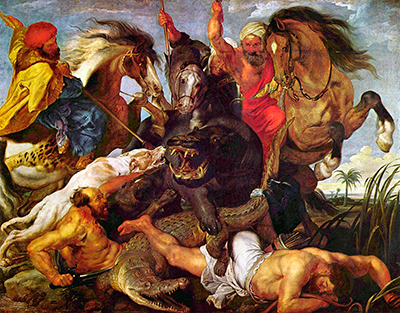
The painting shown above, The Hippopotamus and Crocodile Hunt, is one example from the mature Antwerp years. Its animals, mounted hunters and compressed movement belong to a group of hunting pictures associated with the Bavarian elector. It is a work by which to enter Rubens's world of courtly display, large commissions and forceful figure painting. It is not an image of the artist himself. The full story of the Munich picture belongs to the artwork page; this biography asks how a painter trained in Antwerp came to make it.
At a Glance
- Born28 June 1577, Siegen [1][2]
- Italian years1600–08 [1][2]
- Antwerp court appointmentSeptember 1609 [2]
- Died30 May 1640, Antwerp [1]
Childhood, Antwerp and an artist's education
Rubens's parents, Jan Rubens and Maria Pijpelinckx, had left Antwerp amid the religious and political conflict in the Low Countries. Peter Paul was born during their years in the German town of Siegen. After Jan's death, Maria returned with the family to Antwerp in 1589. The city supplied the language, patrons and professional institutions in which her son would establish himself, even though his later career extended far beyond it.
His education involved humanist learning as well as practical training. The Rubenshuis identifies Otto van Veen as an especially influential teacher; Van Veen's learned approach to history painting helps explain why the young artist treated stories from scripture and classical literature as subjects requiring research and invention. Copying prints was part of that education. The Metropolitan Museum notes that some of Rubens's earliest known drawings are copies after printed images. Such work taught him to study another artist's construction of figures and narratives, then select what might be useful in a new composition.
In 1598 Rubens entered the Antwerp Guild of St Luke as a master. This date marks professional standing, not the end of learning. His later drawings show an artist who kept studying sculpture, earlier paintings and the living model. It is more useful to think of his training as an ongoing method than as a childhood phase completed before his first commissions. His collection of art and antiquities would eventually give the Antwerp studio material to examine as well as objects to display.
Italy, 1600–08: looking and working
Rubens left for Italy in 1600. The journey placed him close to ancient sculpture and to paintings by artists whose work he already knew through copies and prints. The Met names Leonardo, Raphael, Michelangelo and Titian among the figures important to this study. Their impact was not a single borrowed style. Rubens investigated bodies in motion, complex groupings, colour and the way a large composition could address a viewer from a distance. The drawings made during and after Italy show how he converted looking into usable material for later work.
He entered the service of Duke Vincenzo Gonzaga of Mantua soon after arriving. Mantua was a base, but his service did not confine him to one city. In 1603–04 he went to the Spanish court on Gonzaga's behalf and painted an equestrian portrait of the Duke of Lerma. That assignment brought diplomacy, travel and portraiture together early in his career, though it should not be confused with the formal peace missions of the late 1620s. A painter working for a ruler could carry gifts, meet other courts and pursue commissions at the same time.
Rome provided major church work. Rubens made an altarpiece for Santa Maria in Vallicella; the earlier version survives at the Musée de Grenoble, while a later solution remained connected with the Roman church. These are separate objects, so a bare reference to “the Vallicella altarpiece” can conceal an important change in the commission. In Mantua he also worked for the Jesuit church of Santissima Trinità. The Italian years guide follows these places and works more closely, including the difference between an object made in Italy and one inspired by Italy years later.
In 1608 news of his mother's serious illness prompted his return to Antwerp. The Met dates his departure from Italy to late October; Rubenshuis likewise places the return in 1608. He would not establish himself again in Italy, though its works and the classical past remained part of his thinking. The return was a career decision as well as a family journey: Antwerp offered commissions and a position that could give a painter both local roots and a European reach.
Antwerp after 1608: marriage, court service and a house
The political setting had changed. The Twelve Years' Truce began in 1609, and church rebuilding and furnishing in the Southern Netherlands created demand for substantial religious pictures. In September 1609 Rubens was appointed court painter to Archduke Albert and Archduchess Isabella, rulers of the Spanish Netherlands. He was permitted to remain based in Antwerp rather than move his household to Brussels. On 3 October 1609 he married Isabella Brant. Those dates place court employment and marriage in the same year; the marriage is sometimes misdated in short modern biographies.
In 1610 Rubens acquired property on the Wapper in Antwerp and developed it as a home and working complex. Rubenshuis describes a studio, garden, portico and space for his collection. The setting joined domestic life, display, business and production. It does not prove that every painting bearing his name was made there or painted entirely by his hand. Commissions could involve assistants, specialists and work completed for distant patrons. The building made those different activities possible within an Antwerp base.
Rubens and Isabella had children, and family members appear in some portraits and studies. Their presence in his art is valuable evidence of a private world, but it does not license an identification of every female figure with Isabella or every child with a named son or daughter. A portrait drawing, a religious image and a mythological figure have different purposes. The biography can connect life and work without turning uncertain resemblances into facts.
Altarpieces and the demands of a large studio
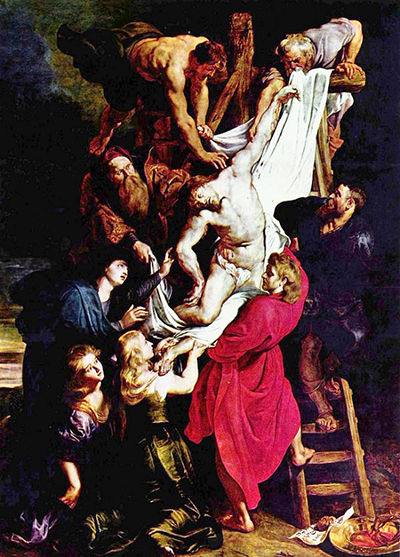
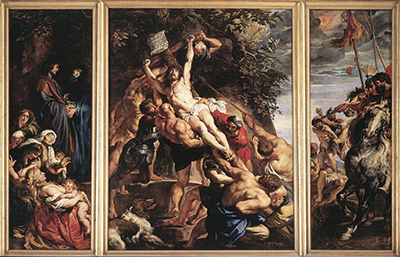
Two Antwerp triptychs show the scale of his early return. The Elevation of the Cross, made for the church of St Walburga and now in the Cathedral of Our Lady, drives its main event across three panels. The Descent from the Cross was made for the cathedral in 1611–14. In its central scene a group lowers Christ's body, while the wings expand the religious programme. Both paintings were designed for particular church settings. A museum-like view of an isolated central panel leaves out part of the original encounter.
Such commissions required planning. Drawings could establish an overall arrangement or develop a difficult figure; small oil sketches could test colour and present an idea to a patron. The Met describes a working pattern in which a design moved through drawings, painted studies and more finished work, with assistants involved at some stages. This is a broad account of studio practice, not a formula that every surviving picture followed. The oil sketches and technique guide explains what an individual painted study can and cannot tell us about a final work.
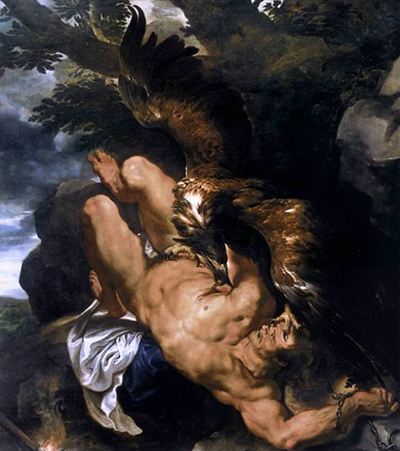
Rubens also worked with artists whose skills complemented his own. Frans Snyders painted the eagle in Prometheus Bound, a documented instance of a specialist's contribution to a particular painting. He collaborated with Jan Brueghel the Elder in works where figures meet detailed natural settings. Anthony van Dyck became closely associated with the studio in the later 1610s, though a precise start date is uncertain. These relationships did not have one fixed form. A collaborator could be a mature artist with a distinct specialism, and the distribution of work differs from object to object.
Rubens's 1618 correspondence with Sir Dudley Carleton gives a rare view of how he described pictures available for an exchange involving antiquities. He distinguished works by his own hand from those involving pupils and discussed value accordingly. The letters are evidence of business negotiation and degrees of authorship; they are not a licence to assign an undocumented modern picture to a pupil. The workshop and collaborators guide treats those distinctions in more detail. Here the essential point is that a large output depended on design, supervision and decisions about where his own painting was most necessary.
Pictures for courts: myth, history and Marie de' Medici
The hunting picture above belongs to this expanding world of princely commissions. Dated by the Alte Pinakothek to about 1616, it formed part of a group made for Elector Maximilian I of Bavaria. Its violence and movement could serve a courtly taste for spectacular subjects. That context differs from an altarpiece's devotional setting, even though Rubens brought his interest in bodies, animals and dramatic action to both. The Munich museum identifies the painting as the only one of its confiscated four-picture cycle to return to that collection.
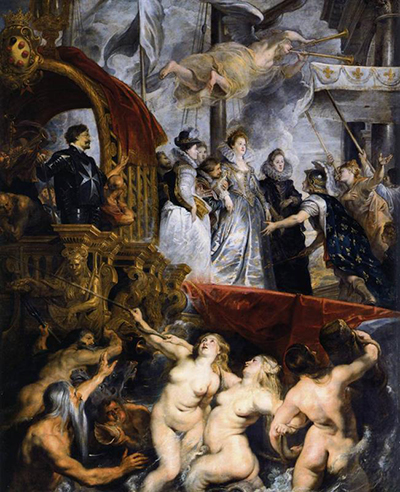
Rubens's largest French undertaking was the cycle for Marie de' Medici, widow of Henry IV and mother of Louis XIII. Talks began in 1621; contracts for two galleries followed on 26 February 1622. The queen's gallery was delivered in 1625. Its great canvases mingle events from Marie's life with gods, personifications and political claims. The Louvre describes 21 narrative paintings and three portraits in the finished queen's cycle. The projected companion gallery for Henry IV was not completed on the same basis. The Marie de' Medici cycle guide separates the historical events depicted from the later dates when Rubens designed and painted them.
Court work also took forms other than easel painting. Designs for tapestries, including the Triumph of the Eucharist project for the Descalzas Reales in Madrid, passed through sketches and other intermediate stages before weaving. A commission might survive today in several media, with different people responsible for different stages. Prints after Rubens's compositions carried images still farther. The prints guide distinguishes the artist who supplied a design from the engraver who cut it and the publisher who issued it.
Diplomacy without leaving painting behind
After Archduke Albert's death in 1621, Rubens worked more closely with Archduchess Isabella and the political interests of the Spanish Netherlands. By the later 1620s, his journeys served efforts to improve relations among European powers. His fluency in several languages and familiarity with courts mattered, but those qualities did not make every trip a successful peace settlement. The diplomacy and courts guide traces the missions and their limits.
Rubens spent 1628–29 in Madrid, where he encountered the Spanish court's collection, studied paintings by Titian and met Diego Velázquez. He then travelled to England in 1629–30. For Charles I he made Minerva Protects Pax from Mars, often called Peace and War. He also received the commission for the ceiling decoration of the Banqueting House in Whitehall; the planning, execution and eventual installation belong to different moments. These works show how painting could operate alongside negotiation, presenting ideas of peace or kingship to rulers who were themselves participants in the political situation.
The honours he received had separate histories. Philip IV granted him a Spanish patent of nobility in 1624; Charles I knighted him in 1630. Neither honour simply labels a style of painting. They record his standing with courts and the social position he had achieved through art and service. His work as a diplomat also had limits: the wars affecting the Netherlands did not end because a painter carried messages between courts. The paintings and the diplomacy need to be read in their own evidence, then brought together where a commission actually connects them.
Loss, a second marriage and the later countryside
Rubens and Isabella's daughter Clara Serena died in 1623. Isabella died on 20 June 1626. These losses belong to the family chronology, but their effect on an individual picture must be argued, not assumed from a tender figure or a mournful subject. In December 1630 Rubens married Helena Fourment. Portraits and drawings of family members from the later years offer a more direct place to examine domestic relationships than a general claim that Helena or Isabella served as the model for every mythological woman.
In 1635 Rubens and Helena acquired Het Steen, a country estate near Elewijt. The change gave him a second setting beyond the Wapper house and helped shape his late attention to landscape. A View of Het Steen in the Early Morning at the National Gallery, London, is associated with the estate. It presents a sweeping rural world of light, fields, buildings and human activity. The ownership makes the connection compelling, but the painting should not be treated as a surveyed map. Rubens selected, arranged and painted a landscape, rather than merely recording a property boundary.
He continued to undertake large court work. For Philip IV's Torre de la Parada, a hunting lodge near Madrid, Rubens devised mythological subjects in the later 1630s; collaborators helped turn designs into finished paintings. At the same time, his late work included portraits and landscapes made on quite different scales. A declining capacity for travel did not end his role as designer and supervisor. It makes the distinction among his own brushwork, his inventions and the hands of others especially relevant in the final years.
Rubens died in Antwerp on 30 May 1640 and was buried in St James's Church. The works he left behind did not form a single neat category. They included pictures made for churches and palaces, more intimate paintings, drawings retained as studio material, designs translated into prints or tapestries, and works in which collaborators had a share. The large scholarly catalogue now devoted to his art reflects this variety. Its numbers count related objects and versions as well as autograph works; they are not a tally of paintings personally completed by Rubens.
Reading the career through surviving objects
A life story is clearest when its dates lead back to objects. The Descent from the Cross belongs to the church patronage of early Antwerp; the Munich hunt belongs to a princely cycle; the Medici series makes a French queen's history into courtly argument; Peace and War is tied to the English mission; Het Steen belongs to his later landscape practice. The sequence shows changes of audience and purpose without pretending that Rubens stopped making one kind of art when he began another.
Each artwork page names the specific object depicted, its present collection and the evidence for its date and attribution. That is particularly useful where several versions share a title or where a drawing and a painting treat the same subject. The biography provides the timeline; the objects show what Rubens, his patrons and his collaborators did within it. Move between them in both directions: a date helps place a painting, while a painting often reveals the practical choices hidden by a date.
A newly documented glimpse of Rubens in Italy
A two-sided sheet from September 1607, now held on long-term loan at the Rubenshuis, makes the overlapping parts of Rubens's Italian career unusually tangible. On one face he drew three men in classical robes in pen and brown ink. The Rubenshuis object account[2] considers them probable apostles, but cannot link the group securely to a surviving painting. On the other face is a draft letter in Italian addressed to Cristoforo Roncalli, known as il Pomarancio. Rubens asks about a painting commissioned by Eleonora de' Medici, Duchess of Mantua. The sheet is small—12 × 20 centimetres according to the museum's acquisition notice[3]—yet it connects drawing, court service and art-world mediation on a single piece of paper.
The letter did not survive in a finished version, and the painting by Roncalli has not been identified in this evidence. Those limits matter. Rubens could advise a patron, monitor another painter's commission and use spare paper to test a group of figures; we need not invent the ultimate painting or call the probable apostles a preparatory drawing for a specific altarpiece. The source also complicates a simple timeline in which Rubens supposedly stopped learning in Italy once he began producing major works. In 1607 he was both working within a courtly network and still collecting visual possibilities in drawings. The sheet was acquired for the Rubenshuis in 2026, so its interpretation may develop as scholars examine it further.
An Antwerp residence built for several roles
Rubens's house on the Wapper was more than an impressive address. The Rubenshuis account of its garden[4] says Rubens and Isabella moved in during the autumn of 1615, while renovation continued. A studio, rooms for art and books, a garden and a distinctive portico made it possible to produce paintings, receive patrons and display learning in one complex. The museum's study of the portico[5] explains that Rubens used a passage between the older residence and the new studio to present classical and Italianate ideas to visitors. The figures of Mercury and Minerva above it associated artistic practice with intellect. This was architecture shaped by a painter's aspirations, not just a convenient addition to house more assistants.
A visitor might have encountered Rubens as host, collector, court servant and artist in the same afternoon. The garden also had practical uses: the Rubenshuis notes that large canvases and panels could be put there to dry. Gardeners, household workers, apprentices and children crossed the grounds. These details prevent an account of the studio from becoming a picture of Rubens alone in a closed room. They do not tell us exactly where each surviving canvas was painted. The estate was an organising centre for a practice that reached churches, palaces and collections far beyond Antwerp.
Collecting was tied to looking and negotiation. A Rubenshuis account of an antique sculpture[7] traces a second-century marble support bought by Rubens from Dudley Carleton and kept by him between 1618 and 1626. Rubens could study such a work, adapt a figure in a painting, show it to a visitor or exchange it within a network of collectors. This one documented object gives the 1618 Carleton correspondence a physical counterpart. It is a better basis for discussing his collecting than a vague claim that he owned “many antiques” with no example or date.
Learning while working
Rubens's reading continued alongside an intense working schedule. The Rubenshuis account of his library[6] draws on letters, book orders and binding records to show his interest in ancient literature, history, architecture, natural history, politics and news. He sought original-language texts and talked about books with friends. He also used written accounts to prepare courtly history subjects and diplomatic work. The library was not a store of ready-made pictures: texts and objects offered possibilities that a painter had to interpret, arrange and test. They also explain how he could participate in learned conversations with patrons and courtiers.
Rubens's practice of making prints after his designs widened those conversations. The Rubenshuis biography[20] describes engravers who carried his images across borders and privileges intended to protect them from unauthorised copying. This was an entrepreneurial structure with artistic consequences. A viewer in another city might know a Rubens composition through a print rather than a painting. At the same time, the engraver and publisher were makers with their own roles. Fame achieved through reproducible images is part of the life story, but it must not be mistaken for evidence that Rubens personally cut each plate.
A final decade of invention and dependence
In the 1630s Rubens spent more time with Helena Fourment and their growing family, but his late work does not resolve into one private style. The Rubenshuis biography[20] describes his painful gout and its effect on travel and work; it also describes how, from a distance, he oversaw a large decorative programme for Philip IV's Torre de la Parada. Other artists, including Jacob Jordaens, helped complete the commission. A reduced ability to work continuously at the easel could increase the importance of sketches, instructions and supervision without eliminating his invention. Individual paintings still need their own attribution evidence.
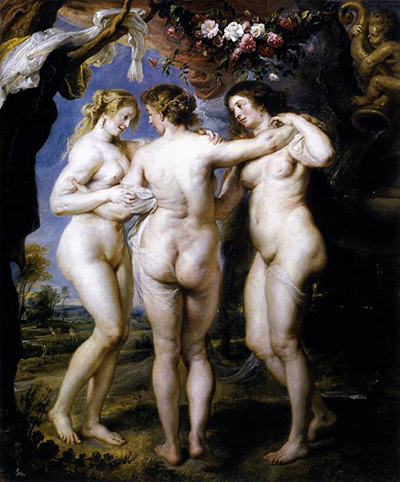
The same years produced works with very different audiences. The Prado Three Graces remained in Rubens's possession at his death; A View of Het Steen has an especially close relationship to the landscape around his country estate. Royal commissions, family images and landscape painting coexisted rather than replacing one another in a tidy sequence. Rubens's death in 1640 left these objects to travel by inheritance, sale and collection. His youngest daughter Constantia was born after his death, according to the Rubenshuis. That detail reminds us that the household's history continued beyond the point where a conventional artist biography ends.
Why the biography remains tied to the objects
A life can be made to sound more certain than its surviving evidence. Letters give Rubens's own words but may have been written to persuade a correspondent; paintings convey choices of pose and subject but are not diaries; later inventories may record an object after its original context has changed. The 1607 draft letter gives direct evidence of one network, not all of his relations in Italy. The 1618 Carleton exchange identifies distinctions Rubens made in one negotiation, not a universal formula for studio attribution. The 2026 Louvre research describes the Medici cycle as largely autograph while retaining uncertainty about detailed production. These examples show why a good biography alternates between a chronology and precisely identified works.
The Rubenshuis documentation[8] continues to gather photographs, letters, bibliography and other material behind the Corpus Rubenianum. That research can change an attribution, a date or a proposed connection between two works. The story told here should therefore be read alongside the page for the object in question. It is possible to describe Rubens's extraordinary range without claiming every associated painting was completed by his hand or attaching a family event to every expressive figure he painted.
Browse Rubens artworks
Frequently Asked Questions
He was born in Siegen on 28 June 1577 to Jan Rubens and Maria Pijpelinckx. The family later returned to Antwerp, where he trained and established his principal workshop.
His Italian stay ran from 1600 to 1608. He worked for the Gonzaga court in Mantua, travelled to Rome and other centres, and made a visit to the Spanish court on Gonzaga's behalf. He returned to Antwerp after news of his mother's illness.
Rubens married Isabella Brant on 3 October 1609. She died in 1626. He married Helena Fourment in December 1630. Their portraits and the family's chronology should be distinguished from uncertain identifications of figures in religious or mythological paintings.
Yes. He undertook political work for the rulers of the Spanish Netherlands and travelled to the courts of Madrid and London in the late 1620s. He continued to make and plan paintings during these journeys. The surviving evidence should be used to identify a particular mission rather than treating every court visit as diplomacy.
No. His practice included drawings and oil sketches by his hand, paintings he executed or supervised, work with named specialists and later prints or copies after his designs. An individual collection record is the starting point for deciding how much of a particular object can be attributed to him.
Discussion
Which part of Rubens's life makes you look at a work differently?
Share an object record or reliable source if it clarifies a date or attribution.
Reader Insights
How did Rubens's Italian years affect the works he made in Antwerp?
What do the studio records tell us about collaboration?
Which painting best connects his art with court politics?
Join the Conversation
Add a specific observation or source below.
References
- Rubenshuis, Biography of Rubens. View source
- Rubenshuis, Three Men in Traditional Robes and draft Roncalli letter, 1607. View source
- Rubenshuis, acquisition notice for the 1607 double-sided sheet. View source
- Rubenshuis, the Wapper garden and household. View source
- Rubenshuis, portico and garden pavilion. View source
- Rubenshuis, Rubens and his library. View source
- Rubenshuis, documented antique from the Carleton exchange. View source
- Rubenshuis, continuing artwork documentation. View source
- The Metropolitan Museum of Art, Peter Paul Rubens (1577–1640): The Drawings. View source
- Palazzo Ducale, Mantua, Rubens at the Palazzo Ducale. View source
- Musée de Grenoble, Saint Grégoire pape… , first Vallicella altarpiece. View source
- Cathedral of Our Lady, Antwerp, The Elevation of the Cross. View source
- Cathedral of Our Lady, Antwerp, The Descent from the Cross. View source
- Herzog August Bibliothek, Rooses edition of Rubens's correspondence. View source
- Alte Pinakothek, The Hippopotamus and Crocodile Hunt. View source
- Louvre, the Galerie Médicis. View source
- Brepols, Nils Büttner, The Medici Series. View source
- National Gallery, London, A View of Het Steen in the Early Morning. View source
- Rubenshuis, Het Steen archive. View source
- Rubenshuis biography. View source