 by Tom Gurney
Tom Gurney BSc (Hons) is an art history expert with over 20 years experience
Published on June 19, 2020 / Updated on October 14, 2026
Email: tomgurney1@gmail.com / Phone: +44 7429 011000
The moment after the hunt
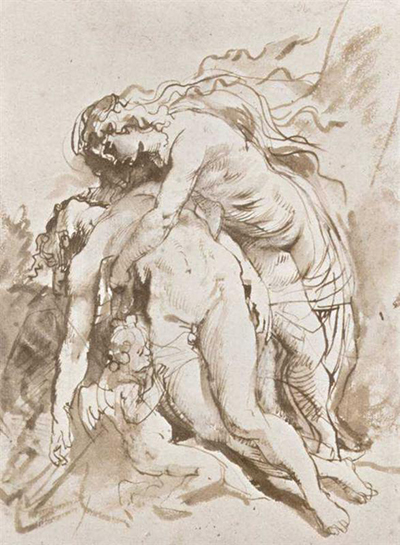
Venus bends over the body of Adonis. His head falls to one side, his arm hangs down, and the weight of his body seems to slip away from her grasp. Her curved back and sweeping hair press towards him as if she could still hold him upright. The drawing gathers a story into a single physical problem: one living figure tries to support a dead one. Light paper remains visible between rapid brown strokes and washes, so the scene feels both urgent and unfinished.
The work reproduced here is a drawing, not a painting called The Death of Adonis. The British Museum's collection record[1] identifies it as Venus Lamenting over the Dead Adonis, museum number 1895,0915.1064. Its current catalogue attributes it to Peter Paul Rubens, dates it about 1612, and describes pen and brown ink with brown wash and white heightening on paper, 20.6 × 15.1 centimetres. The image retained for this page matches the compact, upright sheet. Those material facts matter because several other Rubens works tell related parts of Adonis's story on very different supports and scales.
The museum has not always credited this particular sheet to Rubens. Its record preserves a former attribution to Anthony van Dyck. That is an attribution history, not the present maker line. Keeping both facts visible lets a reader understand why old captions may differ without suggesting that the current collection has no view. The local route uses the broad name Death of Adonis; the displayed heading and caption specify the mourning drawing.
At a Glance
- ArtistPeter Paul Rubens; formerly attributed to Van Dyck [1]
- SubjectVenus lamenting the dead Adonis [1]
- DateAbout 1612; catalogues differ [1][2]
- MediumPen and brown ink, brown wash and white heightening on paper [1]
- Dimensions20.6 × 15.1 cm [1]
- CollectionBritish Museum, 1895,0915.1064 [1]
Where this work sits in Rubens's career
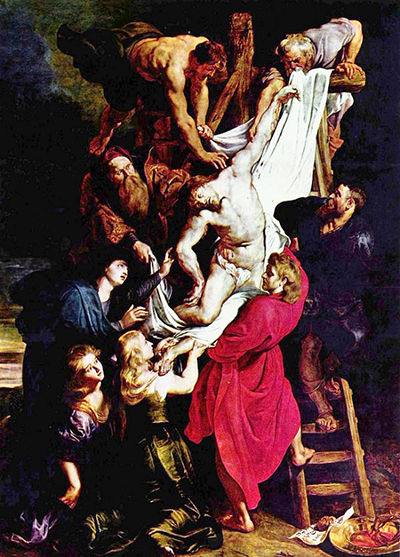
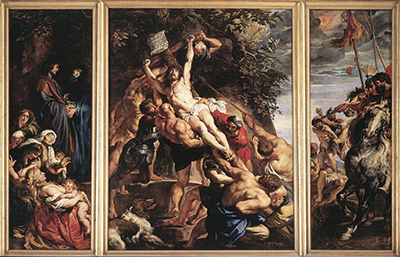
The Elevation of the Cross
1609–10The Descent from the Cross
1611–14The Garden of Love
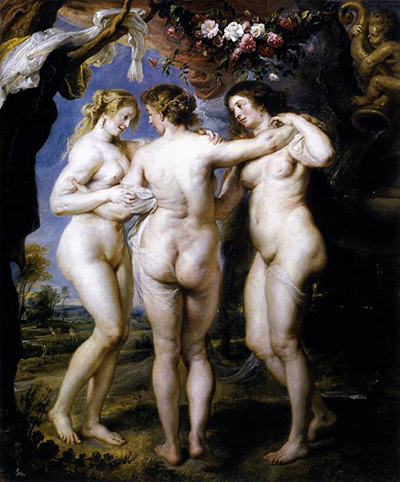
1630–35The Three Graces
1630–35Contents
- How do the marks carry the grief?
- What part of the Adonis myth is shown?
- Are there other drawings of the lament?
- Is the Dulwich picture the same work?
- Why do dates and attributions differ in catalogues?
- What should a reader take from this sheet?
How do the marks carry the grief?
The left side of Adonis's body is described with relatively spare lines. His dropped arm is almost a vertical measure of stillness. Around it, shorter marks make the figures' clothing and legs difficult to separate at first glance. Venus's head comes close to his, and the movement of her body is expressed through long curves. The sheet does not need a full landscape, a boar or a pack of hunting dogs to identify the aftermath: the contact between the two figures supplies the action.
Brown ink gives the drawing its structural contours. Diluted wash then gathers shadows under the bodies and in recesses of cloth. The white heightening identified by the British Museum offers another way to lift forms out of the toned passages. A reproduction at this size cannot reliably tell which pale line is added white and which is the exposed paper. It can show the larger pattern: hard and soft marks alternate, making the body seem heavy while the drapery and hair remain restless.
The drawing is small enough to be studied at close range. Its upright format pulls the two bodies into a narrow field, unlike the broad horizontal canvases made for other versions of the story. Adonis's bare torso occupies much of the centre. Venus does not appear as a distant mythological emblem; she is a figure straining around a person whose weight resists her. The result is an experiment in gesture as much as an illustration of a literary subject.
We should not turn every open contour into proof of a precise working sequence. The sheet does not contain a dated studio note explaining whether Rubens began at Adonis's torso or Venus's head. Its visible revision-like overlaps show a design being worked out, but their exact order needs technical examination. Describing the pressure, wash and changing clarity of the lines is more secure than inventing the minutes of its making.
What part of the Adonis myth is shown?
Adonis, beloved by Venus, dies after a hunting encounter with a boar. The image shows lamentation after the fatal injury, not the moment when he sets out or when the animal strikes. The distinction is easy to lose because works titled Venus and Adonis or Death of Adonis may select different instants from the same story. Here the fallen body, Venus's support and the absence of active pursuit put grief at the centre.
The RKD scholarly catalogue of the Dulwich oil sketch[2] discusses the story in Ovid's Metamorphoses and a later lament attributed to Bion. These literary sources help explain why artists could vary the figures gathered around Adonis and the position of his wound. They do not prove that Rubens followed one passage word for word in this particular drawing. The paper concerns a visual response to the death, not an illustrated page with a labelled source text.
The drawing's emotional emphasis is therefore precise but not narrow. We see the human problem of a body that can no longer stand and a companion unwilling to let it fall. The name Venus tells us the grief is mythological; the marks make it physical. That combination is one reason the sheet remains legible even to a viewer who does not know the full story of Adonis's birth, love and hunt.
The RKD catalogue[2] also lists a much later Rubens oil sketch of The Death of Adonis at Princeton, about 1639, connected to a hunting composition for the Spanish king. That design concerns the violent death itself rather than Venus's close lament over a fallen body. A search result using only “Death of Adonis” might lead to either work. The Princeton sketch has its own panel support, dimensions and late date; none describes this London sheet. Keeping the narrative instant in the title is thus an identification aid, not merely a stylistic preference.
Are there other drawings of the lament?
Yes. The National Gallery of Art in Washington[3] holds another Rubens Venus Lamenting Adonis, accession 1968.20.1, dated about 1608–12. It is larger, 30.6 × 19.8 centimetres, and is catalogued as pen and brown ink on laid paper. An inscription at its upper centre reads “Spiritum morientis excipit ore”; the RKD catalogue[2] translates the phrase as a description of receiving the dying man's spirit with her mouth. That inscription belongs to the Washington sheet, not the British Museum drawing shown here.
A third related drawing is in Antwerp's Museum Plantin-Moretus. A Belgian state notice[4] identifies the British Museum and Washington sheets as comparators for the Antwerp work and says that no finished painting is known for which the three drawings together can securely be called preparatory studies. The notice reports a possible Van Dyck attribution for the Antwerp sheet. That proposal should not be silently transferred to the London drawing, whose current museum maker line is Rubens.
The three related compositions are valuable precisely because they are not interchangeable. Their different sizes, inscriptions and placements of Venus and Adonis show an artist returning to a theme. The RKD catalogue says the group differs in composition from the later Dulwich modello. That difference prevents an appealing but unsupported narrative in which each drawing is simply a step leading to that specific oil sketch. The relationship may be thematic and exploratory without being a documented production chain.
Is the Dulwich picture the same work?
No. Dulwich Picture Gallery DPG451[2] is a painted oil sketch on oak panel, about 1613–15, measuring 48.6 × 66.4 centimetres in the RKD catalogue. It includes Venus, Cupid and the Three Graces around Adonis in a wider arrangement. The RKD describes it as a modello for a large painting now in the Israel Museum, Jerusalem. Those facts belong to the Dulwich panel, not to the small vertical London drawing.
The separation is visible in the bodies' positions. The RKD notes that Adonis lies roughly parallel to the lower edge in Dulwich, while in the group of three drawings his body is more upright, with legs bent and head inclined. That is more than a change of material. The compositions organize grief differently: the drawn group tests a close encounter between two figures, while the painted sketch develops a broader gathering around the dead hunter.
The Dulwich work also has its own complicated physical history. Its oak panel consists of two members and acquired a small top addition in the nineteenth century, according to the RKD technical note. That history is interesting, but it is no evidence that the British Museum paper sheet was enlarged or painted over. Comparing works requires keeping their object histories in their own columns. Shared subject words in a catalogue search are not enough to merge media, measurements or conservation findings.
The large Jerusalem painting, dated about 1614 by RKD and catalogued as a canvas, is another distinct object. Its size, figures and finished landscape are part of a different artistic task from the portable London drawing. The existence of the Dulwich-to-Jerusalem relationship does not by itself supply a lost painting for the three related lament drawings. The Belgian notice explicitly leaves such a finished work unknown.
Why do dates and attributions differ in catalogues?
The British Museum's current information, as recorded in this project's object audit, dates the London sheet about 1612 and gives 20.6 × 15.1 centimetres. The RKD Dulwich comparative catalogue lists the same British Museum number with an earlier 1603–05 date and a slightly different 21.7 × 15.3 centimetres. These are not two objects with the same accession number. They are differing catalogue statements about one sheet. The holding collection's current facts are used in the page's primary caption, while the disagreement is stated rather than averaged into a false precision.
The former Van Dyck attribution is a second kind of difference. Rubens and Van Dyck worked in a closely connected Antwerp environment, and old attributions to one or the other occur in catalogues of related works. But a former credit is not a vote that cancels the museum's current one. The British Museum names Rubens for this drawing, and its record keeps Van Dyck as a historical attribution. The Antwerp sheet has a separately reported uncertainty. A reader can compare the drawings without treating every attribution debate as identical.
The date of a drawing is often inferred from style and relationships to other works rather than written on the sheet. A range such as “about 1612” should retain its about. Nor can the date of a painting about Adonis be transferred to a related drawing. The Washington sheet's date, the Dulwich panel's date and the Jerusalem canvas's date each answer a question about a particular object. This page's date belongs to British Museum 1895,0915.1064.
What should a reader take from this sheet?
Its force lies in a simple arrangement of weight and care. Venus bends; Adonis yields. Pen lines and thin wash keep the movement open, allowing the viewer to see the design as a search rather than a polished declaration. The subject is an ancient myth, but the action depends on ordinary bodily facts: a shoulder to grasp, a head to support, an arm that no longer responds.
Its catalogue history also teaches a practical way to look at Rubens. Identify the physical object first, then compare related inventions. The British Museum sheet is a small drawing with a current Rubens attribution and a former Van Dyck one. The Washington and Antwerp drawings revisit the lament, while Dulwich and Jerusalem belong to a different, more populous composition. Those distinctions make the image on this page clearer, not less moving.
They also protect the drawing's particular achievement. The London sheet does not require a finished painting to justify its survival or interest. Its compact format holds an idea about grief in the act of being shaped, with enough ink to give the figures weight and enough unworked paper to leave the encounter open.
Rubens artworks directory
Frequently Asked Questions
No. The image shows a pen-and-wash drawing on paper in the British Museum, number 1895,0915.1064.
Venus, his lover in the myth, bends over and supports his body after the fatal hunt.
The British Museum's current catalogue dates it about 1612. An RKD comparative entry proposes an earlier date, so an exact year should not be asserted.
The British Museum currently attributes this sheet to Peter Paul Rubens and records Anthony van Dyck as a former attribution.
No. Washington's 1968.20.1 is a separate, larger drawing with an inscription. It is related in subject, not the sheet reproduced here.
It belongs to the British Museum, London. Consult its collection record[1] for current access information.
Discussion
Look at how Venus supports Adonis's body.
Share a close observation or a reliable source about the British Museum sheet.
Reader Insights
What can the pen and wash show before the design is fixed?
How does this drawing differ from the Dulwich oil sketch?
What do differing catalogue dates tell us about evidence?
Join the Conversation
Add your reading below, keeping each Adonis object distinct.
References
- British Museum, Venus Lamenting over the Dead Adonis , 1895,0915.1064. View source
- RKD Studies, Dulwich Picture Gallery II, Venus Lamenting Adonis , DPG451. View source
- National Gallery of Art, Rubens, Venus Lamenting Adonis , 1968.20.1. View source
- Belgian Official Gazette, 29 April 2020, p. 29600, Antwerp drawing notice. View source