 by
Tom Gurney
Tom Gurney BSc (Hons) is an art history expert with over 20 years experience
Email:
tomgurney1@gmail.com
/ Phone:
+44 7429 011000
Henri Matisse, Zorah on the Terrace , 1912–13: Introduction
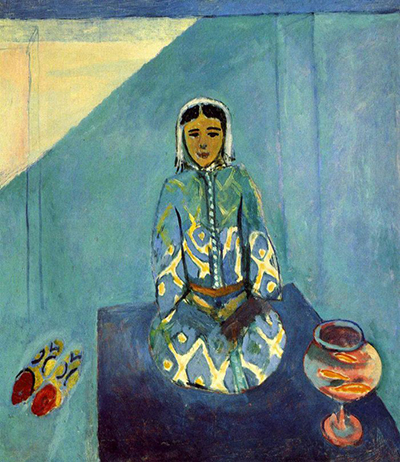
Zorah faces us from the center of a blue-green space. Her patterned clothing spreads over a dark carpet, while a pair of bright slippers lies to one side and a bowl of goldfish glows on the other. A slant of pale light enters at the upper left; the walls and floor are much harder to separate. Henri Matisse painted Zorah on the Terrace during his second stay in Tangier, 1912–13 . The Pushkin State Museum of Fine Arts owns this oil on canvas , 115 × 100 centimetres , inventory Ж-3396 . It is the central picture of the Moroccan Triptych . [1] [2] [3]
The scene has a named sitter and several recognizable objects, yet its spatial setting is spare. Matisse gives us enough to see Zorah seated with her shoes set aside and a fishbowl nearby. He lets blue and green loosen the boundaries around them. The painting's calm appearance comes from that arrangement of large color areas and small warm accents, rather than from a story that can be read in Zorah's expression.
At a Glance
- Artist Henri Matisse
- Work Zorah on the Terrace
- Date 1912–13
- Explore Painting
This work across Henri Matisse’s career
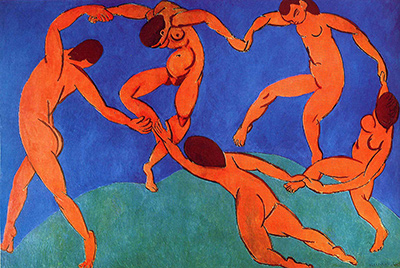
Dance (1910)
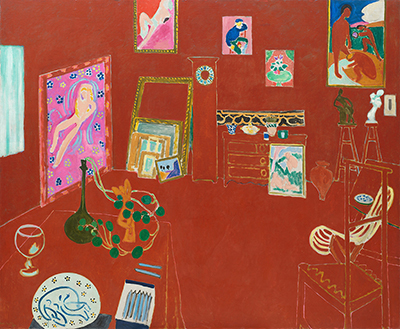
1910The Red Studio
1911The Piano Lesson
1916The Snail
1953Contents
- What makes the space difficult to place?
- How does Zorah hold the center?
- Why do the slippers and fishbowl matter?
- When was the painting made?
What makes the space difficult to place?
Two wall-like planes meet behind Zorah. A few upright lines and a shift in color suggest a corner, but they do not clearly mark the exact point where the floor begins. The dark, nearly rectangular shape under the figure can be read as a carpet. Around it, cooler blue-green paint lets her seem both grounded and oddly suspended. The former Museum of Modern Western Art's curatorial description calls attention to this disappearing floor-wall junction. [2]
The title tells us that Zorah is on a terrace. It does not tell us which terrace or whether the image records a precise rooftop. The National Gallery of Art's 1990 education packet allows for a rooftop terrace or a courtyard corner. That uncertainty fits what we see: there is an angled patch of light, an enclosed feeling and very little architectural detail. A definite claim about a particular building would give the picture a certainty it does not supply. [4]
Light and shade are clearer than architecture. A pale yellow triangle crosses the upper left, then stops against the blue-green field. Zorah and the carpet occupy the cooler portion. This diagonal makes the whole setting feel lit from outside the frame. It also sets a different triangle across the lower half: slippers at left, fishbowl at right and Zorah's head above them. The National Gallery's packet points out that compositional balance. Matisse makes a very still scene active through these angled relationships. [4]
The blue-green is not one flat color. It moves from a darker, denser carpet to lighter turquoise and muted green around Zorah's shoulders. A dark band at the top holds the wide canvas together; thin vertical marks hint at walls without enclosing the figure firmly. The painting can feel expansive and enclosed at once. Much of the openness comes from how color travels across surfaces that would be divided more strictly in a descriptive interior.
How does Zorah hold the center?
Zorah is shown frontally, her face small above the broad shape of her clothes. A light covering outlines her dark hair and face. Her garment carries large yellow and pale forms over blue, with long sleeves spreading into the central area. The pattern draws the viewer down from her face to the carpet and back up again. Her body is present, but Matisse does not depend on detailed modeling of arms and legs to make the pose legible.
The face is direct and comparatively reserved in color. Dark eyes, brows and hair stand against warmer skin tones and the pale edge of the head covering. Looking at it can invite a guess about what Zorah thinks or feels. The canvas records her pose and gaze; it does not give access to her private state. The stronger claim is visual: her still frontal form anchors a setting whose surrounding planes are deliberately hard to fix.
Zorah was a real Moroccan model who posed for Matisse during his Tangier work. Pushkin's Morozov research says she also worked at a hotel and posed more than once in 1912 . MoMA calls her the model for the triptych's central painting. Those institutional accounts support her identity and repeated role in his work. They do not establish the exact age, family story, sexual history or supposed rooftop workplace asserted by the older version of this page. Her name belongs in the painting's account without turning uncertain biography into fact. [5] [3]
Matisse made other images of Zorah, including a separate standing portrait. The existence of more than one pose helps explain why this panel should not be treated as an accidental encounter. Here he gives her a central, stable position in a three-part work. The variation among related portrayals concerns pose, clothing and setting; it should not make the sitter into a generic symbol detached from the individual who modeled for him.
Watch: Matisse’s art and working methods
Choose a museum film or a close reading to continue exploring Matisse’s work.
Matisse: “For Me It’s Always New”
The Museum of Fine Arts, Boston considers Matisse’s creative practice.
Watch on YouTubeWhy do the slippers and fishbowl matter?
At the lower left, the slippers— babouches in the museum archive's terminology—lie apart from Zorah. They are small, yet their warm red and yellow make them conspicuous against blue-green ground. Across the painting, the round fishbowl carries another concentration of orange and red. The two bright passages balance each other below the more subdued face and garment. Their size would hardly dominate a room, but in this limited palette they are strong visual markers. [2] [4]
The slipper forms can almost resemble lively fish shapes, an analogy made in the former Museum of Modern Western Art's account. That comparison works as a way of looking across the canvas, not as a claim that the objects have changed identity. Left and right answer one another: one pair of objects is dry and set aside, the other round and filled with water and moving fish. Their warm colors draw the eye outward from Zorah and then return it to her place between them. [2]
Goldfish recur in Matisse's paintings of this period. An Art Institute of Chicago study discusses them across several works and names Zorah on the Terrace and the separate Arab Café as two Moroccan examples. The study reads the bowl as an object of contemplation. That is an interpretation of how the motif works in the paintings; it does not prove what Zorah was thinking during a sitting. In this composition, the bowl also supplies a transparent, curved form against the broad blue planes. [6]
Its orange-red color is unusually concentrated. The pale lit patch at the upper left creates one kind of warmth, while the fish and their bowl create another at the lower right. These areas keep the dominant blue-green from becoming monotonous. The patterned garment makes an additional bridge: its yellow shapes have some of the brightness of the slippers and the light, while its blue belongs to the walls and carpet. The figure is thus connected to both the cool setting and the warm accents.
When was the painting made?
The current Pushkin object record dates Zorah on the Terrace 1912–13 . MoMA's detailed chronology places On the Terrace among paintings of Matisse's second Tangier stay , which began in October 1912 and ended in mid-February 1913 . These records support the period, but not a precise January 1913 completion date. An older Museum of Modern Western Art archive gives 1912 and slightly different height, 116 centimetres rather than the owner's current 115 . For the public headline and dimensions, the current owner record is the controlling source. [1] [7] [2]
During those visits Matisse painted Tangier's people, interiors and architecture. The three triptych pictures do not show one continuous scene. Landscape Viewed from a Window looks out toward the city and bay from a hotel window; The Casbah Gate looks through a heavy arch toward the old city; Zorah on the Terrace centers a person within a blue-green enclosure. MoMA's exhibition account places this Zorah canvas between the two views. The motifs differ, but blue and the experience of looking into or through a space help connect them. [3]
Pushkin's Morozov research says Matisse assembled the three works for the Russian collector Ivan Morozov . That makes the triptych a deliberate grouping, while leaving each canvas its own job. The window opens outward, the gate draws us through a threshold, and Zorah meets us from the center. This middle panel does not need an invented narrative about the sitter to link them. Its person, carpet, light and fishbowl are enough to give the group a human focus. [5]
Return to the upper-left light, then let your eye follow the color down to the slippers and across to the fishbowl. Zorah remains the fixed point between these moving accents. That arrangement is what gives the portrait its particular force: a named sitter stays unmistakably present even while the room around her slips toward color. See View from the Window, Tangier and The Casbah Gate for the other triptych panels, or Goldfish for another treatment of the fish motif.
Explore 113 Matisse artworks
This directory covers the 113 individual works explored in these articles, rather than a complete catalogue of Matisse’s output. Cut-paper designs and prints appear under Drawing in the medium filter; each row names its form. Dates retain the qualifications explained in the linked articles.
Discussion
Look again at the images and ideas explored in Henri Matisse, Zorah on the Terrace , 1912–13. These editorial prompts invite your observations.
Reader Insights
What makes the space difficult to place?
Which comparison discussed in the article helps you see the work differently?
How do the materials and historical setting affect your reading?
Join the Conversation
Share a detail, comparison or question about Henri Matisse, Zorah on the Terrace , 1912–13 below.
References
- Pushkin State Museum of Fine Arts , Zorah on the Terrace , current owner date, medium, dimensions, inventory and accession. View source .
- Museum of Modern Western Art archive , Zorah on the Terrace , historical object record and curatorial interpretation of color, carpet, slippers and fishbowl. View source .
- Museum of Modern Art , Matisse in Morocco exhibition release, Zorah and central triptych panel. View source .
- National Gallery of Art , Matisse in Morocco teachers' packet (1990), visual reading and uncertainty over terrace or courtyard setting. View source .
- Pushkin State Museum , Morozov collection research on the Moroccan Triptych, Zorah's modeling and Matisse's triptych assembly. View source .
- Art Institute of Chicago , Woman before an Aquarium and Woman on a Rose Divan study, recurring goldfish motif and Moroccan comparison. View source .
- Museum of Modern Art , Henri Matisse's Travels in Morocco chronology, second Tangier stay and On the Terrace . View source .
 Henri Matisse.jpg)