 by
Tom Gurney
Tom Gurney BSc (Hons) is an art history expert with over 20 years experience
Email:
tomgurney1@gmail.com
/ Phone:
+44 7429 011000
Henri Matisse, Composition (The Yellow Curtain), 1915: Introduction
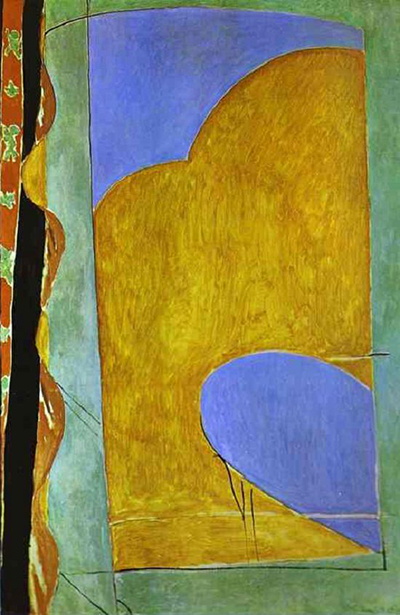
A great irregular yellow form fills the center of Henri Matisse's Composition. Blue opens above it and returns in a smaller shape below; a dark strip and a wavering warm-colored edge run down the left. At first the canvas can look like an arrangement of colored areas with almost no recognizable subject. The window in Matisse's home at Issy-les-Moulineaux is nevertheless its starting point. Notes taken during a later interview with the artist connect the blue to the sky and a glass canopy, the green to a window frame and trees, and the left-hand fabric to a curtain. The picture asks the viewer to move between those observed things and the large shapes they became in paint.[1]
The Museum of Modern Art in New York now catalogues the painting simply as Composition, made in 1915, oil on canvas, 146 × 97 centimetres, accession 355.1997. The page title preserves its better-known yellow-curtain name. MoMA's provenance records it as Le Rideau jaune at a 1931 Paris exhibition; the museum's 1997 acquisition announcement used The Window/The Yellow Curtain. These titles identify the same work from different moments. The record does not establish a simple story in which Matisse formally replaced one title with another on a known date.[1][2]
At a Glance
- Artist Henri Matisse
- Work Composition (The Yellow Curtain)
- Date 1915
- Explore Painting
This work across Henri Matisse’s career
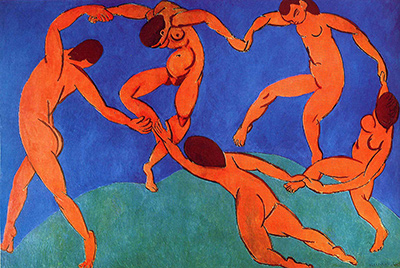
Dance (1910)
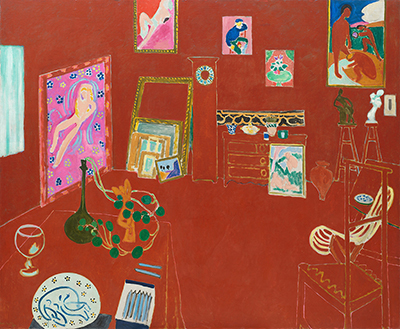
1910The Red Studio
1911The Piano Lesson
1916The Snail
1953Contents
- What is the viewer looking through?
- How do the colors hold the image together?
- Was the painting improvised or extensively revised?
- Which earlier window painting is closest?
- What happened to the canvas after 1915?
What is the viewer looking through?
MoMA's label draws on notes from a 1931 interview with Matisse. They describe a view from a curtained window in his Issy house. A blue glass canopy covered the front door outside; the window frame's green suggested trees beyond; the contrast of trees and sky prompted the large yellow mass. The notes also say the curtain itself was red, its lining was yellow and Matisse added the pattern. This is valuable evidence of how he later explained the scene, but it is a record of an interview sixteen years after the painting, not a photograph of the view or a diary of every 1915 decision.[1]
The composition gives almost no conventional distance markers. We cannot follow a path through a detailed garden, identify a row of trees by trunk and branch, or see the front door rendered as an architectural drawing. Instead, blue and yellow touch across a broad curved edge. The green surrounds them in thinner passages, functioning as frame and color at once. The window's ordinary job is to separate room from exterior. Here its parts interlock so closely that the curtain, frame, sky and view all help shape the same nearly flat surface.
In its 1997 acquisition release, MoMA described the yellow view as flowering acacia trees. That account gives a concrete way the museum has understood the garden, while the later label stresses Matisse's remembered sensation of green trees against blue sky. The image alone cannot verify the species. It is more revealing to ask why a tree-filled view has become such a large, uninterrupted yellow body. The painting gives the contrast and force of the experience priority over identifying individual branches.[2][1]
How do the colors hold the image together?
The yellow rises from near the bottom of the central opening and swells toward the upper right. Its edge dips below the blue at upper left, then climbs into a high rounded curve. Lower down, a second blue area pushes in from the right, taking a bite-shaped space out of the yellow. This makes the yellow appear to move around blue at two different heights. What might be sky and canopy in the remembered view becomes a sequence of colored intervals across the canvas.
The left side prevents that broad center from becoming a detached abstract emblem. A narrow patterned red-orange strip borders the canvas, followed by a deep dark vertical. Just inside it, a warm curtain edge bends and swells. Small green pattern marks on the outer strip and glimpses of yellow along the fabric support the 1931 account of a red curtain with yellow lining. The dark band gives the soft shapes a firm side, but the curtain's uneven edge keeps the frame from feeling architectural or rigid.
At the bottom and right, pale green-blue paint borders the brighter center. A few thin dark strokes cross these passages. They look fragile beside the large masses and make the picture's drawn structure visible without describing each object in detail. The canvas is not a smooth print of flat shapes: subtle changes in the yellow surface, narrow overlaps and exposed marks reward close looking. The small reproduction can show their placement, though it is not sufficient for a technical account of pigments or paint layers.
The current title, Composition, emphasizes this ordering of forms. The historical yellow-curtain title points back to an object within the scene. Each helps with a different first look, and neither cancels the other. A viewer can begin by locating the curtain at left, then see how its long dark and warm edges balance the sweep of yellow across the center. The abstract organization does not make the observed window irrelevant; it is the means by which Matisse makes the window's colors felt.[1]
Watch: Matisse’s art and working methods
Choose a museum film or a close reading to continue exploring Matisse’s work.
Matisse: “For Me It’s Always New”
The Museum of Fine Arts, Boston considers Matisse’s creative practice.
Watch on YouTubeWas the painting improvised or extensively revised?
MoMA's label for its Matisse: Radical Invention, 1913–1917 exhibition notes that many canvases from these years went through substantial revision. It describes this painting as a return to a mode in which Matisse drew the composition and then filled it with color, giving the result freshness and immediacy. That is an object-specific distinction from some of his more visibly reworked paintings of the period. It does not prove that every stroke was completed in one session or that he made no adjustment at all.[1]
The firm curving boundaries make that approach plausible to the eye. Yellow and blue meet along clear, decisive arcs; the central fields are broad enough to register as single relationships rather than many small color notes. Yet the left curtain has its own irregularities and the thin dark marks do not disappear beneath an entirely finished-looking surface. The effect is lively rather than mechanical. A simple initial drawing and large color areas could still demand careful choices about where a curve begins, how far it rises and how much blue remains.
The painting belongs to a period when Matisse tested unusually spare ways to construct an image. MoMA's 1914 View of Notre Dame, made from a Paris studio rather than the Issy house, compresses another observed view beneath blue paint and visible earlier marks. It shows that Matisse could make a place recognizable through relatively few cues, but its documented reworking differs from the method MoMA describes for Composition. The comparison concerns two ways of reducing a view, not a claim that they show the same window or share a hidden preparatory sequence.[3][1]
Which earlier window painting is closest?
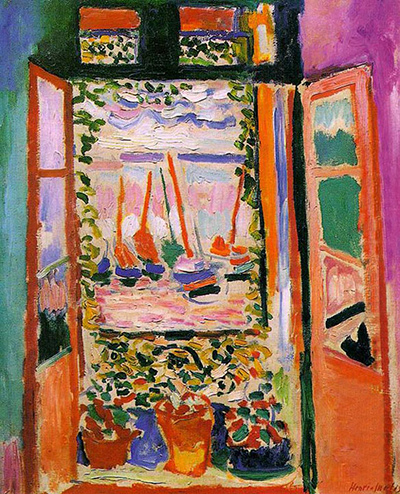
The Centre Pompidou holds Matisse's Porte-fenêtre à Collioure of 1914, a vertical canvas built around an almost black central opening. In an owner-published essay, curator Isabelle Monod-Fontaine treats the later yellow curtain as a close counterpart. She notes the shared three-part organization of left edge, window and right edge, then argues that the 1915 painting makes the structure more supple through the curtain's wavering border and the large arcs beyond it. This is a documented visual comparison, not evidence that the Collioure canvas was a literal study for the Issy one.[4]
The difference is striking. The 1914 window's central darkness can make looking outward feel blocked or uncertain. In Composition, yellow and blue seem to flood the opening, while the red curtain both marks the room and enters the field of the view. The two works show how the simple device of a window could support very different accounts of space and sensation. The later painting is not more realistic because Matisse could name its source in 1931; it is more openly colored and curving despite retaining the same basic problem of inside and outside.
A nearer domestic comparison is The Blue Window, painted at Issy in 1913. It joins a bedroom dressing table to a view toward Matisse's studio in a continuous blue field. Composition gives the room far fewer identifiable objects and relies more heavily on the curtain and window frame. The blue painting records another view from the property, not necessarily the identical opening. Together they show how Matisse could keep returning to the boundary between domestic space and the world outside while changing nearly every color and compositional decision.[5]
What happened to the canvas after 1915?
MoMA's published provenance traces the work to Alphonse Kann by 1931. During the Nazi occupation, the Einsatzstab Reichsleiter Rosenberg (ERR) confiscated it in October 1940. The museum records a transfer through dealer Gustav Rochlitz and a later sale to Paul Petrides. With Matisse's help, it was returned to Kann in 1946. A French Ministry of Culture record independently associates the work with ERR inventory Ka 1061 under a wartime title meaning “Composition in Blue and Yellow.” These records document a specific episode of looting and restitution; the title used by the confiscators should not be mistaken for Matisse's final preferred title.[1][6]
Subsequent owners and dealers carried the painting through London, Belgium and New York before MoMA acquired it in 1997. The acquisition was later than the work's appearance in MoMA's 1992–93 Matisse retrospective, so exhibition at the museum should not be confused with ownership at that date. MoMA describes its provenance research as continuing; the account here follows its published record and does not claim every interim transaction has been resolved beyond it.[1][2]
Look once more from left to right: patterned curtain, dark vertical, pale frame, blue, yellow, then blue again. The large forms can seem freely abstract until the window account gives them a physical setting; the setting then seems newly strange because so little of it has been described conventionally. Follow The Blue Window for the earlier Issy comparison, or browse the paintings directory and Matisse biography for the broader career.
Explore 113 Matisse artworks
This directory covers the 113 individual works explored in these articles, rather than a complete catalogue of Matisse’s output. Cut-paper designs and prints appear under Drawing in the medium filter; each row names its form. Dates retain the qualifications explained in the linked articles.
Discussion
Look again at the images and ideas explored in Henri Matisse, Composition (The Yellow Curtain), 1915. These editorial prompts invite your observations.
Reader Insights
What is the viewer looking through?
Which comparison discussed in the article helps you see the work differently?
How do the materials and historical setting affect your reading?
Join the Conversation
Share a detail, comparison or question about Henri Matisse, Composition (The Yellow Curtain), 1915 below.
References
- Museum of Modern Art , Composition , object 355.1997, current owner record, 1931 interview notes, 2010 process label and published provenance. View source .
- Museum of Modern Art , 1997 acquisition announcement, historical title, garden interpretation and acquisition context. View source .
- Museum of Modern Art , View of Notre Dame , distinct Paris 1914 window view and reworking. View source .
- Centre Pompidou , Porte-fenêtre à Collioure owner essay, Isabelle Monod-Fontaine's comparison with Le Rideau jaune . View source .
- Museum of Modern Art , The Blue Window , distinct 1913 Issy window painting. View source .
- French Ministry of Culture , Rose Valland database, Composition en bleu et jaune , ERR identification and wartime title. View source .
 Henri Matisse.jpg)