 by
Tom Gurney
Tom Gurney BSc (Hons) is an art history expert with over 20 years experience
Email:
tomgurney1@gmail.com
/ Phone:
+44 7429 011000
Henri Matisse, Draped Nude , 1936: Introduction
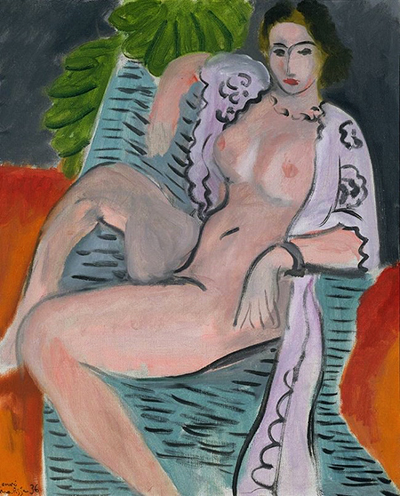
Henri Matisse's Draped Nude places a seated woman close to the viewer. One leg lies across the arm of a blue-green chair; the other extends toward the bottom edge. A pale patterned drape falls from her shoulders and down the right side, partly covering a body painted in pinks, reds and gray-violets. Behind her, broad green leaves interrupt a dark ground. The painting is full of recognizable things—person, fabric, furniture, plant—yet their outlines and colors also make a tight arrangement of curves, stripes and contrasting fields. Its sitter was Lydia Delectorskaya , Matisse's studio assistant and model. [1] [2]
The painting is also titled Femme nue drapée . A museum exhibition organized with Tate identifies it as a 1936 oil on canvas and records that Tate purchased it in 1959 . Christie's later catalogue for a related but different Matisse painting dates this particular canvas more closely, to 6–7 November 1936 . That two-day date belongs to the catalogue's reconstruction of a four-painting sequence; the museum exhibition gives the secure year. These distinctions matter because the old account of this work placed the series in spring and left the sitter's identity unclear. [1] [2]
At a Glance
- Artist Henri Matisse
- Work Draped Nude
- Date 1936
- Explore Painting
This work across Henri Matisse’s career
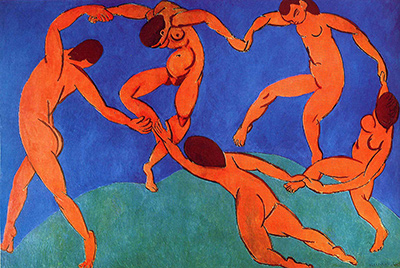
Dance (1910)
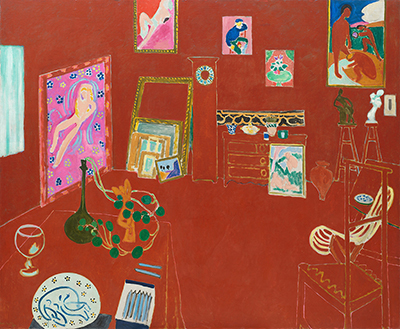
1910The Red Studio
1911The Piano Lesson
1916The Snail
1953Contents
- Who is seated in the chair?
- What holds the figure in place?
- Why did Matisse paint several seated nudes?
- Is this a portrait or a study of pattern?
Who is seated in the chair?
Delectorskaya was a Russian émigré who began working with Matisse in 1932 . The Norton Simon Museum describes her as a trusted studio assistant as well as a model; the Art Gallery of New South Wales notes that she did not begin posing for him until 1934 . She was therefore much more than a person summoned briefly to sit still. In the studio, she helped organize the work around the pictures and became a repeated subject of them. Naming her corrects the anonymity that can make a nude appear to be only a painter's arrangement of shapes. [3] [4]
In this painting she looks outward. Dark hair frames a pale face whose brows, eyes and red mouth remain legible even though the surrounding body is more freely modeled. Her shoulders turn slightly, while the chair holds a more frontal position. One hand hangs over the right armrest. The other side of the pose is less contained: a bent leg rises over the chair's left arm and the opposite leg runs down toward the canvas edge. The pose sets several directions moving at once. Matisse does not need an elaborate room around her to give the body weight and placement.
The title calls attention to the drape, but it does not explain why Delectorskaya is posed this way or what she felt while sitting. The pale cloth exposes as much of the body as it covers. Its black curling border gives the eye another line to follow, from shoulder through lap and down beside the chair. The painting lets a viewer compare a human contour with a textile contour without treating the sitter's mind as a fact available from the image. A direct gaze can feel confrontational or composed; neither response establishes a documented emotion.
What holds the figure in place?
The armchair does more than provide a seat. Its turquoise-blue surfaces run behind the figure and gather again beneath her. Short, nearly black strokes cross the upholstery in repeated rows. At the left, the chair back curves around the raised leg. At the right, the armrest provides a solid ledge beneath the hanging hand. The chair's shape makes the body's unusual angle readable. Remove the striped back and the overlapping limbs would be much harder to place in space.
The chair also competes with the figure. Its repeated dark marks pull attention away from a single skin-colored center and give the lower half of the painting a strong pattern. A dark line under the thigh separates flesh from upholstery, while the pale drape forms another vertical division on the right. Matisse allows the chair to look like furniture and a patterned field at the same time. The viewer can move between seeing the sitter supported by it and seeing the colors and marks lock together on the flat canvas.
The green plant at upper left adds a different rhythm. Its broad leaves fan outward behind Delectorskaya and reach near her hair and shoulder. Against the almost black upper background, their color feels especially bright. Orange-red areas on either side of the lower chair bring warmth back into a composition dominated by cool upholstery and dark ground. The plant is a visible part of the setting, but no botanical or symbolic meaning is needed to explain its pictorial job: it prevents the dark background from becoming an empty wall and balances the pale drape on the opposite side.
Matisse shifts between firm outlines and softer joins. The face is bounded enough to retain individual features. The arm, hand and thighs turn through changes in pink, gray and red rather than through detailed anatomical shading. The upholstery's black hatching remains much more regular than the body's painted transitions. This mixture makes the scene neither a conventional portrait in a carefully measured room nor a fully flat arrangement. Christie's description of the 1936 sequence similarly singles out Tate's canvas for its recognizable face, foreshortened limbs and slight recession in the chair. [2]
Watch: Matisse’s art and working methods
Choose a museum film or a close reading to continue exploring Matisse’s work.
Matisse: “For Me It’s Always New”
The Museum of Fine Arts, Boston considers Matisse’s creative practice.
Watch on YouTubeWhy did Matisse paint several seated nudes?
Christie's catalogue identifies four closely related canvases of Delectorskaya in an armchair made during November and December 1936 . It places a lightly handled Nu au fauteuil et feuillage , now associated with Musée Matisse in Nice, on 3–5 November . Tate's Femme nue drapée follows on 6–7 November . A third picture comes after a short pause, and the last, Nu assis, fond bleu , was worked on from 16 November to 6 December . These dates replace the legacy page's vague “spring” chronology with a specific, attributed account. [2]
The four works reuse a seated model, chair, plant and pieces of cloth, but repeating the subject gave Matisse opportunities to test different relations among them. In Tate's painting, the body still has a clear seated position: an armrest supports the hand, another catches a leg, and the face keeps the sitter's particular features. Christie's describes the final blue-background canvas as flattening the furniture and foliage into more condensed, patterned shapes. That final canvas is a separate object. Its bolder abstraction helps show what Tate's painting preserves, rather than making Tate's version merely an unfinished step toward it. [2]
The sequence also follows an earlier sustained collaboration. In 1935 , Delectorskaya posed for Matisse's Large Reclining Nude , often called The Pink Nude , now at the Baltimore Museum of Art. Christie's account notes that she photographed stages of that canvas as he revised it. The Baltimore museum lists it among major works in the Cone Collection. The 1935 reclining nude and this 1936 seated nude are not versions of the same painting: their formats and poses differ. They do, however, show how the same studio partnership could support several distinct solutions to the problem of depicting a body in a painted space. [2] [5]
Is this a portrait or a study of pattern?
The painting supports both readings. Delectorskaya's face makes her presence particular. The chair, cloth and foliage repeat curves and stripes around her so insistently that the picture also invites comparison of forms. The word “nude” in its title names a long-standing art subject; “draped” points to the cloth that turns that subject into a play between covered and uncovered areas. Neither word should erase the sitter's identity or turn every painted object into a coded story.
Look first at her face, then follow the drape's black edge toward the lower right. Return along the chair's horizontal marks and the line beneath the raised thigh. Those paths explain how Matisse keeps a complex pose clear in a small, compressed setting. The painting's energy comes from the tension between a body that appears to occupy a chair and colors that insist on their life as paint. The later seated nudes shift that balance, but this canvas has its own precise arrangement of person, fabric, foliage and furniture.
For another work made with Delectorskaya, see The Pink Nude . The paintings directory places Draped Nude among Matisse's changing approaches to figures and interiors.
Explore 113 Matisse artworks
This directory covers the 113 individual works explored in these articles, rather than a complete catalogue of Matisse’s output. Cut-paper designs and prints appear under Drawing in the medium filter; each row names its form. Dates retain the qualifications explained in the linked articles.
Discussion
Look again at the images and ideas explored in Henri Matisse, Draped Nude , 1936. These editorial prompts invite your observations.
Reader Insights
Who is seated in the chair?
Which comparison discussed in the article helps you see the work differently?
How do the materials and historical setting affect your reading?
Join the Conversation
Share a detail, comparison or question about Henri Matisse, Draped Nude , 1936 below.
References
- Yokohama Museum of Art , Nude: Art from the Tate Collection exhibition press release, Tate-collaborative caption for Draped nude (Femme nue drapée) , medium, 1936 date and 1959 purchase. View source .
- Christie's , Nu assis, fond bleu catalogue essay, 2014 account of the four related 1936 canvases, Lydia Delectorskaya and the 6–7 November date for Tate's separate Femme nue drapée . View source .
- Norton Simon Museum , “Matisse's Homage to Catherine Viviano”, Delectorskaya's studio roles and a distinct 1936 drawing. View source .
- Art Gallery of New South Wales , Matisse audio experience, account of Delectorskaya beginning to pose in 1934. View source .
- Baltimore Museum of Art , Cone Collection overview, collection identification of the separate 1935 Large Reclining Nude / The Pink Nude . View source .
 Henri Matisse.jpg)