Henri Matisse.jpg)
 by
Tom Gurney
Tom Gurney BSc (Hons) is an art history expert with over 20 years experience
Email:
tomgurney1@gmail.com
/ Phone:
+44 7429 011000
Henri Matisse, Blue Nude (Souvenir de Biskra), 1907: Introduction
Henri Matisse's Blue Nude (Souvenir de Biskra) fills a wide canvas with a reclining woman who seems too forceful to settle into a conventional resting pose. One arm bends behind her head, her legs fold across the lower half, and dark blue marks break the pale skin into weighty planes. Palms rise behind her, yet the body presses toward the front of the picture rather than receding into a landscape. The painting offers a remembered setting and a closely worked human form at once. It asks viewers to look at how the body is made in paint, not simply to identify where the figure lies.[1]
The Baltimore Museum of Art owns the canvas as Blue Nude, dated 1907. It is oil on canvas, measuring 92.1 × 140.3 centimetres, and belongs to the Cone Collection under accession 1950.228. Souvenir de Biskra, often translated as Memory of Biskra, is a historical extension of the title that appears in the museum's exhibition record. That fuller name is useful here because Matisse later made four quite different seated Blue Nude cut-outs in 1952. This page concerns the large reclining painting, made about forty-five years earlier.[1][2]
At a Glance
- Artist Henri Matisse
- Work Blue Nude (Souvenir de Biskra)
- Date 1907
- Explore Painting
This work across Henri Matisse’s career
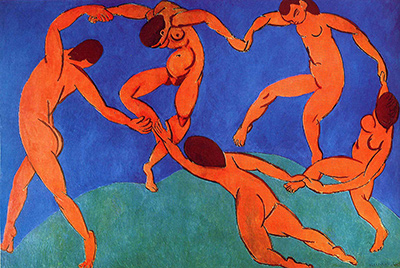
Dance (1910)
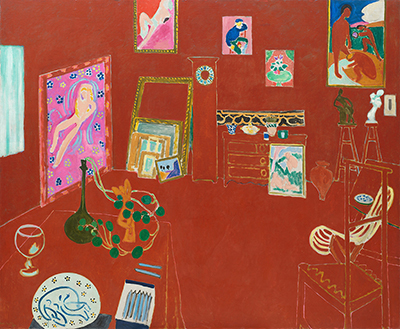
1910The Red Studio
1911The Piano Lesson
1916The Snail
1953Contents
- What do you see first in the painting?
- Why is Biskra in the title?
- How did sculpture affect this painted body?
- Is Blue Nude still a Fauvist painting?
- How was it received in 1907?
- What happened at the 1913 Armory Show?
- How did it reach Baltimore?
- How does it relate to Matisse's later nudes?
- Annotated details
What do you see first in the painting?
The figure reaches almost from side to side. Her head is at the upper left, propped by a sharply angled arm. The torso twists through the centre, while the lower limbs turn back across the foreground. There is little empty canvas around her. Even the gaps between arm, body and legs are active shapes, filled by dark paint or fragments of vegetation. The pose is recognizable as a reclining nude, a long-established subject in European painting, but it gives neither the easy horizontal line nor the smooth, uninterrupted skin often associated with that tradition.
Blue does more than tint the scene. Along the body, dark and mid-blue strokes describe hollows, edges and sudden changes of direction. Pale pinks and lighter flesh tones seem to push forward against them. The abdomen, chest, hip and knees therefore appear as separate masses that meet under pressure. MoMA's retrospective guide describes this alternation of blue shadow and pink highlight as a way of carving volume with color. Seen closely, the effect is unstable: a blue stroke may read as a shadow on skin in one place and as a contour pushing the body into its surrounding field in another.[3]
The hands and feet resist a tidy anatomical reading. Their size and angle change as the eye travels around the figure. A bend of the arm can feel plausible as a gesture while its exact position in space is hard to reconstruct. MoMA notes this conflict between a weighty body and distorted extremities viewed from different angles. Matisse was not simply failing to observe anatomy; the painting uses altered proportions and emphatic brushwork to make a body that holds the canvas together. That reading is supported by the visible difference between the firm central masses and the less settled ends of the limbs.[3]
Behind the figure, upright palm forms offer a thin screen of place. They do not create a deep, mapped landscape with a path for the eye to enter. The upper field is broken into greens, yellows and dark passages, so foliage and ground sometimes merge. The nude can appear to sit in front of the palms while sharing their coarse, angular paint. Looking from body to background and back again makes the space fluctuate. The figure is both conspicuously present and inseparable from the colored surface around her.
Why is Biskra in the title?
Biskra is a city in Algeria. Matisse had travelled to Algeria in 1906, and the Baltimore Museum says the palms recall what he saw there. It also places the making of this painting in Collioure, France, in the early months of 1907. The title therefore points to a remembered experience rather than identifying the canvas as a view painted in Biskra. “Souvenir” is an apt word: the vegetation provides an association, while the painting's main labor is the construction of the reclining figure.[1]
The name gives the scene an apparent geographical precision that the canvas itself does not supply. There is no documented landmark that allows this background to be matched to a particular site in the city. The palms signify a place for Matisse, but they also belong to a European pictorial habit of turning North African locations into imagined settings for the nude. Algeria was under French colonial rule when he travelled there. That context matters when reading the image: a French artist's recollection of a colonized place is a viewpoint, not a transparent account of that place or its people.
The Baltimore Museum describes Matisse's interest in African sculpture as another influence on the painting's emphatic form. “African sculpture” covers many traditions and objects, and the record does not identify one sculpture copied in this canvas. It is safer to hold the museum's broad account beside what can be seen: a body built from forceful shapes, dark contours and shifts of color, with vegetation recalling a separate journey. The two claims, about sculptural form and Algerian memory, help frame the work without turning every bend of the figure into evidence of a specific source object.[1]
The distinction also changes how to read the title. Memory of Biskra names an artistic reconstruction, not the sitter's identity. The owner record does not name the model, and the picture does not invite a biographical portrait reading. Treating the woman as an anonymous emblem of a place would obscure the painted body's formal complexity. Treating the palms as irrelevant decoration would overlook why the historical subtitle persisted. Matisse brought a remembered landscape and a studio problem together on one canvas; the resulting image does not reduce neatly to either one.
Annotated Details from Blue Nude (Souvenir de Biskra)
The numbered points identify visible features discussed in this article. Return from each detail to the whole composition. Blue Nude (Souvenir de Biskra) — Henri Matisse
.jpg)
Details from BLUE NUDE (SOUVENIR DE BISKRA)
Compare the cropped details with the complete images above. Notice how their colours, shapes and positions contribute to the larger compositions.
Head and bent arm
The head and bent arm form a compact group of curves. Blue-green shadows give the pale body weight against the darker foliage.
 Detail 01 head-and-bent-arm.jpg)
Torso and ground
The body nearly fills the width of the canvas, while cool strokes below it keep flesh and ground visibly connected.
 Detail 02 torso-and-ground.jpg)
Folded legs
The legs turn back toward the torso. Dark contours make their folded position compete with the surrounding painted colour.
 Detail 03 folded-legs.jpg)
How did sculpture affect this painted body?
MoMA's 1992 retrospective guide says Matisse derived the reclining pose from a small clay sculpture he was making at the time. He had already been sculpting for several years and treated the medium as a complement to painting. The Baltimore Museum later brought Blue Nude into its 2007 exhibition Matisse: Painter as Sculptor, alongside versions of reclining nudes in bronze and later canvases. These sources support a close relationship between the painting and Matisse's sculptural practice. They do not turn the oil canvas into a copy of a finished bronze or establish that every contour was transferred mechanically from clay.[3][4]
A sculpture can be turned, viewed from changing positions, and felt as a mass occupying space. This painting suggests that experience through its accumulated volumes: a raised shoulder, a projecting hip, heavy bent legs. Yet it must also work on a flat, fixed surface. The blue shadows and pink highlights make rounded flesh appear solid, while broad strokes and unusual angles continually return the viewer to the painted plane. MoMA's guide makes exactly this double observation, describing a figure that seems carved out and flattened at the same time.[3]
The bent upper arm shows the problem in miniature. It gives the head support and closes a strong shape above the body. As a bodily gesture it suggests depth: the elbow and hand must occupy different positions in space. As an arrangement of paint, the arm is also a loop that holds the top-left area of the canvas. Likewise, the legs can be read as weight bearing down toward the foreground, or as crossing bands that keep the composition moving sideways. The same form serves bodily and pictorial needs, which is one reason the pose feels tense rather than restful.
The Baltimore Museum calls the work a response to nineteenth-century idealized nudes. That is convincing as an account of its deliberately rough surface and unconventional anatomy, though the painting still takes a subject inherited from that tradition. Matisse did not need to abandon the nude to change its terms. He made the sitter's body large, resistant to an effortless glance, and visibly shaped by choices about color and brushwork. The result is an image of a human figure and a demonstration of how difficult it is to make that figure occupy a modern painted space.[1]
Watch: Matisse’s art and working methods
Choose a museum film or a close reading to continue exploring Matisse’s work.
Matisse: “For Me It’s Always New”
The Museum of Fine Arts, Boston considers Matisse’s creative practice.
Watch on YouTubeIs Blue Nude still a Fauvist painting?
Matisse had become associated with Fauvism after the bright and dissonant paintings he showed in 1905. The Baltimore Museum places Blue Nude at the end of that period. MoMA's 1992 guide treats 1907 as a turn toward sustained study of the figure. Those descriptions are compatible if “end” means a change of emphasis rather than a clean switch of styles. The strong color remains, but it now builds a single body that dominates the picture.[1][3]
The blue is especially revealing. It is not naturalistic local color for skin, yet it helps explain the body's volume. Its stripes and patches work against the pale flesh and the darker setting. In a conventional rendering, a shadow might disappear into the illusion of three-dimensional flesh. Here the blue insists on its identity as paint. It lets the viewer see both a modeled torso and the colored marks that produce that torso. This tension between volume and visible surface, rather than a simple move from “wild” color to restrained modelling, makes the work a turning point.
The Baltimore Museum relates the painting's blue and solidity to Paul Cézanne, who had died in 1906 and whose work Matisse admired. That is the museum's interpretive account of a homage, not evidence of an inscription naming Cézanne on the canvas. The comparison is most useful when kept specific: weight, construction and the use of color to bind a form together. It does not require the figure to look like a Cézanne nude in every detail. Matisse's sharp distortions and palm-filled background give the painting its own, less stable space.[1]
Subsequent work helps reveal what was still unresolved here. MoMA's retrospective guide points to the simplified monumental figures of Le luxe and Bathers with a Turtle, painted after Blue Nude. In those later pictures, broader areas of color and firmer outlines take over some of the work done by dense blue and pink modelling here. This is a comparison across Matisse's changing practice, not a claim that he discarded the 1907 canvas as a failed experiment. It shows several ways he kept testing what a figure could do on a flat surface.[3]
How was it received in 1907?
The painting first appeared at the Salon des Indépendants in Paris, which ran from 20 March to 30 April 1907. The Baltimore Museum records a hostile response from critics and visitors, who saw ugliness in its forceful treatment of the nude. That reaction makes sense of the formal challenge without making public hostility a measure of artistic value. Viewers used to smoothed skin and a stable pose encountered an oversized body whose color and shape refused those expectations.[1]
The early date matters in another common comparison. Blue Nude and Picasso's Les Demoiselles d'Avignon both belong to 1907, but MoMA's account places Matisse's painting before Picasso began work on the latter. It is therefore misleading to describe this particular painting as a response to Demoiselles. Later works can be discussed in relation to that exchange; the chronology of this canvas needs to stand on its own. Its immediate context includes Matisse's clay work, his 1906 travel, Cézanne's recent death and the 1907 Salon, all of which have direct support in the museum accounts.[5][1]
Leo and Gertrude Stein acquired the painting in 1907, according to the Baltimore Museum's provenance. Their possession did not erase its controversial reputation, but it began a documented path through the collections of people who took modern painting seriously. The early acquisition also reminds us that “the public” was never of one mind. Hostile reviews and committed private interest could coexist around the same work.[1]
What happened at the 1913 Armory Show?
Six years later, Blue Nude travelled with the International Exhibition of Modern Art, usually called the Armory Show. The Baltimore Museum lists it in New York, Chicago and Boston in 1913. In Boston it was shown under the title The Blue Woman; the museum's exhibition history also records that English title in the Armory Show circuit. The changing name demonstrates how a work now commonly identified by a French subtitle moved among languages and audiences. It did not become a new painting when the label changed.[1]
Its reception in Chicago produced a durable story. The Baltimore Museum states that students at the Art Institute of Chicago burned a reproduction of the painting in protest. The distinction is essential: the original oil canvas survived and remains in Baltimore. The incident reveals how strongly the image could function as a public symbol of modern art, but it should not be retold as physical damage to Matisse's work. Nor does a single stunt stand for every visitor's response to the exhibition.[1]
The shift from the Paris Salon to the travelling American show also changed the terms of attention. In Paris the work could be judged against familiar expectations for the nude and against Matisse's earlier color. In the United States it entered a broad presentation of modern European and American art, where viewers argued over unfamiliar approaches to the body and pictorial space. The canvas's visible features stayed the same; the exhibition setting made those features part of a larger public debate.
How did it reach Baltimore?
The Baltimore Museum's ownership record traces the painting beyond the Steins through Alphonse Kann, Georges de Zayas, the Marius de Zayas Gallery and John Quinn. Quinn owned it by 1920. After his death, it appeared in the sale of his collection at Hôtel Drouot in Paris in 1926. This chain matters because it places the picture in an active transatlantic market for modern art, rather than suggesting that it passed directly from its first Paris buyers to the Baltimore museum.[1]
Claribel Cone bought Blue Nude at that 1926 Paris auction. The Baltimore Museum's Cone papers corroborate the purchase and its date. On Claribel's death in 1929, the painting passed to her sister Etta Cone. Etta's 1949 bequest brought it to the Baltimore Museum of Art, which now records it under the accession number 1950.228. The accession number includes a later administrative year; it does not mean Claribel bought the work in 1950 or that Etta lived until then.[1][6]
The Cone Collection is a substantial context for the work's present identity. Baltimore identifies the sisters' collecting as a major source of its Matisse holdings, with hundreds of works spanning paintings, sculpture and works on paper. Within that range, Blue Nude can be seen alongside Matisse's later solutions to the reclining figure. This collection history helps explain why a painting initially criticized in Paris and mocked in Chicago became a central museum object in Baltimore. Its place there was the result of specific choices by collectors, followed by a bequest, not an inevitable rise from scandal to fame.[7]
The museum's exhibition list also shows the title continuing to shift. At a 1931 Paris exhibition, it was listed as Le Nu bleu (Souvenir de Biskra). Earlier American records use The Blue Woman; the present owner uses Blue Nude as the main title. The subtitle is thus historically grounded, while the current collection record remains the soundest source for date, medium, dimensions and accession. A reader can use the full title to find this specific painting without assuming every blue nude in Matisse's work is a version of it.[1]
How does it relate to Matisse's later nudes?
Matisse returned to the reclining female body repeatedly. MoMA's 1992 retrospective guide compares the 1907 canvas with his Large Reclining Nude of 1935, also in Baltimore. The later picture simplifies the figure into clearer contours and gives surrounding spaces more equal force. That difference makes Blue Nude look especially dense: shadows, flesh, limbs and foliage crowd one another, as if the relationships were still being worked out with every stroke. The comparison concerns visual method across decades, not a claim that the women or settings are the same.[3]
The four 1952 Blue Nudes are another, more distant comparison. They are cut-paper works with compact seated figures built from painted blue paper and white gaps. Centre Pompidou's account of the series connects the later works to Matisse's long interest in the nude, while distinguishing their separate objects and owners. The early painting and late cut-outs share a recurring subject and a striking color. Their procedures are different: here, blue strokes model and disrupt a figure painted on canvas; in the cut-outs, the edge of a colored piece and the white space beside it make the body legible.[2]
These works require separate identification. Blue Nude I, Blue Nude II and Blue Nude IV treat individual 1952 works. The earlier Baltimore canvas belongs with the Matisse paintings and connects to the artist's broader biography. Similar titles can guide a comparison, but they cannot substitute for an object's date, materials and visible form.
Return to the painting's arm, bent over the head, and follow it into the shoulder and torso. The blue marks first make the body seem solid, then make its edges difficult to pin down. Look from the folded legs to the upright palms: the body occupies a shallow painted setting that bears the memory of another place. Blue Nude (Souvenir de Biskra) holds these effects together without settling them. Its lasting force lies in that active encounter between sculptural weight, unsettled color, an inherited nude pose and a remembered landscape.
Explore 113 Matisse artworks
This directory covers the 113 individual works explored in these articles, rather than a complete catalogue of Matisse’s output. Cut-paper designs and prints appear under Drawing in the medium filter; each row names its form. Dates retain the qualifications explained in the linked articles.
Discussion
Look again at the images and ideas explored in Henri Matisse, Blue Nude (Souvenir de Biskra), 1907. These editorial prompts invite your observations.
Reader Insights
What do you see first in the painting?
Which comparison discussed in the article helps you see the work differently?
How do the materials and historical setting affect your reading?
Join the Conversation
Share a detail, comparison or question about Henri Matisse, Blue Nude (Souvenir de Biskra), 1907 below.
References
- Baltimore Museum of Art , Blue Nude , accession 1950.228, current owner record, object details, interpretation, provenance and exhibition history. View source .
- Centre Pompidou , “The Secret History of Henri Matisse's Blue Nudes”, distinction between the 1907 painting and 1952 paper works. View source .
- Museum of Modern Art , Henri Matisse: A Retrospective guide (1992), p. 4 for the clay study and painted form; pp. 4 and 8 for later comparisons. View source .
- Baltimore Museum of Art , “The BMA Presents Matisse: Painter as Sculptor ” (2007), painting and sculpture exhibition context. View source .
- Museum of Modern Art , Matisse and Picasso exhibition history, relative chronology of Blue Nude and Les Demoiselles d'Avignon . View source .
- Baltimore Museum of Art , Cone Papers, Claribel Cone's 1926 auction purchase and family collection context. View source .
- Baltimore Museum of Art , modern collection overview, Cone Collection and Matisse holdings. View source .
 Henri Matisse.jpg)