 by
Tom Gurney
Tom Gurney BSc (Hons) is an art history expert with over 20 years experience
Email:
tomgurney1@gmail.com
/ Phone:
+44 7429 011000
Henri Matisse, The Sheaf (La Gerbe): from cut paper to ceramic: Introduction
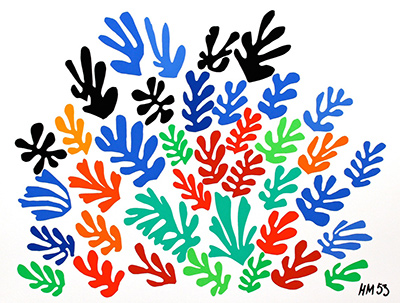
Henri Matisse's The Sheaf spreads coloured, branching shapes across a broad white field. Blue, red, orange, green and black forms rise and fan out without settling into a single stem or a tidy repeated pattern. A small “HM 53” mark appears near the lower edge in the familiar image. The design belongs to 1953 , one of the years in which Matisse's paper cut-outs became monumental. It was made as a full-scale maquette —a working design—for a ceramic wall piece commissioned for a Los Angeles home. [1] [2]
Two related objects must be kept distinct. The paper maquette , now in the Hammer Museum's UCLA collection , is gouache-painted paper cut and pasted onto paper and mounted on canvas; MoMA gives its dimensions as 294 × 350 cm . The ceramic realization , now at the Los Angeles County Museum of Art (LACMA) , is coloured tile embedded in plaster and measures 303.21 × 361 cm in LACMA's current record. They share the design and title La Gerbe , but have different materials, sizes and owners. “The Sheaf” is the English rendering of the French title. [1] [3]
At a Glance
- Artist Henri Matisse
- Work The Sheaf (La Gerbe)
- Date 1953
- Explore Cut paper and drawing
This work across Henri Matisse’s career
Dance (1910)
1910The Red Studio
1911The Piano Lesson
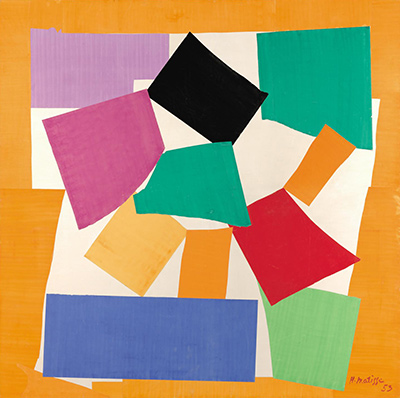
1916The Snail
1953Contents
- What do the coloured shapes show?
- Why was The Sheaf made?
- How did a paper cut-out become a mural?
- What changed from the Brody home to LACMA?
- How does it compare with another design from the commission?
- Where can I see The Sheaf?
- Annotated details
What do the coloured shapes show?
The picture invites several readings at once. Some shapes resemble leaves or fronds, with a central length and short projections to either side. Others are wider and look almost like open hands. A cluster may suggest flowers or sea plants. The title points toward a gathered bundle, but the shapes do not specify one botanical species. What matters most on the surface is how Matisse sets their varied outlines and colours into a rising, spreading rhythm. The white field remains open between them, giving each shape a clear edge and letting the eye move through the group rather than across a solid block.
The lower area holds more greens, reds and orange, with several forms seeming to grow up and outward. Higher up, black and bright blue shapes spread across both sides. Matisse does not build the composition as a mirror image. One side reaches farther, and the branches do not repeat at exactly the same intervals. This unevenness keeps the cluster lively. The empty white spaces between tips are as important as the coloured pieces: they stop the forms from merging and make the viewer notice each new direction.
The colour arrangement is equally varied. A blue shape may be near black in one part of the field and near orange or green elsewhere. Several red pieces cluster, yet they are not confined to one stripe. Because the shapes are flat, colour is not used to shade leaves into three-dimensional realism. Instead, it separates one form from its neighbour and makes a new visual path across the surface. At a distance the entire group gathers into a bouquet-like burst; closer looking breaks it back into individual, differently cut pieces.
The white background does not depict a landscape, table or vase. There is no painted ground line to tell us where this “sheaf” stands. The design therefore can fill an architectural wall without making the viewer look through it into a fictional room. On the original Brody patio, the shapes would have met actual surrounding walls, light and plants. In the paper maquette, white space lets Matisse test how the coloured group would read at the scale of that wall. [2] [3]
Why was The Sheaf made?
Los Angeles collectors Sidney and Frances Brody approached Matisse in 1952 about a work for the courtyard of their new home, designed by architect A. Quincy Jones . LACMA describes the eventual ceramic as Matisse's only West Coast commission. It was conceived for a particular architectural setting rather than produced as a generic canvas to be hung anywhere. Its generous horizontal spread and strong colour would have to work at the scale of a patio wall. [2] [3]
The accepted design was not Matisse's first proposal. LACMA's account says he showed the Brodys a full-size paper cut-out when they visited him at Cimiez, Nice , in May 1952 . They rejected it and accepted a later design, La Gerbe . The first composition became associated with Apollo : its paper version is in the Moderna Museet, Stockholm , and a separate ceramic realization is in the Toledo Museum of Art . That history matters because it shows a real choice within the commission. Apollo was not an earlier name for The Sheaf , and the two ceramics belong to different collections. [2] [4] [5]
An architect's courtyard asks an artwork to live with changing light, weather, movement and the proportions of walls. We cannot reconstruct every moment of Matisse's negotiation from the finished image, but the commission explains why its scale and transfer to durable tile were central decisions. The paper version tested a visual arrangement; the ceramic version supplied a physical work for the Brodys' home. LACMA later reunited the maquette and ceramic in a 2013 exhibition, making that relationship especially plain to visitors. [3] [4]
Annotated Details from The Sheaf (La Gerbe)
The numbered points identify visible features discussed in this article. Return from each detail to the whole composition. The Sheaf (La Gerbe), 1953 — the original cut-paper maquette for the ceramic design.
.jpg)
Details from THE SHEAF (LA GERBE)
Compare the cropped details with the complete images above. Notice how their colours, shapes and positions contribute to the larger compositions.
A red centre
Small red branching forms gather through the middle. Their repeated lobes give the broad spray a dense, warm centre.
 Detail 01 a-red-centre.jpg)
Blue and black branches
Blue and black forms rise on the left at different angles. Each silhouette remains distinct within the spreading arrangement.
 Detail 02 blue-and-black-branches.jpg)
White intervals
White channels open between the coloured branches. Their changing widths let the fan expand without becoming one solid mass.
 Detail 03 white-intervals.jpg)
Watch: Matisse’s art and working methods
Choose a museum film or a close reading to continue exploring Matisse’s work.
Matisse: The Cut Outs
Tate introduces its exhibition devoted to Matisse’s cut-paper work.
Watch on YouTubeHow did a paper cut-out become a mural?
Matisse made the paper design with gouache-painted sheets cut into shapes and arranged on a white field. Gouache is an opaque, water-based paint; in the cut-out method, the painted paper already supplies the colour of each piece. The artist can cut an outline directly from it, move it, and compare it with neighbouring shapes before the arrangement is fixed. A maquette in this case is not a tiny sketch of a large mural. MoMA records The Sheaf as a full-scale work, almost three and a half metres wide. [1] [6]
MoMA's 1956 announcement, issued when the maquette was shown there, describes painted sheets, scissor-cut forms and pieces pinned where Matisse could study and revise their arrangement. A pinned element can be shifted or replaced; a pasted and mounted paper work preserves a decided state. That process helps explain the lively asymmetry of The Sheaf . It looks spontaneous, but the relation of each colour to the white intervals and surrounding forms could be tested repeatedly. The paper work is an artwork with its own scale and material, not merely an instruction sheet for ceramic makers. [6]
The translation into ceramic required another kind of making. LACMA catalogues its mural as ceramic tile embedded in plaster and describes it as created in fifteen sections . Those sections were made in France and shipped to Los Angeles after Matisse died in November 1954 . Ceramic colour and surface behave differently from paint on paper; the work also needed a structure suitable for the Brodys' wall. Even where the broad design remains recognisable, a viewer looking closely at the mural encounters tile and joints rather than the cut edge of paper. [3] [4]
This distinction matters for the reproduction, too. At only a few hundred pixels wide, it clearly communicates the design's coloured branches and white spaces, but it cannot prove whether the photographed surface is the Hammer maquette or LACMA's ceramic. The identity of the underlying composition is well documented; the physical source of this particular file is still to be checked. A close reading can describe the shared arrangement without calling visible digital pixels “paper fibres” or “tiles.”
What changed from the Brody home to LACMA?
The completed ceramic occupied the Brodys' courtyard for more than half a century. Frances Brody promised it to LACMA, then left it to the museum upon her death in 2009 . In 2010 , the mural was carefully removed and installed at LACMA. Curator Stephanie Barron describes a work weighing about 2,000 pounds that had to be lifted from the house and mounted on a new support. The move separated it from the architecture for which it was commissioned while allowing it to be seen as part of a public collection. [4]
At the Brody residence, a viewer could see the mural with the courtyard's architecture and living plants. In the museum, its relation to the paper maquette, colour samples and other Matisse works can be examined more directly. The 2013 LACMA exhibition displayed the two versions together for the first time. Neither setting is a neutral frame: one emphasizes an art-and-architecture commission, while the other helps tell the story of its making and preservation. [3] [4]
The museum's collection record calls the ceramic La Gerbe and gives accession number M.2010.1 . That number belongs to the LACMA mural, not to the Hammer's paper work. It is a useful safeguard when searching images or reading captions: a photograph of a coloured frond design may refer to the maquette, the installed tile or a later reproduction. Material, dimensions and owner identify which object is under discussion. [3]
How does it compare with another design from the commission?
The Brodys' first rejected proposal, Apollo , provides the closest documented comparison. LACMA's commission account links the earlier paper design to the cut-out at Stockholm and a ceramic version at Toledo. The Toledo Museum of Art describes its 1953 ceramic Apollo as a more framed composition: a central face associated with the sun, blue side columns and a symmetrical arrangement. The Sheaf has no central face and no enclosing columns. Its forms spread from a looser gathering into the edges of the white field. The contrast clarifies what the accepted design offered for the courtyard: a broad vegetal rhythm rather than Apollo 's staged, architectural centre. [4] [5]
This is a comparison of documented alternatives, not a claim that one design was objectively better. We know the Brodys declined the first and accepted the next; the museum records do not turn that decision into a universal artistic ranking. Both works show Matisse considering how cut paper could lead to ceramics. The Sheaf makes the transfer particularly clear because its original maquette and final mural survive in two Los Angeles museums.
Other 1953 cut-outs give a wider context. The cut-outs directory leads to works such as The Snail , where coloured pieces occupy a different spatial rhythm, and Large Decoration with Masks , another mural-scale design. They should be studied as separate objects with their own intended settings, not as interchangeable examples of a single late style.
Where can I see The Sheaf?
The ceramic mural belongs to LACMA , while the paper maquette is in the Hammer Museum's UCLA collection. Consult the museums' current display information before a visit: ownership does not mean that both works are hanging in accessible galleries at any given time. LACMA's object record is the best source for the mural's present collection data, and MoMA's 2014 exhibition caption gives a clear material and size record for the maquette. [1] [3]
Seen first as a pattern, The Sheaf can appear instantly legible: a burst of colourful growth. Its history makes it richer. The white field was arranged with cut, painted paper at near mural size; the accepted design moved into tile for a particular courtyard; and the two material versions now tell that process from different collections. Looking back at the gaps between the branches, the uneven distribution of colour and the open edge of the cluster shows how carefully a seemingly simple design was made to hold a wall.
Explore 113 Matisse artworks
This directory covers the 113 individual works explored in these articles, rather than a complete catalogue of Matisse’s output. Cut-paper designs and prints appear under Drawing in the medium filter; each row names its form. Dates retain the qualifications explained in the linked articles.
Frequently Asked Questions
Discussion
Look again at the images and ideas explored in Henri Matisse, The Sheaf (La Gerbe): from cut paper to ceramic. These editorial prompts invite your observations.
Reader Insights
What do the coloured shapes show?
Which comparison discussed in the article helps you see the work differently?
How do the materials and historical setting affect your reading?
Join the Conversation
Share a detail, comparison or question about Henri Matisse, The Sheaf (La Gerbe): from cut paper to ceramic below.
References
- The Museum of Modern Art , 2014 illustrated caption for the Hammer Museum maquette; MoMA 2014 exhibition image caption. View source 1 . View source 2 .
- Los Angeles County Museum of Art , Henri Matisse: La Gerbe exhibition account. View source .
- Los Angeles County Museum of Art , La Gerbe , ceramic object M.2010.1. View source .
- Stephanie Barron , LACMA, history of the Brody commission and mural move. View source .
- Toledo Museum of Art , Apollo , ceramic object 1983.40. View source .
- The Museum of Modern Art , 1956 announcement of the Sheaf maquette. View source .
 Henri Matisse.jpg)