 by
Tom Gurney
Tom Gurney BSc (Hons) is an art history expert with over 20 years experience
Email:
tomgurney1@gmail.com
/ Phone:
+44 7429 011000
Luxe, calme et volupté by Henri Matisse: pleasure built from colour: Introduction
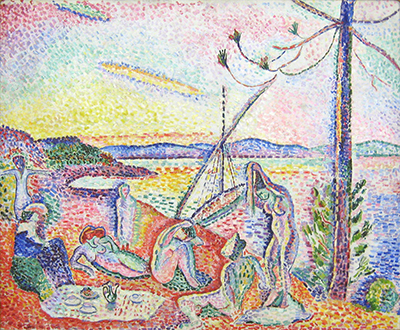
Henri Matisse's Luxe, calme et volupté shows bathers resting beside a Mediterranean shore. A clothed woman sits among the nudes, a small standing figure wraps itself in a towel, a boat lies beyond them, and a spare pine tree reaches across the sky. From a distance the picture promises the ease named in its title: luxury, calm and pleasure. At close range, however, the shore breaks into hundreds of separate coloured touches. Matisse made this painting after a summer in Saint-Tropez with Paul Signac. It is at once a scene of leisure and an experiment in how colour can hold a large, many-figured composition together.[1][2]
At a Glance
- Artist Henri Matisse
- Work Luxe, calme et volupté
- Date 1904
- Explore Painting
This work across Henri Matisse’s career
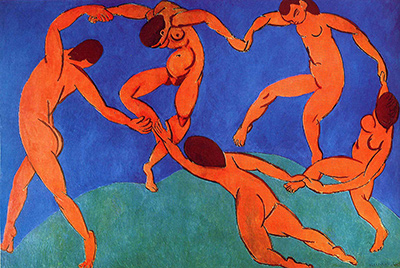
Dance (1910)
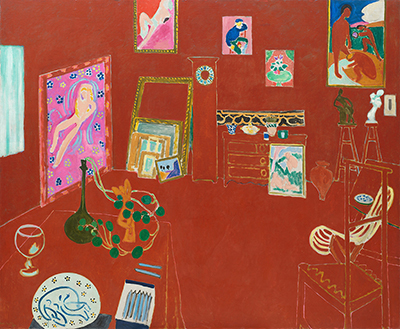
1910The Red Studio
1911The Piano Lesson
1916The Snail
1953Contents
- What is Luxe, calme et volupté?
- What happens on the shore?
- Why does the surface look divided into coloured touches?
- How did Saint-Tropez enter a painting made in Paris?
- What did Matisse take from Cézanne?
- What does Baudelaire's title add?
- Was this already Fauvism?
- How does it compare with Le Bonheur de vivre?
- How did the painting reach its present collection?
What is Luxe, calme et volupté?
The Centre Pompidou records the work as oil on canvas, 98.5 × 118.5 centimetres, made in autumn–winter 1904 and catalogued as AM 1982-96. Its record names Paris, quai Saint-Michel, as the place of execution. The summer at Saint-Tropez supplied observations, sketches and a previous composition; the finished painting was made after Matisse returned to Paris. This distinction matters because the work is often described simply as a picture painted at the seaside. Its shore is remembered and constructed, not a single afternoon transcribed in front of the motif.[1][2]
The French title comes from the refrain of Charles Baudelaire's poem L'Invitation au voyage. English renderings vary, but “luxury, calm and pleasure” conveys its three linked ideas. The title points toward an imagined place of comfort and delight. It does not turn the canvas into a literal illustration of every detail of the poem. Matisse uses the words to give a mood and a horizon for the scene, while the visual experience depends on specific arrangements of bodies, trees, water and coloured marks.[2][3]
The work belongs to the Centre Pompidou collection. Its collection record says that it entered by dation in 1982 and was deposited at the Musée d'Orsay in 1985. Those are different facts: a deposit does not make Orsay the owning collection, and a familiar museum association does not guarantee the canvas is permanently in one gallery. Loans and exhibitions can change where it is displayed. For identification, the Pompidou inventory number and object record are more reliable than a fixed claim about where a visitor can see it on a given day.[1]
What happens on the shore?
The shore is crowded without becoming a single dramatic event. At the left, several bodies cluster near a spread of light fabric and picnic things. One person lies low, another bends, and a clothed woman sits upright. Near the centre, a warm-coloured reclining figure catches the eye. Other bathers stand or turn toward the water. At the right a tall, bare pine rises beside the shoreline. Beyond the figures, the sea and distant land form narrow horizontal bands. A sailboat interrupts the water and suggests travel beyond the immediate resting place.[1][2]
The viewer can begin with the red-orange ground in the foreground and move toward the cooler blue sea. But the figures interrupt that easy recession. Their bodies form a chain of poses across the picture: curled, seated, stretched, standing and turning. A bright arm or shoulder can draw attention away from the horizon and back toward a nearby patch of paint. Rather than give one main actor, Matisse makes a group whose members are variously occupied. The apparent calm is an effect of coexistence; no one is directing the others through a story with a clear beginning and end.[2]
Two figures have a stronger biographical connection than the anonymous bathers. The Pompidou account explains that Matisse carried the clothed Amélie Matisse and the small standing Pierre over from an earlier Saint-Tropez painting, Le Goûter. The Met is more cautious about the standing towel-wrapped figure in the finished canvas, identifying it presumably as Pierre. That caution is useful. The composition includes people drawn from family experience, yet it also places them within an invented arrangement of nude bathers. It is neither a straightforward family portrait nor a documentary record of everyone who shared one picnic.[2][3]
Look at the pine on the right. Its trunk acts like a vertical stop beside the bands of shore and sea, while its thin branches carry the eye back toward the centre. The same tree appeared, in a different setting, in the Saint-Tropez source painting described by the Pompidou. Here it helps turn an open view into a composition with an edge and a rhythm. The boat, by contrast, pulls attention outward. One element anchors the shore; the other suggests departure. Their coexistence suits a title that promises repose while imagining a journey.[2]
Why does the surface look divided into coloured touches?
Matisse was testing Divisionism, the Neo-Impressionist practice associated with Paul Signac and, before him, Georges Seurat. Instead of mixing every colour into a smooth patch on the palette, a painter can place distinct touches beside one another so that the eye experiences their combined effect at a viewing distance. This is why parts of Luxe, calme et volupté seem to shimmer. Pink, blue, yellow, green and orange marks remain legible individually, yet together they suggest a sunlit shore, a body or a distant sky. The canvas never asks the eye to forget that it is looking at paint.[2][4]
The marks vary rather than following one mechanical recipe. Some are small dabs, others longer strokes or loosely brushed passages. Their changes of direction can give a figure weight, set water apart from land, or enliven a cloud. The Pompidou describes the painting as a singular exercise in pointillist painting, but it also stresses that Matisse did not obey the technique's rules without difficulty. The word “pointillist” should therefore guide looking at the separated surface, not lead us to imagine that every mark is an equally sized dot placed according to a rigid formula.[2]
Colour creates both light and structure. Warmer reds and oranges collect in the foreground and around the figures. Cooler blues and greens move through the water, the hills and shaded areas. A pale yellow sky opens above them, touched with pink and blue. The effect is not the consistent local colour of a photograph: the same hue can move across different objects, joining a patch of shore to a body or a strip of distant land. This recurrence makes the parts of the picture belong to one painted field even while bodies and landscape remain distinct.[1][2]
At arm's length, a bather's contour can be interrupted by the very touches that make the figure luminous. Step back and the body becomes more legible. Step in again and its edge dissolves into neighbouring colour. That movement between distances is central to the painting's experience. Matisse was interested in the freedom of separated strokes, yet the Pompidou's account of his 1905 correspondence shows his unease that divided painting could weaken the expressive force of contour. The tension is visible: a figure needs an edge to stand apart, while the luminous surface keeps trying to draw it back into the whole.[2]
How did Saint-Tropez enter a painting made in Paris?
In the summer of 1904, Matisse went to Saint-Tropez with Amélie and their young son Pierre. Signac, who was working there, was an important point of contact. The Met's record for Matisse's Chapel of Saint Joseph places the family stay from mid-July through mid-October and reminds us that Saint-Tropez was then a small fishing town. The coastal light and Signac's example gave Matisse a practical setting in which to try a brighter, more divided manner of painting.[2][5]
The earlier Le Goûter—often described in English as a snack or picnic scene—became one source for Luxe, calme et volupté. According to the Pompidou, Matisse retained the seated, dressed Amélie, the standing Pierre and the stripped pine trunk, then placed them within a more elaborate shore populated by bathers. This is a specific compositional relationship, more informative than saying that one picture simply “inspired” another. The later canvas changes the scale and company of the family group. The familiar figures no longer define the whole event; they are woven into an imagined scene that mixes personal memory with an older artistic subject.[2]
The return to Paris also helps explain the picture's deliberate arrangement. Matisse had time to combine experiences and sources rather than follow what happened to be visible in front of him. The Pompidou describes his use of a small Cézanne painting he owned alongside the Saint-Tropez composition. The result is an invented coast with five principal nude bathers in distinct poses. The figures feel selected and arranged, not casually discovered. To say that the scene grows from Saint-Tropez is therefore accurate; to identify it as a literal view of a specific bank or a single witnessed gathering would go beyond the evidence.[1][2]
A separate 1904 study for Luxe, calme et volupté also exists. The Met included a study on loan in its exhibition on Matisse, Derain and the origins of Fauvism. That listing is enough to establish that the painting had a preparatory stage, but it does not make the study interchangeable with the Pompidou canvas. The finished work has its own size, inventory number, ownership and surface. A small image labelled with the same title may show a study rather than this completed shore scene, so visual identity matters when comparing reproductions.[1][6]
Watch: Matisse’s art and working methods
Choose a museum film or a close reading to continue exploring Matisse’s work.
Matisse: “For Me It’s Always New”
The Museum of Fine Arts, Boston considers Matisse’s creative practice.
Watch on YouTubeWhat did Matisse take from Cézanne?
The Pompidou's teaching account connects the five bathers with a small Cézanne painting Matisse owned. Cézanne's bathers gave a model for arranging human bodies as a durable structure rather than merely recording people at leisure. In Luxe, calme et volupté, each bather takes a different posture. Together, their bent limbs and upright forms organize the foreground and middle distance. Their shapes punctuate the horizontal shore, while the seated clothed figure and tree help steady the grouping at either side.[2]
This relationship does not mean that the canvas is a Cézanne copy. Matisse combines a compositional idea from an admired painter with a divided surface encouraged by Signac and with motifs from his own summer painting. The resulting beach is more populated than a simple landscape study and more optically restless than a set of solid, modeled bathers. We can see why the Pompidou calls it a synthesis: it holds together ways of painting that make different demands on the eye. Cézanne helps stabilize the bodies; the coloured touches keep those bodies vibrating within the scene.[2]
The bathers also became a repertoire for later work. A Pompidou object essay on Matisse's sculpture Nu couché I notes that a reclining-nude idea is already present in this 1904 painting and that its principal figures introduce poses he would revisit. That is a bounded comparison: the later sculpture is not one of the painted people removed from the canvas, and the painted body does not prove that Matisse had already settled the sculpture's final form. It shows him returning to the problem of how a figure's bend, stretch or turn can become an expressive shape.[7]
What does Baudelaire's title add?
Baudelaire's L'Invitation au voyage imagines an elsewhere of beauty and repose. Matisse borrowed its refrain for a canvas where a boat and a broad expanse of water make travel visually imaginable. Yet the picture does not tell us where the boat is headed or who might board it. The title works as an invitation to feel a quality of the place. It does not supply a hidden itinerary that would turn every figure into a character in the poem.[2][3]
The three words are also a useful test for looking. “Calm” can be found in the reclining bodies, still water and leisurely grouping. “Pleasure” is suggested by the open air, rest and company. “Luxury” need not mean costly objects or fashionable dress; it may be the abundance of light, time and sensation that the scene makes available. These are readings invited by title and image, not claims that every bather is happy or that Matisse painted a personal fantasy in a precisely documented state of mind. The picture gives forms through which viewers can explore the promise of its words.[2]
There is also productive friction between promise and method. The subject offers ease, but the eye has to work to join the small strokes into bodies, light and space. A bather can seem settled when seen from across a room and unsettled when its edge breaks apart close up. The painting may therefore feel peaceful as a scene and active as a surface. That double experience is more specific than treating its title as a simple label for a happy picnic. Matisse made pleasure visible through a demanding experiment in how coloured marks relate to one another.[2]
Was this already Fauvism?
The painting stands immediately before the better-known Fauvist moment of 1905. It was shown at the Salon des Indépendants that spring, months before Matisse's more freely coloured works at the autumn Salon d'Automne became associated with the name “Fauves.” Its bright palette and willingness to depart from natural colour anticipate later developments. Its divided marks, however, tie it closely to the Neo-Impressionist method Matisse was testing in 1904. Calling it simply “the first Fauvist painting” erases the particular experiment that gives the canvas its surface.[3][4]
Contemporary responses were not uniform. The Met's exhibition account says that some critics at the 1905 Salon des Indépendants faulted Matisse for drawing on other painters' styles without asserting enough of his own. Signac saw more promise: he acquired the work for his Saint-Tropez home. A broad claim that the painting was either universally celebrated or universally rejected would flatten this record. It could be controversial to some viewers and valuable to an artist who understood the divided-colour practice it explored.[3]
Matisse himself was not simply satisfied with the technical result. As the Pompidou explains from his correspondence, he felt that divided colour could destroy what contour made eloquent. That concern helps place the painting within an active search rather than at the end of a completed doctrine. Its great achievement does not require the artist to have endorsed every consequence of the method. He had found an unusually luminous way to fill a large shore scene, and at the same time had discovered a problem he would keep working through: how to make colour and line speak together.[2]
How does it compare with Le Bonheur de vivre?
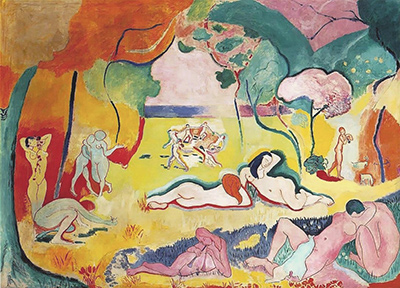
About a year later, Matisse began Le Bonheur de vivre, another scene of people at ease in a landscape. The related subject makes the change in painting easy to see. In Luxe, calme et volupté, small distinct touches spread across nearly every part of the canvas. In the later Barnes painting, broader colour areas and long curving contours take on much more of the task of connecting figures and setting. The later group also includes a tiny circle of dancers and other separate activities across a much larger field.[2][8]
The comparison is not a story in which an inferior experiment is discarded for a final answer. The 1904 canvas has its own balance between a remembered place, a borrowed poetic title, a family motif and a bathers tradition. Its divided surface makes the light seem dispersed among bodies, trees and water. The 1905–06 painting asks different questions about scale, line and the arrangement of many groups in an imagined Arcadia. Reading them side by side shows Matisse revisiting a pleasure scene by changing the visual means through which pleasure is experienced.[2][8]
For a reader moving through Matisse's paintings, the sequence is useful because it resists a single, unchanging definition of his style. He could work with small separated touches in 1904, broad fields and sweeping lines in 1906, and still later test entirely different ways to make colour carry a composition. His artist page offers the wider chronology. This canvas is a clear starting point: its visible brushwork lets us watch him weighing light, colour, contour and a subject inherited from art and poetry.[4][8]
How did the painting reach its present collection?
Signac bought Luxe, calme et volupté in 1905. The Pompidou's teaching account says the painting remained in his family until 1950. It entered the French national collection by dation in 1982, and the Pompidou object record notes its deposit at the Musée d'Orsay in 1985. The ownership sequence is worth keeping separate from the history of where the painting has been displayed. Its connection with Orsay explains why many references name that museum, while the Pompidou inventory number identifies the collection record for the work itself.[1][2]
Signac's purchase also gives a contemporary response from within Matisse's artistic circle. The older painter had promoted divided colour, and Matisse's work did not follow his method strictly. Nevertheless, Signac valued the painting enough to own it. That fact does not prove that the two artists agreed about every choice on the canvas. It does show that the picture was received as a substantial experiment by someone closely involved in the practice it tested.[2][3]
Explore 113 Matisse artworks
This directory covers the 113 individual works explored in these articles, rather than a complete catalogue of Matisse’s output. Cut-paper designs and prints appear under Drawing in the medium filter; each row names its form. Dates retain the qualifications explained in the linked articles.
Frequently Asked Questions
The work belongs to the Centre Pompidou collection and has been deposited at the Musée d'Orsay since 1985, according to the owner record. Its actual display location can change with loans and exhibitions. Consult the current museum record before planning a visit around this particular canvas.[1]
The clothed seated figure is connected with Amélie Matisse, and a standing towel-wrapped figure is presumably Pierre, carried over from the Saint-Tropez source composition. The nude bathers should not be treated as identified family portraits on that basis. Matisse combines those personal motifs with an invented bather grouping.[2][3]
Matisse was trying a divided-colour method associated with Signac's Neo-Impressionism. Adjacent marks produce a lively effect of light while remaining visible as marks. He used the method freely and later expressed concern that it could weaken the contour of a figure. That unresolved tension gives the picture much of its energy.[2][4]
Discussion
Look again at the images and ideas explored in Luxe, calme et volupté by Henri Matisse: pleasure built from colour. These editorial prompts invite your observations.
Reader Insights
What is Luxe, calme et volupté ?
Which comparison discussed in the article helps you see the work differently?
How do the materials and historical setting affect your reading?
Join the Conversation
Share a detail, comparison or question about Luxe, calme et volupté by Henri Matisse: pleasure built from colour below.
References
- Centre Pompidou , Luxe, calme et volupté , AM 1982-96. View source .
- Centre Pompidou , teaching dossier, Luxe, calme et volupté . View source .
- The Metropolitan Museum of Art , “The Allure of Saint-Tropez,” Matisse: In Search of True Painting . View source .
- The Metropolitan Museum of Art , “Henri Matisse (1869–1954)”. View source .
- The Metropolitan Museum of Art , Chapel of Saint Joseph, Saint-Tropez . View source .
- The Metropolitan Museum of Art , Vertigo of Color exhibition objects. View source .
- Centre Pompidou , Nu couché I . View source .
- Barnes Foundation , Le Bonheur de vivre . View source .
 Henri Matisse.jpg)