 by
Tom Gurney
Tom Gurney BSc (Hons) is an art history expert with over 20 years experience
Email:
tomgurney1@gmail.com
/ Phone:
+44 7429 011000
Henri Matisse, Studio under the Eaves, 1903: Introduction
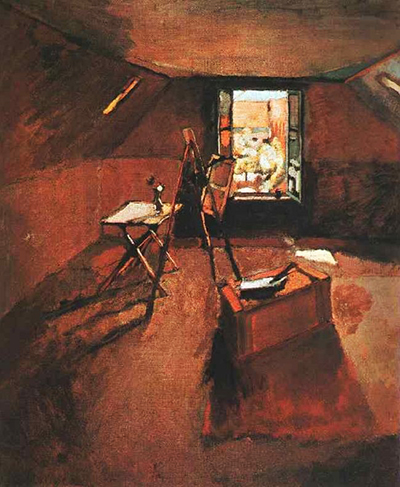
Henri Matisse's Studio under the Eaves takes us into a narrow attic in Bohain, the northern French town where he grew up. A sloping roof and two small skylights bear down on the room. A folding table, an easel and a wooden crate serve as studio furniture. Farther back, an open window releases a startling patch of bright color. The picture is both a record of a place where Matisse tried to work and a carefully organized passage from a dark foreground toward light. [1]
The painting is sometimes reached through the shorter name The Attic Studio , which remains in this page's address. The Fitzwilliam Museum, its owner, calls it Studio under the Eaves . Its catalogue records the French title L'atelier sous les toits , an oil painting on canvas measuring 55.2 × 46 centimetres and catalogued around 1903 . Those details establish which of Matisse's many studio pictures this page discusses; the title in the heading follows the museum's public label. [1] [2]
At a Glance
- Artist Henri Matisse
- Work Studio under the Eaves
- Date 1903
- Explore Painting
This work across Henri Matisse’s career
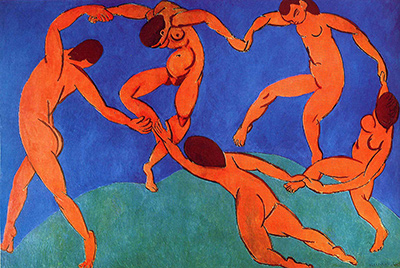
Dance (1910)
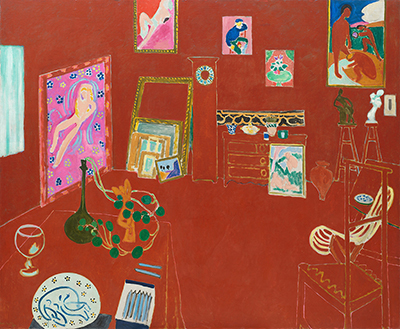
1910The Red Studio
1911The Piano Lesson
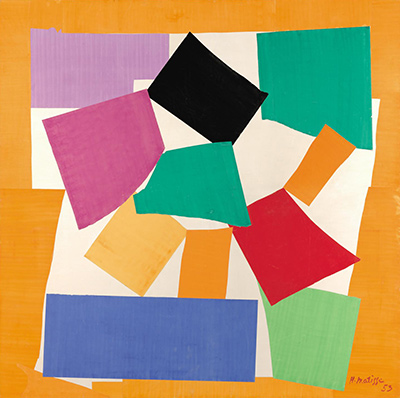
1916The Snail
1953Contents
- What can we see in the attic?
- Why does the window matter so much?
- Why was Matisse working in Bohain?
- Are the flowers a symbol?
- How does this studio compare with The Red Studio?
- What do we know about the work itself?
What can we see in the attic?
Start with the roofline. The inclined walls make the room feel low and enclosed, even though the picture gives us enough depth to look past the easel and table toward the far wall. Two little skylights break the roof plane, but neither seems to flood the interior. Most of the space remains brown, rust-colored and nearly black. The light is selective: it catches certain edges and leaves other objects only partly distinguishable from their surroundings. [1]
The working materials are modest. The Fitzwilliam identifies a palette resting on a simple crate, an easel positioned near a folding table, and a vase with two dahlias . These are specific objects, not a generalized symbol of artistic life. The crate does the job of a stand; the table offers a place for the flowers; the easel marks the room as somewhere a picture can be made. In the small reproduction, the flowers are delicate touches rather than a showy still life. They bring a second kind of looking into the studio: Matisse could attend to a small natural arrangement even in a cramped working space. [1]
The easel and the surface it holds sit between us and the window. The painting does not provide a legible image on the canvas inside the picture. Instead, its backward or angled plane joins a cluster of rectangles: canvas, crate, tabletop and window. MoMA's exhibition label emphasizes this arrangement of flat shapes and how it moves the viewer's attention toward the outside. That account is useful because it begins with visible construction rather than treating the room as an accidental snapshot. [3]
No person appears in the room. Still, the palette and easel imply a worker who has just stepped away or might return. We stand near the artist's tools, looking across them. The empty studio can therefore function as an indirect portrait of Matisse's practice without giving us his face. It says little about the exact task in progress: we cannot identify what was being painted on the easel from this image alone.
Why does the window matter so much?
The window is comparatively small, yet it commands the composition. Its shutters open around a zone of vivid blues, greens and warm touches. Against the attic's dark browns, even this limited glimpse feels spacious. Matisse does not describe a detailed landscape that we can map to a particular view. He gives us a strong contrast between an interior filled with tools and a concentrated patch of outdoor light. MoMA curator Ann Temkin stresses precisely that opposition between the somber room and the brilliant color beyond it. [4]
Several lines in the room help us reach the opening. The slant of the roof, the table's edges and the easel's angle all draw attention inward. The bright rectangle catches the eye after it has moved through the darker work area. The Fitzwilliam also points to the long shadow cast by the chest or crate toward the viewer. It does something surprising: the incoming daylight makes the foreground darkness more emphatic. Light and shadow are not two separate halves of the scene; one creates the other. [1]
The little skylights provide a useful comparison within the painting. One might expect roof windows to brighten an attic, but here they remain pale breaks in a largely dim ceiling. The open vertical window carries the stronger color and the stronger promise of space. This difference helps explain why the eye settles there. It is not simply the brightest shape; it is the only clear route beyond the room's roof, furniture and walls.
The Fitzwilliam reads the window as a visual hint of the brighter color that would distinguish Matisse's later painting. MoMA's exhibition label makes a similar connection. That is an informed interpretation, not a prediction Matisse wrote into the canvas for us to decode. The painting's first effect is immediate and visible: a limited patch of light can change the whole character of a dark room without dissolving the dark paint around it. [1] [3]
Watch: Matisse’s art and working methods
Choose a museum film or a close reading to continue exploring Matisse’s work.
MoMA Conservators discover Matisse's process for "The Red Studio" | CONSERVATION STORIES
Conservators examine the making of The Red Studio.
Watch on YouTubeWhy was Matisse working in Bohain?
The Fitzwilliam identifies the studio as the top floor of 24 Rue Fagard in Bohain. Matisse had returned to his hometown with his young family during a severe personal and financial crisis. His parents-in-law, Armand and Catherine Parayre, had worked for Thérèse Humbert , whose large fraud was exposed in 1902. The museum is clear that the Parayres were themselves innocent of wrongdoing, but they lost money and came under suspicion. Police searched the hat shop belonging to Matisse's wife, Amélie, and his own studio. He was also trying to support a household and had suffered insomnia and nervous exhaustion. [1]
This history explains why the plain attic setting can carry more weight than its furniture alone might suggest. The room was a rented workplace during a difficult return, as MoMA's label and audio account describe it. The Fitzwilliam reports an uneasy reception from Matisse's father and little enthusiasm in Bohain for his painting. In a July 1903 letter to his friend Simon Bussy, Matisse even considered giving up painting for more reliable employment. The evidence supports the seriousness of the crisis, although it cannot tell us that each dark brushstroke corresponds to a particular feeling on the day he made this canvas. [1] [3] [4]
The modest equipment invites a similarly careful reading. A crate under a palette and a folding table are consistent with an improvised, economical studio. The Fitzwilliam interprets the sparsity in relation to Matisse's strained finances. Yet these things were also practical furnishings of an actual workspace. The painting gains force by letting that practical fact and the larger context coexist. We see how the artist worked in this particular room before we turn it into an emblem of hardship. [1]
Are the flowers a symbol?
The vase on the table is easy to overlook beside the window. The Fitzwilliam identifies its contents as two dahlias and recalls fellow artist Jean Puy's account of Matisse being moved by withering flowers in 1902. The museum suggests a possible association with the older tradition of flowers as reminders that life is brief. That is one reading of the motif, not a documented statement by Matisse about these particular dahlias. The available reproduction does not allow us to diagnose whether they are fresh or fading. [1]
Their formal role is easier to see. The flowers make a small upright interruption on the tabletop. They place a fragile natural shape among the attic's boards and furniture, and their position helps connect the working area to the window beyond. Even without a fixed symbolic meaning, they alter the rhythm of the composition. The viewer moves from the palette and canvas to the vase, then outward to the light. What could seem like a minor object helps the room feel observed and lived in.
How does this studio compare with The Red Studio?
MoMA brought Studio under the Eaves into its exhibition Matisse: The Red Studio , placing the 1903 attic in conversation with Matisse's later pictures of workspaces. In 1911 , at Issy-les-Moulineaux, Matisse painted The Red Studio . MoMA's exhibition material describes that later studio as a larger, purpose-built space, constructed after plans developed with a contractor. The red painting simplifies walls and floor into a unified color field, while this earlier Bohain canvas keeps its sloping roof, brown shadows and strong difference between inside and outside. [3]
The comparison is illuminating because the subject is shared even as the rooms and methods differ. In each work, the studio is worth painting for itself: furniture, working surfaces and the arrangement of objects tell us how Matisse thought about making art. But the attic does not need to be treated as a rough draft for the later red picture. Its pressure of darkness against a small opening is a distinct solution to a distinct room. The later studio's broad red field asks a different question about how color can hold a space together.
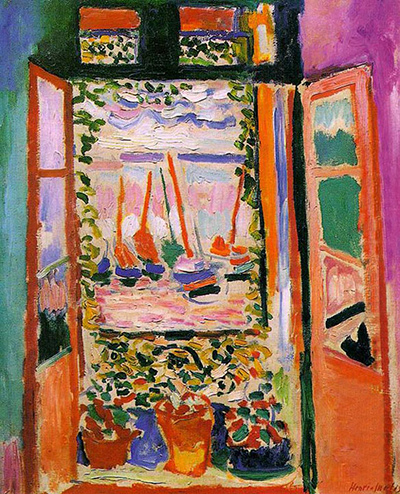
Readers following Matisse's changing treatment of light can also look at Open Window, Collioure , painted in 1905 . The shared motif is an opening onto outdoors; the compositions, places and color structures are different. In the Bohain attic, the window remains a relatively small, distant focus. At Collioure, window and view play a much larger part in the picture. The comparison helps show what Matisse could make of this motif without pretending that one painting directly caused the other.
What do we know about the work itself?
The Fitzwilliam records the painting as oil on canvas , signed at the lower left, and accessioned as PD.14-1964 . It came to the museum through a 1964 bequest by A. J. Hugh Smith via the National Art-Collections Fund. Its object record dates it circa 1903 while preserving an older opinion that placed it around 1900; it also cites Alfred Barr's early-1903 Bohain attribution. The museum's current public presentation and MoMA both use 1903 , so that is the working date here. The surviving note is a reason to avoid claiming an exact day or month. [1] [2] [4]
Looking again at the painting, begin at the crate and palette near the front, follow the easel and table toward the vase, then let the converging lines take you to the open window. Return along the long shadow toward your own position. That circuit keeps the image from becoming a simple before-and-after story of gloom giving way to color. Matisse lets the dark attic and the bright exterior remain present together. The room is a difficult place to work, but it is also a room in which he continues to look, arrange and paint.
For more of his work across periods, use the Henri Matisse artist page and the paintings directory .
Explore 113 Matisse artworks
This directory covers the 113 individual works explored in these articles, rather than a complete catalogue of Matisse’s output. Cut-paper designs and prints appear under Drawing in the medium filter; each row names its form. Dates retain the qualifications explained in the linked articles.
Discussion
Look again at the images and ideas explored in Henri Matisse, Studio under the Eaves, 1903. These editorial prompts invite your observations.
Reader Insights
What can we see in the attic?
Which comparison discussed in the article helps you see the work differently?
How do the materials and historical setting affect your reading?
Join the Conversation
Share a detail, comparison or question about Henri Matisse, Studio under the Eaves, 1903 below.
References
- Fitzwilliam Museum , Studio under the Eaves , 1903, object interpretation, Bohain context and visual description. View source .
- Fitzwilliam Museum , L'atelier sous les toits , object record PD.14-1964, material, size, ownership and dating note. View source .
- MoMA , Matisse: The Red Studio , extended artwork labels, Studio under the Eaves label and later studio context. View source .
- MoMA , Studio Under the Eaves , exhibition audio, object data and attributed interpretations by Ann Temkin and Claire Messud. View source .
 Henri Matisse.jpg)