 by
Tom Gurney
Tom Gurney BSc (Hons) is an art history expert with over 20 years experience
Email:
tomgurney1@gmail.com
/ Phone:
+44 7429 011000
Henri Matisse, Studio Interior (Intérieur d'atelier), c.1903–04: Introduction
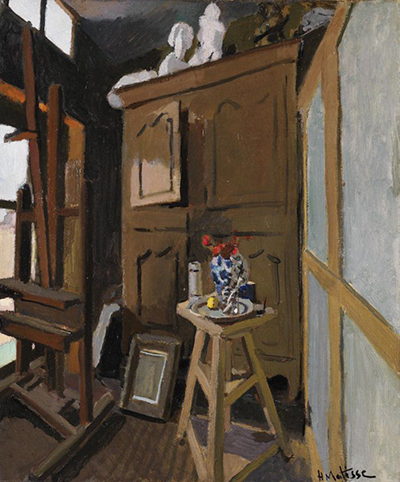
A tall cupboard takes up much of Henri Matisse's Studio Interior . At its foot, a small arrangement of flowers and pale objects stands on a narrow wooden support. An easel crowds the left edge; what looks like the back of a canvas or panel rises on the right. No painter appears. The room tells us about painting through the objects and spaces around it. Tate identifies this work as Intérieur d'atelier , dates it about 1903–04 , and records it as oil paint on canvas , measuring 55 × 46 cm . Its accession number is T03889 . [1]
This is a compact, vertical painting, not a sweeping survey of a studio. Matisse has selected a crowded corner and placed the viewer close to it. The cupboard, stand and easel nearly fill the image, while a sliver of floor provides just enough space to stand in front of them. Tate's collection metadata associates the subject with 19 Quai Saint-Michel in Paris . The picture can therefore be read as a view of a working room in the city, although it should not be treated as a measured architectural record of every item in the apartment. [1]
At a Glance
- Artist Henri Matisse
- Work Studio Interior (Intérieur d'atelier)
- Date c. 1903–04
- Explore Painting
This work across Henri Matisse’s career
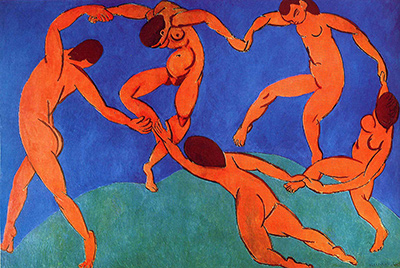
Dance (1910)
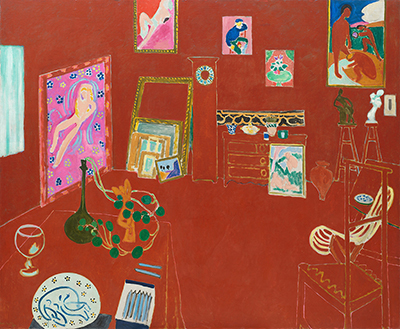
1910The Red Studio
1911The Piano Lesson
1916The Snail
1953Contents
- What can you see in the studio?
- How do line and colour organize the crowded view?
- When did Matisse paint it?
- Is this the same room as The Attic Studio?
- Where is the painting now?
What can you see in the studio?
The large brown cupboard sits just right of centre. Its rectangular doors and projecting top establish the strongest shapes in the picture. Two small, pale sculptural forms appear above it; they stand out sharply against the dark upper wall. Tate's object indexing includes sculpture alongside the easel, cupboard and stool, confirming that the room's art-making equipment is part of the catalogued subject. At this reproduction size it would be rash to assign names to the individual forms, but their placement matters: sculpture occupies the highest point of an image that is otherwise dominated by painted and wooden surfaces. [1]
On the left, a dark easel is partly cut off by the picture's edge. Its uprights repeat the cupboard's vertical lines but appear less settled, as though the viewer has caught only a fragment of a larger working area. A pale window or opening at the upper left interrupts that dark side of the room. Below it, a broad diagonal member and several overlapping brown shapes make the easel and nearby furniture difficult to separate. Matisse gives enough information to recognize a studio without spelling out the function of every piece of wood.
The small stand in front of the cupboard holds the painting's still life. Red flowers, blue-white touches in the vessel, a yellow accent and a few light-coloured objects form its brightest cluster. The stand's legs open into triangles beneath it. Their diagonals answer the floorboards, giving the eye a way to move from the crowded still life down to the bottom of the painting. Rather than setting the still life against a plain backdrop, Matisse places it inside a room already busy with boards, frames and doors. We first see it as a flash of colour, then return to examine its separate forms.
A small framed object leans on the floor behind the stand. The pale plane at the far right may be a canvas or panel; the reproduction does not establish what is painted on its other side. These partly hidden things are important because they make the space feel used. They also refuse the tidy completeness of a display case. The room extends beyond the painted edges and behind its larger objects, even though very little empty floor is shown.
How do line and colour organize the crowded view?
Much of the painting is made from browns, greys and dark greens. That restraint makes the concentrated red, yellow and blue-white marks around the flowers particularly noticeable. The pale wall on the right provides a different kind of relief: a broad, quiet area against which the cupboard's edge is easy to read. Near the top, the light sculptural forms make a second bright stop for the eye. Colour is distributed unevenly, guiding attention through the room rather than coating every surface with the same intensity.
The cupboard's doors are described by a few dark lines and changes in brown tone. They do not have the smooth finish of a detailed furniture portrait. The stand, with its angled legs, likewise feels built from visible strokes. Matisse allows the grain of the painted arrangement to remain active. A vertical line can suggest an easel upright, cupboard edge or frame; a diagonal can suggest both a floorboard and a support. This economy makes the scene legible while showing the work of composing it.
There is depth here, but it is compressed. The stand is in front of the cupboard, and the small frame rests behind the stand. Floorboards lead inward, yet the large cupboard blocks any long view through the room. At the right, a narrow pale plane meets the cupboard's brown edge abruptly. These overlaps establish where things sit without turning the studio into a deep, orderly stage. The close quarters are part of the subject. Matisse paints a place where work, storage and looking take place within arm's reach of one another.
Watch: Matisse’s art and working methods
Choose a museum film or a close reading to continue exploring Matisse’s work.
MoMA Conservators discover Matisse's process for "The Red Studio" | CONSERVATION STORIES
Conservators examine the making of The Red Studio.
Watch on YouTubeWhen did Matisse paint it?
Tate's record gives c.1903–04 ; a Los Angeles County Museum of Art exhibition checklist independently lists 1903–1904 , with the same 55 × 46 cm canvas measurement. The approximate date is the useful one. It avoids pretending that the visible room fixes a particular month or that every object was in precisely this arrangement on one documented day. The catalogue facts also keep this canvas distinct from later, larger studio interiors in Matisse's career. [1] [2]
The period mattered to Matisse personally and professionally. The Fitzwilliam Museum records that in 1903 he worked for a time in a makeshift attic studio in Bohain-en-Vermandois , after financial and family troubles had taken him away from Paris. The museum states that Matisse and his family returned to Paris later that year. Those circumstances help place Tate's Paris studio within an unsettled phase, but they do not let us read the artist's precise mood from every brown stroke in this particular painting. [3]
Calling Studio Interior an early studio painting is more informative than forcing it into a neat “realism plus Fauvism” formula. The painting predates the best-known intensely coloured works that gave Fauvism its name. Here Matisse is already thinking about how a painted room can hold still life, sculpture, working equipment and flat colour areas together. That is a visual observation, not a claim that he had settled on a later style in advance. The Museum of Fine Arts, Boston's exhibition on Matisse's studio objects shows how persistent the question of objects in the working space became across his career, while leaving the particular meaning of this early arrangement open. [4]
Is this the same room as The Attic Studio?
No. The Attic Studio is a separate 1903 picture of Matisse's rented space in Bohain , now held by the Fitzwilliam Museum in Cambridge. Its window draws attention toward daylight beyond a dark room. Tate's Studio Interior concerns the Paris workspace and gives the cupboard, still life and equipment the centre of attention. The two works are close in date and share studio furniture as a subject, but neither museum source establishes an exact order in which every part of the two canvases was painted. [1] [3]
The comparison also sharpens what a studio picture can do. The Fitzwilliam and a Museum of Modern Art exhibition label describe the Bohain attic through its table, vase, easel, crate and window: objects and lines direct the eye out of the confined space. In the Tate painting, the main lines turn the eye back into the corner. The easel is only partly visible, the cupboard blocks a distant view, and the still life sits in front of stored and leaning objects. Neither is a simple inventory. Each arrangement gives ordinary equipment a different visual role. [3] [5]
Where is the painting now?
Tate records T03889 as bequeathed by Lord Amulree in 1984 . He is part of the acquisition history; he is not its present owner. A LACMA exhibition checklist also names Tate Modern as the lender of the work. Display locations can change, so Tate's current object page is the sensible place to check before a visit. For a closer look at how Matisse carried sculpture into his practice, see the sculptures overview ; the paintings directory places this room beside his other studio and interior pictures. [1] [2]
The small canvas rewards a slow scan from its outer edges inward. Start with the cropped easel, cross the pale shapes on top of the cupboard, then descend to the flowers and the narrow stand. The route shows how Matisse makes a working room visible without putting the worker in front of us: its tools, stored objects, light and compressed space carry the story.
Explore 113 Matisse artworks
This directory covers the 113 individual works explored in these articles, rather than a complete catalogue of Matisse’s output. Cut-paper designs and prints appear under Drawing in the medium filter; each row names its form. Dates retain the qualifications explained in the linked articles.
Discussion
Look again at the images and ideas explored in Henri Matisse, Studio Interior (Intérieur d'atelier), c.1903–04. These editorial prompts invite your observations.
Reader Insights
What can you see in the studio?
Which comparison discussed in the article helps you see the work differently?
How do the materials and historical setting affect your reading?
Join the Conversation
Share a detail, comparison or question about Henri Matisse, Studio Interior (Intérieur d'atelier), c.1903–04 below.
References
- Tate collection open-data record , Studio Interior / Intérieur d'atelier , T03889, institutional object metadata. Tate object page for current museum information. View source 1 . View source 2 .
- Los Angeles County Museum of Art , Expressionism in Germany and France exhibition checklist, Studio Interior entry, printed p. 15. View source .
- Fitzwilliam Museum , Studio under the Eaves , 1903, collection highlight and context for the separate Bohain painting. View source .
- Museum of Fine Arts , Boston, Matisse in the Studio , exhibition account of objects in Matisse's practice. View source .
- Museum of Modern Art , Matisse: The Red Studio extended artwork labels, Studio under the Eaves label, p. 1. View source .
 Henri Matisse.jpg)