 by
Tom Gurney
Tom Gurney BSc (Hons) is an art history expert with over 20 years experience
Email:
tomgurney1@gmail.com
/ Phone:
+44 7429 011000
Henri Matisse, View from the Window, Tangier , 1912: Introduction
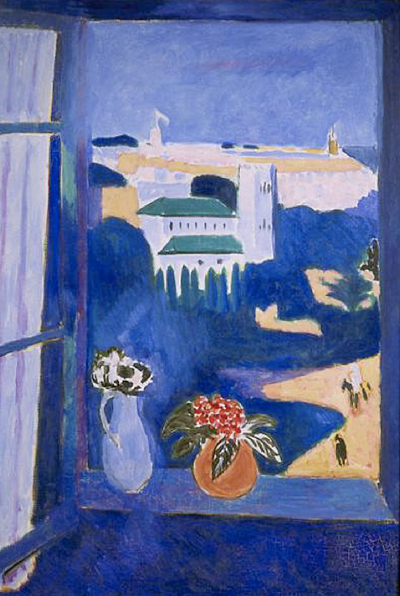
An open blue window frames pale buildings, dark trees and a strip of sky. On the sill sit two vessels of flowers: one light and cool, the other warm with red blossoms. Henri Matisse painted View from the Window, Tangier in 1912 during his work in Morocco. The Pushkin State Museum of Fine Arts owns this oil on canvas, 115 × 80 centimetres, inventory Ж-3395. It is also called Landscape Viewed from a Window; this page keeps the shorter title Window at Tangier. The painting forms one part of Matisse's Moroccan Triptych.[1][2]
The window is not just a border around a city view. Its shutter, sill and flower vessels occupy a substantial share of the tall canvas. The view outside is broken into white architecture, green roof shapes and broad blue-green shadows. Matisse lets the interior edge and exterior landscape meet through color, so the viewer looks both at the window and through it. That double attention makes the painting more specific than a general postcard view of Tangier.
At a Glance
- Artist Henri Matisse
- Work View from the Window, Tangier
- Date 1912
- Explore Painting
This work across Henri Matisse’s career
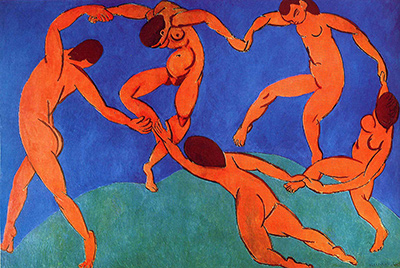
Dance (1910)
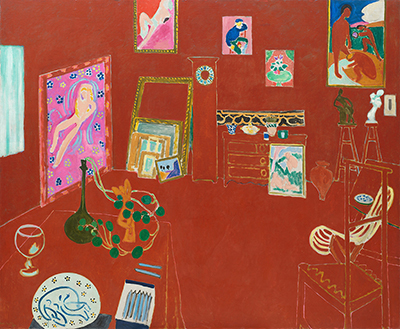
1910The Red Studio
1911The Piano Lesson
1916The Snail
1953Contents
- Where was Matisse looking from?
- Why put flowers on the sill?
- How does blue hold the view together?
- When was this painting made?
- How is it different from Matisse's other windows?
Where was Matisse looking from?
Matisse and his wife Amélie arrived in Tangier on 29 January 1912. The Museum of Modern Art's exhibition chronology places him in room 35 of the Hotel Villa de France, with views toward the Casbah and medina. A companion MoMA account describes this triptych panel as a view of Tangier's city and bay from his hotel window. Those records establish the setting of the motif. They do not require us to name every rooftop or patch of ground visible in the painted opening.[3][4]
The window opens at the left of the canvas. A pale shutter is divided by dark bars, and the blue frame makes a firm vertical boundary between the nearby room and the city beyond. Along the bottom, the sill is broad and deep blue. It is enough to suggest that the viewer stands inside, yet Matisse offers almost no other details of the room. The window itself supplies the interior: one shutter, one ledge and objects resting on it.
Outside, light walls and roofs gather in the middle distance. Blue and green masses around them are less precisely divided, suggesting vegetation, shade and ground. Above is a blue sky whose color is close enough to the window surround to connect near and far. This is not a careful inventory of Tangier's streets. The painting gives a recognizable outlook while letting the blocks of color establish how the scene is felt from that particular vantage point.
It can be tempting to read the small dark marks at the right as a detailed anecdote about people passing by. At the scale of the image, they are too slight for confident identities or actions. Their main effect is one of distance. They remind us how high and far the viewer's position may be, without turning the picture into a story about particular figures. The stronger evidence of place lies in the documented hotel view and the painting's architecture.[3]
Why put flowers on the sill?
The pair of vessels sits exactly where the outward view begins. At left, a pale blue-white jug holds light flowers; beside it, a rounded orange vessel carries a small cluster of red blooms and longer green leaves. These objects are close enough to see separately from the distant buildings. Matisse uses them to change scale abruptly. The flowers occupy a narrow strip of ledge, but their reds, whites and greens pull attention back from the city.
The two arrangements are unequal. One seems quieter, its light flowers nearly joining the pale wall beyond. The other has brighter blossoms and a warm pot that stands apart from the surrounding blue. This asymmetry prevents the sill from becoming a row of matching decorations. The warm orange and red make the viewer feel the coolness of the frame and exterior shadow more strongly. Color moves across the supposed boundary between inside and outside.
Their position also complicates depth. We know the vases are close because they rest on the sill and appear in front of the view. Yet their shapes are painted with the same economy as the buildings beyond. Matisse does not spend all the detail on the foreground and let the background dissolve. He gives each zone just enough information to be recognized, then makes their different colors carry the relationship. The flowers are part of how the view is constructed, not an incidental decoration added afterward.
An open window can promise unlimited space outside, but these vessels hold the eye at the threshold. Follow the pale flowers upward and they nearly blend with the white architecture. Follow the red flowers outward and their warmth is echoed by small light marks among the darker exterior shapes. The eye moves out and back rather than traveling in a single straight line to a distant horizon. That movement is a central pleasure of looking at the painting.
Watch: Matisse’s art and working methods
Choose a museum film or a close reading to continue exploring Matisse’s work.
MoMA Conservators discover Matisse's process for "The Red Studio" | CONSERVATION STORIES
Conservators examine the making of The Red Studio.
Watch on YouTubeHow does blue hold the view together?
Blue appears in the window's frame, the deep sill, the exterior shadows and the sky. These are different things in the scene, but the repeated hue lets them act as one pictorial structure. The left shutter, for example, is clearly near us, while the upper sky is far away. Similar blues link them across a depth that the subject otherwise asks us to keep distinct. Matisse uses that link to make the whole canvas feel coherent.
The blue is not perfectly uniform. The sill is dark and weighty; the frame can be brighter; the distant shadow blends with green; the sky is lighter. The changes let us recognize an interior edge and an outdoor landscape without drawing every surface in full. White architecture then seems lit by comparison. Green roof forms and foliage interrupt it. The painting depends on these measured shifts within a limited palette rather than on a large number of descriptive details.
The Russian Ministry of Culture's discussion of the Moroccan Triptych describes blue as a thread through all three canvases. Here it joins window and landscape. In Zorah on the Terrace it changes the feel of the space around the sitter; in The Casbah Gate it becomes the heavy shade of a gateway. The color is therefore a family resemblance across the group, not a code with one fixed meaning in every painting.[5]
When was this painting made?
The Pushkin owner record dates the canvas to 1912. MoMA's detailed chronology says Matisse had probably all but finished Landscape Viewed from a Window by 14 April 1912, when he left Tangier after his first visit. The cautious wording matters: it places substantial work early in the year but does not establish the final brushstroke or rule out later adjustment. It also corrects the legacy claim that this painting was necessarily made only during his second stay, which began in October 1912.[1][3]
The date is easy to blur because the three triptych subjects came together across Matisse's Moroccan work of 1912–13. MoMA's 1990 checklist labels the assembled set 1912/1913, while the current Pushkin record gives this particular canvas 1912. Those are different levels of description rather than a reason to move the individual painting to 1913. For this page, the owner's object date is the clear headline; the broader span explains the context of the group.[1][6]
The Morozov collection history adds a later point in the sequence. Pushkin's research records that the Russian collector Ivan Morozov bought this canvas directly from Matisse in April 1913, for 8,000 francs. It says Matisse assembled the three Moroccan pictures for Morozov. The painting later entered the Pushkin Museum in 1948. These facts show why the window view is discussed as one part of a deliberate group rather than only as an isolated picture of a hotel room.[2][1]
How is it different from Matisse's other windows?
MoMA's exhibition checklist distinguishes the Pushkin picture from a separate Open Window in Tangier. The latter was listed as a 145 × 94 centimetre canvas in a private collection, whereas Landscape Viewed from a Window was listed at 115 × 80 centimetres in the Pushkin Museum. The same checklist includes a pen-and-ink drawing called View from the Window, Tangier II. Similar titles and the shared window motif do not make these one object or successive names for the Pushkin oil.[6]
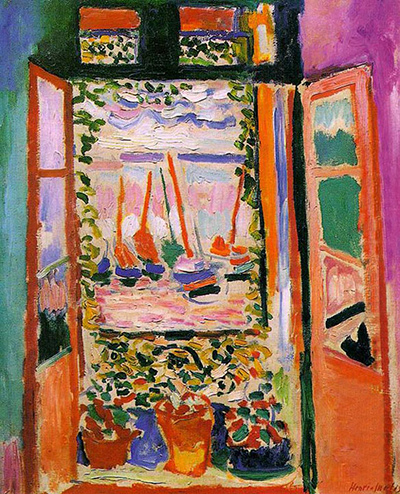
The famous Open Window from Collioure is another distinct painting and another place. Comparing it with this Tangier canvas can be useful: both turn a window into a meeting point between room and world, but the views and dates are different. The Tangier painting gives the sill's flowers a central role and allows blue to pass from the nearby frame into the distant scene. A comparison should clarify that visual choice, not erase the identity of either work.
Look once more from the flowers to the white buildings and back along the left shutter. The view seems open, yet the room's edge stays with us. This is how Matisse makes a familiar act of looking out of a window feel newly deliberate. Continue with the other triptych paintings, The Casbah Gate and Zorah on the Terrace, or compare the distinct Open Window from Collioure.
Explore 113 Matisse artworks
This directory covers the 113 individual works explored in these articles, rather than a complete catalogue of Matisse’s output. Cut-paper designs and prints appear under Drawing in the medium filter; each row names its form. Dates retain the qualifications explained in the linked articles.
Discussion
Look again at the images and ideas explored in Henri Matisse, View from the Window, Tangier , 1912. These editorial prompts invite your observations.
Reader Insights
Where was Matisse looking from?
Which comparison discussed in the article helps you see the work differently?
How do the materials and historical setting affect your reading?
Join the Conversation
Share a detail, comparison or question about Henri Matisse, View from the Window, Tangier , 1912 below.
References
- Pushkin State Museum of Fine Arts , View from the Window. Tangier , current owner record: title, date, medium, dimensions, inventory and accession. View source .
- Pushkin State Museum , Morozov collection research on the Moroccan Triptych, artist's grouping and April 1913 purchase. View source .
- Museum of Modern Art , Henri Matisse's Travels in Morocco chronology, hotel, journey and qualified early painting chronology. View source .
- Museum of Modern Art , Matisse in Morocco exhibition release, hotel-window city and bay view and triptych subjects. View source .
- Russian Ministry of Culture , Artefact, The Moroccan Triptych , interpretation of blue across the three paintings. View source .
- Museum of Modern Art , Matisse in Morocco exhibition checklist, distinct Pushkin window canvas, Open Window in Tangier and related drawing. View source .
 Henri Matisse.jpg)