 by
Tom Gurney
Tom Gurney BSc (Hons) is an art history expert with over 20 years experience
Email:
tomgurney1@gmail.com
/ Phone:
+44 7429 011000
Matisse's Nude with Oranges : a drawn figure among cut-paper fruit: Introduction
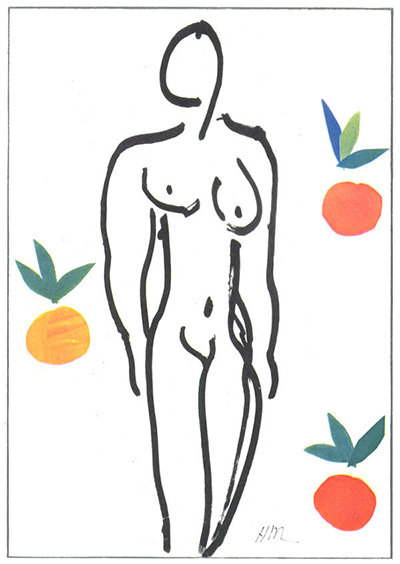
In Henri Matisse's Nude with Oranges , a standing figure rises through almost the full height of a white sheet. Broad black lines describe her body; three bright oranges and their blue-green leaves sit around her. The Centre Pompidou titles the work Nu aux oranges , dates it [1953] , and catalogues it as India ink with gouache-painted, cut-and-pasted papers on paper mounted on canvas . It measures 155 × 108 centimetres and is held in the museum's graphic arts collection as AM 1991-277 . The combination of drawing and collage is essential to what we see: the nude is not itself a blue paper cut-out. [1]
At a Glance
- Artist Henri Matisse
- Work Nude with Oranges
- Date c. 1953
- Explore Cut paper and drawing
This work across Henri Matisse’s career
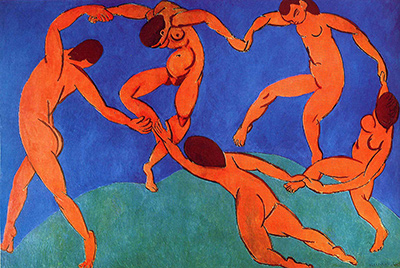
Dance (1910)
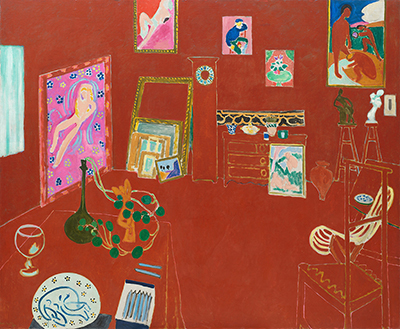
1910The Red Studio
1911The Piano Lesson
1916The Snail
1953Contents
- How is the figure drawn?
- What do the oranges change?
- Is this one of the Blue Nudes?
- Why does the white ground matter?
How is the figure drawn?
The woman faces outward, but Matisse does not close every contour or supply a face. A loop of black ink suggests the head. The shoulders descend into long arm lines, while spare curves indicate breasts, torso and legs. Large areas of untouched white remain within and around the body. Those spaces keep the image light despite its monumental scale. The black strokes have different weights and turns; they read as marks made with a brush rather than as a mechanically uniform outline. The viewer completes parts of the body from a few decisive intervals. [1]
The vertical figure could dominate the whole sheet on its own. The Pompidou's collection essay says Matisse first made the nude as an autonomous brush-and-ink drawing . The oranges were added as cut-paper colour, not painted into the same ink line. This sequence explains why the work can feel both self-contained and newly activated by its surroundings. A woman drawn in black remains central; the paper fruit changes the space through which her body is read. [1]
What do the oranges change?
One fruit appears to the left of the figure and two to the right. Their circular red-orange and yellow-orange shapes punctuate the white ground, while blue and green leaf forms bring cooler colour above them. The fruits do not sit in a bowl or on a tabletop. They surround the standing body at different heights, making the eye travel around it. Anne Coron, writing in the Pompidou's collection catalogue, describes them as counterweights to the nude's upright stillness and as a source of circular movement. That is a reading grounded in the composition: the eye moves from the left fruit across the body to the upper and lower fruits at right. [1]
The owner essay preserves a particularly helpful piece of process evidence. A contemporary studio photograph shows the three fruits attached partly to the drawing sheet and partly to the wall . For the final work, Matisse added strips of paper at the sides, changing the original drawing's space. The result is more than an ink nude with three decorative stickers: the figure, fruit and widened white field have been arranged together. The record does not tell us to treat the photographed trial position and the mounted final arrangement as identical in every detail. [1]
The Pompidou essay suggests that Matisse probably drew the nude while working on two large decoration projects, Grande Décoration aux masques and Décoration fleurs et fruits . Its wording is qualified. The secure point is the progression from independent ink drawing to a composition with coloured cut paper and lateral additions. The picture joins two late practices that are sometimes discussed separately: expansive brush drawing and directly composed shapes cut from painted paper. [1]
Watch: Matisse’s art and working methods
Choose a museum film or a close reading to continue exploring Matisse’s work.
Matisse: The Cut Outs
Tate introduces its exhibition devoted to Matisse’s cut-paper work.
Watch on YouTubeIs this one of the Blue Nudes?
No. The Centre Pompidou's Blue Nude II belongs to the 1952 series of seated bodies built from gouache-painted, cut-and-pasted paper. In Nude with Oranges , the body stands and is drawn in ink ; the fruits and leaves supply the cut-paper elements. The two works share Matisse's interest in a large figure and the active white around it, but their poses, materials and dates remain distinct. Looking from one to the other makes the later artist's willingness to combine and vary methods especially clear. [1] [2]
The Musée des Beaux-Arts de Lyon connects the monumental nude drawing to Matisse's model Carmen Leschennes , whom he called Katia. Its account relates her to figure studies of the early 1950s and suggests the approximately 1953 Nude with Oranges may be close to work prompted by plane trees in 1951 . This is useful context, but it is not a record of a precise sitting for the finished collage. The Pompidou's [1953] date remains the governing catalogue date. Neither source supports calling the final work a 1951 painting in a private collection. [1] [3]
The work entered the Centre Pompidou through a 1991 dation , as its collection record states. Its museum identity is therefore clear even if its display changes. For readers exploring Matisse's cut-outs , Nude with Oranges is a revealing border case: cut colour surrounds an ink figure, and the final white expanse belongs as much to the composition as either material. [1]
Why does the white ground matter?
The white is neither a neutral margin nor a painted interior. The Pompidou's account of the side strips shows that the extent of this ground changed as the cut fruit joined the original drawing. A wider field lets the oranges sit apart from the ink body without floating out of the composition. It also changes the apparent weight of each line: a single black curve becomes more emphatic when it has room around it. The added strips are physical evidence that Matisse worked on the space between drawing and collage, as well as on the coloured pieces themselves. [1]
That sequence encourages two ways of looking. Follow the ink alone, and the body can be read from a handful of open contours. Follow the fruit instead, and the eye circles around the figure, crossing its white interior and returning to the outer field. Neither route cancels the other. The finished work keeps an autonomous drawing visible inside a later, larger arrangement, allowing the difference between the two methods to remain productive rather than hiding one beneath the other. [1]
Explore 113 Matisse artworks
This directory covers the 113 individual works explored in these articles, rather than a complete catalogue of Matisse’s output. Cut-paper designs and prints appear under Drawing in the medium filter; each row names its form. Dates retain the qualifications explained in the linked articles.
Frequently Asked Questions
The Centre Pompidou catalogues it as [1953] . Brackets signal the catalogue's qualified date; the work should not be recast as an exactly documented 1951 painting. [1]
No. The figure is drawn in India ink . The coloured fruit and leaves use gouache-painted, cut-and-pasted paper on a paper support mounted on canvas. [1]
It belongs to the Centre Pompidou , inventory AM 1991-277 . The museum records its acquisition by dation in 1991 . [1]
Discussion
Look again at the images and ideas explored in Matisse's Nude with Oranges : a drawn figure among cut-paper fruit. These editorial prompts invite your observations.
Reader Insights
How is the figure drawn?
Which comparison discussed in the article helps you see the work differently?
How do the materials and historical setting affect your reading?
Join the Conversation
Share a detail, comparison or question about Matisse's Nude with Oranges : a drawn figure among cut-paper fruit below.
References
- Centre Pompidou , Nu aux oranges , AM 1991-277, with Anne Coron's collection essay. View source .
- Centre Pompidou , Nu bleu II , AM 1984-276. View source .
- Musée des Beaux-Arts de Lyon , “Katia à la chemise jaune, une acquisition exceptionnelle”. View source .
 Henri Matisse.jpg)