



 by
Tom Gurney
Tom Gurney BSc (Hons) is an art history expert with over 20 years experience
Email:
tomgurney1@gmail.com
/ Phone:
+44 7429 011000
Red Madras Headdress by Henri Matisse: portrait as pattern and pose: Introduction
In Red Madras Headdress , Henri Matisse places his wife Amélie against a broad blue background. Her pale face looks outward beneath a vivid red head covering marked with curling yellow lines. A dark robe carries rust-coloured patterns across the shoulders and sleeves. Her hands meet near the lower centre, but their contours are deliberately simplified. The painting is recognizably a portrait, while the sitter's clothes, body and surrounding colour are made to work as an almost continuous design. [1]
At a Glance
- Artist Henri Matisse
- Work Red Madras Headdress
- Date 1907
- Explore Painting
This work across Henri Matisse’s career
Dance (1910)
1910The Red Studio
1911The Piano Lesson
1916The Snail
1953Contents
- Which painting is Le Madras rouge?
- How does the headdress shape the portrait?
- What happens to the face and hands?
- Why does the robe matter as much as the face?
- What is the Cézanne comparison?
- How was the portrait first seen?
- How did it enter the Barnes Foundation?
- Annotated details
Which painting is Le Madras rouge?
The Barnes Foundation owns the oil on canvas as BF448 . Its collection record dates Matisse's work more closely than a simple “1907”: between the end of April and mid-July 1907 . The painting measures 100 × 81 centimetres . Barnes uses the English title Red Madras Headdress alongside the French Le Madras rouge . The familiar French name in this page's address refers to this Barnes canvas, not to every portrait in which Amélie wears striking clothes. [1]
The sitter is Amélie Matisse , who appeared repeatedly in her husband's art. That identity is documented by the owner; her particular thoughts during a sitting are not. The portrait offers a direct gaze and a composed pose, yet those visible qualities do not tell us whether she felt comfortable, anxious or impatient. Matisse's decisions about line, colour and costume are what we can inspect. The work asks how a person can remain present when the painter adjusts anatomy and gives fabric almost as much visual weight as a face. [1]
How does the headdress shape the portrait?
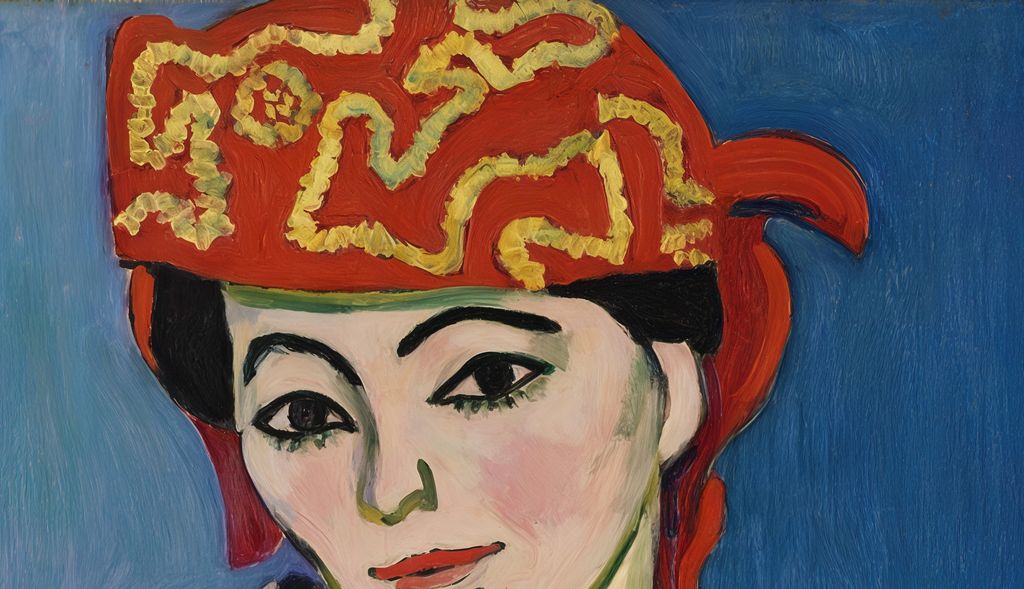
The red head covering is the most concentrated burst of warm colour near the top of the canvas. Yellow loops and bends travel across it, turning a piece of clothing into a field of lively marks. Against the blue behind it, the red seems to advance. The headdress also sets a broad upper boundary for Amélie's face. We see dark hair beneath it and a ribbon-like red shape falling at the right. Costume is therefore doing several jobs: it identifies the sitter's appearance in this particular portrait, frames her head and establishes a strong colour relation with the background. [1]
“Madras” belongs to the painting's historical title. It should not encourage us to invent a story about when or where Amélie acquired the cloth, or what the headdress meant to her personally. What the canvas makes visible is its red field and winding pattern. The Barnes analysis treats the textiles as part of the portrait's decorative richness. Their effect is strongest when we notice how the loops above are answered by broader, rust-coloured shapes across the dark robe below. [1]
The hat also changes the balance of the figure. It enlarges the upper portion of the silhouette while the shoulders spread outward below. Amélie's face sits between those two wide zones, pale enough to remain the centre of attention. The viewer's gaze can move from the yellow lines of the headdress to the dark eyebrows and eyes, then down through the patterned collar to the hands. Those elements do not form a naturalistic account of light falling on cloth. They form a sequence of colour and line that holds a portrait together. [1]
Annotated Details from Red Madras Headdress
The numbered points identify visible features discussed in this article. Return from each detail to the whole composition. Red Madras Headdress — Henri Matisse
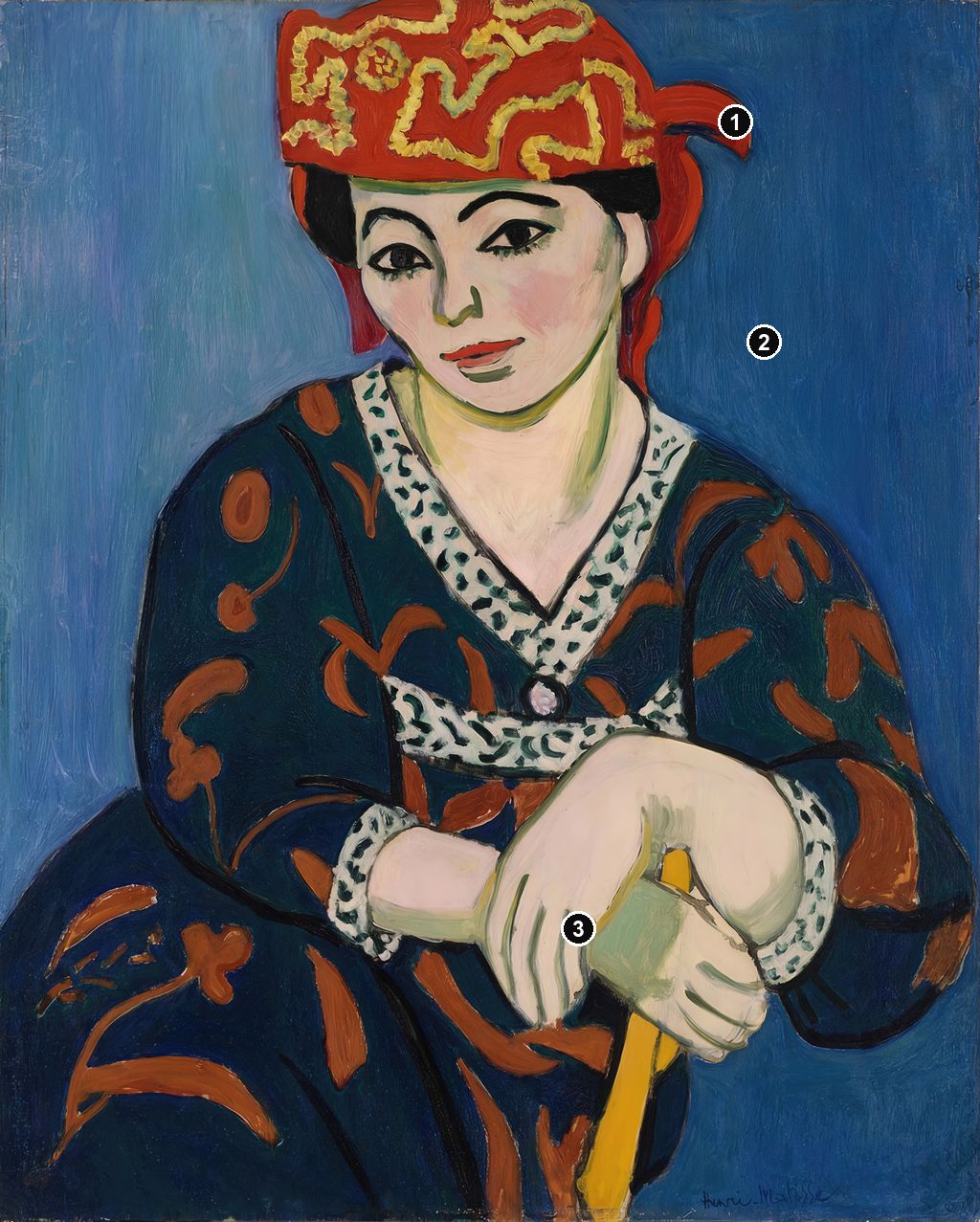
Details from RED MADRAS HEADDRESS
Compare the cropped details with the complete images above. Notice how their colours, shapes and positions contribute to the larger compositions.
The patterned headdress
Yellow curves cross the red headdress, setting a strong patterned shape above the pale face and dark hair.
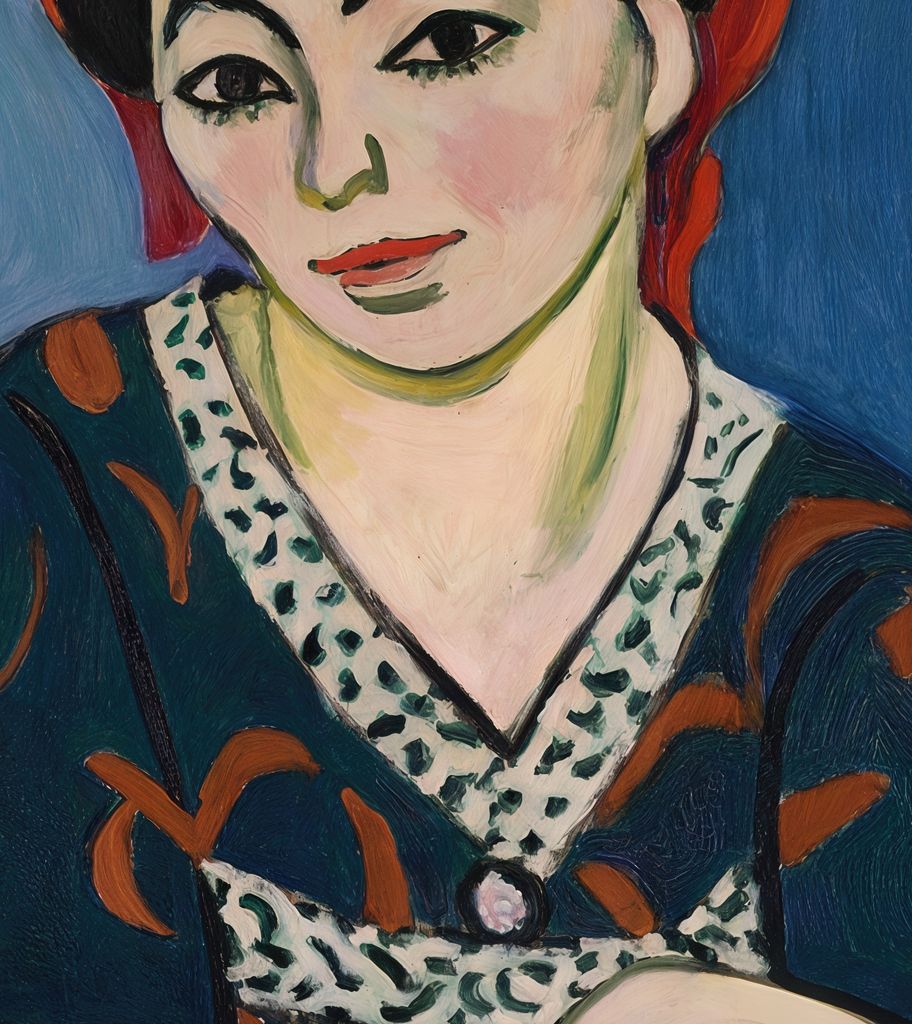
Face and blue field
The face meets a broad blue background. Sparse dark features remain emphatic within the larger colour arrangement.
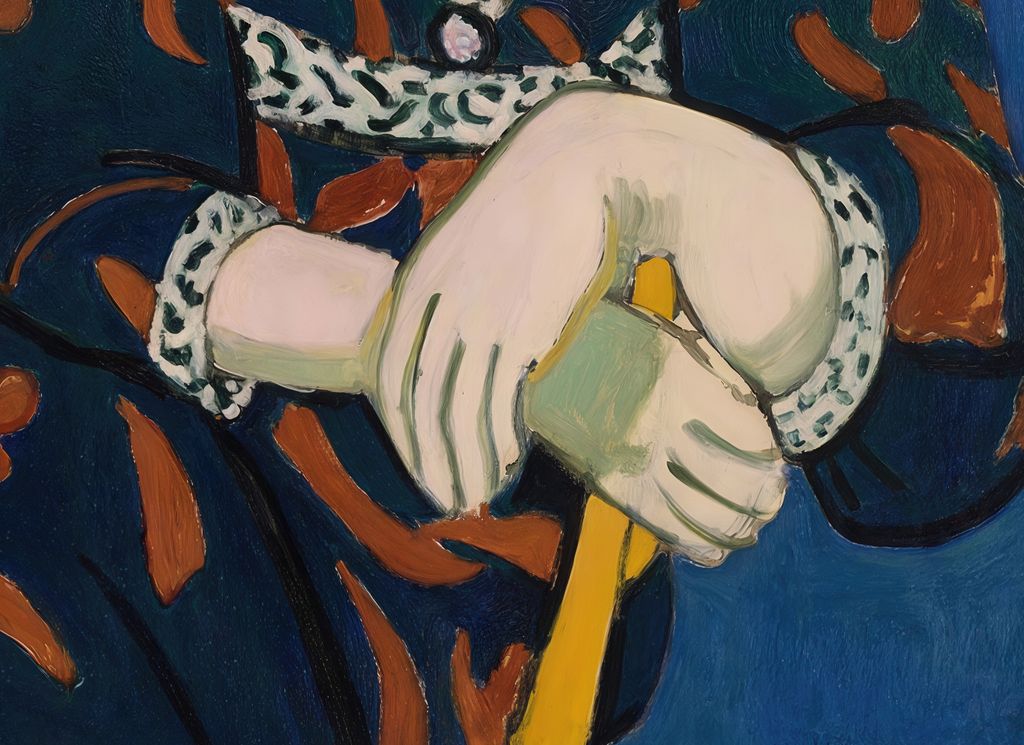
Hands and decorated robe
The hands meet over the dark robe. Rust-coloured patterns repeat across the fabric while pale cuffs and contours separate the arms.
What happens to the face and hands?
The face remains identifiable but is treated with economy. The eyes are strongly marked; the mouth is a small red shape; greenish and pale passages model cheeks and nose only lightly. Barnes's long description points to the abbreviation of facial features and identifies the face as the one area with pronounced impasto , or raised paint. That thicker handling makes the eyes and mouth physically present amid flatter areas of colour. The blue background does not open into a room with furniture to measure. Amélie appears close to the picture surface, her features and clothing organized by coloured areas rather than by a full illusion of three-dimensional space. [1]
Her hands are even less anatomically settled. One pale hand rests over the other near a narrow yellow form. The lengths and angles of the arms do not follow a perfectly measured body underneath the robe. Barnes describes the right arm as shortened and the left as elongated, shaped to follow the painting's curving rhythm. This is a useful way to look: the limbs make sense as parts of the overall design even where they seem unusual as anatomy. The broad sleeves and their pattern help carry the arms toward the hands. [1]
The result is not a portrait that forgets the person in favour of an abstract pattern. Amélie's eyes look toward us, and the meeting hands give the lower part of the pose a quiet focus. Matisse keeps enough facial and bodily information for encounter. At the same time, the painting's colour and line resist the idea that an accurate likeness must be its only measure of success. A face, robe, headdress and flat blue ground each claim their own part in making the image. [1]
Watch: Matisse’s art and working methods
Choose a museum film or a close reading to continue exploring Matisse’s work.
Matisse: “For Me It’s Always New”
The Museum of Fine Arts, Boston considers Matisse’s creative practice.
Watch on YouTubeWhy does the robe matter as much as the face?
The robe is dark, but it is not an empty shadow. Red-brown forms move across sleeves and chest, while a pale collar marked with dark spots creates a bright V beneath the neck. These patterns give the large lower half of the canvas its energy. Without them, the face and hat would float over a single heavy block. With them, warm colour travels from the headdress into the clothing and back toward the sitter's head. The garment becomes a network of visual connections. [1]
Barnes's interpretation says Matisse uses costume to flatten and partly dissolve the body's anatomy, while also recalling a portrait tradition in which dress conveys something about a sitter's public presentation. This is a more limited and useful claim than guessing Amélie's social ambitions from the fabric. The robe is conspicuous, and its visible pattern competes with bodily volume. It helps make the figure monumental within a fairly modest canvas. We encounter the sitter through a composed image of clothing and colour, not through a neutral record of her appearance. [1]
The blue ground intensifies this effect. It is relatively even compared with the headdress and robe, so the patterned figure stands out sharply. But the ground also prevents a clear depth behind her. There is no detailed wall, chair or window to explain where she sits. Barnes notes this compression of space. The viewer's attention stays with the relations among broad areas: blue behind, red above, dark patterned clothing below and the pale face between them. [1]
What is the Cézanne comparison?
The Barnes Foundation's long description says Matisse almost certainly had in mind Cézanne's portraits of his own wife. That is a curatorial interpretation, not a recorded statement by Matisse naming one exact source canvas. The comparison concerns the figure's frontality, compressed depth and abbreviated features and hands. In both artists' work, the sitter can become a firm arrangement of shapes on the canvas rather than a figure modeled smoothly within a room. The qualification matters because a visible resemblance does not establish a specific act of copying. [1]
Barnes also notes that the frontal pose and rich textile setting can recall portraits by Gauguin. Here too, the connection is best understood as a visual comparison, not a proven list of paintings Matisse had open before him. The portrait's particular achievement is its own balance: a direct human gaze inside a composition whose strongest rhythms come from a red patterned headdress, a dark robe and blue ground. The comparison with earlier artists gives us ways to describe that balance without dissolving the work into a collection of influences. [1]
An earlier portrait of the same sitter helps show the variety of Matisse's approach. In Portrait of Madame Matisse: The Green Stripe , painted in 1905 and now at SMK in Copenhagen, the colour problem is concentrated in a close view of Amélie's face. A vertical green band divides warm and cool halves. In Red Madras Headdress , the head is one centre within a larger web of costume and pattern. Both pictures make colour active rather than simply descriptive, but they do so through different scales, clothing and arrangements of the body. [1] [2]
How was the portrait first seen?
Barnes records the picture at the 1907 Salon d'Automne under the title Tête d'expression . Its short description says critics did not receive it well on that first showing. The longer catalogue account notes that some contemporary commentators assigned racialized identities to Amélie on the basis of her costume. Those labels reveal the viewers' projections, not the sitter's identity. This 1907 response should not be confused with the famous 1905 uproar around Matisse's separate Woman with a Hat . The two episodes concern different works and stages of his portrait painting. The later title Le Madras rouge directs attention to the garment; the earlier catalogue title emphasized an expressive head. [1] [3]
The work continued to circulate. Barnes lists it in the 1912 Second Post-Impressionist Exhibition in London and then in the 1913 International Exhibition of Modern Art in New York, Chicago and Boston. At the New York Armory it appeared as catalogue number 401 , under Le Madras Rouge . The Art Institute of Chicago's digitized catalogue lists no. 237, “Red madras,” lent by “Michal Stein,” a printing error for Michael; it also reproduces the painting with the caption “Woman in Red Madras.” Those title changes are evidence of how the same canvas was presented to different audiences. They do not signal separate versions of the painting. [1] [4]
The Armory exhibition brought European modern art to American viewers, but its fame should not be substituted for a specific response to every canvas. The owner record documents that Red Madras Headdress travelled with the exhibition and gives its catalogue numbers; it does not prove that all visitors reacted alike. Its inclusion is enough to show the portrait's path from a Paris Salon into an international discussion of modern painting. [1] [4]
How did it enter the Barnes Foundation?
The Barnes provenance is unusually detailed and sometimes qualified. It says Bernheim-Jeune probably bought the painting from Matisse in October 1907 . By early 1908 , it was in the Paris apartment of Michael and Sarah Stein , although the exact sale to them has not been documented. Their photograph provides stronger evidence of possession than an invented transaction date would. The work later passed through a complicated wartime history in Berlin before reaching Danish collector Christian Tetzen-Lund by 1920 . [1]
Albert C. Barnes bought the portrait from Tetzen-Lund through dealer Paul Guillaume on 19 January 1925 , according to the foundation's record. The sequence is not the same as the provenance of every other Matisse painting owned by Barnes. In particular, the name “Stein” here means Michael and Sarah, not automatically Leo and Gertrude. Following the individual canvas through its documented owners helps preserve the history of this painting rather than giving it a generic modern-art journey. [1]
Explore 113 Matisse artworks
This directory covers the 113 individual works explored in these articles, rather than a complete catalogue of Matisse’s output. Cut-paper designs and prints appear under Drawing in the medium filter; each row names its form. Dates retain the qualifications explained in the linked articles.
Frequently Asked Questions
The Barnes Foundation identifies her as Amélie Matisse , the artist's wife. The red patterned headdress gives the painting its best-known title. The visible pose does not establish her private feelings or the circumstances of every sitting. [1]
Barnes dates the oil painting between the end of April and mid-July 1907 . This is more precise than the broad “1907” used in many summaries. The work was exhibited later that year at the Salon d'Automne. [1]
No. The Green Stripe is a smaller 1905 Amélie portrait owned by SMK in Copenhagen. Red Madras Headdress is the 1907 Barnes canvas, BF448 , with a full headdress and patterned robe. The two paintings offer a useful comparison because the sitter is shared and the pictorial decisions differ. [1] [2]
Explore more of Matisse's paintings or return to the artist overview .
Discussion
Look again at the images and ideas explored in Red Madras Headdress by Henri Matisse: portrait as pattern and pose. These editorial prompts invite your observations.
Reader Insights
Which painting is Le Madras rouge ?
Which comparison discussed in the article helps you see the work differently?
How do the materials and historical setting affect your reading?
Join the Conversation
Share a detail, comparison or question about Red Madras Headdress by Henri Matisse: portrait as pattern and pose below.
References
- Barnes Foundation , Red Madras Headdress (Le Madras rouge) , BF448. View source .
- SMK Open , Portrait of Madame Matisse: The Green Stripe , KMSr171. View source .
- SFMOMA , Femme au chapeau (Woman with a Hat) , 91.161. View source .
- Art Institute of Chicago , digitized 1913 International Exhibition catalogue. View source .


 Henri Matisse.jpg)
