 by
Tom Gurney
Tom Gurney BSc (Hons) is an art history expert with over 20 years experience
Email:
tomgurney1@gmail.com
/ Phone:
+44 7429 011000
Henri Matisse quotes: what the artist said about making art: Introduction
Henri Matisse's words are often presented as a loose collection of encouraging sayings. His most useful statements are more precise. He wrote about how a painting's parts work together, why exact likeness is not the only aim of drawing, how colour gains force from neighbouring colour, and what cutting painted paper made possible. The short quotations below have an identifiable published or museum source. Each belongs to a particular moment in his long practice; an English translation should not be mistaken for the only possible wording of his French. [1]
The distinction matters on a quotes page. A sentence lifted from an essay can appear to contradict another made decades later, especially if its date and subject vanish. Matisse did change his methods. He moved among painting, sculpture, drawing, printmaking, illustrated books and cut-outs. His comments are most helpful when they direct us back to those objects and the choices visible in them. The artist overview gives the wider career; this page follows a small number of statements to the works they can illuminate.
At a Glance
- Artist Henri Matisse
- Lived 1869–1954
- In focus Quotes
Contents
- What did Matisse mean by an art of balance?
- Where did he locate expression in a picture?
- What did Matisse say about colour?
- What did “exactitude is not truth” mean for drawing?
- Why did he call studio objects actors?
- What is “drawing with scissors”?
- How should Matisse quotations be used?
What did Matisse mean by an art of balance?
In Notes d'un peintre , published in 1908 , Matisse imagined an art of “balance, purity, and serenity” in the English wording used by the Metropolitan Museum of Art. The original French text speaks of équilibre , pureté and tranquillité . The Centre Pompidou reproduces the longer passage, in which Matisse envisages a painting that might relieve a viewer's mental fatigue, comparing that effect to rest in a comfortable chair. This is a stated aspiration in a particular essay, not a description that fits every Matisse painting equally well. [1] [2]
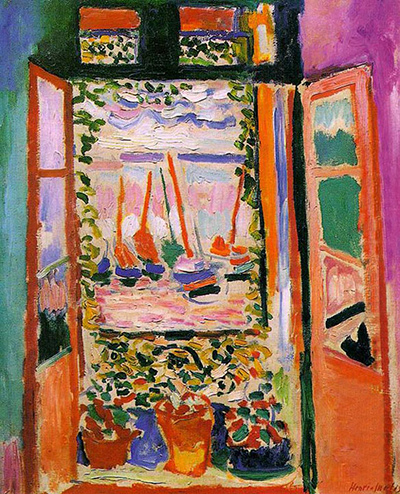
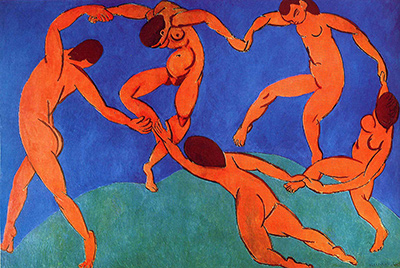
The phrase is sometimes reduced to a claim that his art should always look quiet. That misses the work involved in making an energetic painting hold together. Consider the strong colour of The Open Window or the moving bodies of Dance : neither is visually inert. A painting can have contrasts and motion yet still be organized as a whole. In the 1908 essay, Matisse discussed that organization as a painter considering how a viewer would experience the finished picture. The short “armchair” image is memorable because it names a desired effect, but it does not prescribe beige colour, mild subject matter or effortless production.
His 1908 date also matters. He was writing after the early experiments associated with Fauvism, when critics had already treated his colour as a provocation. The essay offered an account of artistic intention in his own words. It does not mean he had solved every formal question in 1908 or that later cut-outs were merely repetitions of the same idea. Reading the statement beside dated paintings lets it become an opening question: by what arrangement could strong colours and simplified forms produce balance? [1] [2]
Where did he locate expression in a picture?
Another part of the same essay says, in a translation quoted by the Museum of Modern Art, “The entire arrangement of my picture is expressive.” Matisse then specifies figures, the spaces around them and their proportions. Expression, in this account, is not confined to a face registering emotion or a body performing a dramatic gesture. It resides in what each part does in relation to the others. [3]
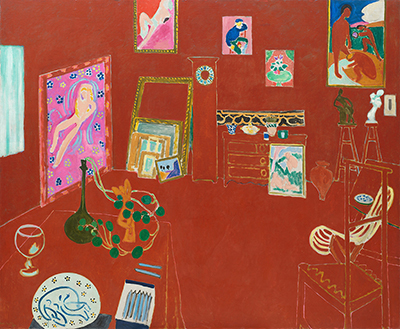
This provides a practical way to look. In The Red Studio , objects are dispersed across a broad red field; empty intervals matter as much as the named things. In Purple Robe and Anemones , lines run between a sitter's clothing, a jug, flowers and the wall. The person remains important, but the picture's force cannot be found only in her facial expression. These are examples of applying Matisse's compositional idea, not evidence that he wrote the 1908 sentence specifically about either later canvas.
The wording also cautions against treating “decorative” as a synonym for superficial. In Notes d'un peintre , composition is a matter of assigning parts their place in an expressive whole. A patterned textile, a blank section or a changed proportion can therefore carry meaning in the painting's construction. If the quotation is printed alone as a slogan, its useful attention to relationships disappears.
What did Matisse say about colour?
A short statement quoted in MoMA's cut-outs catalogue says that colours must “react with one another.” The point is relational. A red area does not have the same visual effect beside blue, green or white; its size and placement also change how it acts. MoMA discusses the line while examining Matisse's studio photographs, in which painted-paper shapes were pinned, moved and placed near other works and materials. The catalogue's excerpt does not supply a securely traceable date for the remark, so it is best read as a documented statement of principle rather than pinned to a particular interview year. [4]
The principle is visible across media. In a painting, a coloured field can steady or intensify its neighbour. In a cut-out, a shape can be shifted across a ground before mounting, changing the balance without repainting either part. This does not mean Matisse followed a fixed colour code where red always stands for one emotion and blue another. It means he judged colours in an arrangement. The paintings directory and cut-outs directory lead to examples made by different methods, where the same question of relation can be asked without assuming the procedures were identical.
The familiar internet line about putting a green that is “not grass” and a blue that is “not the sky” does not need to stand in for this better documented point. Colour in Matisse can name things and exceed them at once. The particular colour statement retained here is useful because it tells a viewer to compare adjacent areas of an actual work. Its value is not an inspirational claim that any bright palette will succeed.
Watch: Matisse’s art and working methods
Choose a museum film or a close reading to continue exploring Matisse’s work.
Matisse: “For Me It’s Always New”
The Museum of Fine Arts, Boston considers Matisse’s creative practice.
Watch on YouTubeWhat did “exactitude is not truth” mean for drawing?
Matisse's French title L'exactitude n'est pas la vérité belongs to a 1947 text about drawing and likeness. It is often rendered “exactitude is not truth.” The Centre Pompidou cites the text in its discussion of Matisse's self-portraits, linking it to the distinction between merely accurate anatomy and the felt character of a sitter. The museum describes how features such as the placement of an ear, the setting of spectacles and the tension of a gaze could remain recognisable even as the drawings differed. The source is about a drawing problem, not a licence to declare every inaccuracy in every painting intentional. [5]
MoMA's collection writing applies the same brief line to Matisse's 1945 self-portraits , whose contours do not aim at an inventory of each anatomical detail. The date of the drawings and the date of the published text should remain separate. If a line changes the nose or jaw but keeps the head's character, likeness can emerge through selection rather than literal measurement. That is a demanding task: choosing what to omit requires sustained looking. [6]
The sentence is often made to sound anti-observation. Matisse's drawing practice gives a better reading. His simplified lines came after close attention to models and repeated work. The drawings directory follows that practice across subjects and techniques. The quotation helps explain why a spare contour may be accurate to an experience of someone without duplicating every visible feature. It should not be used to excuse an unsupported identification of a sitter or an incorrect object title.
Why did he call studio objects actors?
In 1951 , Matisse compared an object in his studio with “a good actor” who could take a part in different pictures. The Museum of Fine Arts, Boston, used the remark to frame Matisse in the Studio , an exhibition that placed works beside some of the objects he kept. A pewter jug, furniture, textiles and other items could recur, yet their visual role changed with their neighbours and the composition at hand. [7]
This remark is more revealing than a general declaration that artists should find inspiration everywhere. It describes a working relationship with particular things. The pewter jug in Purple Robe and Anemones is neither a disposable prop nor a symbol with one permanent definition. Its curve matters beside the robe and wall in that canvas. In another painting, the same jug could occupy a different position and serve a different pattern of lines. To follow Matisse's metaphor is to ask what role an object plays here , rather than assign it a meaning that never changes. [7]
The remark also resists the idea that the artist simply copied whatever stood before him. A kept object could be observed closely, altered in scale or colour, moved, combined with a sitter, or allowed to dominate a still life. The MFA's exhibition drew attention to this traffic between material object and painted one. The quotation gains substance from those concrete examples; removed from them, it becomes another pleasant line about creativity.
What is “drawing with scissors”?
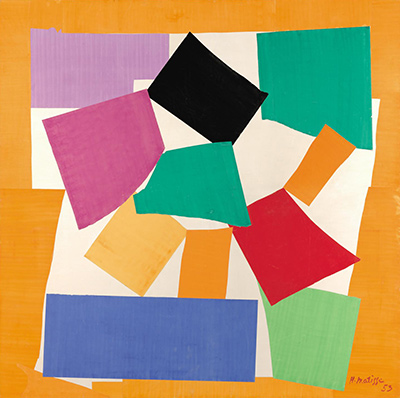
For his late cut-paper practice, Matisse used the phrase “drawing with scissors” , as MoMA records. He worked with sheets coated in gouache, cut forms from them, and arranged the coloured pieces into compositions. Cutting made contour and coloured area at the same time. In Jazz , published in 1947 , his handwritten text compares cutting into colour with a sculptor's direct carving; the Musée Matisse Nice reproduces the French passage and names the book. These short descriptions point to a physical procedure, not simply to the finished works' playful appearance. [8] [9]
There is an important object distinction behind the words. The original cut-paper designs for Jazz were transformed into stencil-printed pages for the published book, whose text reproduces Matisse's handwriting. The National Gallery of Art records a complete copy of that 1947 edition as a volume with twenty colour stencils after the cut-outs. A printed plate is part of Matisse's project, but it is not the same physical arrangement of painted-paper shapes he first cut. The Forms plate page and prints directory follow those formats more closely. [10]
The phrase also reminds us that drawing need not mean graphite on white paper. What mattered to Matisse was the decision made at an edge. A scissors cut could produce a line by separating one area from another, and the freed shape could then be tested against its surroundings. The method joined his long interests in contour and colour while giving him a new way to revise an arrangement. Quoting the phrase with its material steps keeps it from becoming a label for any paper collage, regardless of how that collage was made. [8]
How should Matisse quotations be used?
Start with the source's date and form : essay, interview, book text or later recollection. Check who transcribed or translated it. Then ask whether the statement concerns painting, drawing, objects or cut-outs. A translated phrase may legitimately differ in word choice from another museum's rendering. A short, well-sourced passage is more useful than a long quotation list whose sources cannot be identified. This selection keeps the lines that can be traced and leaves unsupported sayings out of the artist's voice.
Finally, test the words against a work rather than using them as its explanation in advance. The 1908 concern for arrangement can sharpen a look at a later painting, but it does not replace visual evidence. The 1947 phrase about exactitude clarifies an approach to drawing, but it does not prove which sitter appears in a particular portrait. “Drawing with scissors” identifies a method, but a museum record still tells us whether a sheet is a cut-paper original or a printed Jazz page. Matisse's remarks are strongest as invitations to look more closely.
Explore 113 Matisse artworks
This directory covers the 113 individual works explored in these articles, rather than a complete catalogue of Matisse’s output. Cut-paper designs and prints appear under Drawing in the medium filter; each row names its form. Dates retain the qualifications explained in the linked articles.
Frequently Asked Questions
Yes. L'exactitude n'est pas la vérité is the title of a 1947 Matisse text cited by the Centre Pompidou in relation to drawing and likeness. [5]
He meant cutting shapes directly from painted paper and composing with their coloured forms and edges. MoMA uses his phrase to describe this late method. [8]
No. A line needs an identifiable writing, interview, book or reliable museum attribution, with its wording and translation checked. An unattributed quote list alone does not establish that Matisse said it.
Discussion
Look again at the images and ideas explored in Henri Matisse quotes: what the artist said about making art. These editorial prompts invite your observations.
Reader Insights
What did Matisse mean by an art of balance?
Which comparison discussed in the article helps you see the work differently?
How do the materials and historical setting affect your reading?
Join the Conversation
Share a detail, comparison or question about Henri Matisse quotes: what the artist said about making art below.
References
- The Metropolitan Museum of Art , “Henri Matisse (1869–1954)”. View source .
- Centre Pompidou , Fauvism teaching essay quoting Notes d'un peintre ; Centre Pompidou, publication notice for the 1908 essay. View source 1 . View source 2 .
- Museum of Modern Art , The Drawings of Henri Matisse catalogue. View source .
- Museum of Modern Art , Henri Matisse: The Cut-Outs catalogue preview. View source .
- Centre Pompidou , Autoportrait object essay and citation of L'exactitude n'est pas la vérité . View source .
- Museum of Modern Art , Matisse in the Collection of the Museum of Modern Art , 1978 catalogue. View source .
- Museum of Fine Arts , Boston, Matisse in the Studio exhibition account. View source .
- Museum of Modern Art , Henri Matisse: The Cut-Outs . View source .
- Musée Matisse Nice , Une bibliothèque de la couleur , discussion of Jazz . View source .
- National Gallery of Art , Jazz (1947), object 2014.112.18. View source .
 Henri Matisse.jpg)