



 by
Tom Gurney
Tom Gurney BSc (Hons) is an art history expert with over 20 years experience
Email:
tomgurney1@gmail.com
/ Phone:
+44 7429 011000
Henri Matisse, Landscape at Collioure , 1905: Introduction
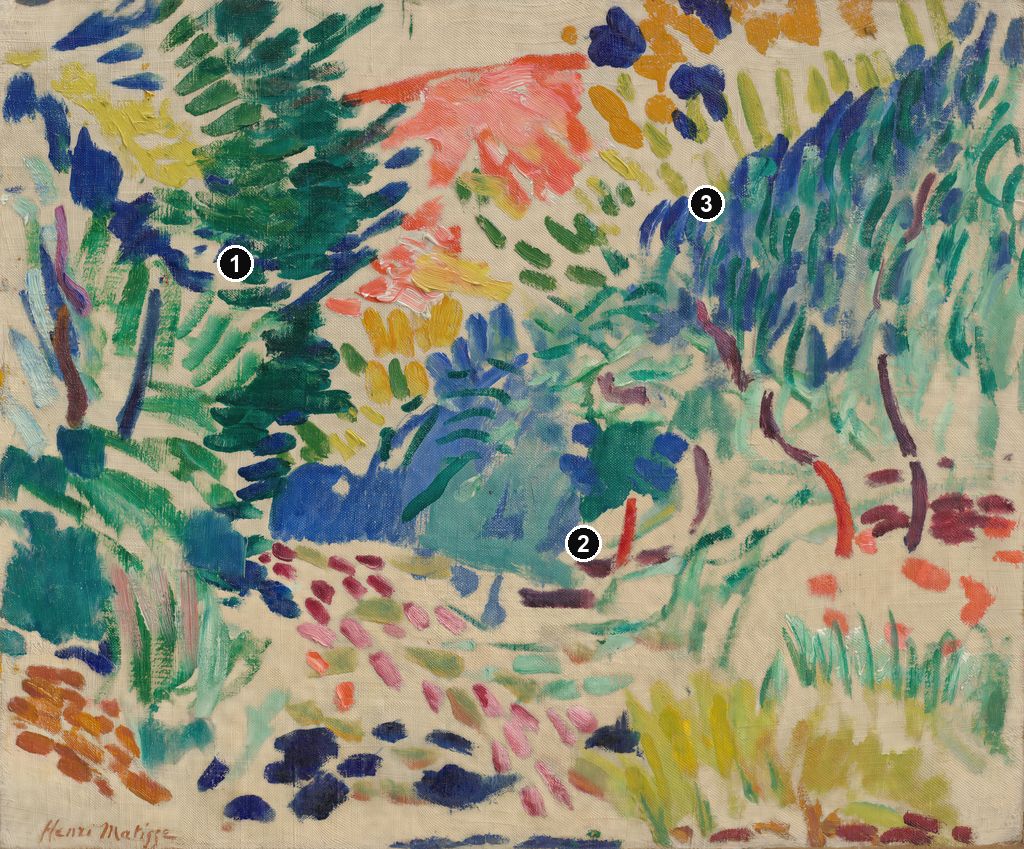
Trees and low growth gather on both sides of a pale opening. Strong green and blue strokes build the vegetation; salmon pink and orange cut across the upper middle; short pink, red and yellow marks scatter near the foreground. Henri Matisse's Landscape at Collioure describes a place without smoothing all these marks into a continuous view. The light color between them is often the canvas itself. Seen from nearby, the picture is a collection of decisions about where to put paint and where to leave it out. Seen from farther back, those separated strokes begin to form a path or clearing between trees. [1] [2]
Matisse made this oil on canvas in Collioure during summer 1905 . The Museum of Modern Art in New York owns it as object 364.1990 , measuring 38.8 × 46.6 centimetres . Its brisk handling can give an impression of incompletion, but MoMA identifies it as a finished work . That distinction is essential: the raw weave, exposed between strokes, is part of the image's effect rather than a sign that Matisse abandoned the canvas before reaching his intended result. [1] [3]
At a Glance
- Artist Henri Matisse
- Work Landscape at Collioure
- Date 1905
- Explore Painting
This work across Henri Matisse’s career
Dance (1910)
1910The Red Studio
1911The Piano Lesson
1916The Snail
1953Contents
- Where does the landscape lead the eye?
- Why is so much canvas visible?
- What changed in Matisse's color in 1905?
- How does it compare with Open Window, Collioure?
- Annotated details
Where does the landscape lead the eye?
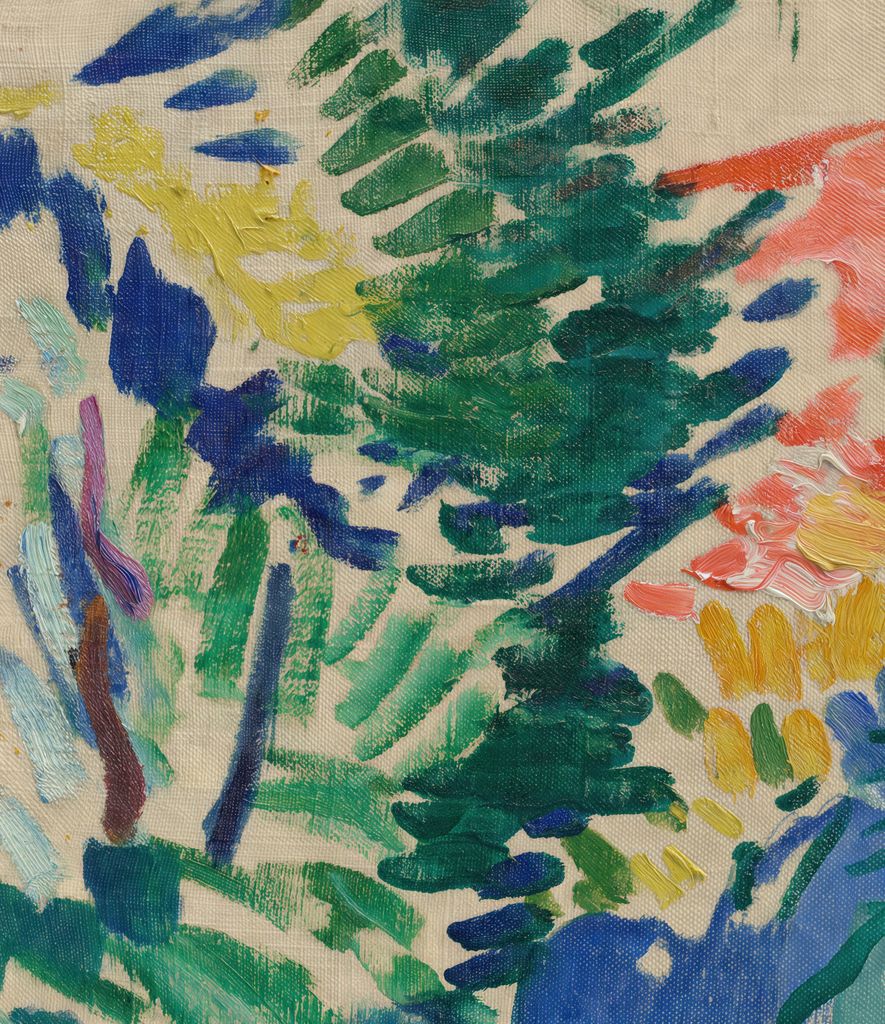
The darkest, fullest cluster of strokes stands to the left of center. Greens and deep blue-violets form a tree mass with branches that seem to reach toward the upper edge. On the right, tall blue-green marks answer it with another group of foliage. These two sides give the eye a passage through the middle. The opening is irregular, not a carefully drawn road bordered by identical trees. Patches of paint move inward and then interrupt the route, so the viewer has to assemble a direction from their spacing.
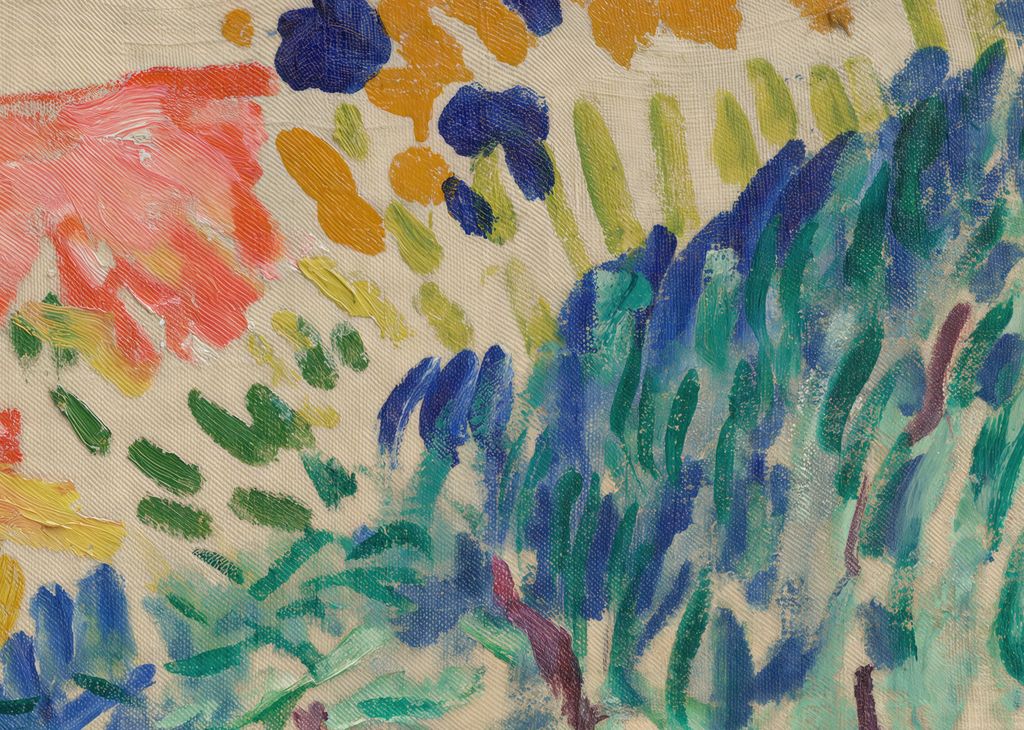
In the middle distance, cooler blue and lavender forms sit beneath a warm coral passage. The MoMA catalogue for the Louise Reinhardt Smith collection describes an inward view between groups of trees and suggests a possible glimpse of sea beyond a rise just left of center. “Possible” matters here. The small painting does not specify a horizon, shoreline or named viewpoint with the clarity of a topographical picture. It gives enough cues for depth while keeping the center open to several readings: a path, a clearing, vegetation thinning toward light, or a glimpse beyond the near growth. [2]
At the bottom, small dark blue and maroon touches punctuate cream canvas. To their right, upright pale green strokes rise like grass. Elsewhere, pink dashes suggest a ground plane without settling into a uniform shadow. These marks make the foreground active and prevent the central opening from becoming an empty blank. They also bring the viewer back to the surface of the painting. The strokes can identify plants and earth from a distance, yet from close range each remains a distinct touch of color.
There is no figure to fix the scale. A branch may feel large because it reaches across the canvas, while the whole object is only about forty-seven centimetres wide. Matisse uses placement and color rather than a person or a building to establish the view. Left and right clusters press toward each other; the middle breathes; the scattered foreground marks bring that space toward us. The structure remains readable even though many of its individual parts resist a precise name.
Why is so much canvas visible?
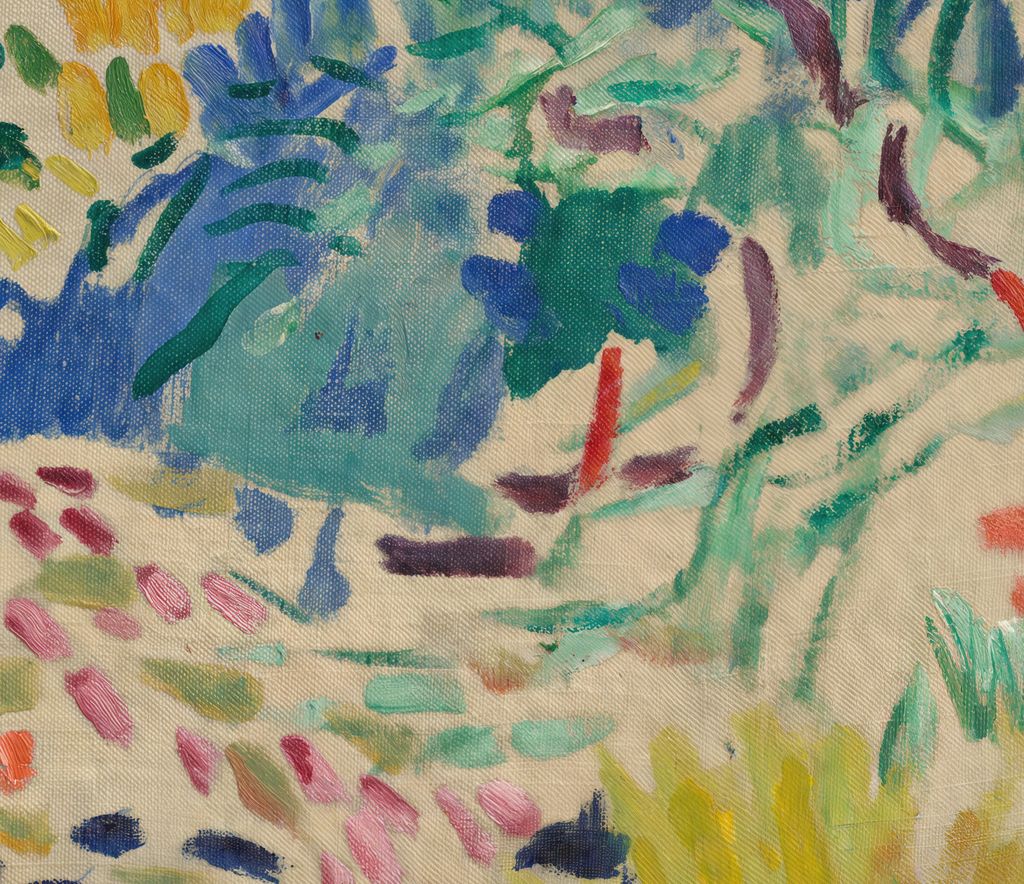
MoMA states that Matisse applied the oil paint to unprimed canvas . In many paintings a preparatory ground covers the raw fabric before the visible image begins. Here the woven support shows between separate strokes. It is not a uniform white background painted to resemble light. The surface itself participates in the color of the landscape, making the gaps between greens, violets and reds conspicuous. Some paint was applied rapidly and, MoMA notes, sometimes straight from the tube. [1]
The open canvas gives the marks room. Dense dark green on the left feels denser because pale intervals appear next to and within it. The salmon and orange areas near the top seem bright without having to cover the whole sky. In the foreground, a few strokes of yellow-green can suggest grass because they stand apart on the light support. The resulting effect is not simply that paint has been economized. Matisse uses what he leaves bare to sharpen the independence of what he does paint.
This choice also changes the relation between space and surface. The same cream area can serve as daylight between leaves, a patch of ground, or exposed fabric. The viewer does not need to decide which role every gap plays before following the image. Matisse allows the support to hold several roles at once. The canvas weave remains visible even while its pale tone helps create the impression of a sunlit place. The painting moves between an object made of fabric and oil and a scene perceived through color.
The older assumption that visible support proves a work is merely a study is contradicted by MoMA's account. Its educational guide specifically compares Landscape at Collioure with Matisse's Study for “Luxe, calme et volupté” of 1904 , a preparatory picture. MoMA calls the latter an oil sketch made toward another painting, while regarding the exposed-canvas Collioure work as finished. Both may look loose, but their documented roles are different. Finish in this case means the relationships among marks and open areas were accepted as the result, not that every inch was filled with paint. [3]
Annotated Details from Landscape at Collioure
The numbered points identify visible features discussed in this article. Return from each detail to the whole composition. Landscape at Collioure — Henri Matisse
Details from LANDSCAPE AT COLLIOURE
Compare the cropped details with the complete images above. Notice how their colours, shapes and positions contribute to the larger compositions.
Dark foliage at left
Blue-green strokes gather into a dense tree mass. Its varied directions suggest foliage while leaving individual brush marks visible.
Open canvas between marks
Light gaps remain between the separate touches of paint. They help form an opening through the vegetation without a sharply drawn road.
Warm colours beyond the trees
Salmon and orange passages meet cooler foliage near the upper middle. The contrast joins distant forms to the surface of the canvas.
Watch: Matisse’s art and working methods
Choose a museum film or a close reading to continue exploring Matisse’s work.
Matisse: “For Me It’s Always New”
The Museum of Fine Arts, Boston considers Matisse’s creative practice.
Watch on YouTubeWhat changed in Matisse's color in 1905?
The painting uses colors that do not stay within a conventional account of sunlit vegetation. Blues and violets move through the trees; coral and orange press into the upper space; pink dashes mingle with green near the ground. These colors still help describe a landscape, but they also establish its rhythm. The left-side mass feels heavy partly because of its dark blue as well as its shape. The central warm passage draws the eye inward because it contrasts with the cool vegetation around it.
MoMA's owner account treats the work as a point at which Matisse began a more spontaneous way of painting. That assessment comes from the pattern of separated strokes and strong colors, not from proof that the canvas was made without thought. Quick marks are visible; the time spent planning each one is not. The relation among them is highly legible: warm against cool, dense against open, short scattered touches against the larger tree clusters. Calling the picture “entirely abstract” would miss that organization of a recognizable outdoor setting. [1]
Collioure was a Mediterranean village near the French-Spanish border. MoMA's teaching guide says Matisse arrived in May 1905 , with André Derain joining him in June, and that Matisse stayed until early September. Those months gave him repeated opportunities to paint and draw in the area. The guide's context helps date the experiment, but this single canvas should not be treated as a diary entry that records the exact weather or hour of one day. Its visible choices transform a scene into a compact study of how color can make space. [3]
The painting also sits at a shift in Matisse's handling of color. MoMA's Smith-collection catalogue relates the 1905 Collioure work to earlier interests in both Van Gogh's forceful marks and the divided color associated with Seurat and Signac. It describes a move away from a more regular mosaic toward freer strokes. These comparisons help explain why the marks here differ in length, direction and density rather than following one mechanical pattern. They do not mean that a single influence accounts for every blue, pink or green touch. [2]
How does it compare with Open Window, Collioure?
Matisse made Open Window, Collioure in 1905 too. The National Gallery of Art holds that separate canvas. There, a window frame, flowerpots and boats clearly organize the viewer's journey from a room to the harbor. The Gallery identifies its display at the 1905 Salon d'Automne , the exhibition that gave the Fauves their famous name. That exhibition history belongs to the Washington painting; it should not be transferred automatically to MoMA's Landscape at Collioure . [4]
The contrast between the two works makes the landscape's method easier to see. Open Window has recognizable architectural edges to hold its unusual color together. Landscape has no window, sill or boat. It asks clusters of brushstrokes themselves to establish near foliage and a more distant opening. Both paintings change the colors one might expect from a Mediterranean view, yet the viewer's foothold differs. One looks outward through an explicitly painted frame; in the other, the eye finds its own route among trees.
The MoMA collection catalogue points to another relationship: the central passage between trees later helped form the landscape setting of Matisse's large Le Bonheur de vivre of 1905–06 . This does not make the small Collioure canvas merely a preliminary sketch for that later painting. The catalogue identifies a compositional connection between a finished landscape and a subsequent, much larger work. Matisse could retain a useful spatial idea while changing the scale, figures and purpose around it. [2]
Start another look with the cream intervals among the left-hand leaves, follow the cooler forms toward the middle, and finish with the small pink and dark strokes below. The image coheres without hiding how it was made. Its unusual finish lies precisely in that balance: enough trees and ground to evoke a place, enough open canvas and separate color to let painting itself remain visible. Compare it with Open Window, Collioure and the later Le Bonheur de vivre ; the paintings guide places the 1905 experiment within Matisse's broader changes in subject and method.
Explore 113 Matisse artworks
This directory covers the 113 individual works explored in these articles, rather than a complete catalogue of Matisse’s output. Cut-paper designs and prints appear under Drawing in the medium filter; each row names its form. Dates retain the qualifications explained in the linked articles.
Discussion
Look again at the images and ideas explored in Henri Matisse, Landscape at Collioure , 1905. These editorial prompts invite your observations.
Reader Insights
Where does the landscape lead the eye?
Which comparison discussed in the article helps you see the work differently?
How do the materials and historical setting affect your reading?
Join the Conversation
Share a detail, comparison or question about Henri Matisse, Landscape at Collioure , 1905 below.
References
- Museum of Modern Art , Landscape at Collioure , current owner record for date, medium, dimensions, accession, unprimed canvas, paint application and finished status. View source .
- Museum of Modern Art , Masterworks from the Louise Reinhardt Smith Collection , composition, later Le Bonheur de vivre relation and account of changing brushwork. View source .
- Museum of Modern Art , Modern Art and Ideas 2 educator guide, Collioure summer context and explicit finished-work comparison. View source .
- National Gallery of Art , Open Window, Collioure , separate 1905 canvas, collection facts, visual account and Salon d'Automne history. View source .


 Henri Matisse.jpg)
